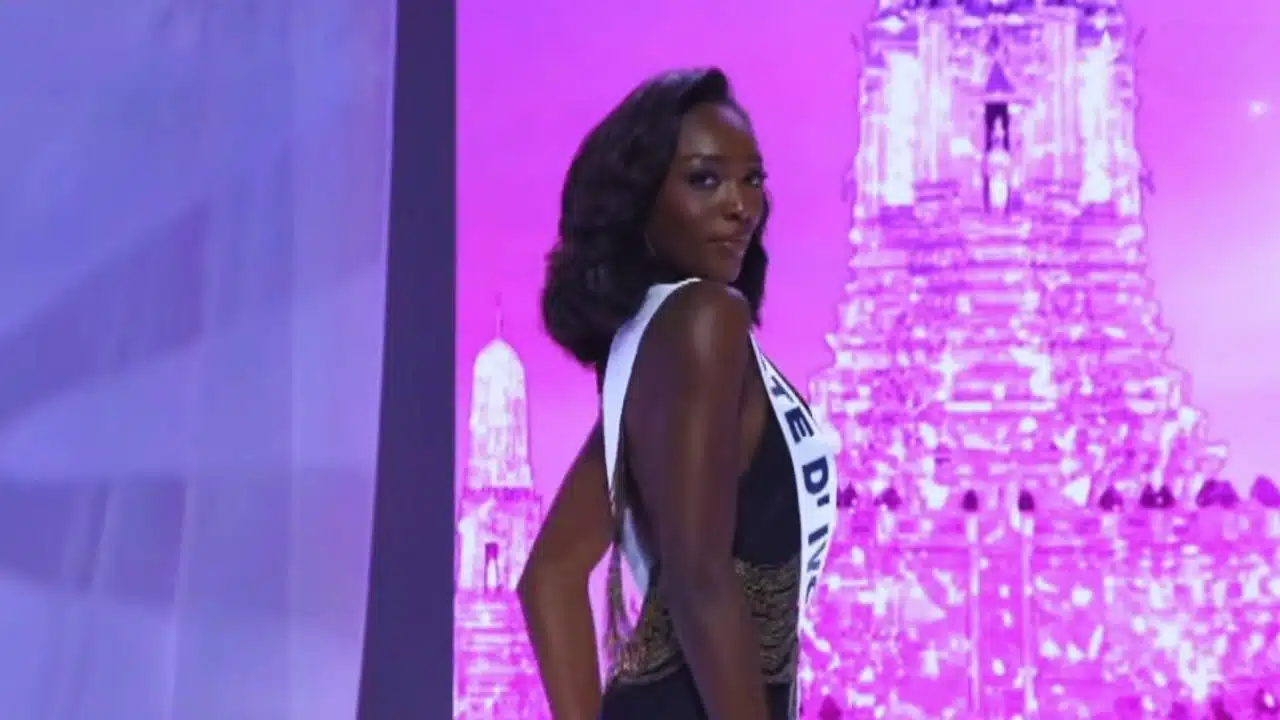
The Miss Universe 2025 competition—held in Bangkok, Thailand—continues to face waves of controversy and internal unrest, as two prominent contestants, Olivia Yacé of Côte d’Ivoire and Brigitta Schaback of Estonia, publicly renounced their titles within days of the global pageant’s conclusion. Their resignations follow a series of troubling reports involving the Miss Universe Organization and its associated national committees, adding new layers to the ongoing scrutiny surrounding this year’s competition.
Olivia Yacé, who entered the global stage representing Côte d’Ivoire and ultimately secured a spot among the top five finalists—finishing as the fourth runner-up—announced her resignation from the title of Miss Universe Africa & Oceania. Her statement, shared on Instagram on November 24, was filled with gratitude, personal reflection, and a strong reaffirmation of her guiding values. Although she celebrated her achievement of reaching the top tier of the competition, Yacé emphasized that her continued involvement with the Miss Universe ecosystem would compromise principles she holds as fundamental to her identity and her mission.
In her message, she expressed that participating in Miss Universe allowed her to see firsthand the extent of her own resilience. Competing on the global stage reinforced her sense of purpose, but she noted that walking a path aligned with her values—centered on dignity, excellence, equal opportunity, integrity, and respect—was ultimately more important than maintaining any title. As a result, she made the deliberate choice to step away not only from the regional title but also from any future affiliation with the Miss Universe Committee. She described this step as necessary to continue a mission larger than the crown itself.
Yacé elaborated on the internal conflict she felt between her role as a pageant ambassador and her deeper calling to serve communities and uplift young girls who look to her as a model of courage and authenticity. She reminded her supporters that one of her lifelong goals has been to inspire girls to pursue spaces where they may feel unwelcomed or overlooked. To her, empowerment is rooted in modeling confidence and advocating for inclusion. The decision to step down, she explained, provides the freedom to focus on this mission without restrictions or compromises.
In her broader statement, Yacé also issued an emotional appeal to Black, African, Caribbean, American, and Afro-descendant communities. She encouraged them to continue challenging the spaces that historically excluded them, to remain present, and to recommit to letting their voices be heard without hesitation or apology. Her message was both a personal declaration and a collective call to action, expressing her commitment to continue advocating for equality and representation through more authentic avenues. She stressed that true leadership involves choosing principles over titles when the two come into conflict.
Alongside these reflections, Yacé extended congratulations to the newly crowned Miss Universe 2025, Fátima Bosch of Mexico, and expressed well-wishes to Miss Universe Jamaica, Gabrielle Henry, following the unfortunate fall Henry suffered during the preliminary evening gown segment. Yacé ended her statement by acknowledging the support she received, recognizing the significance of the journey she experienced, and promising to continue working to inspire others “with the same determination” despite no longer holding her regional title.
Shortly after Yacé’s announcement, the Miss Côte d’Ivoire Committee (COMICI) issued its own public communication, confirming her decision. In a Facebook post, COMICI expressed its regrets but stated that Yacé had formally withdrawn from all Miss Universe-related responsibilities for “personal convenience” tied to the mandates assigned at the international competition. COMICI further noted that the organizational decision included the immediate relinquishing of her Africa & Oceania sash, ensuring that the pageant system would not encounter confusion about her status. The committee reaffirmed that all parties involved had been notified and that the Ivorian representative was no longer connected to any Miss Universe-related titles or duties.
The wave of resignations did not end there. In Estonia, Brigitta Schaback, who also competed at Miss Universe 2025, announced her departure from her national title just two days after the pageant concluded. Schaback revealed her decision in an Instagram post on November 23, asserting that her “values and work ethics do not align” with those of her National Director, Natalie Korneitsik. The 28-year-old explained that her commitment lies in advancing women’s empowerment, gender equality, and ethical leadership—causes she intends to continue pursuing without any further association with the Miss Universe Estonia organization.
Her announcement quickly sparked discussion, prompting a response from the Miss Estonia pageant organization. In a statement, the organization denied the presence of any personal conflict between Schaback and the National Director. Instead, they expressed that while they supported Schaback fully in preparing for and attending Miss Universe, certain public statements made by her in recent weeks were “inappropriate, harmful to others, and not aligned with professional protocols,” ultimately contributing to public controversy. They did not clarify which statements specifically violated their expectations.
The organization noted that all national contestants are required to sign an Exclusive Management Agreement, which outlines professional conduct guidelines and obligations—extending to communication standards, sponsor commitments, and post-pageant responsibilities. According to the organization, Schaback continued to act against these contractual expectations even after returning from the Miss Universe competition, including making unauthorized negative remarks about the pageant system. This behavior, they said, prompted the decision to initiate a formal conclusion of her duties. Despite their disagreements, the organization emphasized its appreciation to the Miss Universe Organization for still allowing Schaback to compete internationally.
These rapid departures by national representatives add to a growing list of controversies surrounding Miss Universe this year. The 2025 competition has faced criticism and significant attention amid a series of internal incidents leading up to and during the event. On November 4, a video circulated live on social media showing pageant executive Nawat Itsaragrisil confronting Miss Universe Mexico Fátima Bosch—who later won the crown—over her alleged refusal to participate in a scheduled promotional photo shoot. The livestream displayed moments of tension and even showed several contestants leaving the meeting room, fueling online conversations about organizational leadership and contestant treatment.
Only a few days before the pageant, another notable disruption occurred when musician Omar Harfouch, who had been appointed as an official judge, resigned publicly via Instagram. Harfouch alleged troubling misconduct within the Miss Universe selection process, claiming that an “impromptu jury” had been formed to select 30 finalists from the full roster of 136 contestants. The Miss Universe Organization quickly denied these allegations, yet the claims intensified public concern about fairness and transparency.
The resignations continued to mount. Former professional soccer player Claude Makélélé, also serving as a judge, announced his withdrawal citing personal reasons. Soon after, Princess Camilla di Borbone delle Due Sicilie—president of the Miss Universe 2025 selection committee—also stepped down from her role, creating further uncertainty about internal decision-making and overall pageant governance.
This chain of events has contributed to a broader narrative of instability for the Miss Universe Organization in recent months. As one of the most recognized global beauty competitions, Miss Universe occupies a significant place in the pop-culture and entertainment world. However, this year’s controversies—from contestant resignations and conflicting public statements to allegations of procedural irregularities and abrupt judge withdrawals—have drawn heightened attention to the internal pressures and ethical concerns shaping the organization’s operations.
Against this backdrop, the decisions by Olivia Yacé and Brigitta Schaback to step away from their titles illustrate a growing sentiment among contestants to prioritize principled leadership and personal advocacy over pageant prestige. Both women have signaled that their commitments to empowerment, fairness, and representation outweigh the symbolic recognition of a crown or sash. Their departures serve as poignant reminders that modern beauty queens increasingly view themselves as agents of change—unafraid to walk away from institutions that no longer align with their values.
As the Miss Universe Organization navigates the fallout from these developments, questions continue to arise about the future of the competition, the clarity of its internal protocols, and the measures needed to restore trust among contestants, national directors, and global audiences. Meanwhile, both Yacé and Schaback have made it clear that their journeys are far from over. Though they have stepped away from their official titles, their commitments to inspiring communities, defending their values, and shaping meaningful social influence remain firmly in motion.