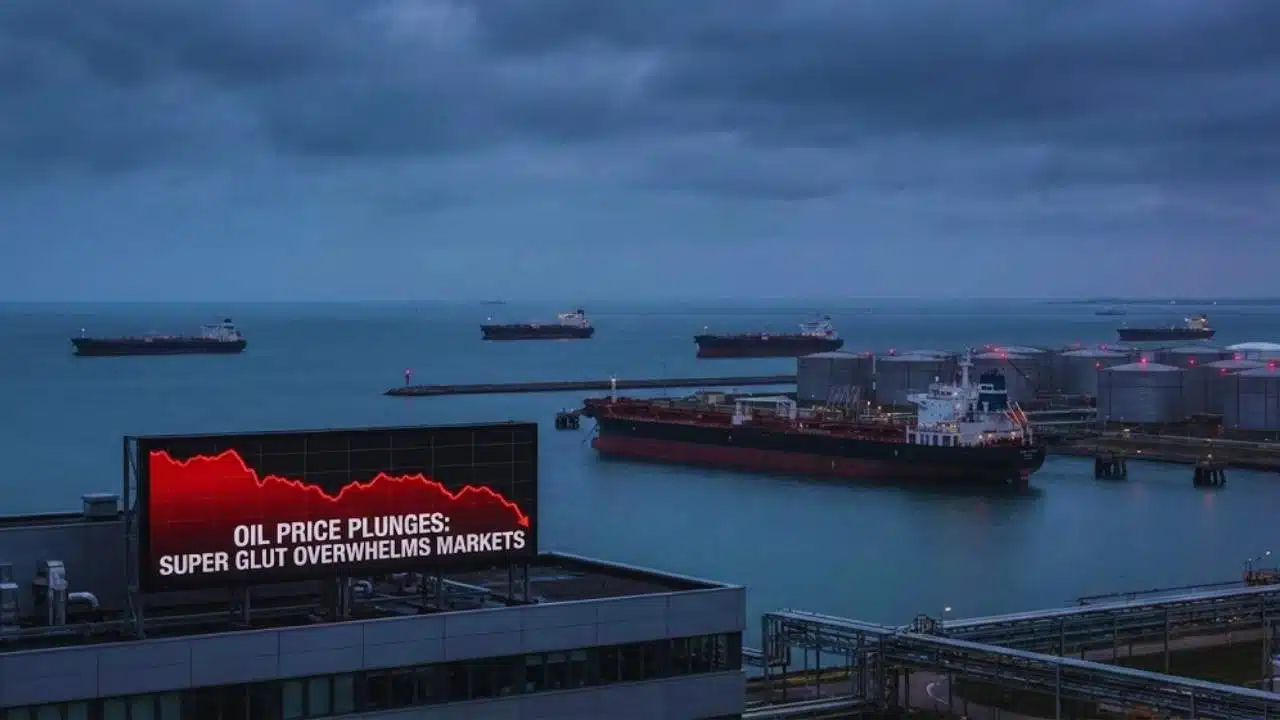
Global oil markets closed for a second consecutive week in the red on December 18, as fears of a massive supply glut continued to outweigh factors that would typically support prices.
West Texas Intermediate (WTI) crude hovered near $56 per barrel, while Brent crude traded around $60 per barrel, reflecting persistent selling pressure across energy markets. Both benchmarks declined roughly 2.5% over the week and are now down close to 18% compared to the same period last year.
Market sentiment has shifted decisively toward concerns about long-term oversupply rather than short-term disruptions. Traders appear increasingly convinced that the global oil market is entering a phase where production growth far exceeds consumption, limiting the potential for sustained price recoveries even during periods of geopolitical instability.
“Super Glut” Warnings Shake Market Confidence
The growing pessimism has been fueled by stark warnings from major commodity traders and energy analysts. Trafigura, one of the world’s largest commodities firms, has warned that oil markets could face a “super glut” by 2026, a scenario defined by prolonged and significant excess supply. This outlook has been reinforced by forecasts from the International Energy Agency, which expects a record surplus of up to 3.8 million barrels per day—nearly 4% of global demand—as early as next year.
Such a surplus would be historically significant and difficult to absorb without major production cuts or a sharp and unexpected rise in global consumption. As a result, traders are increasingly pricing in lower average oil prices for the medium to long term, rather than betting on short-lived rallies.
Rising Global Production Outpaces Demand Growth
A key driver of the oversupply narrative is the rapid expansion of oil production outside the OPEC alliance. Major producers such as the United States, Brazil, Canada, and Guyana have significantly increased output, adding millions of barrels per day to the global market. U.S. crude production has reached a record 13.61 million barrels per day in 2025, underscoring the scale of non-OPEC supply growth.
At the same time, OPEC and its allies (OPEC+) have been gradually increasing production as they unwind earlier voluntary output cuts. Recent figures show the group produced 43.06 million barrels per day in November, up from the previous month. These additional barrels are entering a market that is already struggling to absorb existing supply, further intensifying downward pressure on prices.
Weak Demand Signals, Especially From China
On the demand side, expectations remain muted, with China emerging as a central concern for oil markets. As the world’s largest crude importer, China plays a crucial role in global demand growth. However, research from a state-affiliated institute linked to CNPC suggests that China’s oil consumption may plateau between 2025 and 2030, largely due to rapid electric vehicle adoption and structural economic shifts.
Recent economic data has reinforced this cautious outlook. China’s industrial production rose just 4.8% year over year in November, marking its slowest growth in 15 months, while retail sales have also underperformed expectations. Slower economic momentum raises doubts about whether China can provide the demand boost needed to offset rising global supply.
Geopolitical Tensions Fail to Sustain Price Support
Despite fresh geopolitical developments, oil prices have struggled to find lasting support. The seizure of a Venezuelan oil tanker by the Trump administration and new sanctions targeting individuals linked to President Nicolás Maduro briefly lifted prices, but those gains quickly faded. Similarly, ongoing tensions involving Russia have not translated into sustained price increases.
Hopes for a potential peace deal in Ukraine have further weighed on sentiment, as traders anticipate the possibility of eased sanctions and increased Russian oil exports in the future. Even as Western sanctions target major Russian oil companies, markets appear focused on the broader picture: a world where supply continues to rise faster than demand.
Overall, the oil market remains firmly driven by fundamentals, with oversupply fears dominating outlooks and limiting the upside for prices in the months and years ahead.