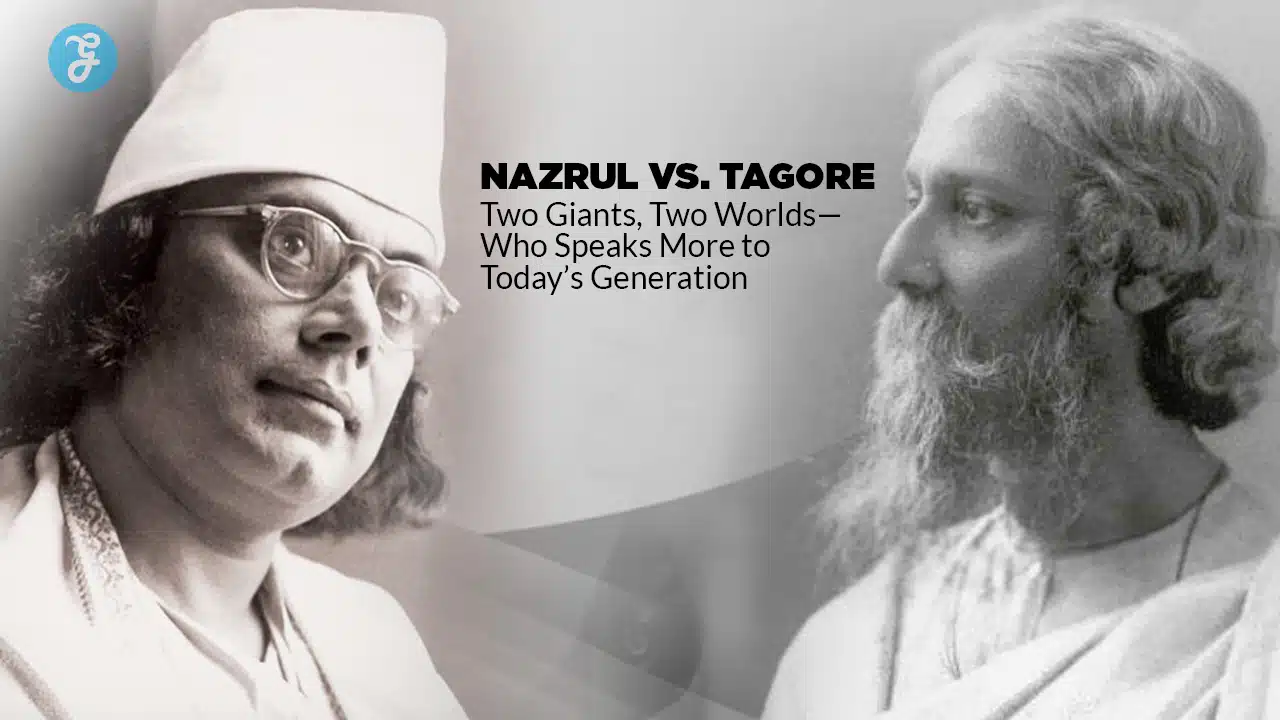
Bengal gave the world two great poets: Rabindranath Tagore and Kazi Nazrul Islam. One is known as the calm philosopher of harmony, the other as the fiery rebel poet of justice. Even today, long after their deaths, they remain at the center of South Asian culture and thought.
Today, the 12th of the Bengali month, Vadra, marks the 49th death anniversary of the national poet of Bangladesh, Kazi Nazrul Islam. However, Rabindranath Tagore is the writer of the national anthems for both Bangladesh and India.
Nazrul vs. Tagore—Which one speaks more to Gen Z? A generation raised on social media, global activism, and fast-changing values may hear their voices differently. Let’s explore how these two literary giants compare and who captures the imagination of today’s youth.
Contextual Backdrop—Two Titans of Bengali Literature
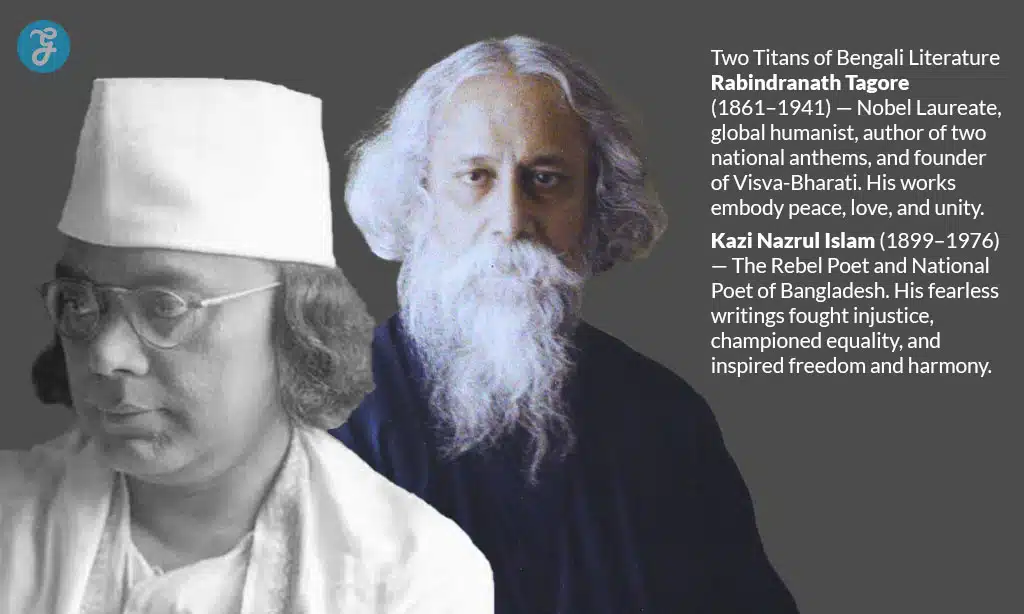
Bengal has always been a land of poets, but two names shine brighter than all—Rabindranath Tagore and Kazi Nazrul Islam. They were not only writers but also visionaries who shaped the cultural, political, and social life of their times.
Tagore was born in the 19th century and became the first Asian Nobel Laureate, admired around the world for his universal message of peace and human unity. Nazrul came later, in the early 20th century, and earned the title of the “Rebel Poet” for his fearless fight against injustice and oppression. He is also the national poet of Bangladesh.
Though they belonged to different eras and carried different moods in their writing, both became voices of Bengal and beyond. Their works still echo across generations—Tagore as the calm thinker and Nazrul as the firebrand revolutionary.
Rabindranath Tagore—The Global Humanist
-
Born in 1861, Tagore was the first Asian Nobel Prize winner (1913).
-
He wrote poetry, songs, novels, and plays. His works carry deep feelings of love, spirituality, and human unity.
-
Tagore’s songs became national anthems—India’s Jana Gana Mana and Bangladesh’s Amar Shonar Bangla.
-
He founded Visva-Bharati University at Santiniketan to promote world culture and education.
Kazi Nazrul Islam—The Rebel Poet
-
Born in 1899, Nazrul came from a humble village in Bengal.
-
He wrote bold poems and songs that fought against British colonial rule, inequality, and social injustice.
-
His writings promoted women’s rights, Hindu-Muslim unity, and rebellion against oppression.
-
Today, he is honored as the National Poet of Bangladesh.
Nazrul vs. Tagore: At a glance
| Poet | Tagore | Nazrul |
|---|---|---|
| Born | 1861 | 1899 |
| Title | Nobel Laureate, “Biswokobi” | Rebel Poet, National Poet of Bangladesh |
| Themes | Love, spirituality, nature, harmony | Freedom, justice, equality, protest |
| Legacy | India and Bangladesh’s national anthem, Visva-Bharati, Nobel Prize | Nazrul Geeti, rebel writings, symbol of resistance |
Nazrul vs. Tagore: Lyrical Differences
Tagore’s Lyricism
Rabindranath Tagore’s poetry is soft, calm, and full of nature. He wrote about rivers, seasons, flowers, love, and God. His songs, known as Rabindra Sangeet, are often slow and meditative.
Example themes:
-
Inner peace
-
Human unity
-
Romantic love
-
Beauty of nature
Nazrul’s Lyricism
Kazi Nazrul Islam’s writing burns with energy. His songs, Nazrul Geeti, are full of passion, anger, and courage. He used direct words to call for rebellion, equality, and change.
Example themes:
-
Fight against injustice
-
Women’s empowerment
-
Religious harmony
-
Freedom from colonial rule
| Aspect | Tagore | Nazrul |
|---|---|---|
| Tone | Calm, reflective | Bold, fiery |
| Focus | Harmony, nature, spirituality | Protest, equality, revolution |
| Audience | Older, reflective generations | Youth, activists, dreamers |
| Style | Symbolic, gentle | Direct, emotional |
For Gen Z, who live in a world of protest culture and quick reactions, Nazrul’s direct fire often feels more relatable. But for those searching for mindfulness and calm in a noisy world, Tagore’s voice still matters.
Social Impact—Legacy Then and Now
Both Tagore and Nazrul left deep marks on society, though in very different ways.
Tagore’s Global Humanitarianism
-
First Asian Nobel Laureate: put Indian literature on the global stage.
-
Advocated peace and universalism.
-
Inspired freedom movements with his philosophy, but in a gentle way.
-
Created a global vision of education through Visva-Bharati.
Nazrul’s Rebel Spirit
-
Active participant in the Indian independence movement.
-
Arrested and jailed for writing revolutionary poems.
-
Wrote boldly about gender equality—rare for his time.
-
Called for unity between Hindus and Muslims, a message still urgent today.
| Aspect | Rabindranath Tagore | Kazi Nazrul Islam |
|---|---|---|
| Core Identity | The “Kabiguru” or “Biswokobi” of peace, education, and culture | The “National Poet of Bangladesh”, and the “Rebel Poet” of resistance, justice, and equality |
| Contribution in Their Time | – First Asian Nobel Laureate (1913) – Gave India and Bangladesh their national anthems – Founded Visva-Bharati University to spread global learning – Advocated cultural reform through art and music |
– Wrote revolutionary poems against British colonial rule – Jailed for his writings calling for independence – Advocated women’s rights and social equality – Promoted Hindu-Muslim unity in a divided society |
| Impact on Freedom Movements | Inspired leaders through humanist philosophy and cultural pride rather than direct rebellion | Inspired ordinary people and activists with fiery calls to action, often seen as a cultural weapon against oppression |
| Global Reach | Admired worldwide, often compared with international poets like Yeats and Rilke, and a symbol of universal humanism | The national poet of Bangladesh who is deeply influential in South Asia and a symbol of people’s resistance |
| Relevance for Today | – Encourages mindfulness and inner peace in an age of stress – Promotes sustainability and respect for nature – Inspires global citizenship |
– Inspires protest culture, climate activism, and gender equality – Speaks directly to Gen Z’s demand for inclusivity and justice – Symbol for resistance against authoritarianism |
| Legacy Style | A bridge-builder, uniting cultures and nations through education and art | A fighter, giving the oppressed courage to rise against injustice |
Who Speaks to Gen Z More Strongly?
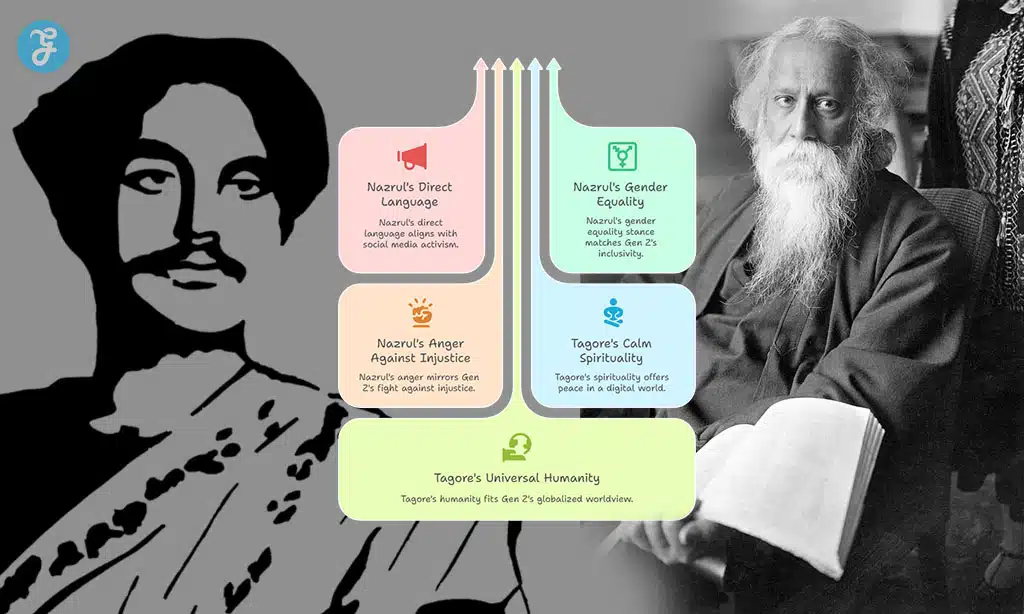
Why Gen Z Might Lean Towards Nazrul
-
His direct language connects with social media activism.
-
He speaks about gender equality, matching Gen Z’s fight for inclusivity.
-
His anger against injustice mirrors the way young people protest climate change, racism, and inequality today.
Why Tagore Still Has a Place
-
Gen Z also struggles with stress, mental health issues, and digital noise.
-
Tagore’s calm spirituality offers peace and balance.
-
His belief in universal humanity fits with a globalized, borderless world.
Opinionated Stand—Two Worlds, One Generation
In my view, Gen Z does not need to choose one over the other. Nazrul’s fiery words give them strength to fight against injustice, while Tagore’s calm philosophy offers healing in a stressful digital world.
-
When Gen Z is out on the streets protesting, Nazrul is their voice.
-
When Gen Z sits alone, searching for peace in a chaotic life—Tagore is their guide.
Both poets balance each other, like fire and water. Together, they speak to the full reality of today’s youth.
Takeaways
Rabindranath Tagore and Kazi Nazrul Islam may have lived in different times, but their voices still reach us today. Tagore whispers of harmony and reflection. Nazrul shouts of justice and rebellion.
For Gen Z, who live in a world of both protests and digital burnout, the answer is clear: they need both. One teaches them how to fight; the other teaches them how to live.