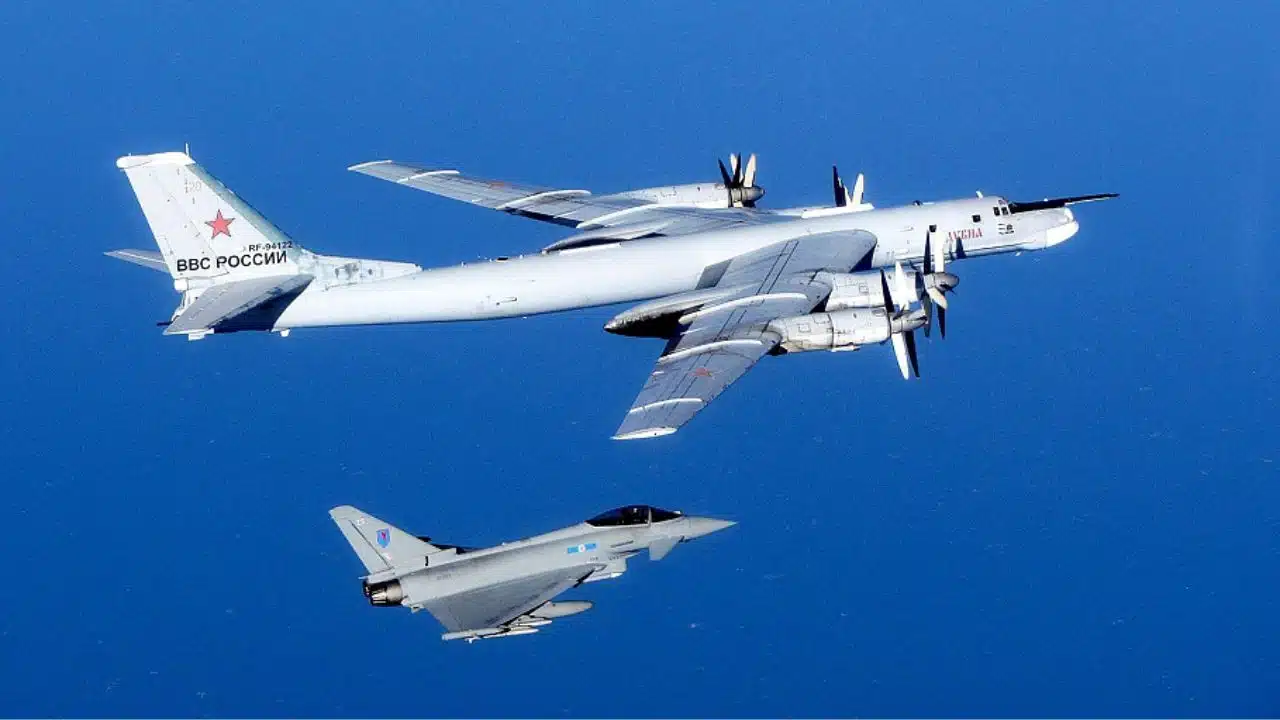
NATO scrambles jets as Russian bombers fly near Norway after Russia said Tu-95MS strategic bombers conducted a planned flight over international waters of the Barents and Norwegian Seas that lasted more than seven hours.
Incident overview (Who/What/When/Where)
Russian Tu-95MS long-range strategic bombers flew a “scheduled”/planned mission over neutral waters in the Barents Sea and the Norwegian Sea, waters north of Scandinavia and northwest of Russia.
Russia’s Defense Ministry said the flight lasted more than seven hours, and that Russian Navy Su-33 fighters escorted the bombers.
As the bombers operated near NATO’s northern area of interest, NATO fighter aircraft were scrambled to track, identify, and shadow the formation, according to reporting that described an allied intercept near Norway during Christmas Day operations.
Key verified details
| Item | What is known (fact-based) |
| Aircraft | Tu-95MS strategic bombers (“Bear” in NATO reporting) operated over the Barents/Norwegian Seas. |
| Duration | Russia said the flight lasted more than seven hours. |
| Escort | Russia said Su-33 fighters escorted the bombers. |
| Location | Russia described international airspace over the Barents Sea and Norwegian Sea (north of Scandinavia). |
| NATO action | NATO fighter jets were scrambled to monitor the mission near Norway, according to published reports of an intercept. |
Russia’s account (Why/How, from Moscow’s statement)
In its public account, Russia’s Defense Ministry framed the mission as routine, describing it as a planned flight over neutral waters rather than an airspace violation.
The ministry also said that “at certain stages” of the route, the bombers were accompanied by fighter jets from foreign countries, without naming which nations launched the intercept.
Russia further argued that its long-range aviation missions are conducted in line with international rules for using airspace over international waters.
What “foreign escort” typically signals
When a military aircraft formation approaches NATO’s periphery, NATO members commonly launch interceptors to visually identify the aircraft, monitor flight behavior, and ensure it does not enter allied airspace.
NATO describes this as part of its permanent, peacetime air-defense posture designed to preserve the security of Allied skies.
NATO’s response (How NATO scrambles jets)
NATO Air Policing is a standing mission that maintains fighter aircraft on continuous readiness—24 hours a day, 365 days a year—to react quickly to suspicious or unusual air activity near Alliance airspace.
NATO says Allied air forces continuously monitor air traffic in and around Europe and may intercept aircraft in cases of suspicious activity close to NATO borders or unsafe air traffic that does not adhere to international air-safety norms.
NATO also notes that, when an interception is required, the relevant Combined Air Operations Centre (CAOC) decides which air base will scramble aircraft based on the incident location.
Air Policing vs. “combat”
These intercepts are usually presented as defensive and procedural—focused on identification, escort, and airspace integrity rather than engagement.
NATO positions Air Policing as a collective allied task to safeguard the integrity and security of airspace.
How this fits NATO’s broader air-defense posture
NATO states that Air Policing is one of the permanent peacetime missions conducted within the framework of NATO Integrated Air and Missile Defence (IAMD).
In practice, IAMD is the umbrella for detecting and responding to air threats, with Air Policing being the day-to-day mission most visible to the public when jets are scrambled.
Why flights near Norway draw attention (Context)
The Barents Sea–Norwegian Sea corridor is a long-running strategic aviation route because it sits near NATO’s northern flank and includes sea lines of communication used by allied militaries and commercial shipping.
In recent years, multiple European and international reports have repeatedly described Russian long-range aviation activity in northern waters as triggering NATO intercepts, reflecting a steady pattern rather than a one-off event.
Russia’s own statement that foreign fighters escorted the bombers indicates the mission was detected and actively monitored throughout portions of the route.
What changes—and what doesn’t
What does not change in this specific incident is the core claim from Russia that the bombers flew over international waters (not inside NATO airspace), while NATO’s standard response is still to launch interceptors when unusual military flights approach allied areas of interest.
What can change is the frequency, size, and messaging around these flights, particularly when they coincide with major holidays or heightened geopolitical tension, which can amplify public attention even when airspace boundaries are not crossed.
Final thoughts
- Monitoring and intercept activity in the High North is likely to remain frequent because NATO maintains a permanent Air Policing mission built for rapid response to unusual activity near allied airspace.
- Russia’s confirmation of a long-duration Tu-95MS mission—and its note that foreign fighters escorted the formation—signals continued operational tempo and routine contact between Russian long-range aviation and NATO interceptors.
- Watch for any follow-up statements from NATO commands or Norway’s defense authorities that could clarify which allied aircraft were scrambled and whether any safety incidents (such as loss of communication or unsafe maneuvering) were recorded.