Many entrepreneurs launch their businesses expecting instant growth, but the reality of running a service business hits hard within the first few months. You patch together a website, land your first client, and suddenly you are drowning in a sea of deliverables, unpaid invoices, and scope creep. The early days are chaotic. If you do not recognize the pitfalls early, you will end up working 80-hour weeks just to break even. Making starting a marketing agency mistakes is a normal part of the journey, but repeating them is what bankrupts new founders.
You do not need to figure everything out the hard way. Thousands of owners have walked this path before you, failing in predictable ways. By studying where they went wrong, you can shortcut your path to profitability. We are going to look at the exact traps that catch new owners off guard. From pricing blunders to hiring nightmares, knowing these issues upfront will save you thousands of dollars and countless sleepless nights. Let us break down the worst offenders so you can build a stable, scalable business from day one.
1. Saying Yes to Every Single Client
When you first open your doors, panic often sets in because you need cash flow to survive. You end up taking any project that comes your way, regardless of whether it fits your core skills. One day you are building an ecommerce website, and the next day you are running search ads for a local plumber. This scattered approach quickly leads to massive burnout. It also prevents your team from becoming true experts in any specific industry or service line. Here is a breakdown of how a generalist approach compares to a niched focus.
| Strategy Approach | Revenue Potential | Operational Efficiency | Client Retention Rate |
| Generalist (Any Client) | Low to Medium | Poor (Custom work every time) | Average |
| Specialist (Niche Focus) | High (Premium pricing) | Excellent (Templatized work) | High |
Moving away from the generalist trap requires a deliberate shift in how you position your brand.
The Danger of Custom Deliverables
Creating a brand new strategy for every single client destroys your profit margins. When you take on random projects, you cannot build repeatable systems. Every task requires fresh research, custom software setups, and unique troubleshooting. You end up spending hours of unbillable time just figuring out how to deliver the work. This kills your effective hourly rate and leaves you with zero time to actually grow the business.
Transitioning to a Specialist Model
You need to pick one specific industry or one specific service and master it. If you only run email campaigns for direct-to-consumer apparel brands, you quickly learn exactly what works and what fails. You can build templates, automate the reporting, and deliver results faster than a generalist ever could. You become known as the go-to expert in that space, which means you can start charging premium rates for your specialized knowledge.
Best for: Founders who feel overworked and are struggling to scale beyond a handful of clients.
Why We Chose It: Niching down allows you to build highly repeatable workflows that reduce stress and increase profit margins.
Things to consider: It might take three to six months to fully transition your existing client base into your new specialized model.
2. Underpricing Your Services to Win Business
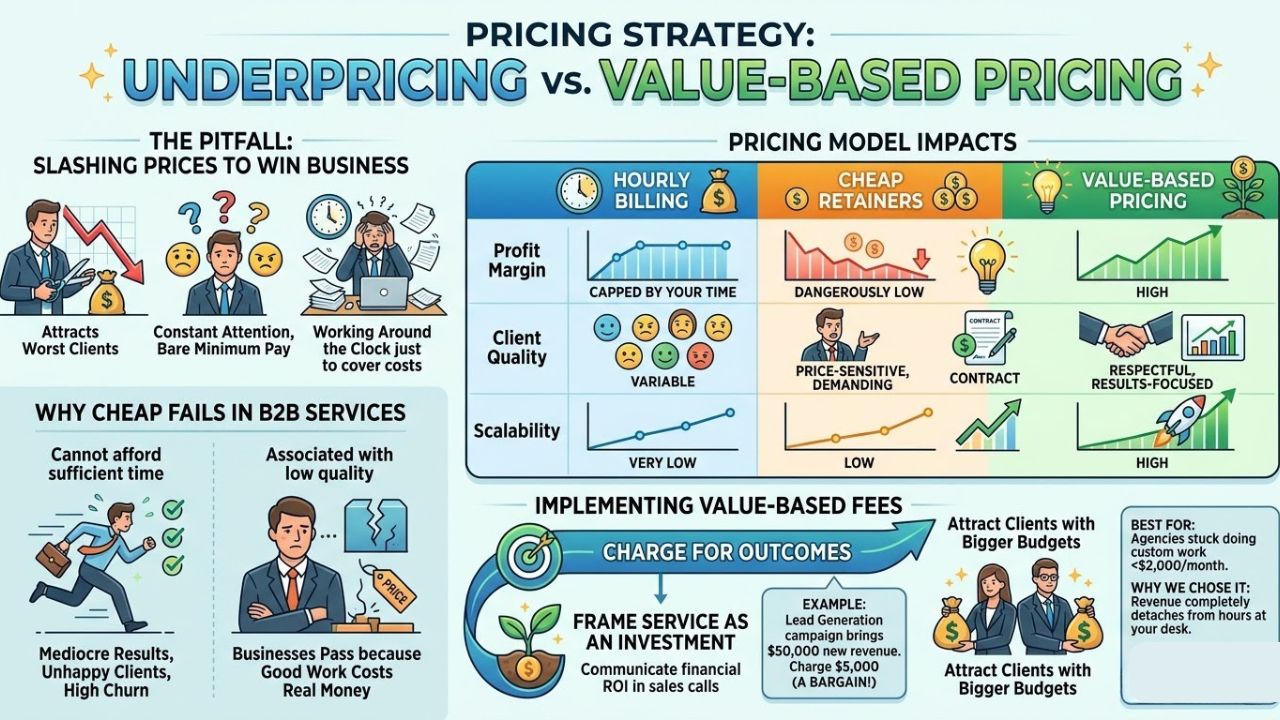
Pricing is usually the hardest thing to figure out when you launch. Most new owners look at their competitors, slash their prices by twenty percent, and hope it brings in a flood of easy work. This race to the bottom attracts the worst types of clients who demand constant attention while paying the bare minimum. You quickly find yourself working around the clock just to cover your basic software subscriptions. Let us look at how different pricing models impact your daily operations.
| Pricing Model | Profit Margin | Client Quality | Scalability |
| Hourly Billing | Capped by your time | Variable | Very Low |
| Cheap Retainers | Dangerously Low | Price-sensitive, demanding | Low |
| Value-Based Pricing | High | Respectful, results-focused | High |
Fixing your pricing structure is the fastest way to instantly improve your cash flow and mental health.
Why Cheap Fails in B2B Services
When you charge low fees, you literally cannot afford to spend the necessary time to do an excellent job. You have to rush through tasks to get to the next paying client. This leads to mediocre results, unhappy clients, and a high churn rate. Furthermore, business owners often associate low prices with low quality. If you pitch a comprehensive SEO strategy for two hundred dollars a month, serious businesses will pass because they know good work costs real money.
Implementing Value-Based Fees
Instead of charging for your time, you need to charge for the outcome you provide. If your lead generation campaign will realistically bring a client fifty thousand dollars in new revenue, charging them five thousand dollars is a bargain. You have to learn how to communicate the financial return on investment during your sales calls. Frame your service as an investment rather than an expense, and you will naturally attract clients with bigger budgets.
Best for: Agencies currently stuck doing custom work for less than two thousand dollars a month.
Why We Chose It: Value-based pricing completely detaches your revenue from the number of hours you sit at your desk.
Things to consider: You must have a proven track record and strong case studies to confidently sell value-based packages.
3. Ignoring the Importance of Clear Scope Boundaries
You sit down with a client, agree on a set of deliverables, and start the project with high hopes. A week later, they ask for a tiny favor, like changing a few colors on a landing page. You agree because you want to be helpful. Two weeks later, they want a completely new email sequence written from scratch for free. This is scope creep, and it is one of the most deadly starting a marketing agency mistakes. It eats up your team bandwidth and ruins your profitability. Review the common boundary issues below.
| Type of Scope Creep | Client Request | Financial Impact on Agency |
| Unplanned Revisions | “Can we just try three more designs?” | Wastes hours of design time |
| Extra Deliverables | “Could you also post this on TikTok?” | Steals time from paying tasks |
| Out of Hours Support | Texting you on Sunday mornings | Destroys your work-life balance |
Setting strict boundaries from day one is the only way to protect your time and your profit margins.
The True Cost of Being Nice
Every time you say yes to free work, you are training your client to expect free work. They will push the boundaries as far as you let them. If you do not have a formal process for handling extra requests, your team will get frustrated and overworked. Your profit margin on that client drops to zero, and your other paying clients suffer because you are distracted by unbilled tasks.
Using Strict Statements of Work
You must outline exactly what is included in your service and, more importantly, exactly what is excluded. Put this in a formal Statement of Work document that the client must sign before you begin. When they ask for something extra, you do not have to say no. You simply say that you would love to help them with that, and you will send over a separate invoice for the new scope. This keeps the relationship professional while protecting your bottom line.
Best for: Service providers dealing with clients who constantly demand extra meetings and extra revisions.
Why We Chose It: A detailed Statement of Work removes all emotion from the conversation when a client asks for free labor.
Things to consider: You need to train your account managers to enforce these documents rather than caving to client pressure.
4. Hiring Full-Time Employees Prematurely
Landing a massive contract feels amazing, and the immediate reaction is usually to go out and hire full-time staff to handle the workload. You take on salaries, benefits, and payroll taxes before you actually have consistent revenue to support them. If that large client suddenly cancels their contract three months later, you are left with a massive overhead bill that you cannot pay. This cash flow trap shuts down new businesses constantly. Here is how different hiring models affect your risk level.
| Hiring Setup | Financial Risk | Flexibility | Onboarding Time |
| Full-Time W2 Staff | Very High | Low | Slow (Weeks) |
| Dedicated Freelancers | Medium | High | Fast (Days) |
| White-Label Partners | Low | Very High | Immediate |
Protecting your cash flow means scaling your labor costs up and down with your actual revenue.
The Overhead Death Spiral
When your fixed costs exceed your reliable monthly recurring revenue, you operate in a constant state of anxiety. You start taking on terrible clients just to make payroll. Managing full-time employees also requires a massive amount of leadership, training, and human resources work. Most new founders are great at marketing but terrible at management, leading to internal chaos and high employee turnover.
Leveraging Fractional Talent
In your first year, you should heavily rely on specialized freelancers and contractors. If you need a copywriter, hire one on a project-by-project basis. This keeps your profit margins protected. If you lose a client, your contractor expenses automatically drop as well. Once you have a stable baseline of recurring revenue covering your basic operating expenses for at least six months, then you can slowly start converting your best contractors into full-time team members.
Best for: Founders who have fluctuating monthly revenue and project-based client work.
Why We Chose It: Using contractors protects your profit margins and allows you to test different talent before making a long-term commitment.
Things to consider: Freelancers work with multiple clients, so you do not have total control over their daily schedules.
5. Forgetting to Market Your Own Business
It is incredibly common to see a brilliant lead generation firm with a website that has not been updated in three years. You get so busy fulfilling promises for your clients that you completely neglect your own sales pipeline. When a major client eventually leaves, you panic because you have zero fresh leads coming in. This feast-and-famine cycle is exhausting and entirely preventable. Look at the difference between proactive and reactive pipelines.
| Pipeline State | Lead Flow | Stress Level | Business Growth |
| Proactive Marketing | Steady daily inquiries | Low | Predictable scaling |
| Reactive Marketing | Zero leads until panic hits | Extremely High | Stagnant or declining |
Treating your own company like your most important client is the key to breaking the feast-and-famine cycle forever.
The Danger of Dry Pipelines
If you only market yourself when you need money, you are already too late. B2B sales cycles take time. A prospect you speak to today might not sign a contract for two months. If you wait until you lose a client to start prospecting, you will face a sixty-day gap with zero income. This desperation will force you to accept lower prices and terrible terms just to survive the month.
Time-Blocking Internal Growth
You have to dedicate specific hours on your calendar every single week solely to your own outbound efforts. Treat this time block exactly like a meeting with your highest-paying client. Do not cancel it. Use this time to write case studies, send outbound emails, post on LinkedIn, or optimize your own funnel. Consistent daily action builds a compound effect, ensuring you always have a waiting list of prospects ready to work with you.
Best for: Owners stuck in the feast-and-famine revenue cycle.
Why We Chose It: Consistent daily prospecting guarantees you will never be held hostage by one large client threatening to leave.
Things to consider: It requires immense discipline to ignore urgent client emails to focus on your own internal marketing tasks.
6. Operating Without Standard Operating Procedures
In the beginning, every single process lives entirely in your head. You know exactly how to launch a campaign, how to audit an account, and how to send a report. But when you finally bring on help, chaos erupts. Because nothing is written down, your new team members constantly interrupt you with basic questions. You end up micromanaging everything and working even more hours than you did when you were solo. Here is a look at how documentation changes your daily operations.
| Operational State | Training Speed | Error Rate | Owner Involvement |
| No Documentation | Very Slow | High | Constant |
| Basic Checklists | Moderate | Medium | Moderate |
| Full Video SOPs | Fast | Low | Minimal |
Systematizing your knowledge is the only bridge between owning a job and owning an actual asset.
The Bottleneck of Founder Knowledge
If every task requires your final approval, your business can only grow as fast as you can personally work. This is the hardest ceiling to break through. Without clear rules, your team will make mistakes, the quality of work will drop, and clients will complain directly to you. You will eventually conclude that nobody else can do the work properly, trapping you in the fulfillment role forever.
Building Your Playbook
You do not need to spend weeks writing massive corporate manuals. Start small. The next time you perform a routine task, record your screen while you do it. Explain your thought process out loud. Save that video into a shared folder. Over a few months, you will build a massive library of training materials. When you hire someone new, you simply hand them the video library. They can learn your exact methods without eating up your valuable time.
Best for: Founders who are currently spending more time answering team questions than doing actual work.
Why We Chose It: Screen recordings are the fastest way to extract knowledge from your brain without writing hundreds of pages of text.
Things to consider: Platforms change frequently, so you will need to update your training videos at least once a year.
7. Relying Strictly on Word of Mouth
Referrals are fantastic. They close faster, they trust you more, and they rarely argue about price. However, referrals are completely unpredictable. You cannot control when a past client decides to recommend you. If your entire growth strategy relies on hoping people talk about you, you do not have a real business model. Relying solely on referrals is a massive starting a marketing agency mistakes that halts growth. Compare these different growth channels below.
| Lead Generation Source | Control Level | Predictability | Setup Effort |
| Client Referrals | None | Low | Zero |
| Organic Content | Medium | Medium | High (Takes months) |
| Cold Outbound / Ads | High | High | High (Requires budget) |
Taking control of your own lead flow requires implementing proactive outbound systems.
The Illusion of Safety
Many new owners brag that they have never spent a dollar on advertising because they get all their business from referrals. This sounds great until the market shifts or their network dries up. When the referrals stop, these owners have absolutely no idea how to go out into the market and generate a conversation from scratch. They lack the fundamental sales skills required to survive in a competitive landscape.
Launching Predictable Acquisition Systems
You need a repeatable system that generates leads on demand. This could be a targeted cold email campaign using clean data, a direct message strategy on social platforms, or a simple paid advertising funnel offering a free audit. The specific channel matters less than the consistency of the effort. When you have a system where you can spend one dollar to reliably make three dollars back, you finally have a scalable enterprise.
Best for: Businesses that experience wild revenue swings from month to month.
Why We Chose It: Cold outbound puts the control of your pipeline directly back into your own hands.
Things to consider: You will face a lot of rejection when reaching out to cold prospects, which requires thick skin and persistence.
Final Thoughts
Building a service business from the ground up is a massive undertaking, but you do not have to fall into the same traps as everyone else. The most destructive starting a marketing agency mistakes usually stem from a lack of focus and a fear of losing out on revenue. By picking a tight niche, charging what your results are actually worth, and fiercely protecting your time with strict boundaries, you set yourself apart from the amateurs.
Stop treating your business like a chaotic freelance gig. Write down your standard operating procedures, protect your profit margins by using agile contractors, and never stop filling your own sales pipeline. If you systematically address these core areas, you will transition from a stressed-out operator into a true CEO, capable of scaling a highly profitable operation for years to come.
Frequently Asked Questions (FAQs)
How long does it usually take for a new service business to become profitable?
If you keep your expenses low and rely on contractor labor, you can become profitable within your very first month. However, most founders who sign long-term leases and hire full-time staff immediately often take six to twelve months to reach actual profitability.
Is it too late to choose a niche if I already have a dozen general clients?
It is never too late. You can begin marketing yourself strictly within your new niche today while continuing to service your legacy clients. As your specialized roster grows, you can slowly transition or fire the clients that no longer fit your primary focus.
What is the best way to determine my value-based pricing?
Start by calculating the actual financial upside your service provides. If you help a client generate an extra ten thousand dollars a month, charging a flat rate of two thousand dollars makes total sense. Aim to provide at least a three-to-one return on investment for the client.