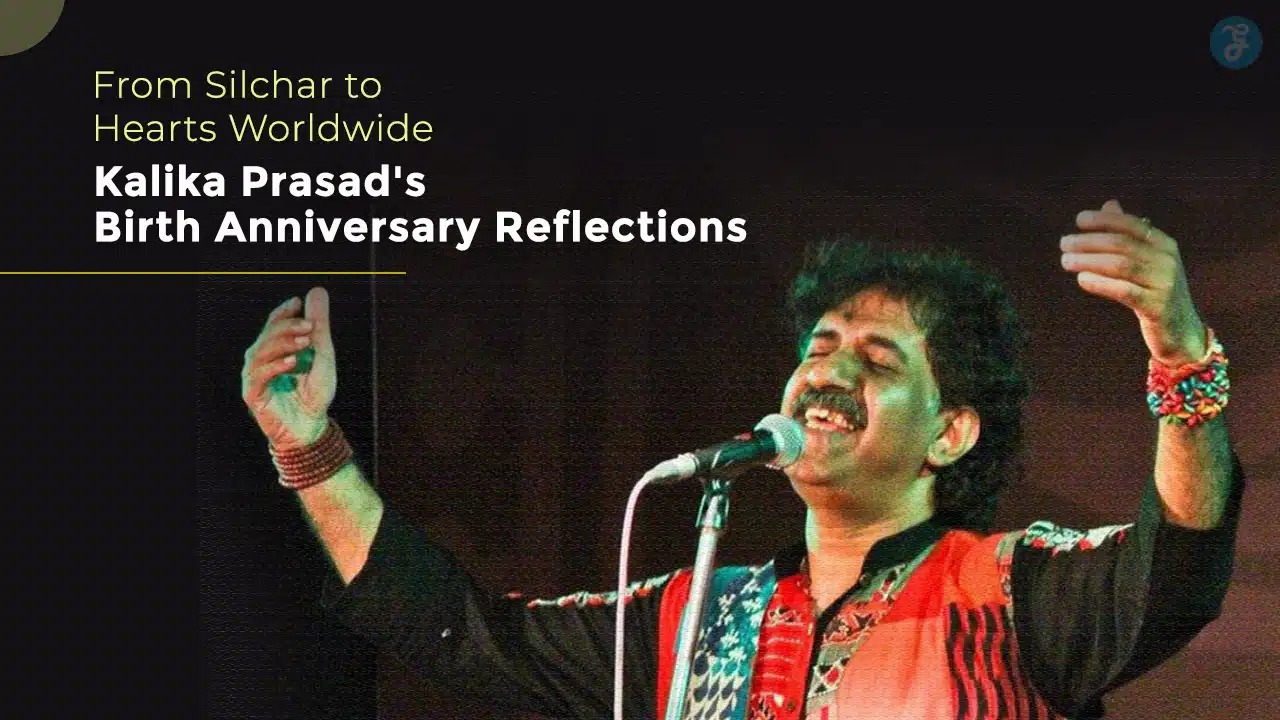
Every once in a while, an artist emerges whose voice goes beyond music. Kalika Prasad Bhattacharjee was one such person. Born in the culturally rich town of Silchar in Assam, Kalika Prasad became a symbol of Bengali folk revival and musical scholarship. His birth anniversary is more than a date—it’s a celebration of a life that bridged traditional roots with global rhythms.
Kalika’s journey from Silchar to the international stage was one marked by passion, purpose, and a deep commitment to preserving the soulful strains of Bengali folk. As we reflect on his life and legacy today, we are reminded of how one man’s vision can transcend geographical boundaries and reach hearts across the world.
The Early Years in Silchar
A Childhood Rooted in Culture and Music
Kalika Prasad was born on September 11, 1970, in Silchar, Assam. Growing up in a Bengali family that valued literature and music, Kalika was exposed to rich cultural traditions from a very young age. His father, Bhaba Prasad Bhattacharjee, was a school teacher and cultural enthusiast who nurtured his son’s interest in music.
At a Glance: Kalika’s Early Life
| Feature | Details |
| Birthplace | Silchar, Assam, India |
| Birthdate | September 11, 1970 |
| Cultural Environment | Rooted in Bengali folk, literature, arts |
| Family Influence | Strong support from father and relatives |
| First Exposure to Folk | Local fairs, Baul songs, and kirtans |
Education, Influences, and Folk Traditions
Kalika Prasad was deeply influenced by the oral traditions of rural Bengal. He studied at Ramakrishna Mission Vidyalaya in Narendrapur and later completed his education at Jadavpur University, Kolkata, where he studied history. His academic background made him more than a performer—it made him a cultural historian.
Kalika Prasad and the Revival of Bengali Folk Music
Founding Dohar: A Mission to Archive and Perform
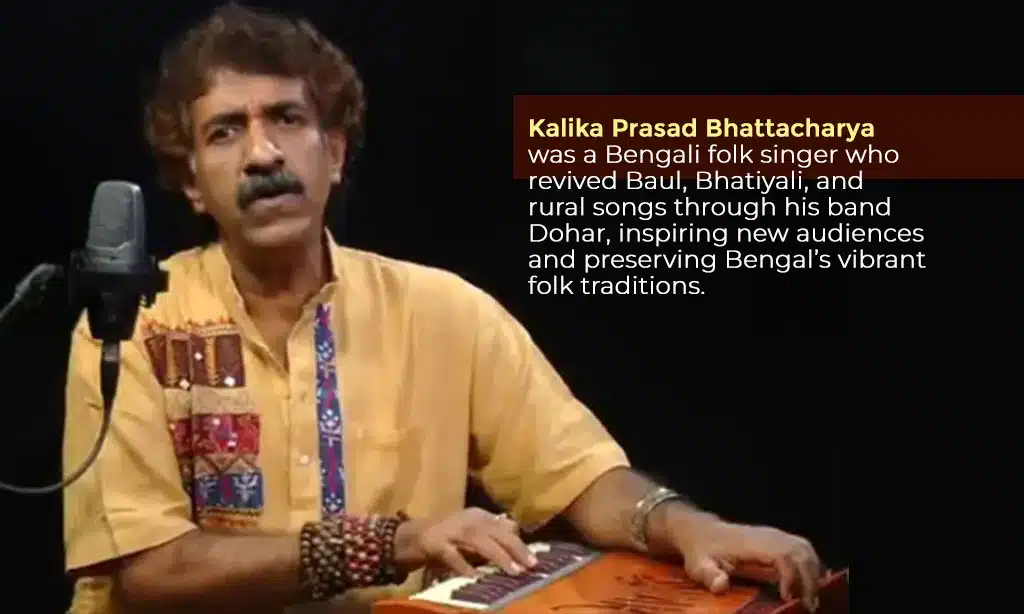
Dohar began on 7 August 1999 in Kolkata. The name means “chorus.” The aim was simple and powerful: collect on the ground, respect the source, and then bring the songs to stage and record without losing their soul. The lineup evolved over time, and after 2017 the ensemble continued under Rajib Das’s leadership.
Dohar milestones (select)
| Year | Milestone / release (label) |
| 2001 | Bandhur Deshey (Concord Records India) |
| 2002 | Banglar Gaan Shikorer Taan (Sony Music) |
| 2004 | Rupsagare (Saregama) |
| 2006 | Bangla (Saregama) |
| 2007 | 2007 (Saregama) |
| 2009 | Mati’swar (Orion Entertainment) |
| 2011 | Matir Kella – musical documentary (Saregama) |
| 2012 | Baul Fokirer Rabindranath (Orion) |
| 2013 | Sahasra Dotara (Orion) |
| 2015 | Unisher Daak (Picasso Entertainment) |
His Mission to Preserve and Globalize Folk Music
Kalika Prasad wasn’t just singing songs; he was reviving stories. He traveled extensively through rural Bengal, collecting songs that were fading away. His efforts made Bengali folk music accessible to younger generations and global audiences.
He incorporated instruments like the ektara, dotara, and khamak, and stayed true to the rustic tones of Bengal’s soil. Under his leadership, Dohar performed internationally, including in the U.S., Bangladesh, and the U.K.
Collaborations and Cross-Cultural Music
Kalika Prasad collaborated with classical artists, Bollywood musicians, and cultural institutions. His ability to blend authenticity with innovation made him a bridge between generations, genres, and geographies.
The Folk Forms He Carried
Baul (mystic quest songs)
Baul songs speak of an inner journey and love for the divine within the human body. In 2008, Baul songs (Bangladesh) were inscribed on UNESCO’s Representative List of the Intangible Cultural Heritage of Humanity.
Baul at a glance
| Item | Details |
| Core idea | Inner quest; the “man of my heart” |
| Regions | Across Bengal, with Kushtia as a historic hub |
| Sound | Minimal, led by ektara and voice |
| Notable figure | Lalon Shah’s corpus influences many Baul repertoires |
UNESCO documentation confirms the heritage inscription and explains why the form matters.
Bhatiyali (boatmen’s river songs)
Bhatiyali has long, flowing lines that echo water and distance. It grew along river routes in eastern Bengal and West Bengal. Boatmen sing downstream with time to stretch phrases.
Bhatiyali at a glance
| Item | Details |
| Core image | River, boat, horizon |
| Mood | Solitude, longing, reflection |
| Setting | Sung by boatmen (majhi/mallah) in the delta |
| Notes | Strong ecological connection in texts and imagery |
Banglapedia and related archives describe the tradition’s river context and performance style.
Bhawaiya (north Bengal–Assam laments)
Bhawaiya grew in the north—Rangpur (Bangladesh), Cooch Behar (West Bengal), and Goalpara (Assam). Lyrics often reflect working lives—mahouts, cart drivers, buffalo herders—and the long wait of those at home. The singing stretches tones to carry pain and memory.
Bhawaiya at a glance
| Item | Details |
| Region | North Bengal, Rangpur, Goalpara |
| Themes | Separation, labor, travel |
| Style | Elongated lines, deep emotion |
Jhumur belongs to the red-soil belt of western West Bengal (Purulia, Bankura, Birbhum, Bardhaman, West Medinipur) and also Jharkhand and Odisha. Migration carried it to tea gardens, so you’ll hear it in North Bengal and parts of Assam too.
Jhumur at a glance
| Item | Details |
| Region | Western West Bengal + Jharkhand + Odisha; later spread to tea belts |
| Communities | Kurmi-Mahato, Bhumij, Oraon, Munda and others |
| Vibe | Rhythmic, communal, celebratory |
Themes in His Lyrics & Stage Storytelling
Kalika’s song picks and short talks circled simple, human themes. Rivers and journeys. Work and seasons. Devotion and everyday wisdom. Love and separation. He treated folk as living conversations, not museum pieces.
Theme map
| Theme | Listener takeaway |
| Rivers & migration | Movement, distance, homecoming |
| Devotion (bhakti) | Quiet strength and acceptance |
| Labor & seasons | Monsoon, harvest, festivals |
| Love & separation | Waiting, letters, paths, ferries |
These themes surface across Bhatiyali, Baul, Bhawaiya, and Jhumur repertoires referenced in the sources above.
Essential Songs & Recordings
Use this table as a beginner’s gateway. Most are traditional songs arranged and performed by Dohar.
| Track | Tradition / region | Mood or theme | Where to sample |
| Kothay Pabo Tare | Baul | Devotional search; “man of my heart” | Saregama single; Spotify/Apple/YouTube (2007) |
| Amar Bhanga Naoer Bhorosha Ki Aar | Bhatiyali (river) | Monsoon mood; fragile hope | Matir Kella selections on YouTube; streaming |
| Gari Chale Na | Work/folk | Road, effort, movement | Saregama jukebox on YouTube |
| Jale Na Jaiyo | River/folk | Warning, care, journey | Saregama jukebox on YouTube |
Beyond Music: The Intellectual and Cultural Thinker
Kalika Prasad as a Historian and Scholar
Kalika’s knowledge wasn’t limited to music. He was a historian by training, with deep insights into the socio-political context of Bengal’s folk music. He published articles, delivered lectures, and appeared in cultural debates that helped establish folk music as a subject worthy of serious academic attention.
Social Commentary Through Lyrics and Talks
Many of his songs spoke of poverty, rural life, gender roles, and environmental change. Through lyrics and performances, he voiced issues that mattered—turning folk music into a medium for social consciousness.
Table: Folk Themes in Kalika’s Work
| Social Theme | Song Example/Performance | Message Conveyed |
| Rural Hardship | “Matir Tan” | Dignity of agrarian life |
| Migration | “Bhromor Koiyo Giya” | Displacement and longing |
| Women’s Role | “O Bhromor Koiyo Na” | The voice of rural Bengali women |
| Nature & Loss | “Mon Majhi Re” (Live renditions) | Climate, river loss |
Legacy: Archiving, Teaching & Cultural Memory
Kalika believed archiving is action. Collect the song with context—place, lineage, language—then teach it on stage and in workshops. In Kolkata, he helped seed and co-organise Sahaj Parav, an open-air “root music” festival. After 2017, Dohar and collaborators continued the festival, hosting artists from across India and Bangladesh.
Legacy pillars
| Pillar | What that looks like |
| Field archiving | Collecting with credits and place notes |
| Teaching | Workshops, campus circuits, stage talk-throughs |
| Public festivals | Sahaj Parav (open-air folk platform; EZCC editions) |
| Mentoring | Encouraging new singers and instrumentalists |
A Tragic Loss, an Eternal Legacy
His Untimely Death and Its Impact on Bengal
Kalika Prasad’s life was tragically cut short on March 7, 2017, in a road accident in West Bengal. He was just 46 years old. The loss sent shockwaves across Bengal and the cultural community of India.
Tributes from Artists, Intellectuals, and Fans
Political leaders, scholars, folk musicians, and fans came forward to express their grief. Cultural programs were held in his memory in Kolkata, Silchar, Dhaka, and London. His funeral was attended by thousands.
Global Memorials and Annual Observances
Today, his birth and death anniversaries are observed through musical tributes, discussion panels, and school-level folk competitions. NGOs and music institutions have also named fellowships and awards in his honor.
Film & Screen Work: Bhuban Majhi (2017)
Kalika was music director for Bhuban Majhi, a Bangladesh film set across 1970–71 and later years. The soundtrack includes his vocals. The film opened days before his passing. Dhaka arts pages marked his birthday with special screenings that year.
Film facts
| Item | Details |
| Title | Bhuban Majhi (Bangladesh) |
| Release | 3 March 2017 |
| Role | Music director; also sang “Ami Tomar E Naam Gai” |
| Lead cast | Parambrata Chatterjee, Aparna Ghosh |
| Notes | War-era narrative; Baul philosophy thread |
Why Kalika Prasad Still Lives in Our Hearts
Timeless Lyrics That Speak to Every Generation
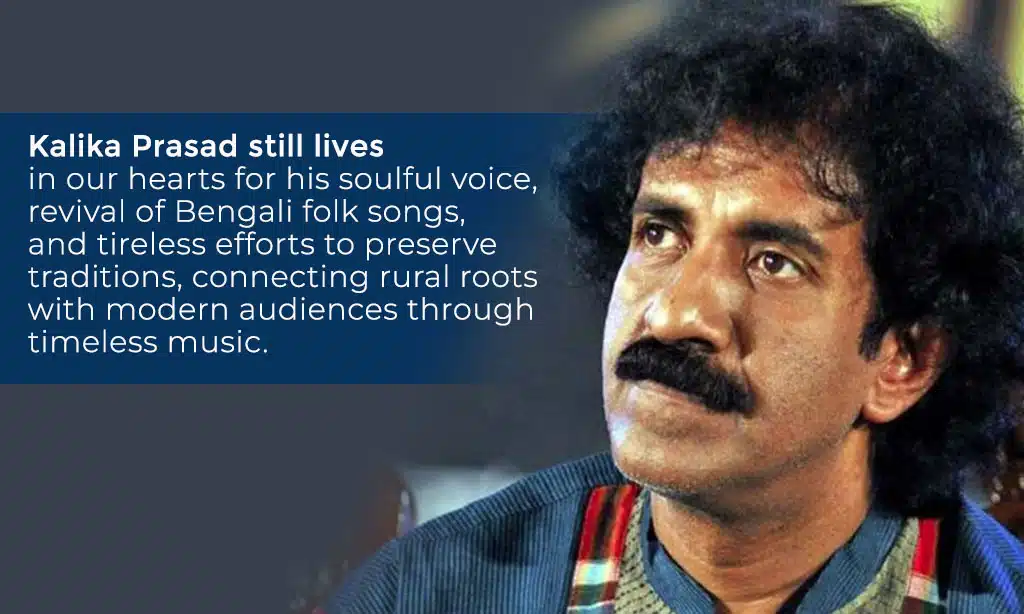
His lyrics blend tradition with timelessness. Kalika believed that music should be both rooted and resonant. Young and old alike continue to sing his songs at festivals, schools, and online platforms.
Popular Songs That Continue to Inspire
| Song Title | Theme | Platform Popularity (2025) |
| “Bangla Gaan Gai” | Love for mother tongue | 2M+ views on YouTube |
| “Matir Tan” | Folk revival, rural pride | Spotify favorite playlist |
| “O Bhromor Koiyo Na” | Feminine voice in folk tales | Academic folk courses |
Influence on Emerging Musicians
Many new-age folk artists cite Kalika Prasad as their inspiration. Platforms like Coke Studio and independent folk festivals in India have featured artists who grew up listening to his music.
The Digital Revival
His songs are now archived and available on platforms like Spotify, Apple Music, and YouTube. Documentary filmmakers have released tributes and biographical accounts on streaming platforms.
Reflections from the 2025 Birth Anniversary
Events Held in Silchar, Kolkata, and Internationally
The 2025 birth anniversary was marked by:
- A mega folk music fest in Silchar
- A memorial concert at Rabindra Sadan, Kolkata
- Online international symposium hosted by Bangla Academy
| City | Event Type | Key Highlights |
| Silchar | Music Fest | School children performing Dohar songs |
| Kolkata | Concert & Tribute | Collaborations with folk fusion bands |
| London/Dhaka | Online Symposium | Talks on cultural preservation |
Quotes and Memories from Friends and Scholars
Kalika’s colleagues spoke of his humility, his tireless travels through villages, and his dream of making folk music respected again.
Why His Legacy Still Feels Fresh
Folk traditions are gaining new relevance in the digital era. Kalika’s work sits at the intersection of tradition and modernity, making his legacy ever more meaningful.
Kalika Prasad for the Next Generation
Educational Initiatives in His Name
- Schools in West Bengal now include folk modules in music curriculum
- The Kalika Prasad Memorial Foundation offers scholarships to folk musicians
Digital Archives and Documentary Projects
New efforts are underway to digitize his vast collection of:
- Baul songs
- Bhatiyali recordings
- Interviews and public talks
Documentaries such as “Songs of the Soil: The Kalika Prasad Story” are available on OTT platforms.
Inspiring Young Artists
Art academies in Assam and Bengal have started “Folk Week” programs each year to inspire children and young artists to explore their roots—something Kalika had always dreamed of.
Takeaways: From Silchar to the World
Kalika Prasad Bhattacharjee may have been born in a small town in Assam, but his voice echoed across India and beyond. His music connected hearts, revived heritage, and reminded us that our past still has a voice worth listening to.
His work continues through students, digital platforms, annual tributes, and the unshakable connection people feel when they hear his voice. As we honor him on his birth anniversary, we are reminded that real art doesn’t die. It echoes forever.