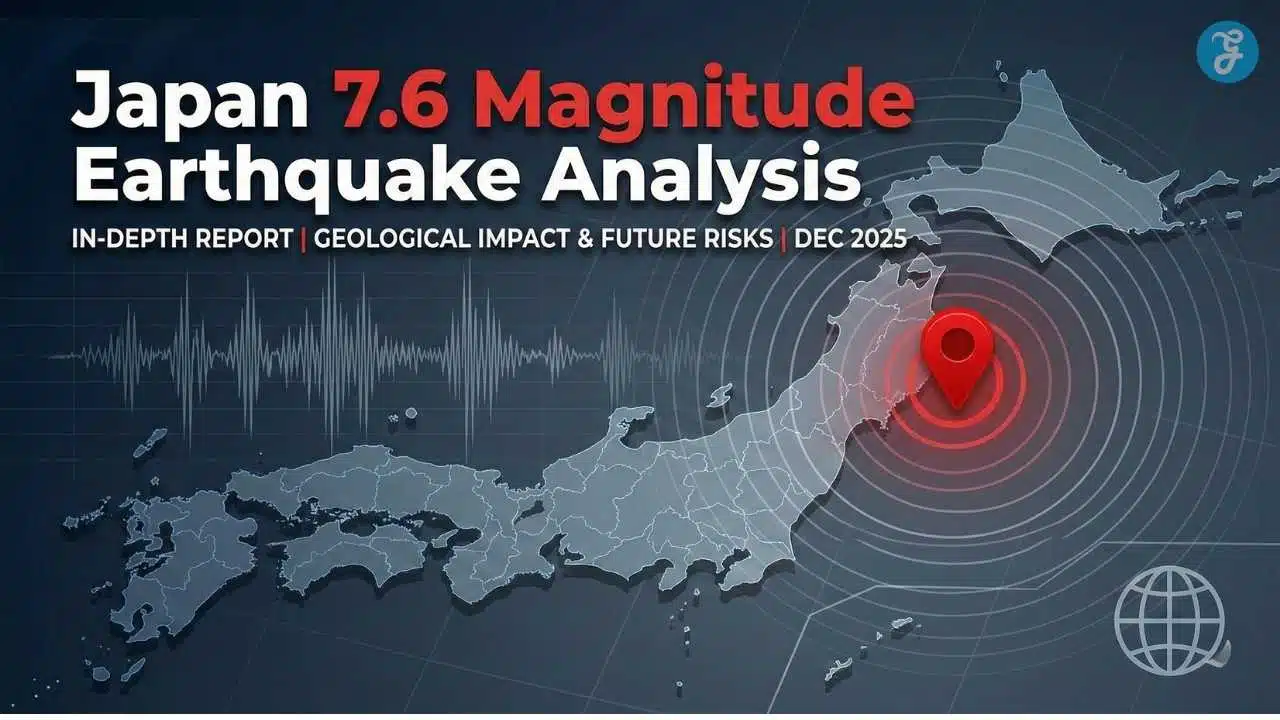
At 11:15 PM on Monday night, the freezing dark of Northern Japan was shattered by a violent geological convulsion. A magnitude 7.5 earthquake, originating deep in the Japan Trench, sent shockwaves rolling through Aomori, Iwate, and Hokkaido prefectures. For residents of the Tohoku region, the shaking was more than just a physical event; it was a visceral, terrifying echo of March 2011.
While the immediate devastation was mercifully limited—thanks to Japan’s world-class engineering and a stroke of geological luck—the event has triggered a far more complex crisis. For the first time in its history, the Japan Meteorological Agency (JMA) has issued a “Hokkaido-Sanriku Offshore Subsequent Earthquake Advisory.” This specific warning indicates that the probability of a catastrophic Magnitude 8.0+ “Megaquake” occurring in the next seven days has risen roughly 100-fold.
As Prime Minister Sanae Takaichi’s government scrambles to balance economic stability with public safety, the people of Northern Japan face a harrowing week of waiting. They do so in sub-zero temperatures, with damaged infrastructure and the psychological weight of a potential “Big One” looming over the horizon. This analysis explores the anatomy of the quake, the science behind the advisory, and the economic ripple effects that could extend far beyond the Japanese archipelago.
Anatomy of the Event: The 7.5 Magnitude Jolt
The earthquake signaled its arrival with a violent “Upper 6” intensity shaking in Hachinohe and “Lower 6” in Misawa, forceful enough to make standing impossible and to crack reinforced concrete. Unlike the sharp, jarring shocks of inland earthquakes, this subduction zone event was characterized by long-period ground motion, a rolling, sickening sway that lasted for over 60 seconds across the Tohoku region.
The Japan Meteorological Agency (JMA) quickly pinpointed the epicenter off the coast of Aomori, revising the magnitude from an initial 7.6 down to 7.5. Despite the slight downgrade, the event unleashed energy roughly equivalent to 30 atomic bombs, reminding the region that the geological stress from the 2011 disasters is far from resolved.
The Mechanism of the Rupture
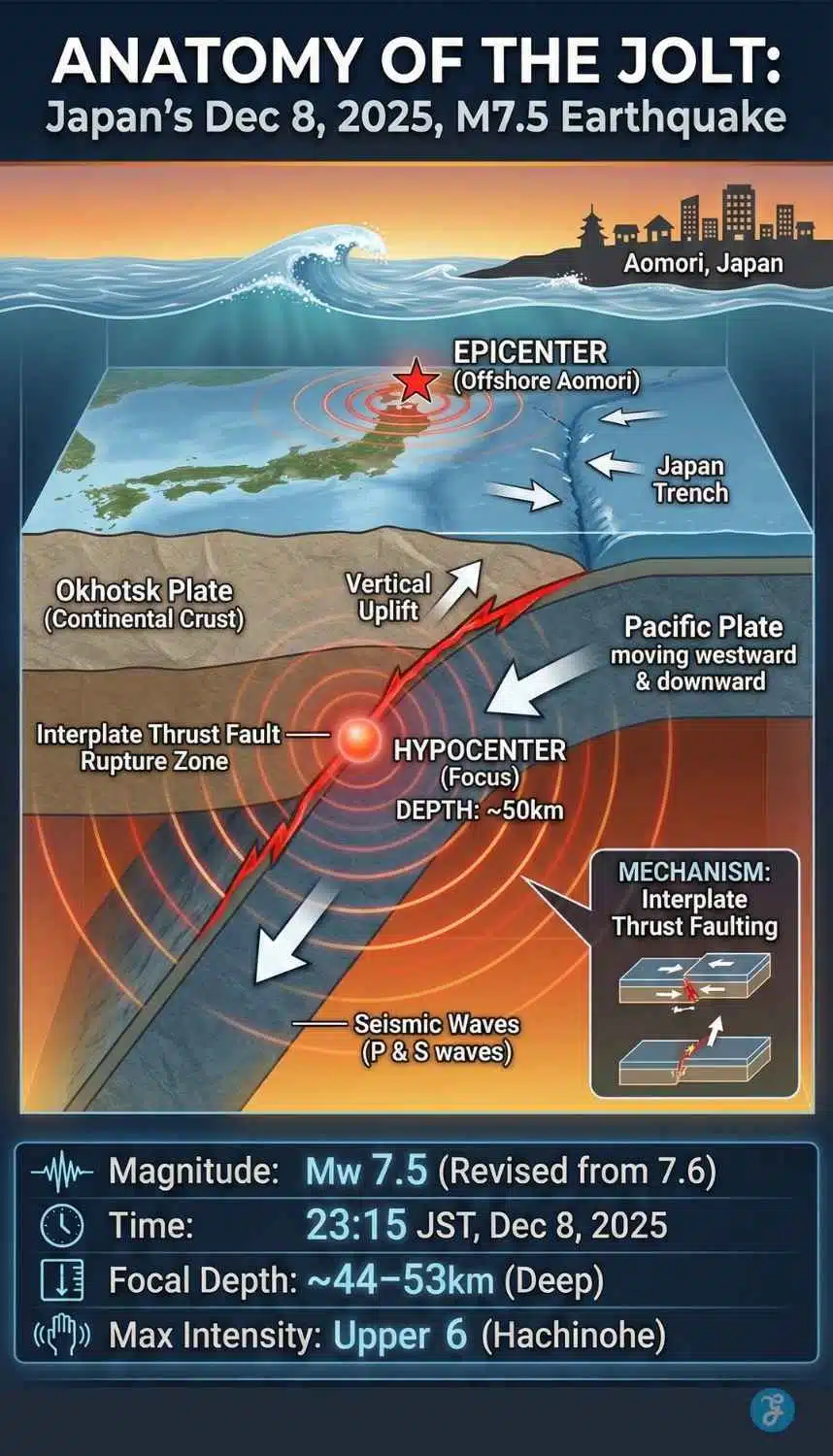
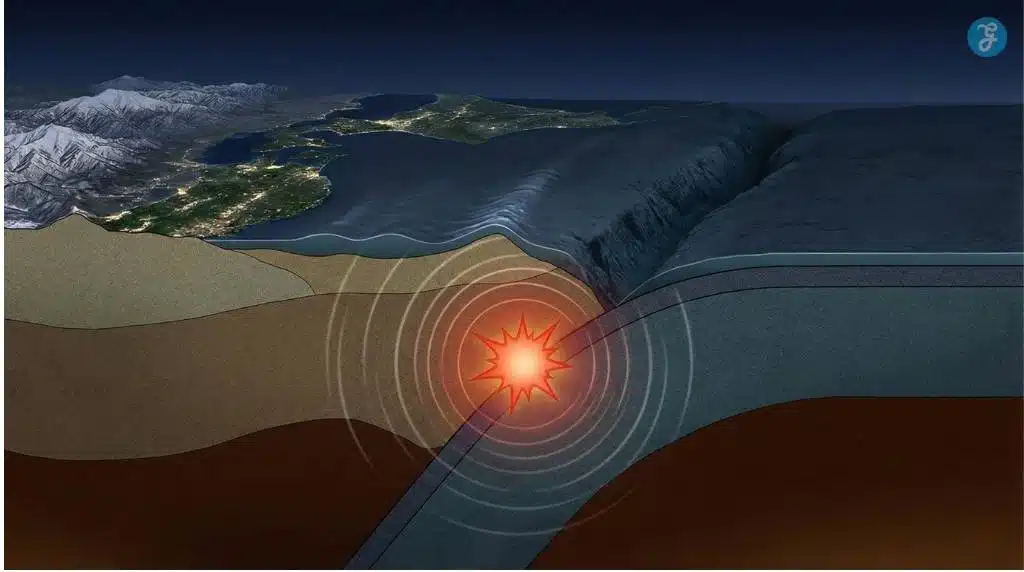
The earthquake occurred in the Pacific Ocean, approximately 80 kilometers east of Misawa, Aomori Prefecture. This location places it squarely on the western edge of the Japan Trench, a subduction zone where the dense Pacific Plate dives relentlessly beneath the Okhotsk Plate (on which Northern Japan sits).
According to JMA seismologists, the rupture was a classic interplate thrust faulting event. The stress that had accumulated from the Pacific Plate pushing westward was released in a violent slip at a depth of roughly 44 to 53 kilometers.
- Magnitude Revision: Initial automated systems rated the quake at 7.6. After manual review of waveform data, the JMA revised this to Mw 7.5.
- Duration: Residents in Hachinohe reported strong shaking lasting over 60 seconds, a hallmark of a long-period subduction zone event.
Seismic Intensity Distribution
The shaking was not uniform across the region. The Japanese “Shindo” scale, which measures ground intensity and human perception rather than total energy release, painted a picture of violent localized impact.
In Hachinohe, Aomori Prefecture, the quake registered as “Upper 6.” At this level of intensity, it is impossible for a person to remain standing. Heavy furniture is thrown across rooms, unreinforced concrete block walls collapse, and wooden houses with low earthquake resistance may lean or flatten. In the cities of Misawa and Towada, the intensity was a “Lower 6,” still sufficient to shatter reinforced glass and cause structural fissures. Further north in Hakodate, Hokkaido, the shaking reached an “Upper 5,” causing significant alarm and stopping pedestrians in their tracks.
| Prefecture | Location | Shindo Intensity | Perception |
| Aomori | Hachinohe | Upper 6 | Impossible to stand; furniture moves/topples. |
| Aomori | Misawa / Towada | Lower 6 | Difficult to stand; windows may shatter. |
| Iwate | Morioka / Kuji | Upper 5 | Walking is difficult; dishes fall from shelves. |
| Hokkaido | Hakodate | Upper 5 | Significant shaking; frightened pedestrians stop. |
The Role of J-Alert
The nation’s J-Alert early warning system was a critical success factor. Because the epicenter was 80km offshore, the “P-waves” (primary waves) were detected seconds before the damaging “S-waves” reached the coast. This provided residents in Aomori City and Hachinohe with approximately 15 to 20 seconds of warning—enough time to slow high-speed trains and for families to dive under tables.
Tsunami Verification: The Warning vs. Reality
Immediately following the rupture, the JMA issued a Tsunami Warning for waves of up to 3 meters (10 feet). Memories of 2011 meant compliance was nearly 100%; thousands of residents in coastal towns like Kuji and Miyako immediately evacuated to higher ground, driving up hill roads in the pitch black.
Why Was the Tsunami Smaller Than Predicted?
The actual tsunami waves were significantly smaller than the forecast. The highest recorded wave was 70 centimeters (28 inches) at Kuji Port.
Scientific Analysis:
- Depth: The quake occurred at a depth of ~50km. Tsunamis are most devastating when the rupture breaks the surface of the seabed (shallow focus). The depth dampened the displacement of the water column.
- Motion: The “slip” may have had a stronger horizontal component than vertical, displacing less water than a pure vertical thrust would have.
Recorded Tsunami Wave Heights (Dec 8-9)
| Observation Point | Prefecture | Max Height | Arrival Time (Approx) |
| Kuji Port | Iwate | 0.7 m | 11:55 PM |
| Urakawa | Hokkaido | 0.5 m | 12:10 AM |
| Hachinohe | Aomori | 0.4 m | 11:58 PM |
| Mutsu | Aomori | 0.2 m | 12:05 AM |
Status: As of Tuesday morning, all warnings have been lifted. However, the JMA warns that sea levels may fluctuate unexpectedly for several days due to “trapped waves” bouncing off the coastline.
The “Megaquake” Advisory: A Historic Warning
The most significant news emerging from this event is not the physical damage, but the bureaucratic and scientific response. For the first time for this specific region, the JMA has activated the “Hokkaido-Sanriku Offshore Subsequent Earthquake Advisory.”
What is this Advisory?
Instituted after the lessons of 2011 and refined over the last decade, this protocol is activated when a magnitude 7.0 or greater earthquake strikes a specific zone of the Japan Trench or Chishima Trench. It is the northern equivalent of the Nankai Trough “Megaquake Alert” that gained international attention in 2024. It is not a prediction, but a statement of heightened probability.
The Statistical Threat
The advisory is based on the theory of foreshocks.
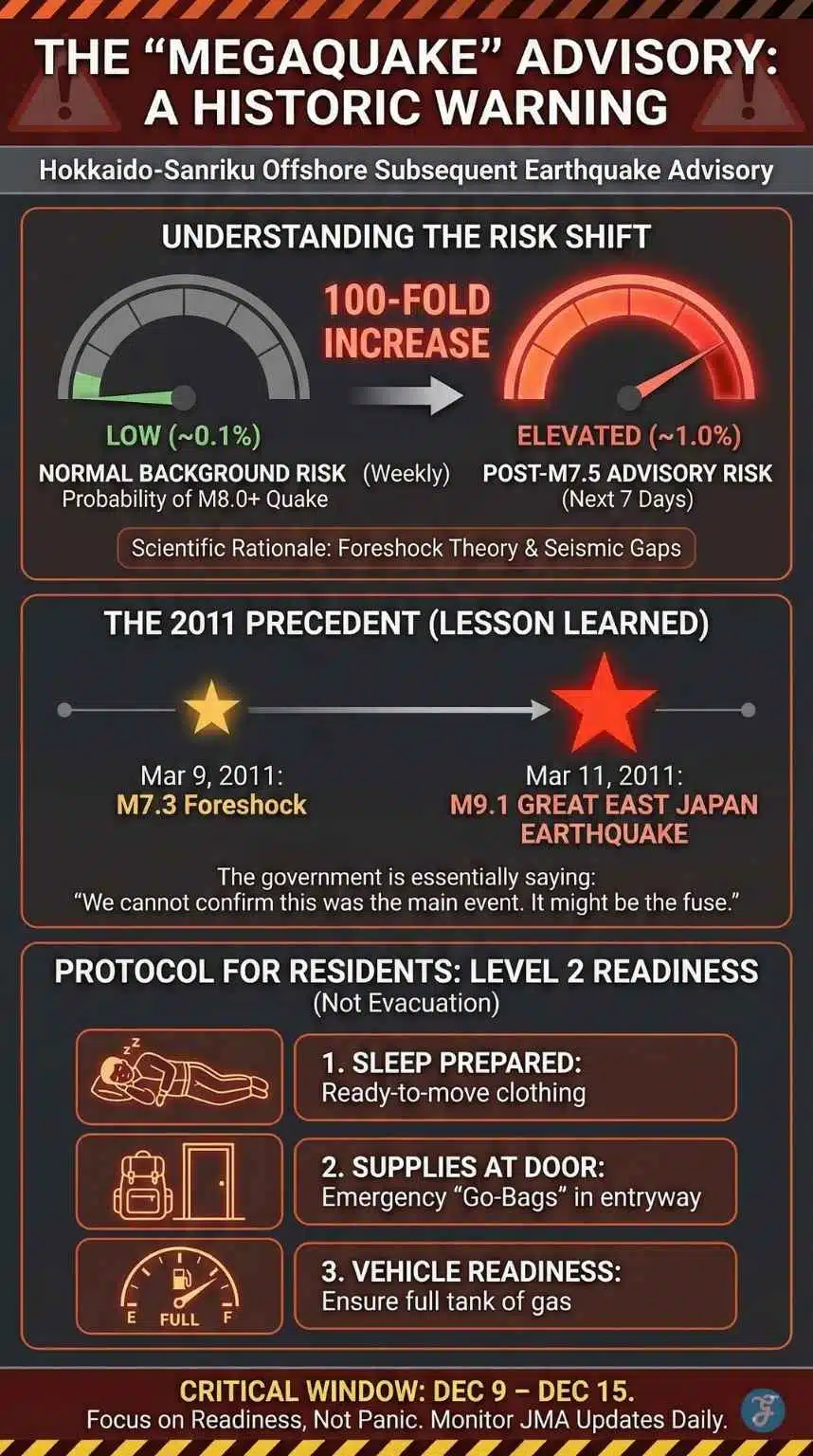
- Normal Risk: In any given week, the chance of an M8.0 earthquake is roughly 0.1%.
- Current Risk: After a magnitude 7.5 event, statistical models suggest that the probability of a larger, follow-up quake occurring within 7 days rises to roughly 1.0%.
While 1% sounds low, in seismology, it is a flashing red light. The 2011 Great East Japan Earthquake (M9.1) was preceded by a M7.3 quake exactly two days prior. The government is essentially saying: “We cannot confirm this was the main event. It might be the fuse.”
Protocol for Residents
Prime Minister Takaichi has not ordered a general evacuation, which would paralyze the region. Instead, the government has issued a “Level 2” readiness protocol:
- Sleep Prepared: Residents are urged to sleep in clothing suitable for outdoor evacuation.
- Supplies at Door: Emergency “Go-Bags” must be moved to the entryway.
- Vulnerable Populations: Nursing homes in tsunami inundation zones are on voluntary standby for relocation.
Damage Assessment & Human Cost
Casualties: Rising Numbers
As rescue teams reach more isolated hamlets, the injury count has risen.
- Confirmed Injuries: 51 (as of Tuesday afternoon).
- Fatalities: 0 confirmed.
- Details: The majority of injuries are fractures and lacerations caused by falling furniture. In Hachinohe, a hotel facade collapsed, injuring two pedestrians. In Tohoku town, a man was injured when his vehicle plunged into a road fissure that opened in the asphalt.
The “Winter Compound” Disaster
The timing of this quake is particularly dangerous. Northern Japan is in the grip of early winter.
- Temperature: Lows of -1°C to 3°C (30°F–37°F).
- The Heating Crisis: The initial blackout affected 2,700 households. In these temperatures, a home without power loses heat rapidly. Although power is mostly restored, kerosene delivery lines (the primary heating fuel in the north) have been disrupted by road cracks.
- Shelters: Approximately 480 evacuees spent the night at Hachinohe Air Base and school gymnasiums. The Defense Ministry deployed 18 helicopters to deliver blankets and heating units to these centers, recognizing that hypothermia is a secondary killer in winter quakes.
Infrastructure & Nuclear Safety
The specter of Fukushima hangs over every seismic report in this region. This week, the focus was on the Rokkasho facility.
The Rokkasho “Sloshing” Incident
The Rokkasho Nuclear Fuel Reprocessing Plant in Aomori is a critical, controversial facility holding large amounts of spent nuclear fuel. During the quake, the facility experienced a phenomenon known as “sloshing.” The long-period ground motion caused the water in the spent-fuel cooling pools to oscillate violently, eventually spilling approximately 450 liters onto the floor of the containment building.
Japan Nuclear Fuel Ltd. (JNFL) and the Nuclear Regulation Authority acted quickly to contain the narrative and the spill. They confirmed that the water remained entirely inside the controlled radiation zone and that no radiation escaped to the outside environment. However, while the facility is safe, the incident is a sobering reminder that liquid storage facilities are uniquely vulnerable to the long, rolling waves of large subduction quakes, a vulnerability that engineers must constantly reassess.
Other Nuclear Facilities
| Plant | Operator | Status |
| Onagawa (Miyagi) | Tohoku Electric | Stable. No damage. |
| Higashidori (Aomori) | Tohoku Electric | Stable. No damage. |
| Fukushima Daiichi | TEPCO | Suspended Operations. Treated water discharge halted immediately as a precaution; no new damage found. |
Transportation Gridlock
- Shinkansen: The Tohoku Shinkansen (Bullet Train) suspended operations between Fukushima and Shin-Aomori.30 While safety checks are nearly complete, the disruption stranded thousands of businessmen and tourists.
- Aviation: New Chitose Airport in Hokkaido saw chaos as rail links to the airport were severed, stranding 200 passengers overnight in the terminal.31
Economic & Supply Chain Analysis
Northern Japan is not just an agricultural hub; it is a vital artery in the global technology supply chain. The Tohoku region is often referred to as the “Silicon Corridor” of Japan due to its high concentration of semiconductor plants and high-tech manufacturing.
Semiconductor Vulnerability
The region hosts major factories for Renesas Electronics, Kioxia (formerly Toshiba Memory), and Sumco (silicon wafers).
- Immediate Impact: Most fabs (fabrication plants) automatically shut down when P-waves are detected to prevent sensitive lithography machines from misaligning.
- The Restart Challenge: Restarting a semiconductor fab is not like flipping a switch. It can take 2-4 days to recalibrate equipment.
- Global Risk: If the “Megaquake Advisory” window passes without incident, the impact will be a minor blip. However, if a larger quake hits, we could see a repeat of the 2011/2021 chip shortages that crippled the global automotive industry. Toyota and Honda are reportedly monitoring their Tier-1 suppliers in Iwate closely.
Market Reaction
- Forex: The Yen held stable at its current levels, indicating traders do not see this as a systemic economic threat yet.
- Equities: Construction stocks (e.g., Kajima, Obayashi) saw a slight bump in Tokyo trading, anticipating repair contracts, while tourism stocks for the Hokkaido region dipped slightly.
Political Leadership: A Test for PM Takaichi
For Prime Minister Sanae Takaichi, this is a defining leadership moment. Known for her hawkish stance on national security, she is now being tested on human security.
- The Response: Takaichi established a task force at the Prime Minister’s Office (Kantei) within 20 minutes of the quake—a speed that was noted favorably by domestic media.
- The Messaging: Her address on Tuesday morning was careful. She avoided alarmism regarding the “Megaquake Advisory” but was firm on preparedness. “We must not let our guard down. The earth is moving, and we must move with caution,” she stated.
- The Stakes: Takaichi’s administration has been pushing for the restart of nuclear reactors to secure energy independence. The safety of the Onagawa and Higashidori plants during this 7.5 magnitude stress test will likely be used as political capital to argue that Japan’s post-Fukushima safety upgrades are working.
Bottom Line: The Critical 7-Day Window
As the sun sets on Tuesday, December 9, Northern Japan is in a state of suspended animation. The immediate recovery is underway—power is returning, glass is being swept up, and trains are resuming. But the psychological toll of the JMA advisory is heavy.
The next seven days (through December 15) are a critical window. Seismologists are watching the tiltmeters and strain gauges on the sea floor for “slow slip” events that might signal a precursor to a larger rupture.
For the international community, this event serves as a dual lesson:
- Resilience Works: A magnitude 7.5 earthquake in many parts of the world would be a mass-casualty event. In Japan, the building codes and J-Alert system turned it into a manageable crisis.
- The Threat Remains: The Pacific Ring of Fire is active. Supply chain managers and governments globally should view this “near miss” as a reminder to verify their own contingencies for the day the advisory becomes a reality.