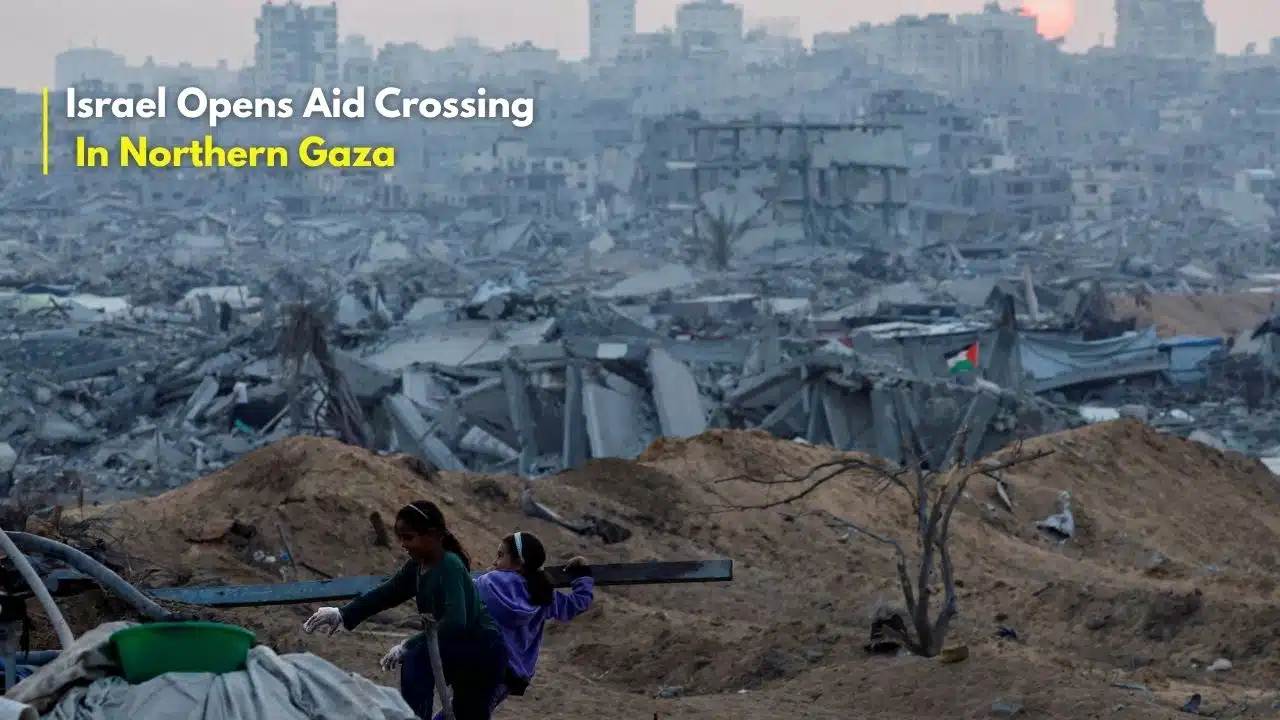
Israel announced the reopening of the Zikim crossing into northern Gaza on Wednesday, November 12, a move confirmed by the UN and aimed at allowing humanitarian aid into the famine-stricken region for the first time in two months. The opening follows a US-brokered ceasefire that began on October 10 and mounting international pressure to address the catastrophic humanitarian crisis.
The Zikim Opening
- What Happened: Israel’s COGAT (Coordinator of Government Activities in the Territories) announced the reopening of the Zikim crossing on November 12, 2025.
- Why It Matters: This is the first time a direct aid crossing to northern Gaza has been opened since September 12, 2025. The region was officially declared to be in a state of famine in August 2025.
- Official Status: A COGAT spokesperson stated the crossing would remain open “permanently,” similar to the Kerem Shalom crossing in the south.
- Humanitarian Toll: The reopening comes as the total death toll in Gaza since October 7, 2023, has reached at least 69,185, according to Gaza’s health authorities
- Ceasefire Context: The move is part of a broader, fragile US-brokered peace plan that initiated a ceasefire on October 10, 2025.
- Logistical Challenges: The UN (OCHA) confirms it was notified, but notes aid will be scanned outside Zikim, offloaded, and reloaded onto Palestinian trucks on a “separate day,” a process that could create delays.
A Desperate Lifeline to a Famine-Hit North
In a significant development for the fragile humanitarian situation in Gaza, Israeli authorities have opened a new artery for aid. On Wednesday, Israel’s military body overseeing civilian affairs, COGAT, announced the reopening of the Zikim crossing, a key entry point into the devastated northern Gaza Strip.
“Today, the Zikim crossing has been opened for the entry of humanitarian aid trucks into the Gaza Strip,” COGAT said in a statement on November 12.
The move was immediately confirmed by the United Nations. The UN Office for the Coordination of Humanitarian Affairs (OCHA) stated, “Overnight, Israeli authorities informed the UN that the Zikim crossing, between Israel and northern Gaza, will reopen for humanitarian cargo.
This reopening is the first positive step for direct aid access to the north in 61 days. The crossing was shut on September 12, 2025, choking off all direct routes for humanitarian supplies. In the intervening weeks, the humanitarian situation, already dire, collapsed completely. In August 2025, the Integrated Food Security Phase Classification (IPC) initiative, a global hunger monitor, officially confirmed famine conditions in north Gaza, a declaration that COGAT contested at the time
For months, UN officials have stated that aid deliveries trucked from the southern crossings, like Kerem Shalom, were insufficient and perilous, often hampered by damaged roads, security risks, and looting. “The opening of direct crossings to the north is vital to ensure that sufficient aid reaches people as soon as possible,” OCHA said in a report in late October.
A COGAT spokesman, speaking to the AFP news agency, added a crucial detail, stating the crossing would now remain open “permanently,” signaling a potential long-term policy shift.
A New Aid Framework Under US Oversight
The opening of Zikim is not happening in a vacuum. It is the first major test of a new, US-led aid mechanism established under a 20-point peace plan brokered by Washington, which led to a ceasefire that began on October 10, 2025.
Just last week, in a significant shift of power, the United States assumed control of Gaza’s humanitarian aid coordination from Israel. According to a November 8 report from The Washington Post, the new Civil-Military Coordination Centre (CMCC), led by US Central Command (CENTCOM), has replaced COGAT as the final decision-maker on “how and what type” of aid enters Gaza .
While humanitarian groups like the Norwegian Refugee Council welcomed the “active engagement” of the US, the transition has been described as “chaotic.”
The UN maintains that despite the new system and the ceasefire, the scale-up is dangerously slow.
“Despite significant progress on the humanitarian scale-up, people’s urgent needs are still immense, with impediments not being lifted quickly enough since the ceasefire.”
— Farhan Haq, UN Spokesperson, November 7, 2025
Haq lamented that, until today, entry was limited to only two crossings (Kerem Shalom and Kissufim), with “no direct access to northern Gaza.” Zikim’s opening makes it the third active crossing.
Data on the Ground: The Scale of Devastation
The Zikim opening provides a glimmer of hope, but the data from Gaza illustrates a catastrophe that will take years, if not decades, to reverse.
1. Humanitarian Aid (Post-Ceasefire)
Since the October 10 ceasefire, the UN and its partners have collected 37,000 metric tons of aid, mostly food, as of November 7.
The World Food Programme (WFP) reports that, in the same period, it has reached 1 million people with family food parcels. However, this is against a total target of 1.6 million, and families are receiving reduced rations.
2. Food Insecurity
Market monitoring from October 2025 showed a slight improvement. On average, households consumed two meals per day, an increase from one meal in July.
However, the grim reality persists: 1 in 5 households (20%) still reported eating only one meal per day. Furthermore, 42% of adults reported limiting their own intake to prioritize feeding their children.
3. Infrastructure and Livelihood Collapse
The physical destruction of Gaza is near-total. A November 3 report from the UN Satellite Centre, based on new comprehensive analysis, found:
- 81% of all structures in the Gaza Strip are damaged.
- 123,000 structures are completely destroyed.
- 50,000 are severely or moderately damaged.
Livelihoods have been systematically erased. A geospatial analysis by the UN’s Food and Agriculture Organization (FAO) and the UN Satellite Centre found catastrophic damage to the agricultural sector:
- Only 13% of cropland in the Gaza Strip is undamaged.
- Nearly 89% of all orchard trees, especially vital olive trees, have been damaged or destroyed.
The Human Element: Logistics and Movement
The logistics of the new crossing are complex. OCHA reported that authorities plan for incoming cargo to be scanned outside Zikim. It will then be “offloaded from Israeli trucks, and reloaded on a separate day onto Palestinian trucks for distribution in Gaza. This “separate day” reloading process is a major concern for aid agencies, who prize speed and efficiency.
In preparation, the UN has spent recent weeks repairing the road leading up to Zikim from inside Gaza and conducting checks for unexploded ordnance.
Despite the desolation, there are signs of human movement towards the north. OCHA partners reported that 4,000 movements from southern Gaza back to the north were recorded in the first week of November alone. This counter-intuitive migration underscores a desperate population caught between displacement camps in the south and the ruins of their homes in the north.
What to Watch Next
The reopening of Zikim is a single step in a complex geopolitical process. The durability of the opening, and the ceasefire itself, remains in question.
All eyes are now on New York, where the United States is circulating a draft Security Council resolution to codify its peace plan. According to texts obtained by AFP, the draft “welcomes the Board of Peace,” a proposed transitional governing body for Gaza.
Crucially, it also seeks to authorize an “International Stabilization Force (ISF)” to provide border security, demilitarize the enclave, and decommission weapons from non-state armed groups
The success or failure of the Zikim crossing will be a powerful indicator of whether the new US-led CMCC can manage the immense logistical and political hurdles of feeding Gaza—and whether this fragile ceasefire will hold as winter fast approaches.