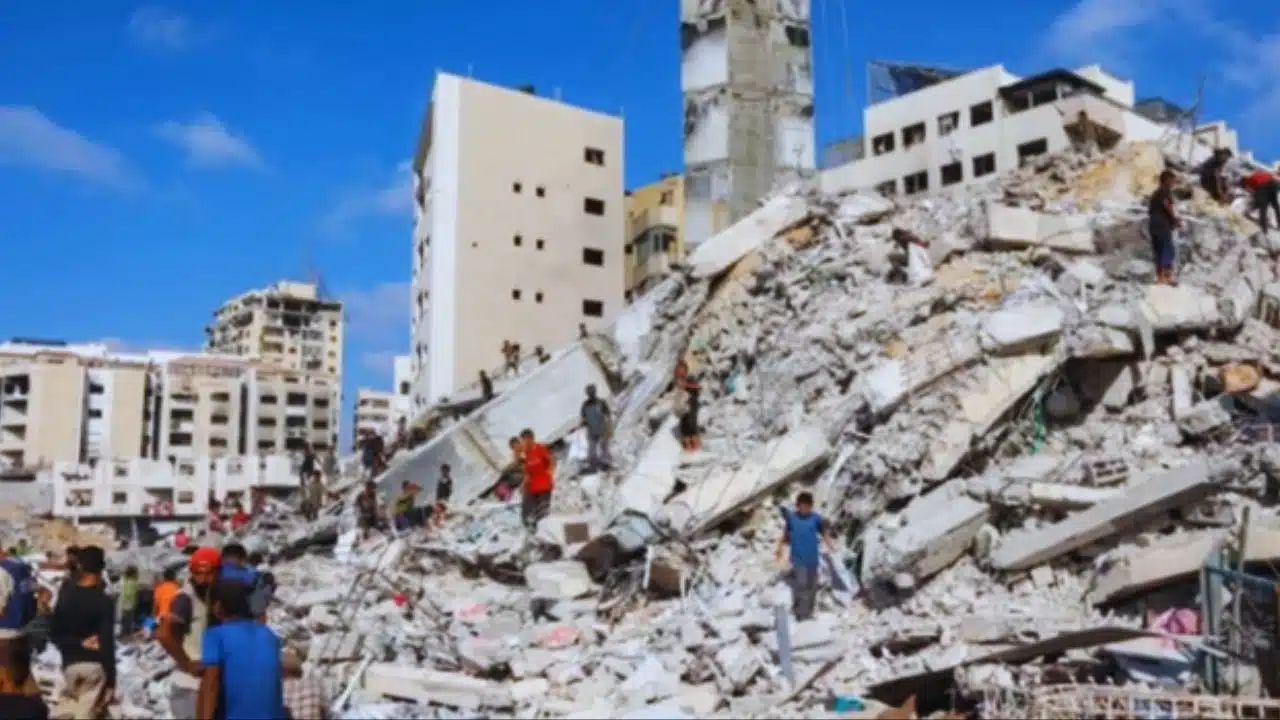
The Israeli military has destroyed another major residential and commercial block in Gaza City, marking the second such attack in just two days. On Saturday, September 6, 2025, Israeli airstrikes brought down the Soussi Tower, a 15-storey high-rise building in the city’s Tal al-Hawa district.
Israeli Defence Minister Israel Katz confirmed the strike by posting a video of the tower collapsing into rubble on his official X account. His caption was brief and defiant: “We’re continuing.” The video quickly circulated online, underscoring Israel’s determination to escalate its assault on the city.
The Israeli Defense Forces (IDF) said the building was being used by Hamas for military purposes, including alleged surveillance operations. Hamas has strongly denied the claim, insisting the tower was purely residential and sheltering displaced families fleeing earlier bombardments.
Residents Describe Panic Before Collapse
Witnesses said panic spread quickly as residents were told to evacuate. Some claimed they had been given only minutes to leave before the strike. One resident, Aida Abu Kas, described the confusion: “Some said it was just a warning, others said it was real. We went out not knowing what would happen next.”
By the time the missiles struck, the tower had emptied out, but many families lost all their belongings. There was no immediate confirmation of casualties, though aid workers warned that some people may have been trapped inside.
The attack mirrored the destruction of the Mushtaha Tower the previous day. That building, located in Gaza’s al-Rimal neighborhood, collapsed after explosives detonated at its base. Palestinians said displaced families had been sheltering inside, but Israel again insisted the site was being used by Hamas.
Israeli Warnings and Humanitarian Zone Push
Ahead of the strike, the IDF dropped leaflets across Gaza City urging residents to relocate south to what it called “humanitarian zones”—primarily the coastal strip of al-Mawasi near Khan Younis.
IDF spokesperson Avichay Adraee, speaking in Arabic, encouraged residents to join “the thousands who have already moved.” Israel has repeatedly promised that medical treatment, food, and water will be provided in these areas.
However, the United Nations and aid agencies have disputed these assurances. They say the tent cities in al-Mawasi are overcrowded, unsanitary, and unsafe, with disease spreading rapidly. Southern hospitals are already overwhelmed, and infrastructure is unable to handle the influx.
Tragically, on Tuesday of the same week, five children were killed in al-Mawasi while waiting in line for water. Witnesses blamed an Israeli drone strike; the IDF has said the incident is still “under review.”
Historic Towers Reduced to Rubble
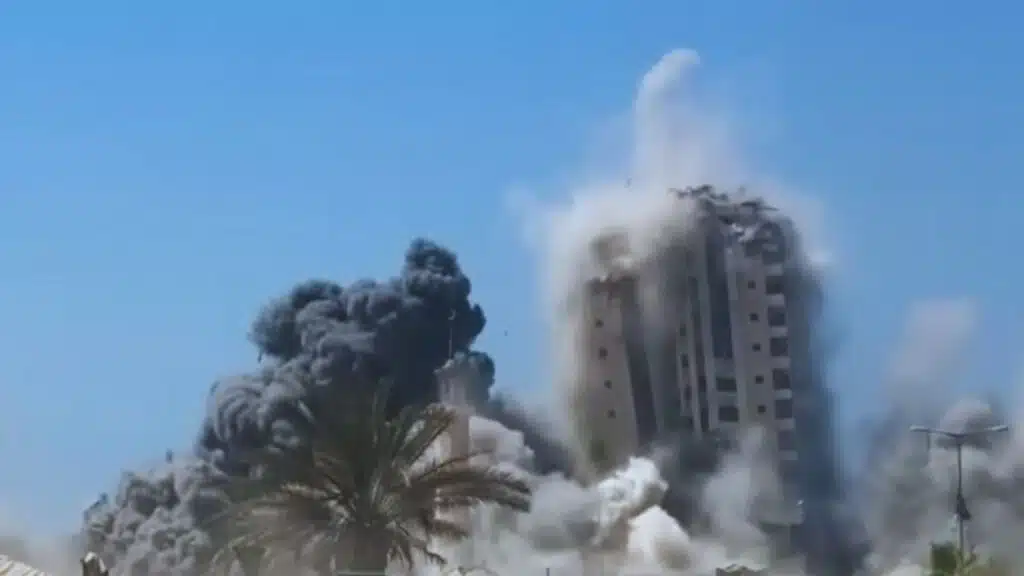
The destruction of Gaza City’s towers carries both strategic and symbolic significance.
These high-rises—usually between 10 and 15 floors—were not only commercial centers but also home to hundreds of families. Their rise in the 1990s followed the signing of the Oslo Accords in 1993, when thousands of Palestinians returned from exile. With little space for horizontal expansion, vertical construction became the only solution.
Entire neighborhoods came to be defined by these towers, and they symbolized the hope of rebuilding Gaza under Palestinian self-rule. Their destruction has therefore hit residents particularly hard, erasing both physical shelter and emotional ties to a period of optimism.
Satellite imagery now shows large parts of Gaza City flattened, with once-bustling districts turned into wastelands of concrete and twisted steel.
Humanitarian Situation: Famine and Displacement
The United Nations estimates that almost one million people are still trapped inside Gaza City. The UN declared a famine in August 2025, citing widespread food insecurity, rising malnutrition, and deaths caused by starvation.
According to Gaza’s Hamas-run health ministry, at least 63,746 Palestinians have been killed since the war began in October 2023. Of those, at least 367 deaths were linked directly to malnutrition and starvation. Aid organizations warn the true figure could be higher, given the collapse of the healthcare system.
Reports from the ground describe residents digging through rubble for food and water, hospitals operating without fuel or medicine, and families relying on contaminated groundwater.
Political Context: Ceasefire Talks Collapse
The escalation follows the collapse of indirect ceasefire and hostage negotiations earlier this summer.
Israel accuses Hamas of refusing meaningful concessions, while Hamas blames Israel for rejecting phased agreements that could have freed hostages in exchange for temporary truces. Prime Minister Benjamin Netanyahu has instead pledged to continue military operations until Hamas is dismantled and Israel has full security control over Gaza.
He has also declared Israel’s intention to “seize all of the Gaza Strip,” signaling a long-term military and political shift rather than a temporary campaign.
Civilian Cost Mounts
Even as Israel insists it uses “precise munitions” and issues advance warnings, Palestinian officials and humanitarian groups argue that civilians are paying the heaviest price.
On the same day Soussi Tower fell, at least 40 more people were reported killed across Gaza. The Guardian put the figure higher, reporting 56 deaths, including civilians gathered near food aid centers.
The repeated strikes on civilian infrastructure—including apartment blocks, schools, and water facilities—have prompted accusations of collective punishment and forced displacement. Gaza’s civil defense spokesman Mahmud Bassal accused Israel of carrying out “a policy of forced displacement” by systematically targeting shelters.
A City Under Siege
With each new strike, Gaza City is losing not only buildings but entire communities, histories, and the fragile hopes tied to them.
The two-day destruction of Mushtaha and Soussi Towers has become emblematic of Israel’s latest push: an all-out assault on a city still housing nearly a million people, many already on the brink of famine.
What was once a cityscape of vertical expansion—built in hope after Oslo—is now collapsing under relentless bombardment. For residents, survival is not only about escaping falling towers but also about finding food, water, and dignity amid one of the world’s worst humanitarian crises.
the Information is Collected from BBc and NYTimes.