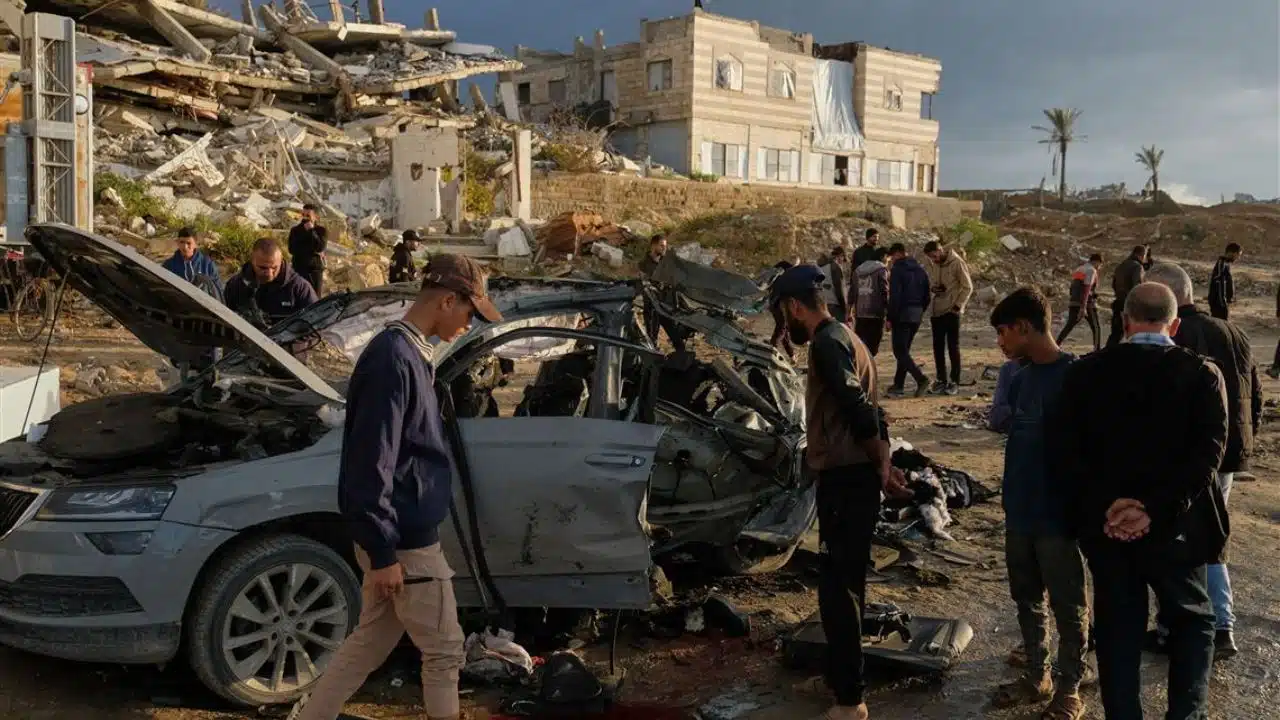
Israel says a targeted strike killed Raed Saad, a senior figure in Hamas’s armed wing, as both sides trade accusations of ceasefire violations.
Israel claims killing of senior Hamas commander Raed Saad in a strike on a vehicle in Gaza City on Saturday, an incident that could further strain a fragile ceasefire that began in October. Hamas did not confirm Saad’s death, and described the incident as an attack on a civilian vehicle outside Gaza City. The reported strike came after Israel said an explosive device wounded two Israeli soldiers in southern Gaza earlier the same day.
What Israel said happened
Israel’s military said it killed Raed Saad, describing him as a senior Hamas commander and one of the figures involved in planning the Oct. 7, 2023, attack that triggered the war. Israeli officials said the strike targeted Saad in response to a Hamas attack involving an explosive device that injured two Israeli soldiers in the south of the territory. In public statements carried by multiple outlets, Israel has also framed the strike as enforcement of ceasefire terms against militants it says remain engaged in planning attacks.
Israeli claims about Saad’s responsibilities focus on weapons and operational capacity. CBS News reported that Saad was in charge of manufacturing for Hamas and had previously led the group’s operations division. A profile by the European Council on Foreign Relations (ECFR) describes Raed Saad as a member of Hamas’s Qassam Brigades Military Council and head of the operations and production departments, and notes he previously led the armed brigade in Gaza City.
What is known about casualties and location
Accounts of casualties varied across reports published on the day of the strike. Reuters, as published by U.S. News, cited Gaza health authorities saying the strike killed five people and injured at least 25. CBS News, citing an Associated Press journalist at Shifa Hospital, reported four bodies arriving after the strike west of Gaza City, while Al-Awda hospital reported three wounded.
Hamas did not confirm the identity of those killed, and did not confirm Saad’s death in its initial reaction. The lack of independent confirmation is significant because targeted killings in Gaza have often been followed by competing claims, especially when strikes hit vehicles or buildings with multiple occupants. Several reports also emphasized that, at the time of publication, there was no immediate confirmation from Hamas or medical personnel that Saad was among the dead.
Why Raed Saad matters to Hamas’s armed wing
Israel’s claim centers on Saad’s alleged role in rebuilding Hamas’s military capacity during the ceasefire. An ECFR profile places Saad inside the leadership structure of Hamas’s armed wing, associating him with both operations and production functions, which are critical for planning attacks and sustaining weapons supply. If Israel’s account is accurate, the killing would remove a senior figure linked to weapons production and battlefield organization at a time when ceasefire enforcement is already contested.
The Qassam Brigades have been described by ECFR as the largest and best-equipped armed group operating in Gaza, and ECFR’s broader background notes that the Oct. 7, 2023, assault involved more than 1,000 Qassam fighters crossing into Israel under cover of heavy rocket and mortar fire. That same ECFR background reports that at least 251 people were abducted during the Oct. 7 attack. CBS News similarly reported that the Oct. 7 attack killed around 1,200 people and involved the taking of 251 hostages.
Ceasefire pressures and disputed “violations”
CBS News reported that the ceasefire took effect on Oct. 10 and that Israel and Hamas have repeatedly accused each other of violating it. CBS also reported Palestinian health officials saying Israeli strikes and shootings have killed at least 386 Palestinians since the ceasefire began, while Israel has said some strikes were retaliation for militant attacks and that troops have fired on people approaching a so-called “Yellow Line” separating Israeli-controlled areas from the rest of Gaza. Israel’s military position, as described by CBS, is that the ceasefire still allows strikes on targets actively engaged in terrorism.
Hamas, for its part, described the vehicle strike outside Gaza City as a serious breach of the U.S.-led ceasefire. Reuters’ account, as published by U.S. News, also framed the strike as the most high-profile reported killing of a senior Hamas figure since the ceasefire came into effect in October. The incident highlights a core tension of ceasefires in Gaza: whether and how “self-defense” or “active threat” exceptions are interpreted and enforced in practice.
Key dates and figures
| Item | What was reported | Why it matters |
| Oct. 7, 2023 | Hamas-led attack killed around 1,200 people and took 251 hostages, according to CBS. | Set the conditions for the war and later ceasefire talks. |
| Oct. 10 (year reported as 2025 in coverage) | CBS reported the U.S.-led ceasefire took effect on Oct. 10. | Defines the framework both sides cite when alleging “violations.” |
| Dec. 13, 2025 (Saturday) | Israel said it killed Raed Saad in a strike on a vehicle in Gaza City. | Israel says Saad was a senior commander tied to weapons and operations. |
| Casualties from the strike | Reuters cited Gaza health authorities: 5 killed, at least 25 injured. CBS/AP: 4 bodies at Shifa Hospital; Al-Awda hospital reported 3 wounded. | Conflicting early numbers are common and complicate verification. |
| Post-ceasefire deaths | CBS reported Gaza health officials: at least 386 Palestinians killed since the ceasefire began. | Helps explain why the ceasefire is described as fragile. |
Wider war context and humanitarian backdrop
CBS News reported that Israel’s campaign in Gaza has killed more than 70,650 Palestinians, and that the Gaza Health Ministry’s totals do not distinguish between civilians and combatants. CBS also reported that much of Gaza has been destroyed and that most of the population of over 2 million has been displaced. These conditions form the backdrop to any escalation, including targeted strikes, because they influence public pressure, negotiations, and the ability of aid systems to function.
Hostage and detainee issues remain central to the political track. CBS reported that Israel has demanded the return of the remains of the final hostage, Ran Gvili, and linked it to moving into the second and more complex phase of the ceasefire. CBS also described that next phase as involving an end to Hamas rule and a demilitarized Gaza with reconstruction under international supervision.
What happens next
Immediate next steps are likely to focus on verification and responses from Hamas and other Gaza authorities, since Hamas did not confirm Saad’s death in its initial statement. Further developments will also depend on whether ceasefire mediators push for de-escalation mechanisms, especially as Israel argues the strike was permitted under the truce’s security provisions. With both sides trading claims of violations and casualty reporting diverging, international pressure is likely to center on maintaining the ceasefire while addressing the unresolved hostage and governance questions tied to a second-phase framework.