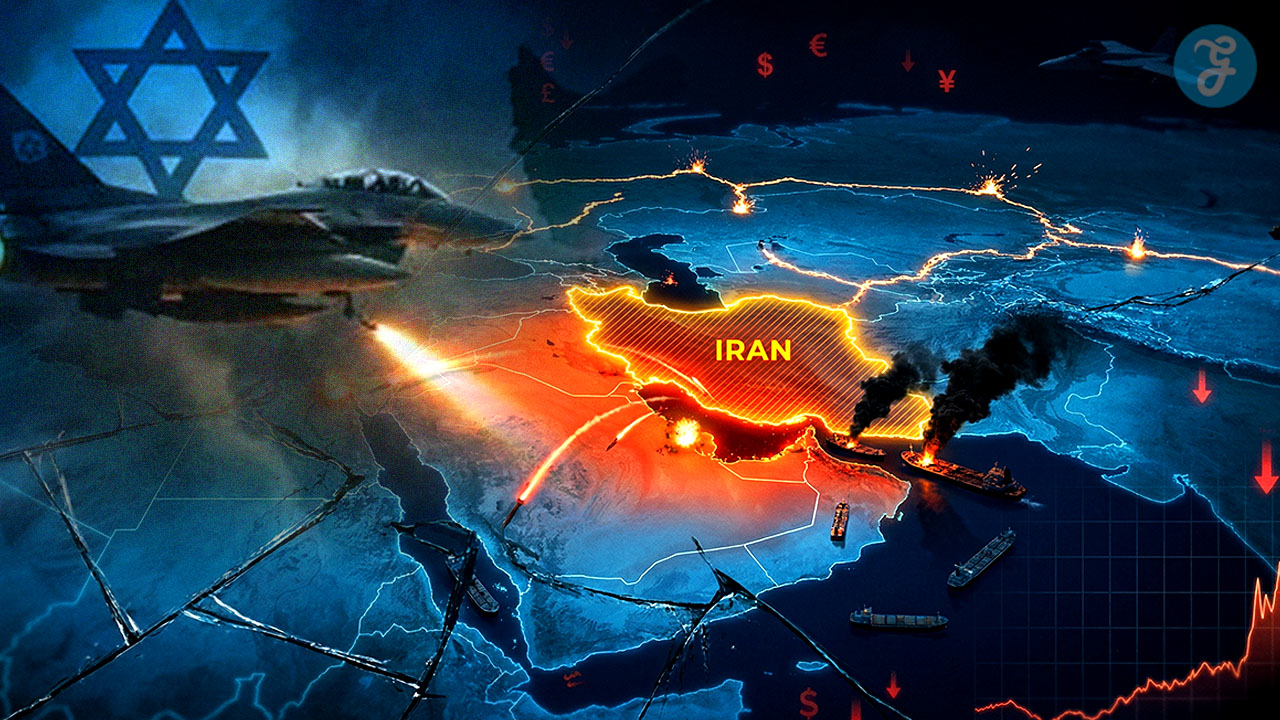
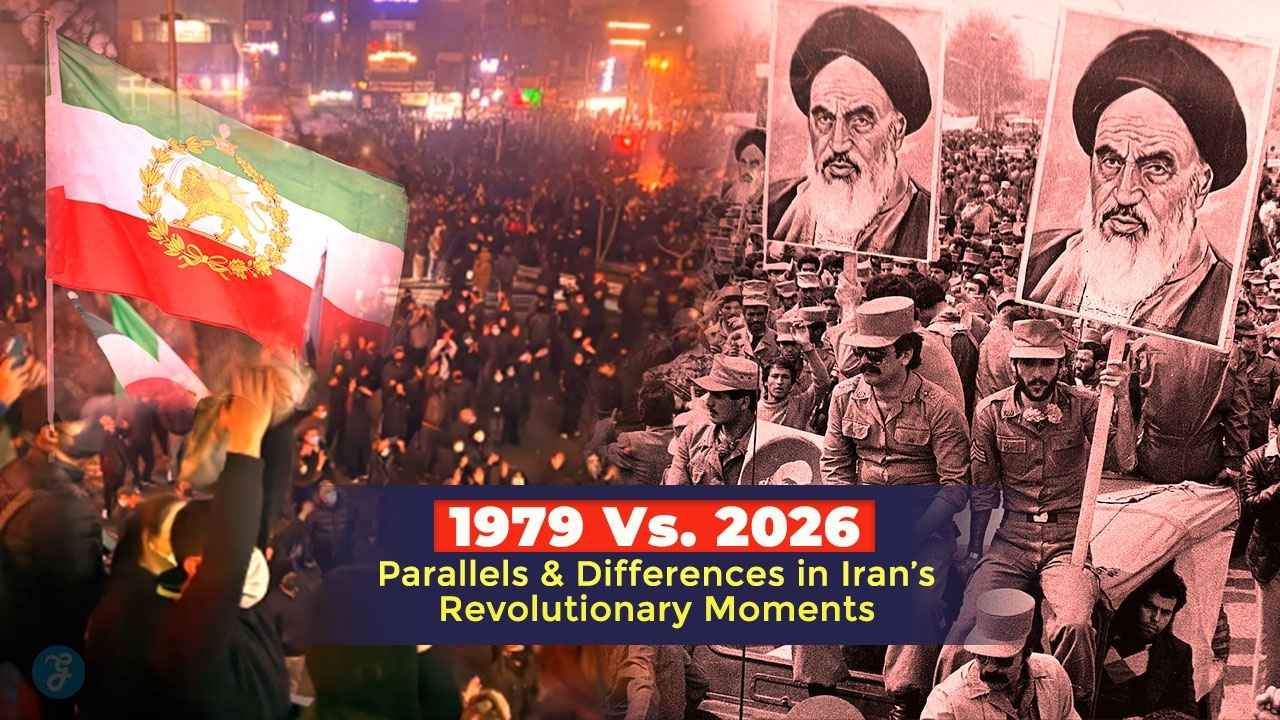
Iran revolutionary moments have historically reshaped the Middle East, and as we stand in mid-January 2026, the world is witnessing what many analysts describe as the most significant systemic threat to the Islamic Republic since its inception in 1979.
This is not merely a repeat of previous protest cycles like the Green Movement of 2009 or the “Woman, Life, Freedom” uprising of 2022. Instead, the current “New Revolution” is a convergence of economic collapse, environmental bankruptcy, and a decimated regional proxy network that has left the regime more isolated than ever before.
To understand the gravity of the current situation, one must look beyond the headlines. By conducting a deep-dive analysis into the parallels and stark differences between 1979 and 2026, we can see the anatomy of a regime at its breaking point.
Key Takeaways: The 2026 Crisis at a Glance
- Economic Trigger: The collapse of the Rial to 1.5 million per USD sparked a historic strike in the Grand Bazaar, the traditional heart of the regime’s support base.
- Environmental Desperation: Unlike 1979, the 2026 movement is driven by “Water Bankruptcy,” with Tehran facing a “Day Zero” water shortage.
- Security Shift: The regime is increasingly relying on foreign mercenaries (Hezbollah/Iraqi militias) due to fears of domestic army (Artesh) defections.
- Geopolitical Vacuum: Following the 12-Day War with Israel (June 2025) and the fall of the Assad regime in Syria, Iran’s “Axis of Resistance” is largely dismantled.
- Leadership Resurgence: For the first time, a clear alternative figure, Reza Pahlavi, has galvanized nationwide protests through a coordinated “Call to Action.”
The December Spark: A Timeline of the 2026 Uprising
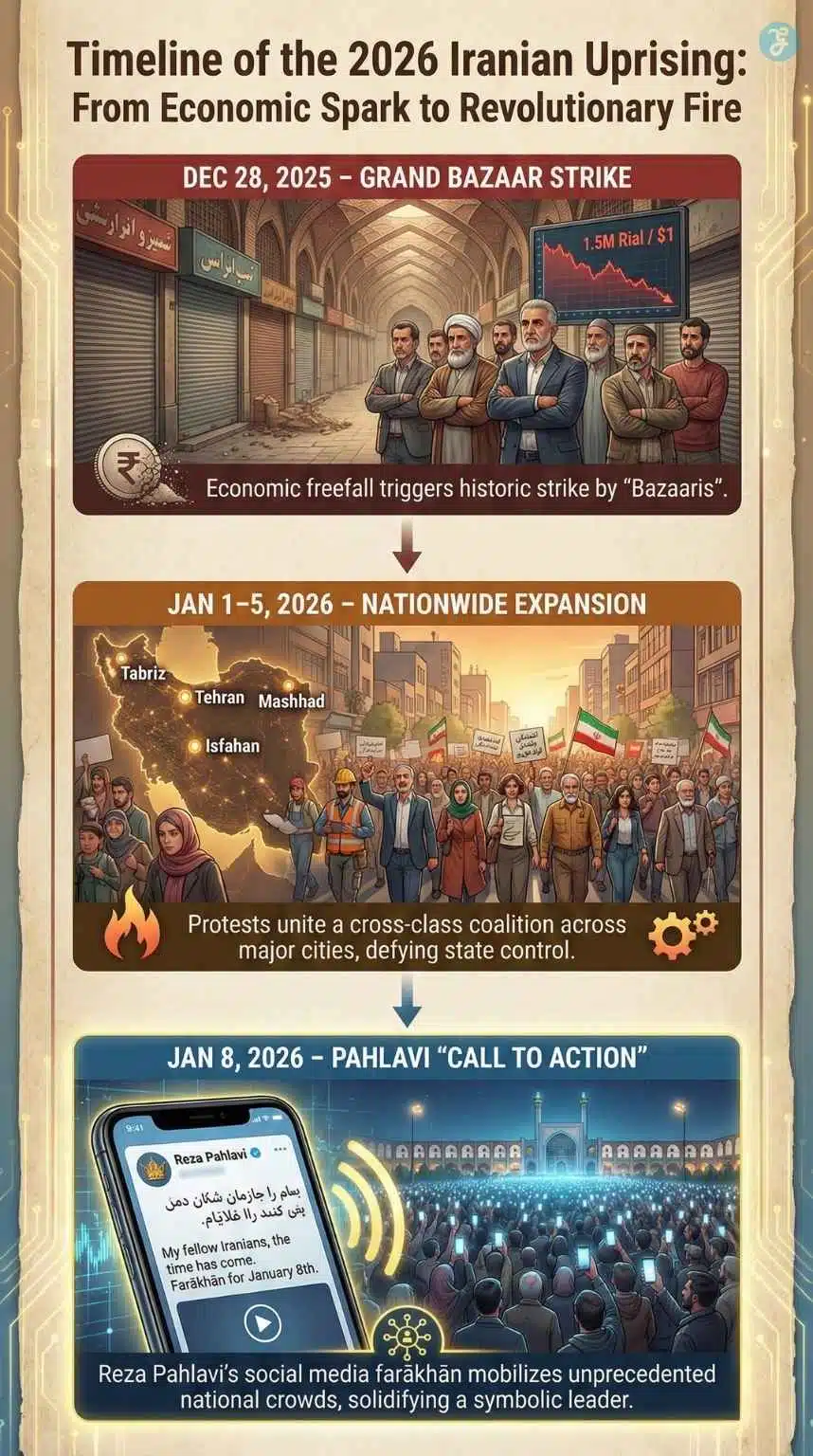
Every revolution requires a catalyst, and for the 2026 movement, that catalyst was a visceral economic shock. While the “Woman, Life, Freedom” movement of 2022 was sparked by social and cultural repression, the current wave is rooted in the very survival of the Iranian household.
The Grand Bazaar Strike [December 28, 2025]
One of the most striking parallels to 1979 is the return of the Bazaar as a revolutionary actor. In the 70s, the merchant class provided the financial backbone for Khomeini’s movement, fearing the Shah’s modernization would render them obsolete.
In January 2026, the roles have shifted. The Bazaar merchants are not striking to bring in a new religious order; they are striking because the IRGC (Revolutionary Guard) has cannibalized the economy. Over 60% of Iran’s GDP is estimated to be controlled by IRGC-linked firms. When the merchants of Tehran, Isfahan, and Tabriz shuttered their shops in late December 2025, it signaled that the regime had lost its last vestige of traditional support.
The Nationwide Expansion [January 1–5, 2026]
Within 72 hours, the strike spread to other major cities, including Isfahan, Tabriz, and Mashhad. By the first week of January, protests had moved from market stalls to university campuses and industrial hubs. Unlike 2022, which saw a predominantly youth-led movement, 2026 features a rare cross-class coalition: industrial workers, teachers, bazaar merchants, and retirees marching side-by-side.
The Pahlavi “Call to Action” [January 8, 2026]
A major turning point occurred on January 8, 2026, when Reza Pahlavi, the son of the late Shah, issued a social media farākhān (call to action). This led to the largest single-day mobilization in the history of the Islamic Republic, with unprecedented crowds filling the streets of over 185 cities. This moment signaled that the opposition was moving from decentralized anger toward a more focused (if still debated) alternative.
Revolutionary Timeline: The Road to 2026
| Date | Key Event | Significance |
| June 2025 | 12-Day War with Israel | Destruction of air defenses; loss of military prestige. |
| Nov 2025 | 100% Drop in Precipitation | Water crisis declared in Tehran; rural unrest begins. |
| Dec 28, 2025 | Grand Bazaar Strike | Merchants shutter shops over the 1.5M Rial exchange rate. |
| Jan 3, 2026 | “Black Saturday” | At least 11 protesters killed in one day; Khamenei calls for “putting rioters in their place.” |
| Jan 8, 2026 | Pahlavi’s Call to Action | Largest mobilization yet; nationwide internet blackout begins. |
| Jan 12, 2026 | Foreign Militia Sightings | Reports of Arabic-speaking fighters used in crackdowns. |
The Economic Engine of Revolution: 1979 vs. 2026
Every revolution needs a trigger. In 1978, it was a slanderous article against Ayatollah Khomeini in the state-controlled Ettela’at newspaper that brought students in Qom to the streets. In late 2025, the trigger was far more visceral: the total collapse of the Iranian Rial. The economic disparity between the 1979 revolution and the 2026 moment is perhaps the most telling indicator of the regime’s vulnerability.
The “Social Contract” Has Collapsed
On December 28, 2025, the Rial hit an unthinkable low of 1.5 million to the USD. This wasn’t just a number on a screen; it was the moment the “social contract” of the Islamic Republic, already fraying since the 2022 “Woman, Life, Freedom” movement, completely snapped.
Unlike the 1970s, where the Shah’s Iran was an oil-rich “island of stability” dealing with the growing pains of rapid modernization and inequality, the 2026 crisis is one of absolute depletion. The “Snapback” sanctions reimposed in 2025, following the collapse of nuclear negotiations and the brief but devastating 12-Day War with Israel in June 2025, have left the state’s coffers empty.
Comparison of Economic Destitution
| Indicator | 1979 Revolutionary Period | 2026 Revolutionary Moment |
| Exchange Rate | ~70 Rial per USD | 1,500,000 Rial per USD |
| Food Inflation | ~15% – 20% | >75% (Official) / >110% (Perceived) |
| Middle Class Status | Expanding / Politically Frustrated | Dissolved / Economically Desperate |
| State Budget | High Surplus (Oil Boom) | Record Deficit (~1,800 Trillion Tomans) |
| Utility Access | Rapidly Expanding | Chronic Blackouts & Water Rationing |
The Security Paradox: The “Foreign Legion” and Internal Friction
If there is one factor that could prevent 2026 from becoming a successful 1979, it is the loyalty of the gun.
The 1979 Military Neutrality
In February 1979, the regular Iranian Army (Artesh) declared neutrality. The Shah’s military was designed for external defense, not internal repression. Once the soldiers, many of whom were conscripts, saw their own neighbors in the streets, they refused to fire.
The Rise of Foreign Mercenaries
Reports surfacing on January 12, 2026, confirm a development that has horrified the Iranian public: the deployment of non-Iranian fighters to suppress domestic dissent. Evidence suggests that over 800 fighters from Iraqi militias (such as Kataib Hezbollah) have been moved across the border to assist the Basij.
By using Arabic-speaking fighters who have no social ties to the Iranian people, the regime hopes to bypass the “hesitation” that broke the Shah’s military.
Cracks in the IRGC?
Despite the use of foreign fighters, internal cohesion is failing. On January 9, 2026, the IRGC Intelligence Organization issued a warning, later deleted from official channels, threatening “trial and decisive action” against military personnel who exhibit “defiance, desertion, or disobedience.” This admission of anxiety suggests that even the elite guards are not immune to the economic suffering of their families.
Geopolitical Shifts: Aftermath of the 12-Day War
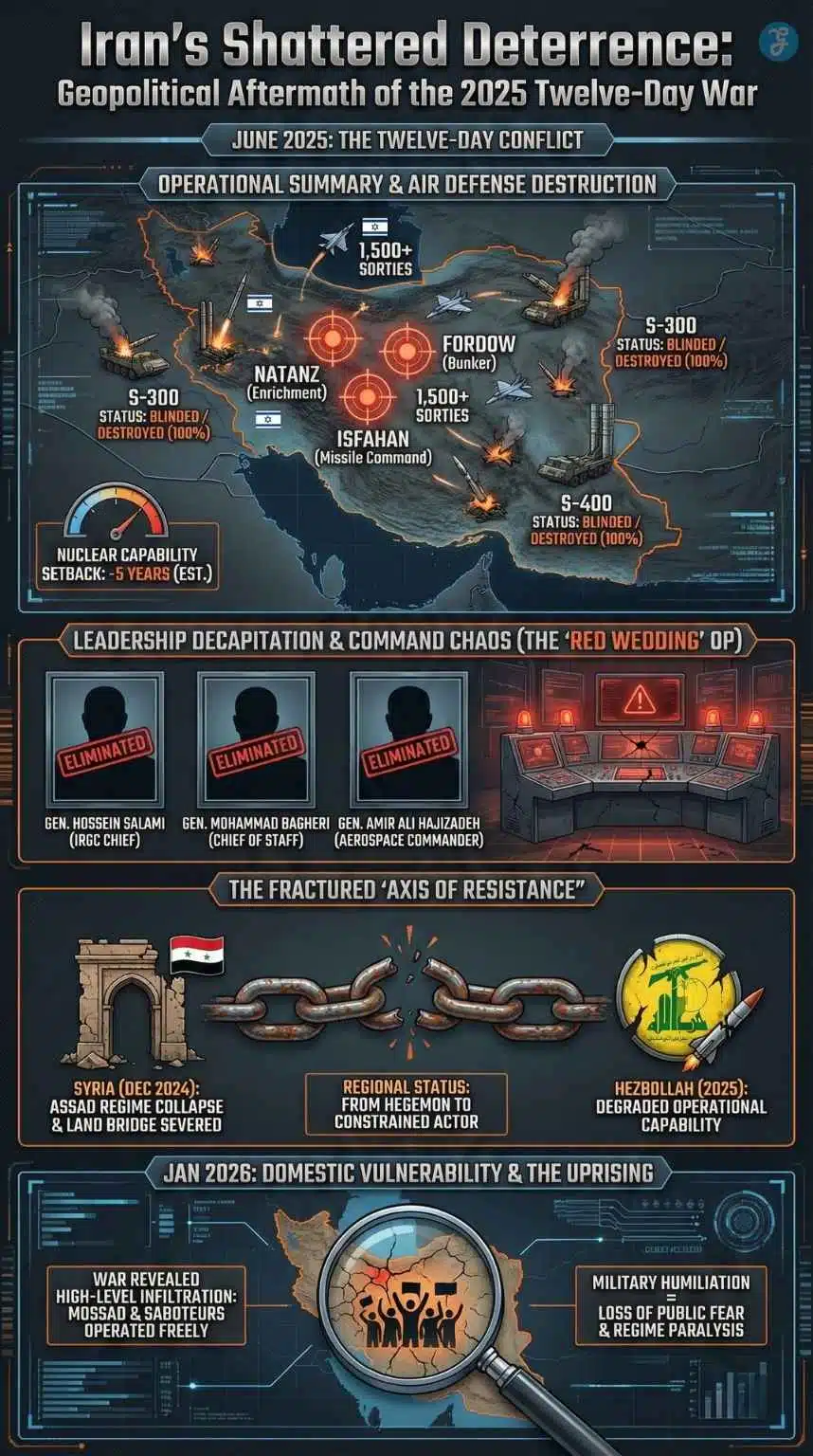
In 1979, the revolution happened during a bipolar Cold War. In 2026, the Islamic Republic is navigating a multipolar world where its regional “Strategic Depth” has evaporated.
The 12-Day War [June 2025]
The brief but devastating conflict with Israel in June 2025 was a watershed moment. The destruction of Iran’s S-300 and S-400 air defense systems stripped the regime of its “invincibility.” For the first time, the Iranian public saw that the state could not protect its own military infrastructure, let alone its nuclear sites.
The Fall of the Assad Regime
The collapse of the Syrian regime in late 2024 removed Iran’s primary land bridge to Lebanon and the Mediterranean. With Hezbollah and Hamas significantly degraded, the “Axis of Resistance” is no longer a shield. This has left the regime’s leadership feeling “encircled” and prone to making erratic, high-risk decisions.
The ‘Trump Factor’ and Foreign Intervention
In 1979, President Jimmy Carter was seen as indecisive. In 2026, the White House has taken a “Locked and Loaded” stance. The threat of U.S. intervention to protect “civilian corridors” has forced the IRGC to keep part of its forces in reserve, preventing a total “Syria-style” slaughter in the streets.
The Environmental “Day Zero”: A Biological Necessity for Revolt
While ideology drove 1979, biological survival drives 2026. This is the first “Environmental Revolution” in the Middle East.
Water Bankruptcy and Tehran’s Thirst
As of January 2026, Tehran’s major reservoirs are at less than 10% capacity. The capital is facing a potential “Day Zero” scenario, where taps could run dry for millions. This isn’t just a drought; it is the result of decades of mismanaging dams by IRGC-linked construction firms (the “Water Mafia”).
Rural Radicalization
In provinces like Khuzestan and Isfahan, once the regime’s rural strongholds, the protests are most violent. Farmers who have lost their livelihoods to dried riverbeds see the regime’s ideological projects (like nuclear enrichment) as a waste of the water they need to survive.
Lethal Pollution
In early January 2026, air pollution in Tehran and Isfahan reached such “lethal” levels that the government was forced to shut down all offices and schools. Protesters are now chanting against the “Mazolt-burning” (low-quality fuel) by IRGC-controlled power plants, linking their inability to breathe directly to regime corruption.
| Criteria | 1979 Perspective | 2026 Reality |
| Environmental Priority | Rapid Industrialization (The Shah) | Survival & Water Security |
| Rural Support | Largely pro-cleric/conservative | Hostile due to agricultural collapse |
| Public Health | Improving via modernization | Declining due to systemic pollution |
Technology and the Digital Resistance
In 1979, Ayatollah Khomeini famously used cassette tapes to bypass the Shah’s censorship. In 2026, the battlefield is the digital ether.
Starlink vs. The Total Blackout
On January 9, 2026, the regime implemented a near-total nationwide internet blackout. However, unlike previous years, this has not silenced the movement. Thousands of Starlink terminals smuggled via the borders of Kurdistan and Baluchistan have created a “Shadow Internet,” allowing protesters to coordinate and leak casualty footage in real-time.
The “Brain Drain” Revolt
Unlike the 1979 revolution, which had a large traditionalist/uneducated base, the 2026 movement is a Revolt of the Technocrats. Iran has one of the highest per-capita concentrations of engineers and doctors in the world, yet its economy is stagnant. This “educated anger” makes the movement harder to suppress because the protesters are tactically savvy, using encrypted comms and decentralized logistics.
Leadership Question and the ‘Alternative’ Problem: The Pahlavi Factor
A revolution without a leader is often a riot; a revolution with a leader is a regime change. The most debated aspect of the 2026 movement is the lack of a singular, on-the-ground leader. However, the vacuum is being filled by a name from the past.
The Khomeini Factor [1979]
In 1979, the opposition was unified under the charismatic, albeit radical, shadow of Ayatollah Khomeini. His message was simple: the Shah must go. He used cassette tapes to bypass state censorship, creating a “centralized” revolutionary command from his exile in France.
Reza Pahlavi as a Focal Point
The 2026 movement is remarkably different. It is decentralized, yet for the first time in 47 years, a specific alternative has gained traction on the ground: Reza Pahlavi, the son of the late Shah.
While not universally loved, Reza Pahlavi has emerged as a symbolic leader. His call to action on January 8 was a “referendum on the street.” Analysts note that approximately 20% of current protest chants specifically call for his return. This represents a significant shift from the 2022 movement, which was largely leaderless and focused solely on “No to the Islamic Republic.”
- The Call (Farākhān): On January 8, 2026, Pahlavi issued a social media call for mass mobilization.
- The Response: In cities like Mashhad and Shiraz, chants of “Reza Shah, Bless Your Soul” have mixed with the 2022-era “Woman, Life, Freedom.”
However, unlike Khomeini, Pahlavi does not have a “clerical network” on the ground. Instead, he relies on Satellite TV (like Iran International and Manoto) and the Digital Resistance. The 2026 movement is not looking for a “New Imam,” but a “Manager” or a “Transitional Figure” to steer the country toward a secular democracy.
The Diversity of the Coalition
Despite the Pahlavi resurgence, the 2026 coalition remains incredibly diverse. Ethnic minorities in Baluchistan and Kurdistan, who have their own long-standing grievances, are coordinating with the urban centers in Tehran. This “unity of desperation” is the movement’s greatest strength, and its greatest challenge, as it lacks a unified political manifesto for the “day after.”
Scenarios for the Future: The Tipping Point
As we look toward the remainder of 2026, political analysts see three primary paths for Iran.
Scenario A: Systemic Collapse [The 1979 Model]
A tipping point is reached where the cost of repression exceeds the benefits of loyalty. If the Bazaar strike continues and the oil refineries in Khuzestan join in, the regime’s financial ability to pay its foreign mercenaries and domestic security forces will vanish, leading to a rapid collapse of central authority.
Scenario B: The IRGC Strongman [The “Egyptian” Model]
In this scenario, a younger faction of the IRGC realizes the clerical leadership is a liability. They “save the system” by removing the Supreme Leader and the clerics, transitioning Iran into a secular, military-led autocracy similar to Egypt.
Scenario C: Prolonged “Syrianization”
The regime retains its loyalty among a core 10–15% of the population and continues to use lethal force. This leads to a stalemate where the state cannot govern, but the opposition cannot fully overthrow it, resulting in a prolonged, low-intensity civil war.
Final Words: The End of an Era
Iran revolutionary moments are rarely linear, but they are always final. The Islamic Republic has survived many crises, but it has never faced them all at once. In January 2026, the regime is fighting a war on four fronts: an economic collapse it cannot fix, an environmental disaster it cannot manage, a regional isolation it cannot break, and a population that has lost its fear.
The 1979 revolution was a choice for a new ideology. The 2026 revolution is a struggle for national survival. Regardless of the immediate outcome of this January’s protests, the structure of the Islamic Republic has been fundamentally hollowed out. The “shadow of 1979” has finally been eclipsed by the reality of 2026.