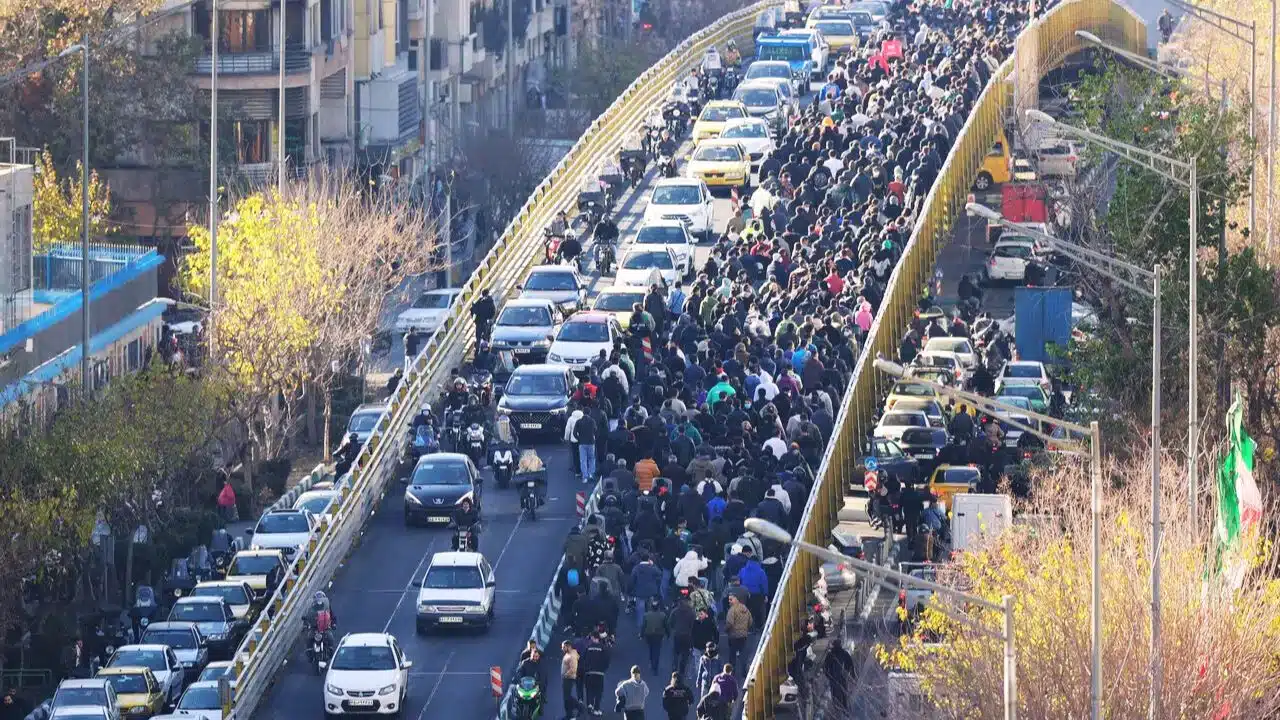
Iran protests over economy turned deadly this week as demonstrations that began with shopkeepers’ strikes over inflation and a collapsing currency spread into western and rural areas, triggering clashes that authorities say killed at least six people across multiple cities.
What happened so far
Protests and strikes began after shopkeepers and bazaar traders in Tehran launched walkouts when the Iranian rial hit fresh record lows against the US dollar, deepening public anger over rising prices and economic stagnation.
As the unrest continued into a fifth day, demonstrations slowed in parts of the capital but expanded into provinces in western and southwestern Iran, where the first reported deaths were recorded.
Authorities and local outlets described the unrest as rooted in livelihood pressures, while videos circulating online showed streets lit by fires and the sound of gunfire during confrontations in some cities.
Timeline (key developments)
| Date (2025–2026) | What happened | What was reported |
| Dec 28–29 | Strikes and protests begin after currency plunge and price pressures. | Bazaar/shopkeeper strike reported, unrest starts in Tehran. |
| Dec 30 | Protests spread to other cities, with crowd-control measures seen in some areas. | Footage showed protests in multiple cities and tear gas used by police in some locations. |
| Jan 1 | First reported fatalities during clashes outside Tehran. | At least six deaths reported across several cities, including protesters and a security-affiliated member. |
Hotspots and casualties
The most intense violence was reported in Azna, a city in Lorestan province, where semi-official reporting cited three deaths amid clashes and gunfire.
In Lordegan, in Chaharmahal and Bakhtiari province, reports described two deaths during protests, with online videos capturing the sound of gunfire as crowds gathered in the street.
Separately, a 21-year-old volunteer linked to the Basij (a paramilitary force affiliated with the Revolutionary Guard) was reported killed after a protest in Kouhdasht, also in Lorestan province.
Reported deaths by location (as publicly described)
| Location | Province | Reported deaths | Notes on who died (as described publicly) |
| Azna | Lorestan | 3 | Deaths reported during clashes; details varied across outlets. |
| Lordegan | Chaharmahal and Bakhtiari | 2 | Rights advocates and officials differed on identities; deaths reported during protests. |
| Kouhdasht | Lorestan | 1 | Reported death of a 21-year-old Basij volunteer after unrest. |
| Total (reported) | — | At least 6 | Combined figure cited by authorities and multiple reports. |
Officials said the fatalities occurred in cities largely home to Iran’s Lur ethnic group, highlighting how the unrest has moved beyond Tehran into regional population centers.
Economic drivers behind the protests
Iran has faced high inflation and a rapidly weakening currency, pressures that directly raise the cost of imported goods and everyday essentials for households.
The exchange rate cited in recent reporting put the market price near 1.4 million rials per US dollar, underscoring the scale of depreciation fueling public anxiety.
Official inflation data cited in reporting showed annual inflation above 42% in December, while food prices were reported up 72% year-on-year, adding to public anger over affordability.
Key economic indicators cited in recent reports
| Indicator | Latest cited level | Why it matters |
| Annual inflation (Dec) | ~42.2% | Signals broad-based price pressure hitting households. |
| Food prices (Dec, y/y) | +72% | Suggests essentials are rising faster than overall inflation. |
| Health/medical products (Dec, y/y) | +50% | Adds pressure on family budgets beyond food and fuel. |
| Exchange rate (USD/IRR, reported) | ~1.4 million rials per $1 | Highlights currency shock and import-cost pressure. |
Reporting also linked the economic stress to the continuing impact of international sanctions and Iran’s difficulty stabilizing confidence in the rial, especially as daily costs rise faster than wages for many workers.
Government response and security measures
Iran’s civilian government, led by President Masoud Pezeshkian, has signaled interest in containing the unrest and acknowledged that economic pressures are driving public discontent.
Authorities reported arrests following protests, including 20 people detained after unrest in Kouhdasht, and state television also described the detention of seven people in a separate operation while announcing the seizure of 100 smuggled pistols.
The government also declared a public holiday across much of the country during the week, officially citing cold weather, amid broader efforts to reduce street activity during a sensitive period.
Final thoughts
The deadly turn in Iran protests over economy increases pressure on authorities to curb violence while addressing public frustration over inflation and the currency’s collapse.
If prices keep rising and the rial remains unstable, further labor actions by traders, students, and other groups could continue spreading the unrest beyond Tehran.
The coming days will likely hinge on whether the state prioritizes dialogue and economic relief or expands arrests and security measures to deter further demonstrations.