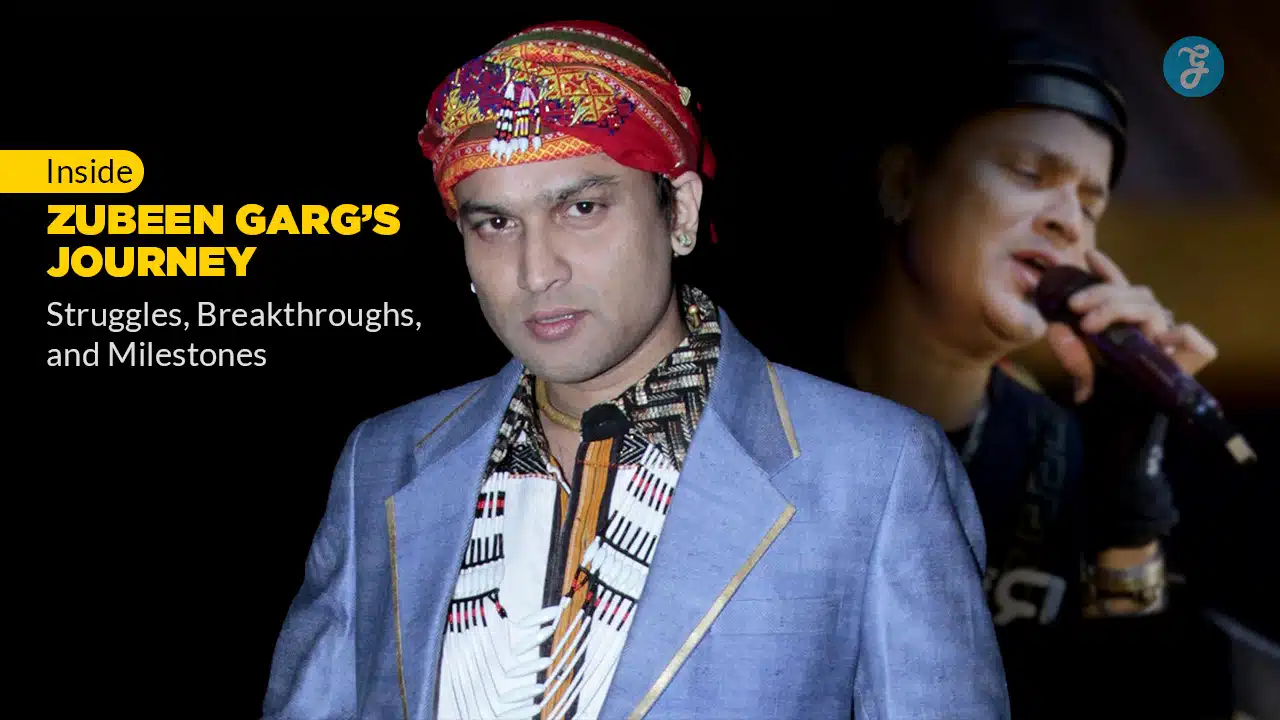
Zubeen Garg (1972–2025) was the voice millions in Northeast India grew up with—and the singer who became a national name with “Ya Ali” (2006). Born Zubeen Borthakur, he worked across Assamese, Bengali, and Hindi music, acted and directed films, and championed social causes.
He won a National Film Award in 2009 for music direction in a non-feature film and later turned director with Mission China (2017) and Kanchanjangha (2019), both regional box-office landmarks. In September 2025, he died in Singapore following a scuba-diving accident; Assam declared state honors for his final rites.
Zubeen Garg At a glance
| Fact | Details |
| Full name | Zubeen Borthakur (professionally: Zubeen Garg) |
| Born | 18 November 1972 |
| Origin | Raised largely in Jorhat, Assam (born in Tura, Meghalaya) |
| Breakthrough | “Ya Ali” (Gangster, 2006) |
| Notable films (as director) | Mission China (2017), Kanchanjangha (2019) |
| Major honour | National Film Award (Best Music Direction, Non-Feature, 2009) |
| Social causes | Flood relief, cultural advocacy, anti-CAA protests |
| Died | 19 September 2025, Singapore; state honors in Assam |
Who was Zubeen Garg?
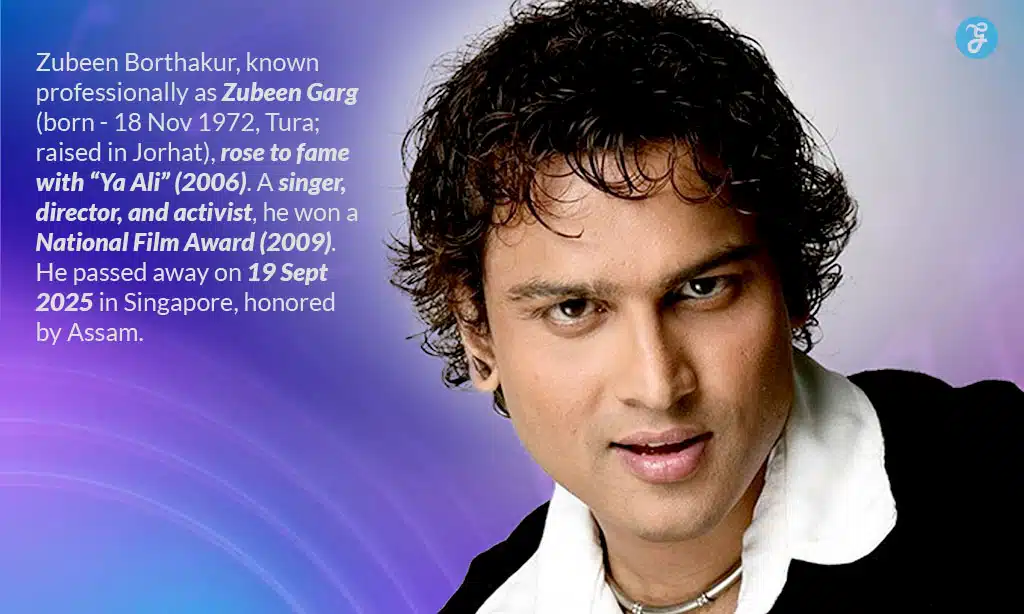
Zubeen Garg was more than a playback singer. He was a composer, multi-instrumentalist, actor, director, and a tireless live performer. His voice crossed language lines and his stage presence anchored modern Assamese pop culture. He recorded in dozens of Indian languages and dialects and kept a close link with folk and mobile theatre traditions in Assam.
| Area | Highlights |
| Languages | Assamese, Bengali, Hindi; also sung in many others |
| Roles | Singer, lyricist, composer, music director, actor, filmmaker |
| Style | Folk roots + pop/rock + filmi + sufi influences |
| Nicknames | “Luit Kontho,” “Heartthrob of Assam” |
Early life and Musical Roots
Zubeen was born on 18 November 1972. Sources note he was born in Tura, Meghalaya, and raised mainly in Jorhat, Assam—two places that shaped his identity and sound. His father, Mohini Mohon Borthakur, served as an ACS officer and wrote poetry and lyrics under the pen name Kapil Thakur; his mother, Ily Borthakur, was a singer and performer. He adopted “Garg,” linked to his Brahmin gotra, as a professional surname. He was named after the conductor Zubin Mehta.
His childhood moved with his father’s postings across Assam. That exposure gave him ears for regional dialects and folk rhythms. He learned several instruments and sang on small stages before his teen years. Over time he developed a style that blended Assamese folk cadence with the hooks of Indian pop. This chapter is the first leg of Zubeen Garg journey, where roots and training set up a long career.
Early life—at a glance
| Topic | Details |
| Birth & upbringing | Born in Tura, Meghalaya; grew up across Assam, especially Jorhat |
| Parents | Mohini Mohon Borthakur (poet/lyricist; ACS officer), Ily Borthakur (singer/performer) |
| Siblings | Sister Jonkie (singer/actor; passed away in 2002) |
| Training | Self-driven; multi-instrumental learning; early stage shows |
| Name | “Zubeen” in homage to conductor Zubin Mehta |
The First Break: Local Stardom to Wider Recognition
In the 1990s, Zubeen released independent Assamese albums that turned him into a household name in the Northeast. His regional stardom led to playback chances beyond Assam. He carried folk ornamentation into contemporary arrangements and kept live shows central to his career.
Career start—key points
| Phase | Markers |
| Regional albums | Cemented fan base in Assam and adjoining states |
| Performance circuit | Mobile theatre, college fests, community stages |
| Crossover | Entry into Bengali and Hindi playback |
| Edge | Folksy color + pop sensibility + stamina on stage |
Breakthroughs That Defined a Generation
“Ya Ali” and the national moment
The pivot from regional icon to national voice came with “Ya Ali” from Gangster (2006). The song’s sufi-pop pull and his textured high notes cut across markets and made “Zubeen” a familiar name in Bollywood music coverage. He earned nationwide nominations and awards for the track in 2006–07.
Multidisciplinary work: singer, composer, actor, director
Zubeen wore many hats. He composed for films and non-feature projects and won the National Film Award in 2009 for music direction in Echoes of Silence—a major recognition that validated his composer credentials at the national level.
| Area | Selected highlights |
| Bollywood playback | “Ya Ali” (Gangster, 2006) – national fame |
| Composer | National Film Award (2009) for Echoes of Silence (Non-Feature) |
| Acting | Lead roles in Assamese films |
| Direction | Mission China (2017), Kanchanjangha (2019) |
Milestones, Awards and Major Collaborations
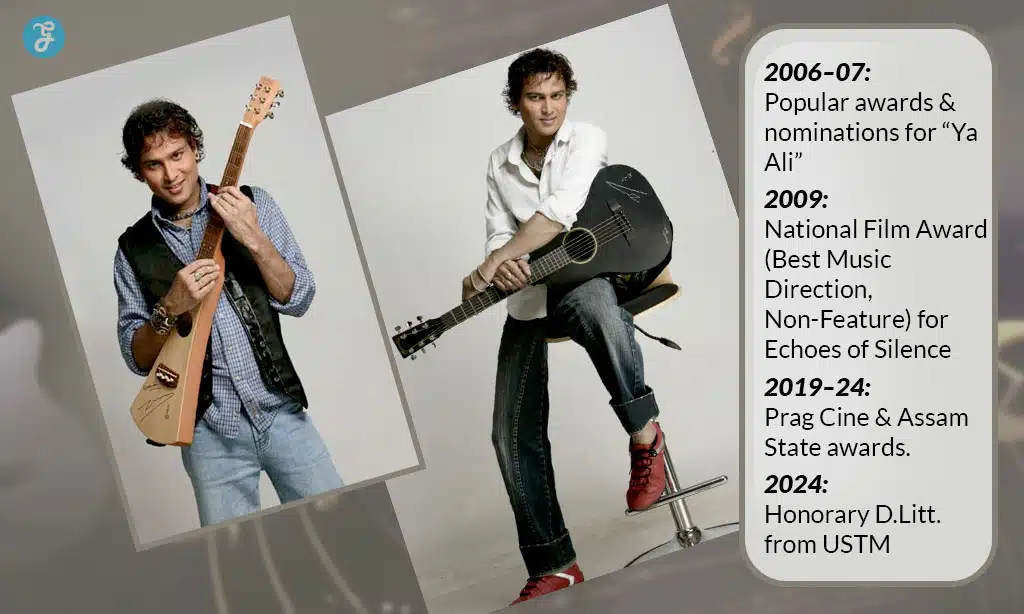
Zubeen’s career spanned recording, touring, cinema, and activism. He collaborated with industry stalwarts and mentored younger musicians in Assam. He received widespread honors, including an honorary D.Litt. (USTM, 2024) for contributions to art and culture.
He also received or was nominated for awards linked to Ya Ali, state film awards, and Prag Cine Awards in the Assamese film ecosystem. The National Film Award stands out as a cross-industry milestone.
| Year | Award | For | Note |
| 2006–07 | Popular awards & nominations | “Ya Ali” | Brought nationwide attention |
| 2009 | National Film Award (Non-Feature, Best Music Direction) | Echoes of Silence | National-level recognition |
| 2019–24 | Prag Cine & Assam State awards (various) | Assamese films & songs | Local industry recognition |
| 2024 | Honorary D.Litt. | University of Science & Technology, Meghalaya | For art and cultural contribution |
Sources span national databases, press images, and university announcements.
Challenges and Comebacks
Like many prolific performers, Zubeen balanced intense touring, film work, and social commitments. He faced health scares at different times and had to slow down occasionally, yet returned to recording and stage work with new projects and collaborations. In interviews and public appearances, peers have recalled his grit and warmth; they also noted periodic health issues in later years.
| Theme | Notes |
| Health | Periodic issues reported by peers; short recovery breaks |
| Workload | High travel + recordings + film projects |
| Response | Returns with new music, regional films, and live shows |
Influence on Assamese and Indian Music
Zubeen’s biggest cultural role was building a bridge. He made Assamese lyrics feel current for a young audience while insisting on folk roots. He also normalized the idea that an Assamese artist could be a pan-Indian voice without losing identity. His multilingual recordings and regional cinema experiments created a path for many younger artists.
| Lens | Impact |
| Language | Mainstreamed Assamese pop aesthetics for a national audience |
| Live culture | Kept mobile theatre and local stages connected to new music |
| Mentorship | Supported younger singers and composers in the Northeast |
| Crossovers | Showed how regional films can scale within local markets |
Philanthropy, Causes and Public Life
Zubeen used his platform for social work. He joined donation drives for Assam flood relief, mobilized fans for aid, and supported charitable efforts such as the Kalaguru Artiste Foundation. Beyond relief efforts, he was a prominent cultural voice in political debates, especially the anti-CAA protests in Assam, urging non-violent, citizen-led action.
| Area | Examples |
| Relief & charity | Donation drives and public appeals during floods |
| Civic voice | Anti-CAA stance, public speeches for peaceful protest |
| Cultural advocacy | Popularized Assamese arts at festivals and tours |
Discography and Filmography Highlights (curated)
| Song | Language | Why it matters |
| “Ya Ali” (Gangster) | Hindi | National breakout; sufi-pop crossover |
| “Mayabini Ratir Bukut” | Assamese | A fan favorite that shows his regional pop charm |
| Handpicked Bengali/Assamese tracks | Bengali/Assamese | Show his range and folk-pop blend |
(For a deeper catalog, consult discography databases and official label playlists.)
Selected film work (as director/lead)
| Film | Year | Role | Notes |
| Mission China | 2017 | Director, writer, actor, composer | Opened to record regional collections; popular music |
| Kanchanjangha | 2019 | Director, actor, writer, composer | Highest-grossing Assamese film at the time; strong youth theme |
Box-office claims are based on regional reporting and trade coverage.
Two landmark films: Mission China (2017) & Kanchanjangha (2019)
Mission China (2017)
Zubeen’s first major directorial venture arrived with buzz. It released across 65+ halls, with reports noting record first-day regional collections and week-one momentum seldom seen for Assamese cinema at the time. The soundtrack fused Assamese pop with a pan-Northeast visual aesthetic.
Quick view: Mission China
| Metric | Detail |
| Release | 8 September 2017 |
| Screens | ~65 (with some outside Assam) |
| First-day net (Assam) | ~₹39 lakh (trade reports) |
| Week-one total (reported) | ~₹2.4 crore (regional estimates) |
| Why it matters | Set a new regional box-office bar; built modern Assamese film marketing |
Kanchanjangha (2019)
His second directorial turned into a local juggernaut. Media in the Northeast reported ₹3.9 crore in 10 days and called it the highest-grossing Assamese film of its time, surpassing Mission China. The film’s themes were rooted in youth aspirations and local scandals, framed with mainstream pacing and music.
Quick view: Kanchanjangha
| Metric | Detail |
| Release | 6 September 2019 |
| 10-day gross (reported) | ₹3.9 crore |
| Why it matters | Demonstrated regional box-office scale with a local story |
| Legacy | Proved a viable model for Assamese commercial cinema |
Timeline: struggles, breakthroughs, and milestones
Below is a clean, skim-friendly timeline you can reuse as a sidebar or a featured table.
| Year | Event | Category | Notes |
| 1972 | Born in Tura, Meghalaya; raised in Assam | Early life | Family steeped in music and literature |
| 1990s | Independent Assamese albums | Career start | Built a massive regional fanbase |
| 2002 | Released Xixhu in memory of sister Jonkie | Personal/Art | Tribute after a family tragedy |
| 2006 | “Ya Ali” becomes a national hit | Breakthrough | Massive airplay and award nominations/wins |
| 2009 | National Film Award for Echoes of Silence (Best Music Direction, Non-Feature) | Recognition | National-level honor |
| 2017 | Directorial debut Mission China | Film milestone | Record opening for Assamese cinema (reported) |
| 2019 | Kanchanjangha becomes top Assamese grosser (reported) | Film milestone | Surpassed Mission China’s lifetime |
| 2024 | Honorary D.Litt. (USTM) | Honor | For contributions to art and culture |
| 2025 | Passes away in Singapore (September 19) | Personal | State honors announced for last rites |
Struggle Life: Setbacks, Pressure, and Quiet Grit
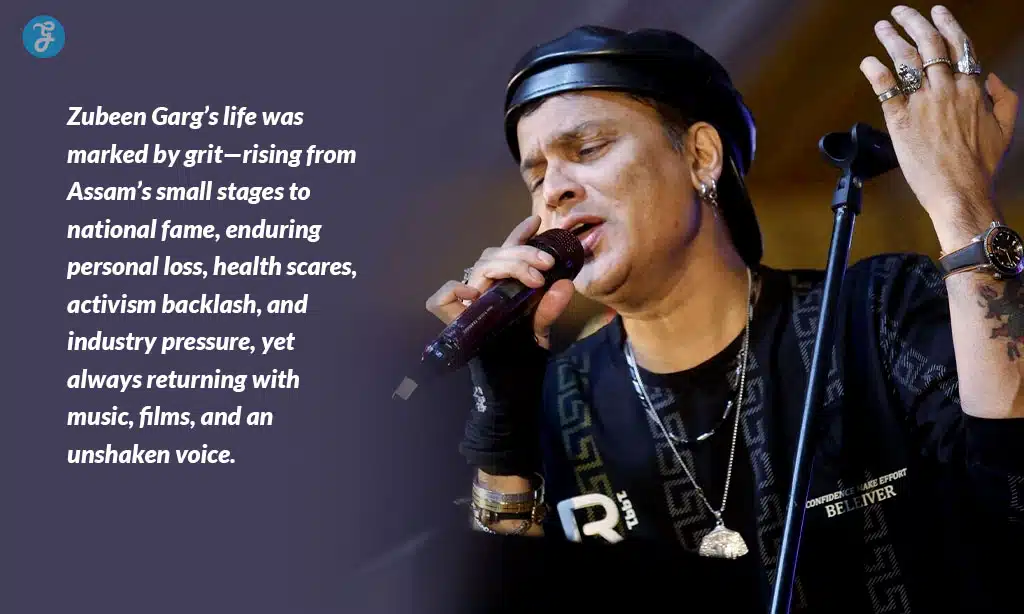
Zubeen Garg’s journey was not only about applause and awards. It also had tough phases—personal loss, health scares, public controversies, and the day-to-day grind of staying relevant across languages and industries.
Early hurdles: building a career from the Northeast
Starting out from Assam in the early 1990s, Zubeen had to win audiences far from the main Hindi and Bengali music hubs. Breaking into playback from a regional base meant long travel, small shows, and constant self-promotion. His early Assamese albums—beginning with Anamika (1992)—earned him a loyal fan base and slowly opened doors outside the region.
Personal loss: the sister he never forgot
In February 2002, Zubeen’s younger sister, Jonkie Borthakur—an actor and singer—died in a road accident. He memorialized her with the album Xixhu released that year. The loss left a long shadow over his personal life and work.
Health setbacks: scare, recovery, and the push to perform
From 2020 onward, Zubeen faced repeated health issues. He was hospitalized after a sudden illness during an event in 2020; admitted again for high blood pressure in 2021; and faced another scare in 2022 in Dibrugarh, Assam.
In November 2023, he collapsed during a recording session in Guwahati and spent several days in ICU before discharge. Close collaborators also spoke about episodes like blackouts in recent years. Even after these scares, he kept returning to the studio and stage.
FAQs on Zubeen Garg
1. What is Zubeen Garg best known for?
He is best known nationally for singing “Ya Ali” in Gangster (2006), and regionally for shaping contemporary Assamese pop while staying rooted in folk and theatre culture.
2. Which major awards did he receive?
A key honour is the National Film Award (Best Music Direction, Non-Feature, 2009) for Echoes of Silence. He also received many regional film and music awards and an honorary D.Litt. from USTM in 2024.
3. What films did he direct?
Mission China (2017) and Kanchanjangha (2019). Both posted strong box-office numbers in Assam; Kanchanjangha was cited as the highest-grossing Assamese film at the time.
He took part in flood-relief drives and used his voice in civic debates, notably against the Citizenship (Amendment) Act (CAA), urging peaceful protest.
5. How did he pass away?
He died in Singapore on 19 September 2025 after a scuba-diving incident, according to festival organisers and major news outlets. Assam announced state honors for his last rites.
Legacy and What Endures
Zubeen Garg’s legacy is not in one hit song or a single film. It is the proof that a regional artist can be local and national at once. He kept Assamese idioms alive in pop formats, took risks as a filmmaker, and turned concerts into community events. His discography remains a map of the Northeast’s modern soundscape; his films showed the ceiling for regional box office could rise with conviction and craft.
Recent Events: Farewell With State Honours
Zubeen’s death on September 19, 2025, in Singapore led to a profound public response. News reports documented crowds lining the streets in Assam, tributes from leaders and artists nationwide, and an official announcement that he would be cremated with full state honours near Guwahati. The North East India Festival event he was slated to attend was cancelled after the tragedy.
Farewell—key facts
| Item | Details |
| Date of death | 19 September 2025 (Singapore) |
| Occasion | Travelled for North East India Festival |
| Official response | State honors for last rites; widespread public mourning |
| Public tributes | Artists, political leaders, and fans across India |
Final Words
Zubeen Garg journey shows how talent, roots, and resilience can travel from local stages to the national spotlight. He balanced folk and film, music and movies, art and activism.
He turned setbacks into comebacks and built space for regional cinema at the box office. His songs and films continue to inspire new artists across the Northeast and India, ensuring that the spirit of his work lives on.