The Indo-German Submarine Deal 2026 has officially transitioned from a decade-long negotiation into a defining pillar of the 21st-century maritime security architecture, signaling a radical shift in how European powers perceive the Indo-Pacific. The global defense market is still reverberating from the high-level diplomatic marathon that took place just days ago in Ahmedabad and Gandhinagar.
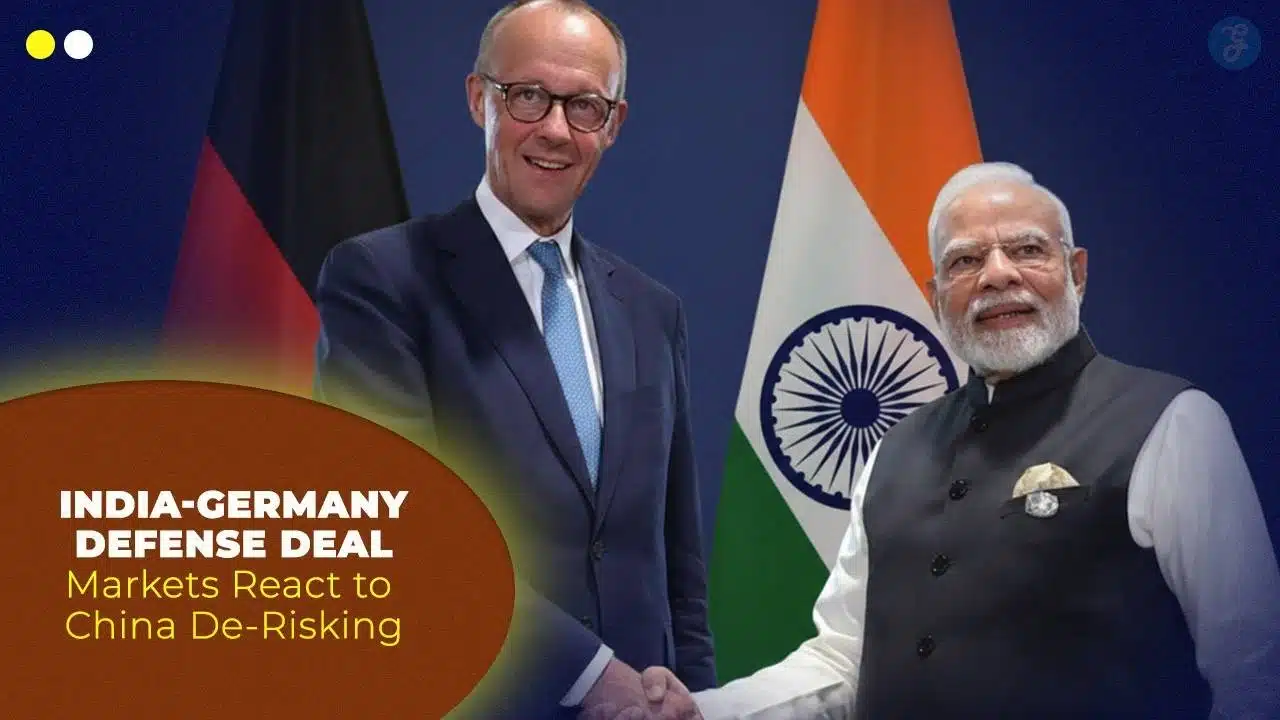
The $8.3 billion (₹72,000 crore) agreement, centered on the procurement and indigenous construction of six advanced conventional submarines, is no longer merely a military transaction; it is the physical manifestation of Germany’s “De-risking from China” strategy and India’s relentless pursuit of naval self-reliance. When German Chancellor Friedrich Merz landed in Gujarat on January 12, 2026, he wasn’t just bringing a business delegation of 23 CEOs; he was bringing a new German doctrine.
This doctrine acknowledges that for Germany to remain an industrial superpower, it must diversify its strategic dependencies and empower democratic allies like India. For the Indian Navy, which has struggled with a dwindling underwater fleet and the rising shadow of the People’s Liberation Army Navy (PLAN), this deal is the most significant technological leap since the original Scorpene project.
- Project 75I Milestone: An $8.3 billion (₹72,000 crore) agreement for six advanced conventional submarines, the largest defense deal in India’s history.
- AIP Technology: The Type-214NG boats will feature mature fuel-cell Air-Independent Propulsion (AIP), allowing them to remain submerged for weeks, a critical deterrent against Chinese naval expansion in the Indian Ocean.
- Total Technology Transfer (ToT): Germany has granted unprecedented “Design Authority” to Mazagon Dock (MDL), shifting India from a mere assembler to a co-creator of underwater stealth tech.
- Strategic “De-risking”: The deal is the primary pillar of Germany’s new China Strategy, which redefines Beijing as a “systemic rival” and seeks to empower democratic allies.
- Ending Russia Dependence: This partnership marks a decisive move to diversify India’s defense ecosystem away from its historical reliance on Russian military hardware.
- Aatmanirbhar Bharat Goals: The project mandates a 60% localization rate by the final vessel, integrating over 1,000 Indian MSMEs into the global German supply chain.
- Geopolitical Choke Points: These submarines are specifically designed for “sea-denial” operations at the Malacca Strait and other vital maritime corridors.
- Beyond Submarines: The 2026 summit also formalized 19 MoUs covering semiconductors, critical minerals, and green hydrogen, ensuring a “China-free” high-tech supply chain.
- Human Connectivity: New agreements on visa-free transit and migration recognize India as a “natural partner” for Germany’s future industrial and technological needs.
The 2026 Policy Catalyst [The Merz-Modi Doctrine]
While the submarine deal is the flagship, the January 2026 summit in Gujarat was the engine that powered it. Chancellor Friedrich Merz’s visit, his first to Asia since taking office, was meticulously staged in Ahmedabad to signal a “personal chemistry” between leaders, mirroring the “Strategic Partnership 2.0.”
The signing of 19 new Memorandums of Understanding (MoUs) during this visit transformed the defense deal from a commercial transaction into a binding security pact. Merz’s administration has explicitly stated that arming India is a proactive step to ensure New Delhi is “less dependent on others, such as Russia,” effectively bridging the gap between European security interests and Indo-Pacific realities.
De-Risking from China: The Economic and Strategic Catalyst
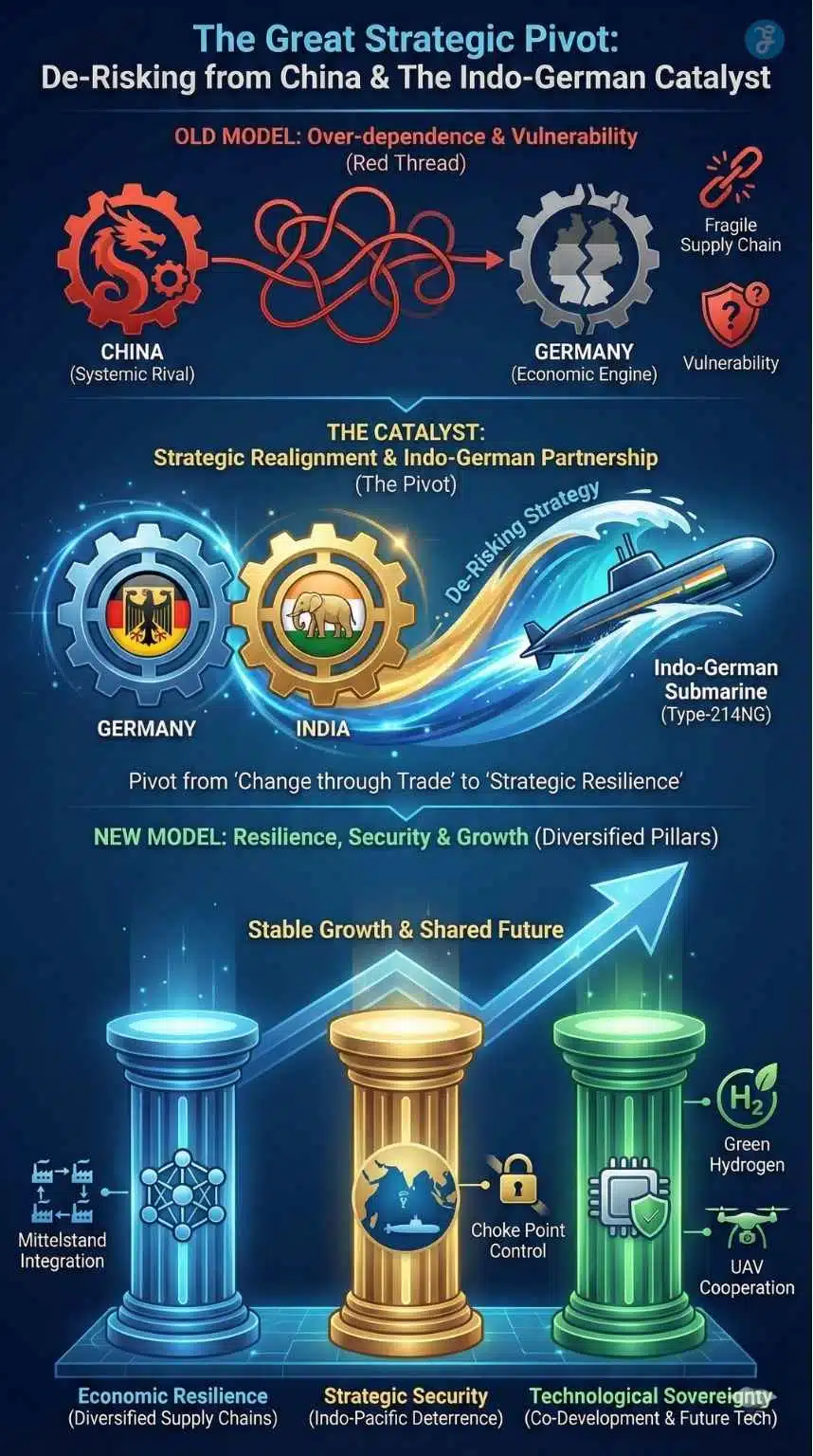
The primary driver behind the sudden acceleration of the Indo-German partnership is the comprehensive recalibration of Berlin’s foreign policy. For decades, Germany’s economic engine was fueled by a “win-win” relationship with China, exporting high-end machinery and luxury cars in exchange for inexpensive consumer goods and critical components. However, by 2025, the structural imbalances became untenable.
From “Partner” to “Systemic Rival”
Under Chancellor Friedrich Merz, Germany has officially dropped the veneer of a purely economic partnership with Beijing. The “De-risking” agenda is now the dominant lens through which Berlin views Asia. This strategy aims to reduce Germany’s vulnerability to Chinese economic coercion by diversifying supply chains and, crucially, building deep defense ties with nations that share a commitment to a rules-based international order.
Why India is the “China Plus One” for Defense
For Germany, India is the only nation with the scale, workforce, and strategic intent to serve as an alternative anchor in the Indo-Pacific. The defense deal is the “crown jewel” of this pivot. By transferring sensitive submarine technology to India, Germany is effectively ensuring that its own industrial base remains relevant while simultaneously creating a “China-free” security ecosystem. This is not about “decoupling” in a total sense, which would be economically catastrophic for Germany, but about ensuring that the most critical technologies and security assets are not tied to a potentially hostile superpower.
Deep Dive into Project 75I: The Technical Superiority
At the heart of the Indo-German Submarine Deal 2026 is the Type-214 Next Generation (214NG) submarine, developed by ThyssenKrupp Marine Systems (TKMS). This vessel was chosen for Project 75I (P-75I) because it perfectly matches India’s unique requirement: a submarine that can operate in both the shallow “littoral” waters of the Arabian Sea and the deep “blue-water” expanses of the Indian Ocean.
Understanding AIP [Air-Independent Propulsion]
The standout feature of the Type-214NG is its Siemens Polymer Electrolyte Membrane (PEM) fuel-cell based AIP.
- Endurance: Conventional diesel-electric submarines must surface or use a “snorkel” every 48 to 72 hours to recharge batteries, making them highly vulnerable to satellite and radar detection. The German AIP allows these boats to remain submerged for 21 consecutive days.
- Stealth: The fuel-cell system has no moving parts, making it virtually silent. In the congested waters of the Indian Ocean Region (IOR), where acoustic signatures are the only way to track an enemy, this “silent lethality” is a game-changer.
- Comparison: While competitors offered various systems, the German PEM technology is considered a generation ahead of the bio-ethanol systems seen in other designs, providing better efficiency and lower thermal signatures.
Weapons and Sensors
The 2026 configuration for the Indian Navy includes 8 × 533 mm torpedo tubes capable of launching heavyweight torpedoes and, most importantly, tube-launched land-attack cruise missiles. These boats are being specifically modified to integrate India’s indigenous weaponry, creating a hybrid of German engineering and Indian firepower.
The “Make in India” Paradigm: Technology Transfer [ToT]
One of the most contentious points of the P-75I negotiations was the level of Technology Transfer (ToT). In a historic move, Germany has agreed to a level of “Design Authority” transfer that it has never before offered to a non-NATO nation.
Breaking the “Black Box” Barrier
Traditionally, foreign OEMs (Original Equipment Manufacturers) keep the “brains” of the submarine—the combat management systems and AIP modules—as a “black box,” where the buyer can operate them but cannot repair or modify the core code. The 2026 deal breaks this barrier.
- Comprehensive Transfer: TKMS will provide Mazagon Dock Shipbuilders Ltd (MDL) with the engineering expertise and technical consultancy to build all six submarines in India.
- Local Maintenance: This ensures that for the 30-year lifecycle of the fleet, India will not have to send components back to Kiel or Hamburg for servicing.
Localization Targets
The roadmap sets an aggressive target for indigenization:
- Boat 1: ~45% indigenous content.
- Boat 6: 60% to 65% indigenous content.
This includes the sourcing of specialized hull steel from Indian mills and the development of local supply chains for sensors, batteries, and interior fittings.
Geopolitical Repercussions: Reshaping the Indo-Pacific
The strategic timing of the Indo-German Submarine Deal 2026 corresponds with the most aggressive expansion of the Chinese Navy in history. Beijing’s “String of Pearls” strategy—building a network of naval bases in Pakistan (Gwadar), Sri Lanka (Hambantota), and Djibouti—has effectively encircled the Indian subcontinent.
As of early 2026, China operates over 60 submarines, including several nuclear-powered attack boats. India, meanwhile, has been operating with a deficit, relying on aging Russian Kilo-class (Sindhughosh) and early-model German HDW (Shishumar) boats. The addition of six Type-214NG boats will allow India to:
- Block Choke Points: Deploy stealthy AIP boats at the Malacca, Sunda, and Lombok straits to monitor Chinese naval movements into the Indian Ocean.
- Sea Denial: Prevent an adversary’s surface fleet from operating freely within India’s Exclusive Economic Zone (EEZ).
- The Two-Front Threat: Maintain a persistent presence in both the Arabian Sea (countering Pakistan’s Chinese-made Hangor-class submarines) and the Bay of Bengal simultaneously.
The European Power Struggle: Sidelining France and Russia
The finalization of the German deal marks the end of an era for India’s traditional defense suppliers.
- The Russian Decline: For decades, Russia was India’s “all-weather” partner. However, the prolonged conflict in Ukraine and the resulting sanctions have made Moscow an unreliable partner for long-term high-tech projects. India’s decision to choose German tech over the Russian Amur-class is a clear sign of diversifying away from the Kremlin.
- The French Setback: France’s Naval Group, which successfully delivered six Scorpene-class submarines (Project 75), was a frontrunner. However, the requirement for a proven, functional AIP system during the RFP stage disqualified the French bid. While India is still considering a “follow-on” order of three additional Scorpenes to keep the MDL production line warm, the German Type-214NG has officially taken the lead for the next generation.
Beyond Submarines: The 2026 Defense Industrial Roadmap
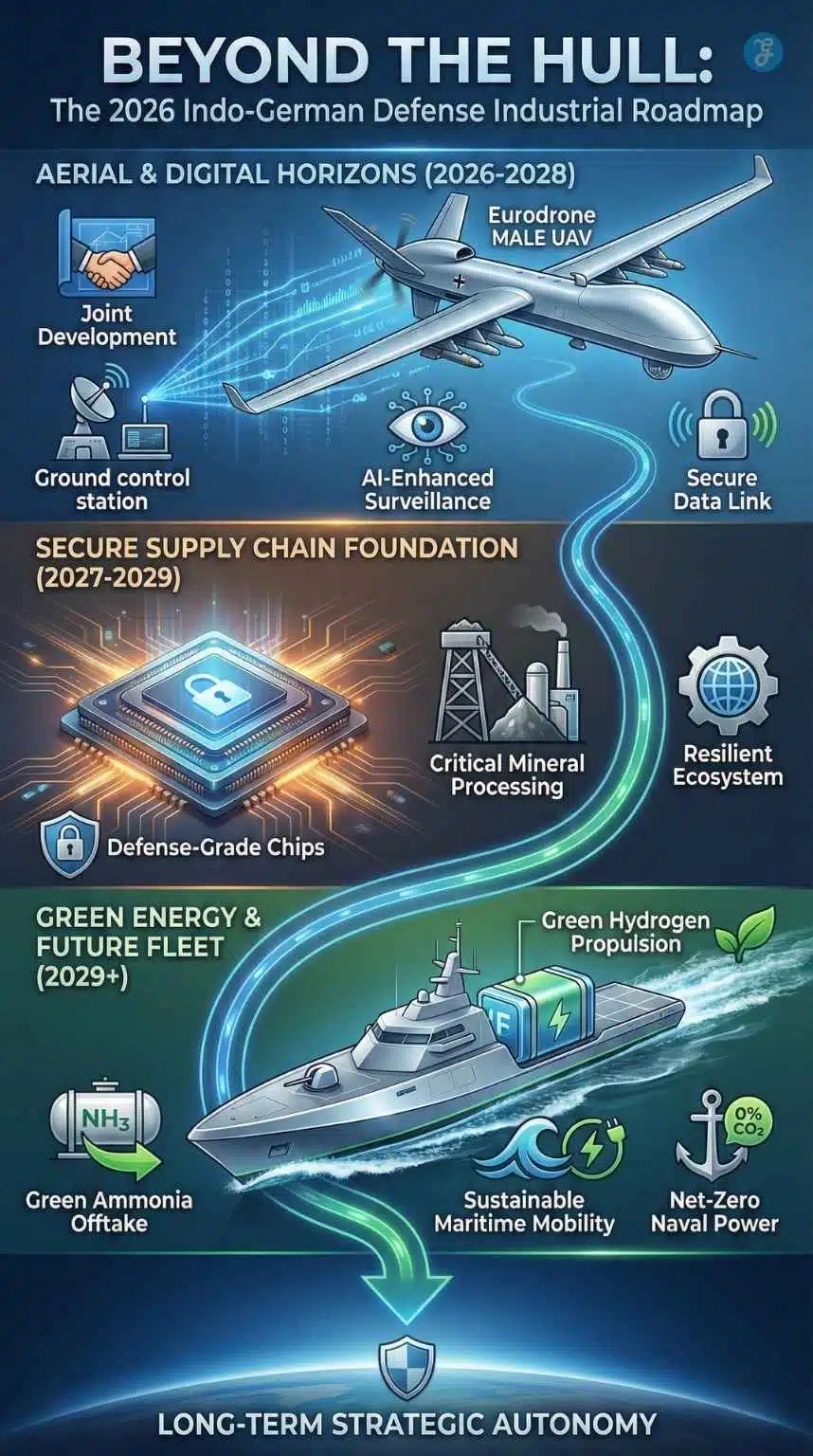
The January 2026 summit wasn’t just about the $8.3 billion deal. Prime Minister Modi and Chancellor Merz signed 19 strategic agreements that broaden the scope of Indo-German cooperation.
The New Industrial Frontier
- Semiconductor Ecosystem Partnership: Germany’s Infineon and other tech giants are collaborating with Indian firms to build a resilient semiconductor value chain. This is vital for “defense-grade” electronics that are currently susceptible to Chinese supply chain shocks.
- Critical Minerals: A Joint Declaration of Intent (JDoI) was signed to explore, process, and recycle critical minerals. These are the building blocks of modern defense tech—from EV batteries for military vehicles to magnets for advanced motors.
- Green Hydrogen: In one of the largest deals under India’s National Green Hydrogen Mission, German energy firm Uniper signed an agreement to source 125,000 tons of green ammonia from India annually. This ties the “Green Transition” directly to the “Defense Partnership,” as future naval platforms look toward hydrogen-based propulsion.
Beyond the Hull: Drones and Aerial Interoperability
The 2026 roadmap has expanded into the “third dimension” of warfare: the air. A landmark agreement was reached between DRDO and the Organisation for Joint Armament Cooperation (OCCAR) for India’s participation in the Eurodrone MALE UAV programme. This allows India to co-develop long-endurance surveillance drones that can integrate seamlessly with the German-made submarines.
Furthermore, the collaboration between HAL and HENSOLDT on LiDAR-based obstacle-avoidance systems for helicopters represents a critical transfer of hardware and software Intellectual Property (IPR), proving that Germany is no longer holding back its “crown jewel” technologies.
The “Mittelstand” Backbone and Supply Chain Resilience
A unique feature of the Indo-German Submarine Deal 2026 is the focus on the German Mittelstand (SMEs). During the January CEO Forum, 23 German business leaders committed to a new “Supply Chain Resilience” initiative. By integrating German small and medium enterprises into the Indian manufacturing ecosystem, the deal creates a “double-lock” against Chinese disruption.
This isn’t just about big shipyards; it’s about the specialized sensors, valves, and gaskets produced by family-owned German firms being manufactured in India. This move secures the “China-free” supply chain that global markets are currently rewarding with high ESG and stability ratings.
Economic Impact: Global Markets and Stock Resilience
The financial world has responded to the Indo-German Submarine Deal 2026 with high optimism.
Market Sentiment
Shares of Mazagon Dock Shipbuilders (MDL) surged 5% to 6% in the days leading up to the Merz visit. Analysts expect MDL to remain a “top pick” in the Indian defense sector for the next decade. The company’s order book, already valued at over ₹27,000 crore, is set to nearly quadruple once the P-75I contract is formally inked (expected by March 2026).
The MSME Ripple Effect
The 60% localization requirement means that over 1,000 Indian Micro, Small, and Medium Enterprises (MSMEs) will be integrated into the global submarine supply chain. This is not just about building a boat; it’s about building an industry. German engineering standards (DIN) will be adopted by Indian suppliers, elevating the quality of Indian manufacturing to global export standards.
Challenges and Strategic Risks
While the deal is a triumph, several hurdles remain that could derail the ambitious 2030s delivery timeline.
- The Timeline Crunch: The first submarine is expected to be delivered between 2032 and 2034. In the fast-moving world of naval warfare, there is a risk that the technology finalized in 2026 might need mid-course upgrades before the first boat even touches water.
- Bureaucratic Red Tape: India’s procurement process is historically slow. Any delay in the “Price Negotiation Committee” (PNC) or the final Cabinet Committee on Security (CCS) approval could push the project into the late 2030s.
- The Geopolitical Blowback: Beijing has already signaled its displeasure, calling the deal a “relic of Cold War thinking.” India and Germany must prepare for increased cyber-espionage and diplomatic pressure as they build this “stealth wall” in the Indian Ocean.
Soft Power and the “Visa-Free” Strategic Shift
In a surprising but highly strategic move during the January 2026 talks, Germany announced visa-free transit for Indian passport holders through German airports. While seemingly unrelated to defense, this “soft power” move is designed to facilitate the rapid movement of Indian engineers and naval officers involved in the P-75I project.
It reflects a level of trust usually reserved for NATO allies. As nearly 60,000 Indian students now study in Germany, this human bridge ensures that the next generation of defense scientists on both sides will have a shared cultural and professional language, making the “De-risking” strategy socially sustainable.
Data Summary: Project 75I at a Glance [Jan 2026]
| Category | Details |
| Focus Keyword | Indo-German Submarine Deal 2026 |
| Estimated Cost | $8.3 Billion (₹72,000 Crore) |
| Vessels | 6 Stealth Submarines (Type-214NG) |
| Primary Technology | PEM Fuel-Cell AIP (Air-Independent Propulsion) |
| Indigenization | 45% (Boat 1) to 60%+ (Boat 6) |
| Strategic Partners | TKMS (Germany) and Mazagon Dock (India) |
| Timeline | Contract Signing: March 2026; First Delivery: 2032-2034 |
Final Words: A New Era of Global Security
The Indo-German Submarine Deal 2026 is far more than a military contract; it is a declaration of intent. It proves that Germany has finally accepted its role as a security provider in the Indo-Pacific and that India has successfully leveraged its market size to gain the world’s most guarded technologies.
As Chancellor Merz noted during his visit to the Sabarmati Ashram, “The winds of global politics are blowing rough, but the anchor of our partnership is deep.”
For the global defense market, this deal marks the end of the post-Cold War order and the beginning of a new, “de-risked” era where democratic nations arm each other to ensure the freedom of the seas.