
The roar of the crowd at Rajgir Hockey Stadium on September 7, 2025, told its own story. India, led by captain Harmanpreet Singh, produced a near-flawless display to defeat defending champions South Korea 4–1 in the final of the 2025 Men’s Hockey Asia Cup. The win not only secured India’s fourth Asia Cup title but also guaranteed them a spot in the 2026 Men’s FIH Hockey World Cup to be held in Belgium and the Netherlands.
For Indian hockey, this was more than a trophy. It was a statement of intent, a celebration of resilience, and a reminder that Asia’s hockey powerhouse has re-established itself as a serious global contender.
A Title Eight Years in the Making
India’s last Asia Cup triumph came in 2017 in Dhaka, when they beat Malaysia in the final. Since then, the trophy had eluded them, with South Korea lifting it in 2019 and 2022. The 2025 campaign in Rajgir was thus not just about winning silverware—it was about reclaiming supremacy in Asia.
The final victory made India only the second team after Korea to have won the tournament four or more times. Korea still lead the chart with five titles, but India have now drawn level in recent dominance, signaling a shift in momentum.
The Perfect Start: Sukhjeet Singh Stuns Korea in the First Minute
Coach Craig Fulton had made his intentions clear before the final—he wanted his side to start fast and assert dominance immediately. His team delivered in spectacular fashion.
Barely 30 seconds into the match, captain Harmanpreet Singh surged down the left flank and delivered a sharp pass into the circle. Sukhjeet Singh, full of confidence and precision, smashed a ferocious reverse hit past Korean goalkeeper Kim Jaehan into the top corner.
The goal electrified the crowd and rattled Korea. It was the earliest goal of the tournament and set the tone for what would be a one-sided contest.
Defensive Discipline in the First Quarter
After taking the lead, India pushed forward with relentless energy. Chances came thick and fast, particularly for Dilpreet Singh and Abhishek, but Korean goalkeeper Kim Jaehan stood firm, even saving a penalty stroke from Jugraj Singh.
What was most impressive about India in the opening quarter, however, was their defensive solidity. Goalkeepers Krishan Pathak and later Suraj Karkera were rarely troubled, thanks to an organized backline marshaled by Rohidas and Harmanpreet. Korea, a side known for their quick counter-attacks, looked blunt and bereft of ideas.
Dilpreet Singh Doubles the Lead
India extended their advantage in the 28th minute. Once again, Harmanpreet Singh was the architect, launching a pinpoint aerial pass from his own half to find Sanjay inside the circle. Sanjay’s composure allowed him to square the ball to Dilpreet Singh, who calmly slotted home from close range.
The 2–0 cushion gave India breathing space heading into halftime. More importantly, it broke Korea’s spirit. The defending champions were left chasing shadows, unable to find a foothold.
Third-Quarter Domination: Dilpreet Strikes Again
The third quarter belonged entirely to India. Their passing was crisp, their pressing relentless, and their creativity unstoppable. In the 45th minute, Dilpreet struck again.
A quick free-hit from Harmanpreet found Raj Kumar Pal, who slipped the ball into the circle. Dilpreet, lurking just yards from the goalmouth, deftly deflected it past the Korean keeper for his second goal of the night. At 3–0, India’s victory looked inevitable.
This brace underlined Dilpreet’s growing reputation as one of Asia’s most clinical forwards. His performance earned him the Player of the Match award.
Rohidas Scores from a Penalty Corner
If the crowd wanted more fireworks, they got it in the 50th minute. India earned a penalty corner, and this time Amit Rohidas stepped up. With an explosive drag-flick, he sent the ball crashing into the net to make it 4–0.
It was fitting that a defender scored India’s final goal—it summed up how every department, from the backline to the forwards, contributed to this emphatic victory.
Korea’s Consolation Strike
South Korea managed to pull one back late in the match, when Son Dain converted a penalty corner. But by then, the result was beyond doubt. India maintained composure in the final minutes, denying Korea any chance of staging a comeback.
For Korea, it was a disappointing end to an inconsistent campaign. They had been outclassed tactically and physically by an Indian team that looked sharper in every department.
India’s Road to the Final: A Campaign of Consistency
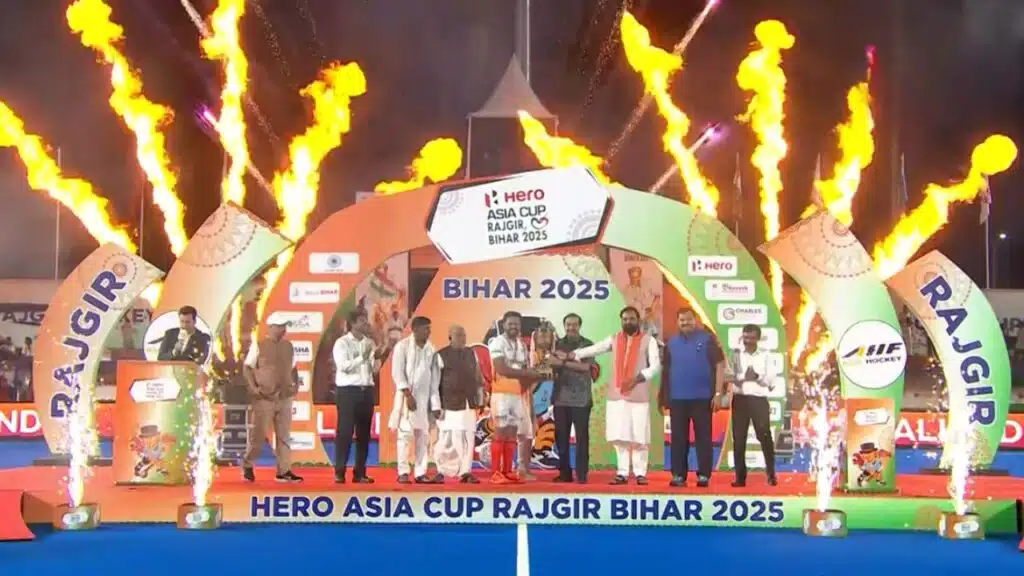
India’s run to the title was built on consistency and firepower:
- Group Stage: India comfortably topped their pool, including a crushing win over China.
- Super 4s: They drew 2–2 with Korea in the opening game but bounced back strongly with wins against Malaysia (4–1) and China (7–0).
- Final: A clinical 4–1 win over Korea sealed the deal.
Across the Super 4s and final, India scored 15 goals in three games, highlighting their attacking depth and versatility.
Historic Achievement and Recognition
This triumph makes India the Asia Cup champions for the fourth time (2003, 2007, 2017, 2025). With four titles, they are just behind South Korea’s tally of five, but the manner of India’s victory suggests a new era of dominance.
Hockey India recognized the effort by announcing INR 3 lakh (₹300,000) rewards for each player and INR 1.5 lakh (₹150,000) for support staff. This financial boost acknowledges not just the star players but the entire team’s contribution, from goalkeepers to bench strength.
What This Means for Indian Hockey
The win carries significance beyond the trophy:
- World Cup Qualification: India have secured their berth in the 2026 FIH Men’s Hockey World Cup, co-hosted by Belgium and the Netherlands.
- Team Confidence: The result strengthens belief in Craig Fulton’s coaching system, which emphasizes early attacking pressure combined with defensive discipline.
- Regional Supremacy: By outplaying both Malaysia and Korea, India have reaffirmed themselves as Asia’s leading hockey nation.
This Asia Cup victory could be the launchpad for India’s bigger ambitions on the global stage.
India’s commanding Asia Cup triumph in Rajgir will be remembered as a turning point for the team. With young players like Dilpreet Singh stepping up and veterans like Harmanpreet Singh guiding with vision, the team looks well-balanced heading into the global stage.
For fans, the victory rekindles memories of past glories while promising a future where Indian hockey can consistently challenge the world’s best.