The Department of Posts, operating under India’s Ministry of Communications, has announced a significant step that will affect millions of customers and businesses. Beginning August 25, 2025, India will temporarily suspend almost all types of postal shipments to the United States. The only exceptions are:
- Letters and official documents
- Gift items valued at up to USD 100
Everything else—including regular parcels, commercial goods, e-commerce orders, and small packages—will not be accepted for delivery to the U.S. until further notice.
Officials clarified that the decision was not taken lightly but was made in response to new U.S. customs regulations that fundamentally change the way inbound shipments are processed.
What Triggered the Suspension? – U.S. Ends “De Minimis” Duty-Free Policy
The suspension follows the United States’ withdrawal of the de minimis exemption that previously allowed goods worth up to USD 800 to enter duty-free.
- On July 30, 2025, the White House announced the removal of this policy, effective August 29, 2025.
- This means all parcels arriving in the U.S., regardless of their value, will now be subject to tariffs and stricter customs checks.
- The U.S. administration argued that the exemption had been “abused” by some shippers. Officials specifically pointed to the entry of illicit fentanyl, synthetic opioids, and chemical precursors, which allegedly exploited lower security checks on small shipments.
By scrapping the exemption, Washington aims to tighten border controls, protect domestic manufacturers, and curb the misuse of low-value shipments.
India’s Position: Why Halt Shipments in Advance?
According to the Ministry of Communications, India Post has been closely reviewing the developments and held discussions with global carriers and customs authorities. Several critical concerns emerged:
- Lack of Clear Implementation Systems in the U.S.
- The U.S. Customs and Border Protection (CBP) has not yet finalized all the procedures for processing duties on low-value imports.
- Carriers and postal operators lack clarity on how much duty will be charged, how it will be collected, and which parties will be responsible.
- Air Carriers’ Inability to Process Parcels
- Airlines transporting Indian postal consignments to the U.S. informed India Post that they cannot accept shipments after August 25, since they would arrive during the transition period (after August 29), when U.S. systems may not be ready.
- Avoiding Losses and Confusion for Customers
- If parcels were sent during this uncertain period, they might be rejected, delayed, or charged unpredictable duties. To prevent this, India Post opted for a precautionary suspension.
Refunds and Customer Guidance
The Department of Posts emphasized that customers will not lose money unfairly:
- Those who have already booked parcels that fall under the suspended categories can apply for full postage refunds.
- Post offices across India have been instructed to provide guidance and issue refunds where necessary.
- Letters, documents, and eligible gift shipments (under USD 100) will continue as normal, ensuring that personal communication remains unaffected.
Impact on E-Commerce and Exporters
This suspension will directly affect India’s exporters, small businesses, and cross-border e-commerce platforms that rely heavily on postal routes to ship inexpensive items to U.S. buyers.
- Platforms like Amazon sellers, eBay traders, and direct-to-consumer brands often use postal services to send small packages under the de minimis exemption.
- Without duty-free entry, their products will face higher costs, making them less competitive in the American market.
- The Global Trade Research Initiative (GTRI), a New Delhi-based think tank, has warned that the fallout will ripple through India’s handicrafts, textiles, jewelry, and low-value electronics sectors, which depend on affordable shipping for global reach.
How the New U.S. Tariff Structure Works
According to GTRI and trade experts, once the U.S. Customs system is fully updated, international parcels will face one of two possible duty structures:
- Ad Valorem Duty: A percentage-based duty applied according to the U.S. tariff schedule under IEEPA (International Emergency Economic Powers Act).
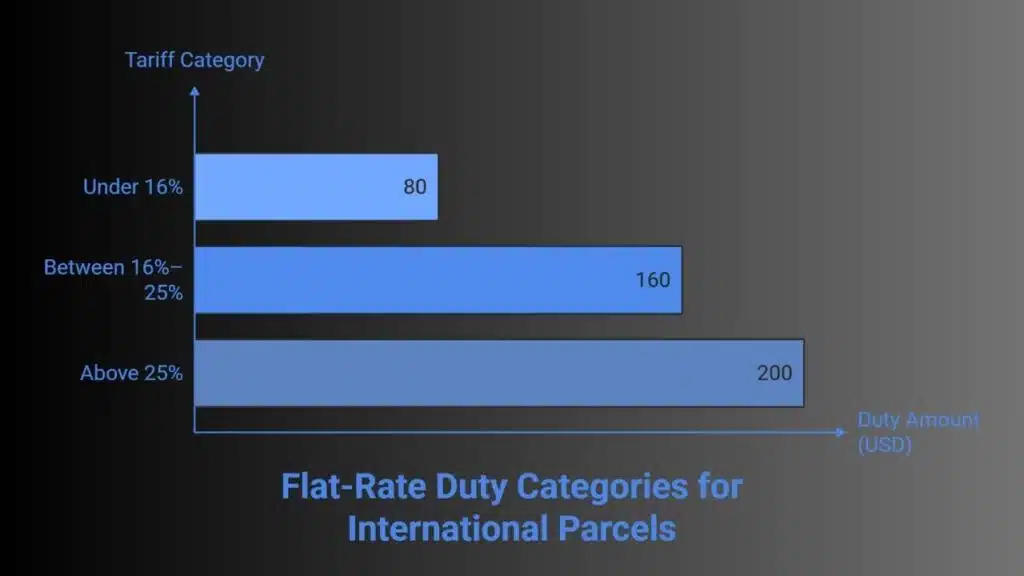
- Flat-Rate Duty: Depending on the exporting country’s tariff category, items may be charged flat duties of USD 80, USD 160, or USD 200 per item.
-
- Countries are grouped into three brackets based on tariff levels:
- Under 16%
- Between 16%–25%
- Above 25%
- Countries are grouped into three brackets based on tariff levels:
However, since CBP has not completed the final systems and guidelines, uncertainty remains about how these duties will be applied to parcels shipped right after August 29.
A Global Chain Reaction: Other Countries Follow Suit
India is not alone in halting shipments. Reports show that several countries in Europe and Asia are also suspending low-value postal deliveries to the U.S.:
- Europe: Germany, France, Italy, Austria, Denmark, and Sweden have already announced similar suspensions. Major courier DHL has also restricted certain parcel services.
- Asia: Singapore, South Korea, and Thailand have followed suit, citing the same uncertainty.
This shows that the U.S. decision is causing worldwide disruption to postal and logistics networks, especially in e-commerce-driven economies.
U.S. Justification: National Security and Trade Protection
The White House has defended the move, claiming that the de minimis loophole was undermining U.S. security and trade.
- Officials argue that criminal groups were exploiting duty-free shipments to smuggle drugs and banned substances.
- The administration also sees the change as part of its “America First” trade agenda, aimed at reducing dependence on foreign imports and giving local businesses a competitive edge.
What Lies Ahead?
India Post has assured customers that this suspension is temporary. The Ministry of Communications is working with stakeholders, including the U.S. Postal Service, CBP, and global carriers, to find solutions.
- Once clear processes for duty collection and parcel handling are established in the U.S., India is expected to resume full services.
- Until then, businesses will need to explore alternative logistics partners such as FedEx, UPS, or private freight services—although these options may be significantly costlier.
The suspension of most India-U.S. postal services highlights how a single trade policy shift in Washington can disrupt global supply chains. What was once a simple and low-cost shipping route has now become uncertain and expensive.
While letters and small personal gifts will still make it through, exporters, small businesses, and online sellers face a new era of tariffs, paperwork, and rising costs. For now, all eyes are on the U.S. authorities to finalize customs processes so that countries like India can safely reopen their postal links without putting customers and businesses at risk.
The Information is Collected from Indian Express and Times of India.