
In a significant development for international travelers from India, the Henley Passport Index 2025 reveals that the Indian passport has climbed eight places, from 85th in 2024 to 77th in 2025. This improvement in ranking has occurred despite a modest increase of just two additional visa-free or visa-on-arrival destinations, bringing India’s total count to 59 destinations. The jump reflects growing diplomatic engagements and evolving geopolitical alignments that have boosted India’s travel freedom globally.
What is the Henley Passport Index and How Does it Work?
The Henley Passport Index, published by Henley & Partners, is a global ranking of countries based on the travel freedom their passports offer. It is updated quarterly and relies on data from the International Air Transport Association (IATA), regarded as one of the most accurate databases for global travel information. The index ranks 199 different passports based on the number of destinations holders can access without obtaining a visa before departure—this includes visa-free, visa-on-arrival, and electronic travel authorization (ETA) access.
Countries are awarded one point per destination their citizens can enter without a visa or where they can obtain one on arrival. No points are awarded for destinations where a visa is required or where government approval is necessary before travel.
India’s Steady Improvement in Global Mobility
India’s improved passport ranking comes after a five-spot decline last year, and it marks a strong recovery in 2025. With 59 destinations now offering visa-free or visa-on-arrival access, Indian passport holders have more flexibility than in previous years. However, it is worth noting that the absolute number of accessible destinations remains relatively low compared to passports at the top of the index.
Visa-Free and Visa-on-Arrival Destinations for Indian Citizens (2025)
While many of the destinations are in Asia, the Caribbean, and Africa, several popular tourist spots now offer easier entry for Indian travelers.
Visa-Free Destinations Include:
-
Malaysia
-
Thailand
-
Maldives
-
Nepal
-
Bhutan
-
Barbados
-
Seychelles
-
Fiji
Visa-on-Arrival Countries Include:
-
Sri Lanka
-
Indonesia
-
Macau (SAR of China)
-
Laos
-
Myanmar
-
Cambodia
-
Tanzania
-
Zambia
Most of these countries allow short-term tourist visits, typically ranging from 15 to 60 days, depending on bilateral agreements and immigration policies.
Asian Passports Lead the Global Rankings in 2025
The 2025 Henley Passport Index has once again confirmed the dominance of Asian countries in terms of passport strength and global mobility.
Top Three Rankings:
-
Singapore – 193 destinations
-
Japan and South Korea – 190 destinations
-
Germany, France, Italy, Spain, Ireland, Denmark, and Finland – 189 destinations
Singapore remains in the top position for the second consecutive year, cementing its diplomatic and global mobility strength. Japan and South Korea continue to hold strong positions due to widespread visa agreements with both Western and Eastern nations.
European Nations Maintain Strong Travel Freedom
European countries continue to dominate the upper tiers of the ranking. In addition to the seven countries sharing third place, a group of other European nations shares the 4th position, offering travel access to 188 destinations. These include:
-
Austria
-
Belgium
-
Luxembourg
-
Netherlands
-
Norway
-
Portugal
-
Sweden
In the 5th spot, New Zealand, Greece, and Switzerland each allow travel to 187 destinations without prior visa requirements.
The high placement of these countries reflects the strength of the Schengen Area, which enables free movement across much of Europe, as well as strong bilateral travel treaties with countries in Asia, the Americas, and Oceania.
UK and US Experience Minor Drops But Remain in the Top 10
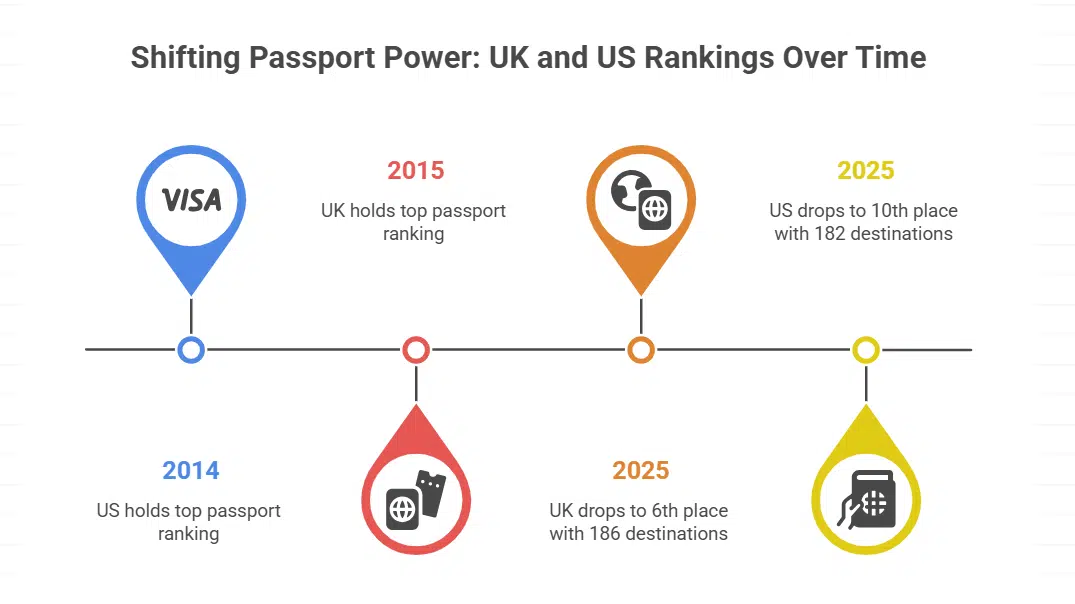
Both the United Kingdom and the United States experienced slight declines in the 2025 passport rankings. The UK has dropped to 6th place, with visa-free access to 186 destinations, while the US has fallen to 10th, now offering access to 182 destinations.
While these rankings still place them among the most powerful passports in the world, the drop reflects more conservative immigration policies and changing international alliances. Interestingly, both countries held the top ranking in the past decade—the UK in 2015 and the US in 2014—but they have since been overtaken by Asian and European countries.
Countries with the Lowest Passport Power in 2025
At the bottom of the Henley Passport Index are countries dealing with conflict, weak diplomatic ties, and poor international mobility arrangements. These include:
-
Afghanistan – access to just 25 destinations
-
Syria
-
Iraq
-
Pakistan
These countries face restrictions and travel bans in many parts of the world due to security concerns and strained diplomatic relationships, severely limiting the mobility of their citizens.
Saudi Arabia Makes a Notable Leap in Visa-Free Access
Among the most improved countries in 2025 is Saudi Arabia, which added four new visa-free destinations to its list, bringing the total to 91 countries. This jump marks a strategic success in the kingdom’s ongoing modernization and soft power diplomacy efforts under its Vision 2030 initiative, which aims to boost tourism, business relations, and international partnerships.
Saudi Arabia’s broader foreign policy reforms and diversified travel agreements with countries across Asia and Africa are beginning to bear fruit in terms of global mobility rankings.
China’s Gradual Climb Over the Last Decade
Over a ten-year period, China has improved significantly, rising from the 94th position in 2015 to 60th in 2025. While this upward movement is notable, China still lacks access to the Schengen Area, which is a major gap compared to other high-ranking passports.
Despite this limitation, the country has made consistent progress by expanding bilateral visa-free or visa-on-arrival agreements, particularly with Southeast Asian, African, and Latin American nations. China’s growing role in international trade and diplomacy contributes to the improving strength of its passport.
Global Trends in Mobility: The Rise of Citizenship Planning
The 2025 passport index also reflects broader geopolitical trends. With increasing instability, economic uncertainty, and stricter immigration policies in many parts of the world, citizens from developed countries like the US and UK are showing a surge in interest in alternative citizenship and residency options.
Wealthy individuals and business owners are increasingly exploring investment migration, golden visa programs, and second citizenships in countries offering greater freedom of movement, political stability, and tax incentives.
This growing trend shows how passports are becoming strategic assets, not just travel documents. In a world shaped by global inequality and political fragmentation, access to international mobility is emerging as a form of economic and social privilege.
Strategic Diplomacy Fuels Passport Rankings
India’s significant rise in the Henley Passport Index 2025 is a testament to its diplomatic outreach, regional partnerships, and growing influence on the world stage. While the total number of visa-free countries remains relatively modest, the upward trend is promising.
Countries like Saudi Arabia and China are also making steady progress through long-term diplomatic engagement and strategic travel partnerships. Meanwhile, traditional passport powerhouses like the US and UK are seeing relative declines as global mobility dynamics shift.
The index not only highlights which passports provide the most travel freedom, but also mirrors global political and economic trends. As countries navigate a complex world of alliances, conflicts, and cooperation, the power of a passport will continue to serve as a barometer of global influence and opportunity.