Getting your content noticed on Google is tough. You work hard to reach the top, only to see another site take the prime spot right above you. That special box is what we call Position Zero, and it changes everything.
Did you know that in the US, these featured boxes often capture the majority of attention before a user even scrolls? They can boost click-through rates significantly for those who land them. Walk you through the simple steps to claim this spot by targeting the right keywords and formatting your answers perfectly and How to steal position zero In 2026
Stick around, and I’ll show you the practical tips that actually work.
What Are Featured Snippets?
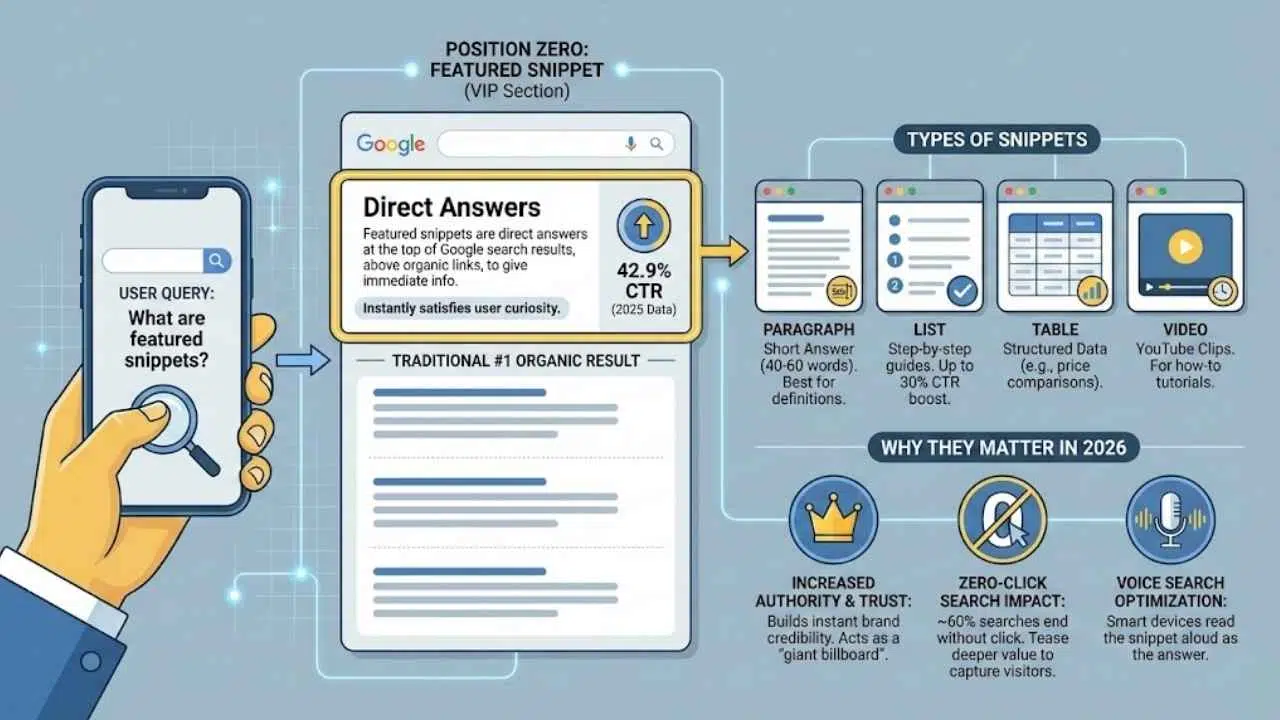
Featured snippets are the direct answers you see at the very top of Google’s search results. They appear above the regular organic links and are designed to give searchers exactly what they need immediately.
Definition and purpose of Position Zero
Position Zero is the VIP section of Google’s Search Engine Results Pages (SERPs). It sits right above the traditional #1 organic result but below the paid ads. Google’s algorithm pulls content straight from a website and showcases it in a clear, highlighted box.
This snippet provides an instant answer. It might grab a paragraph of text, a numbered list, a data table, or even a video clip automatically. The goal is to satisfy the user’s curiosity without forcing them to click around.
Landing in Position Zero is a massive win. According to 2025 data from First Page Sage, securing this spot can drive a click-through rate (CTR) of around 42.9%. That is a huge jump in visibility compared to standard rankings. For SEO optimization in 2026, beating the number one organic result means you must structure your content to be the most helpful, concise answer on the web.
Types of featured snippets: Paragraphs, Lists, Tables, Videos
Featured snippets come in several shapes. Each one serves a specific need for the reader. Understanding these formats is your first step to owning Position Zero.
- Paragraph Snippets: This is the most common type. Google pulls a short answer, ideally between 40 and 60 words, directly from your page. It works best for “what is” or “who is” questions, like “What is SEO optimization?”.
- List Snippets: These appear for step-by-step guides or rankings. Think of searches like “how to brew coffee” or “best marketing tools for 2026.” If you use clear formatting, Google might feature your bullet points or numbered steps, which can increase your CTR by up to 30%.
- Table Snippets: Data looks best in a grid. Google loves to pull structured info for searches like “2026 tax brackets” or “car price comparisons.” A clean HTML table makes it easy for the algorithm to display your data right at the top.
- Video Snippets: For visual learners, Google often features clips from YouTube. These usually show up for “how-to” tutorials, complete with a timestamp that jumps straight to the action.
Why Featured Snippets Matter in 2026
Featured snippets do more than just look good. They grab your reader’s attention instantly. In a crowded digital space, they turn quick answers into major traffic wins for your site.
Snagging Position Zero is like putting up a giant billboard on the busiest street in town. Your brand appears above the #1 organic result, positioning you as the ultimate authority on the topic. This placement signals to users that Google trusts your answer the most.
“A 2025 study by First Page Sage found that while the top organic result is powerful, a featured snippet can command a click-through rate of nearly 43%, making it the most valuable real estate on the page.”
In 2026, smart brands use tight formatting and specific structured data to win these slots. Google gives a “visibility boost” to marketers who master the art of the 40-60 word answer. This special placement drives more eyes to your site and builds instant trust with your audience.
Impact on zero-click searches
There is a catch to all this visibility. Sometimes, users get their answer from the snippet and never visit your website. These are called zero-click searches.
Recent data from SparkToro and Similarweb suggests that around 60% of Google searches in the US now end without a click. Because the featured snippet, or even an AI Overview, provides the facts upfront, the user is satisfied immediately.
This might sound like bad news, but it isn’t. Even if they don’t click, they see your brand name as the source of the truth. To turn these viewers into visitors, you need to offer more than just the basic fact. Tease deeper value in your snippet—like a comprehensive list or a detailed tutorial—that encourages them to click for the full story.
Role in voice search optimization
Position Zero is the voice of the internet. When you ask a smart device like a Google Nest or Apple’s Siri a question, they often read the featured snippet aloud as the answer. If your content holds Position Zero, your words become the answer people hear.
Short, conversational blocks of text around 40-60 words are the gold standard here. If your page claims this spot, you are effectively speaking directly to the user. With voice search continuing to grow in 2026, focusing your SEO optimization on these snippets ensures you remain relevant, even when screens aren’t involved.
How Google Selects Featured Snippets
Google wants clear, well-structured content that directly answers a specific question. The algorithm uses advanced systems, like the BERT and MUM models, to understand the nuance of both your content and the searcher’s intent.
Query relevance and content structure
Winning Position Zero depends on how well you align with the query. Google favors answers that are direct and to the point. The “inverted pyramid” writing style works best here: state the answer first, then explain the details.
For example, if someone asks “How do plants grow?”, start with a clear summary paragraph. Avoid fluff. Tables and lists are excellent for instructions or comparisons because they are easy to scan. Keep your formatting neat with standard HTML tags to help bots grab your answer fast. Sticking to one clear idea per section prevents the algorithm from getting confused.
Use of semantic and structured data
Google’s featured snippets rely heavily on clean code. Pages that use schema markup, specifically JSON-LD, send a clear signal to the search engine about what the content means. Using FAQPage or HowTo schema can significantly boost your chances.
Think of schema as a roadmap for Google’s bots. It tells them exactly which part of your text is the answer, the list of ingredients, or the step-by-step process. In 2026, combining semantic HTML (like proper and tags) with schema markup is the most reliable way to turn ordinary content into a spotlight moment on the SERP.
Strategies to Win Featured Snippets
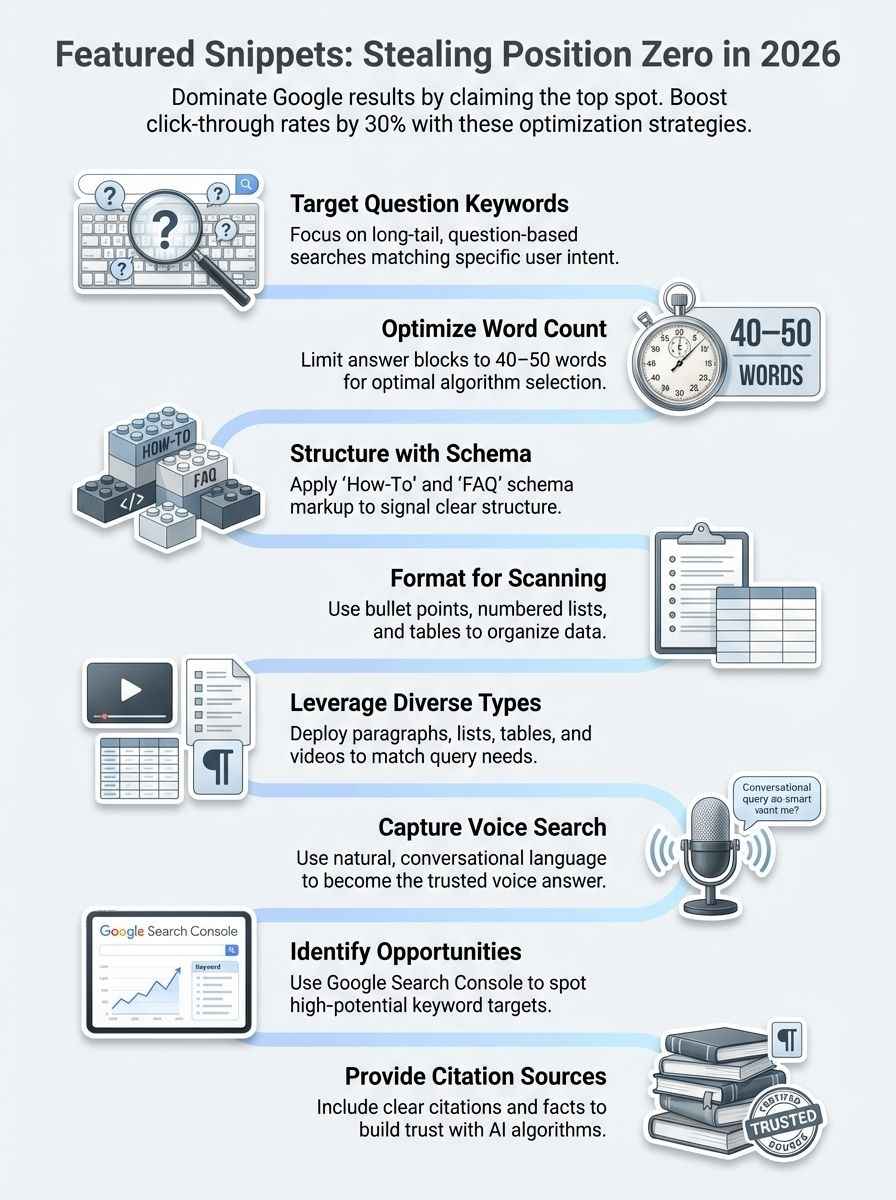
Winning that sweet spot at the top takes a deliberate approach. You need to think like a user and format like a pro. Here is how you can pull ahead of the competition.
Target long-tail and question-based keywords
The SERPs love specificity. Instead of targeting broad terms like “SEO,” aim for long-tail, question-based keywords. Phrases like “how to fix a leaky faucet” or “best SEO strategies for small business 2026” are prime candidates for snippets.
These questions signal a specific intent. Tools like AnswerThePublic or the Semrush Keyword Magic Tool are fantastic for finding these “who, what, where, and how” questions. Focus on matching your content to these specific queries. When you answer the exact question a user is asking, Google is far more likely to pick your content as the best answer.
Write concise, snippet-ready answers
Precision is key. Google prefers clear, simple sentences that sum up a topic in about 40 to 60 words. This is your “elevator pitch” for the algorithm.
If you want Position Zero for “how to boil eggs,” do not start with a story about your childhood farm. Write a direct answer: “To boil eggs, place them in a pot of cold water, bring it to a rolling boil, then cover and remove from heat. Let them sit for 9 to 12 minutes depending on desired firmness.”
This direct approach raises your visibility. It gives Google a perfect, bite-sized block of text to display. Once you have provided the direct answer, you can expand on the details in the rest of your article.
Format content with bullet points, lists, and tables
Structure is your best friend. Google’s algorithm is a machine, and machines love organized data. Using the right format for the right information makes it easy for Google to extract your content.
| Snippet Type | Best For Content Like… | Formatting Tip | |
|---|---|---|---|
| Paragraph | Definitions, Explanations, “What is” questions | Keep it to 40-60 words max. | |
| List (Ordered) | Recipes, DIY Instructions, Step-by-Step guides | Use tags for sequential steps. | |
| List (Unordered) | “Best of” lists, Feature lists, Item checklists | Use tags and keep items concise. | |
| Table | Pricing, Schedules, Comparisons, Data sets | Use clear headers in |
tags |
Here are a few more tips to ensure your formatting wins the spot:
- Use Descriptive Headers: accurate and tags help Google understand the hierarchy of your information.
- Keep List Items Short: Long, rambling sentences in a list can confuse the bot. Stick to one point per bullet.
- Limit Table Width: Simple tables with 2-3 columns display better on mobile devices, which is where most searches happen.
Leverage schema markup for How-To and FAQ pages
Schema markup guides search engines to read your pages with ease. Adding HowTo or FAQPage structured data helps Google pull step-by-step answers directly into featured snippets.
Using these specific schema types is a proven strategy. It allows Google to display your content as a rich result, which can occupy more vertical space on the screen. For the best results, ensure your marked-up content matches the visible text on your page. This accuracy increases visibility for SEO optimization while giving users exactly what they seek—fast facts at their fingertips.
Tools to Identify Snippet Opportunities
Curious where you can snag Position Zero? You don’t have to guess. There are powerful tools available that can help you spot open doors before your rivals do.
Use Google Search Console and SERP analysis
Google Search Console is your first stop. It allows you to see which of your pages are already ranking on the first page. Since snippets almost always come from the top 10 results, these are your low-hanging fruit.
Look for keywords where you rank in positions 2 through 5. These are prime candidates for optimization. Once you identify a keyword, perform a manual SERP analysis. Type the keyword into Google and see if a snippet already exists. If it does, look at what your competitor is doing. Is their answer outdated? Is their list formatting messy? If you can provide a cleaner, more accurate answer (around 40-60 words), you have a great shot at stealing their spot.
Explore “People Also Ask” and competitor snippets
The “People Also Ask” (PAA) box is a goldmine for content ideas. These questions are exactly what your audience is searching for. Tools like AlsoAsked or AnswerThePublic can help you map out these questions visually.
Spot patterns in these questions and repeat the keywords in your answers. Check out competitor snippets, especially those landing above the #1 organic result. Study their structure. Often, a simple tweak—like adding a bold header or converting a paragraph into a bulleted list—can shift the rank positioning in your favor. In 2026, smart research pays off faster than guesswork ever could.
Managing Risks of Zero-Click Searches
Zero-click searches can feel like setting the table but never getting to eat. You provide the value, but you don’t always get the traffic. The key is to make your content so interesting that folks can’t help but click for more.
Craft content that encourages deeper engagement
Think of the featured snippet as a movie trailer. It should give the audience a taste of the action but leave them wanting the full experience. Snagging Position Zero lifts your brand visibility, but you want those visitors on your site.
Don’t stop at the 40-60 word nugget. Spark curiosity. Use phrases like “Here is the summary, but the full process involves three critical nuances…” right after your definition. Drop internal links to deeper guides or case studies. Make every section feel like a friendly chat instead of a dry encyclopedia.
Add value beyond the snippet block
After catching the eye at Position Zero, you must pull readers deeper. Highlight answers that do more than fill the box. For instance, share a step-by-step how-to guide below your main answer or offer an expert “Insider Tip” right after your table.
Google’s algorithms reward rich content that keeps visitors on the page. Add clear calls to action and related articles using simple anchor text like “see more SEO tips.” This encourages users to stick around instead of bouncing away after a zero-click search. Marketers who add this “click-to-expand” depth often see better engagement rates, even in a zero-click world.
Monitoring and Optimizing Snippet Performance
You can’t just set it and forget it. You need to watch your snippet performance like a hawk to ensure you hold onto that top spot.
- Track Your Wins: Use tools like Semrush or Ahrefs to track which keywords trigger snippets for your domain. Look for shifts in your organic traffic.
- Watch for Volatility: Featured snippets can come and go. If you lose a spot, check if the SERP layout changed or if a competitor optimized their answer.
- Refine Your Content: Keep your facts fresh. If a statistic is from 2024, update it to 2026. Google loves current information.
- Test New Formats: If a paragraph isn’t winning, try converting that section into a table or a list. Small formatting tweaks can have a huge impact.
Regularly updating your content helps you hold Position Zero. A small update can boost your organic click-through rates and keep your brand visible right after the paid ads.
The Future of Featured Snippets in AI-Driven Search
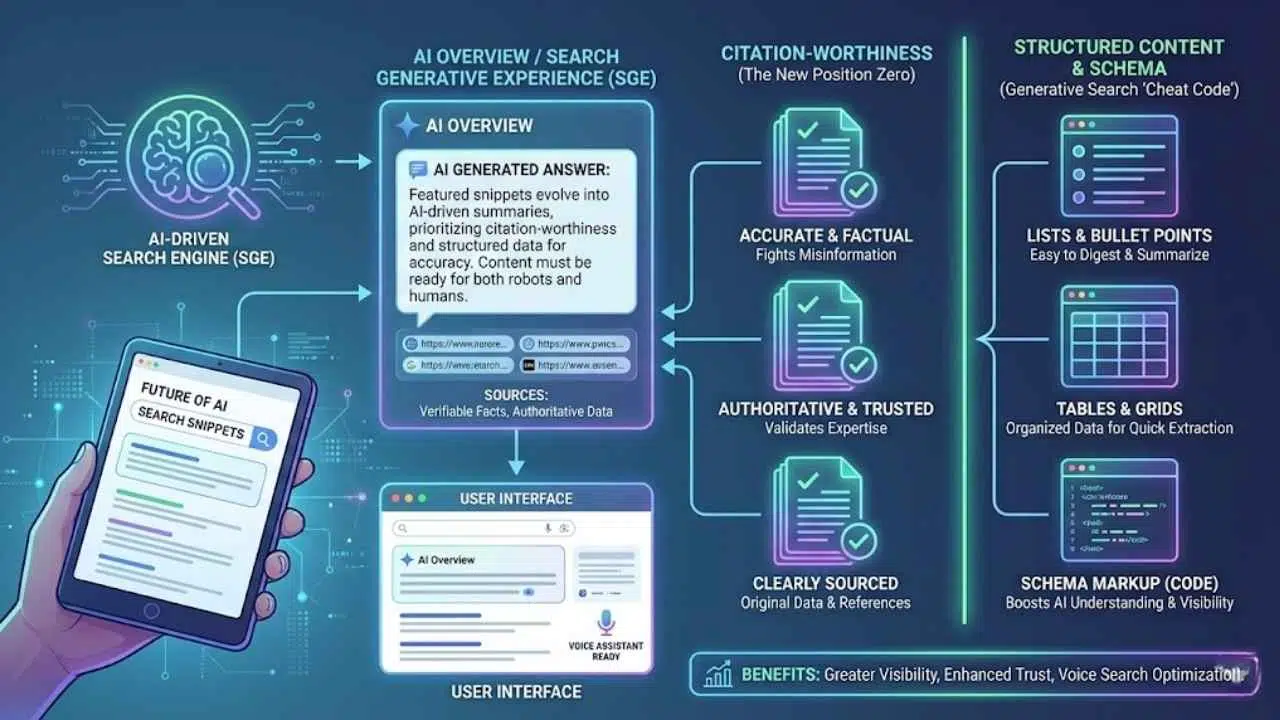
AI is changing how search engines pick top answers. With the rise of AI Overviews and the Search Generative Experience (SGE), your content must be ready for both robots and humans.
Importance of citation-worthiness in AI answers
AI-generated answers often sit right above the main organic results. To get mentioned in these AI summaries, your content needs to be “citation-worthy.” This means it must be accurate, authoritative, and backed by clear sources.
Google’s algorithms favor answers with clear citations because they help fight misinformation. Brands that offer verifiable facts and original data are more likely to be cited as a source in an AI Overview. This citation is the new “Position Zero” in many ways. It validates your brand as a trusted expert in your field.
Structured content’s role in generative search
Structured content is like a cheat code for generative search. Google’s AI models devour clear formats like lists, bullet points, and tables. These structures help the AI understand and summarize your content quickly.
Using schema markup makes your site more appealing to these algorithms. Studies show that well-structured data boosts your chances of being featured in both traditional snippets and AI summaries. Brands using clear paragraph snippets, lists, and tables get greater visibility, adding real weight to their SEO optimization plans in 2026. Structured content also helps voice assistants pull accurate info faster, giving you another edge on the SERP.
Final Thoughts
Winning Position Zero in 2026 isn’t magic; it’s about clear communication and smart formatting. By focusing on direct answers, using tools like the Semrush Keyword Magic Tool to find question-based queries, and structuring your content with tables and lists, you can steal the spotlight.
Remember, the goal is to be helpful. Whether it’s a zero-click search that builds brand awareness or a featured snippet that drives massive traffic, providing the best answer wins every time. The next click could be yours. So, update those old posts, polish your snippets, and get ready to see your name at the very top!