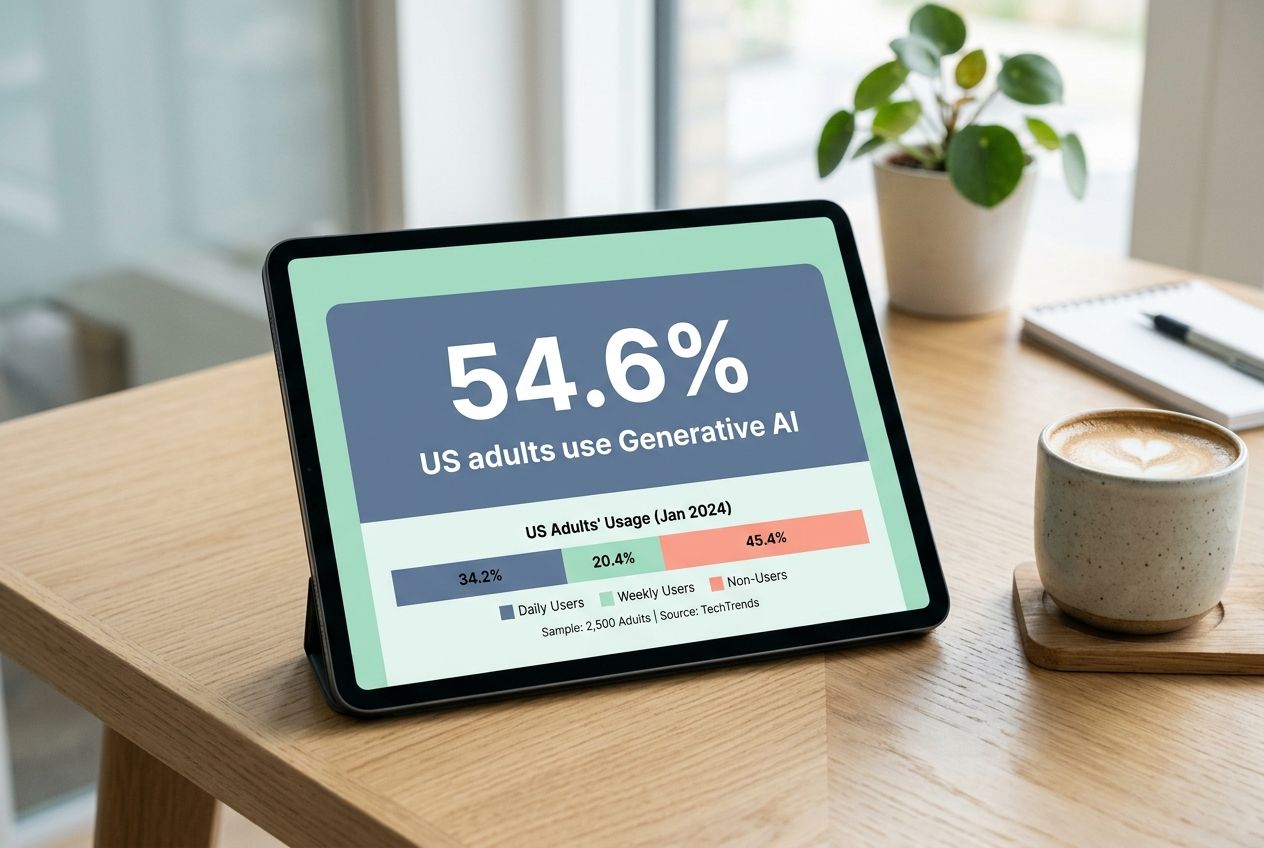
You might feel a bit lost right now, watching your competitors jump ahead with smart new tools. Many business owners wonder how to keep up when computers can suddenly create images, write emails, and answer customer questions. This is not science fiction anymore. It happens every single day across the United States. A November 2025 report from the St. Louis Fed shows that 54.6% of working US adults already use Generative AI. The numbers grow each year, leaving many folks scratching their heads about what steps to take next.
I am going to show you exactly how to build a generative AI strategy for your business in 2026. Grab a cup of coffee, and let’s go through it together in a simple, step-by-step way.
Understanding Generative AI
Generative AI helps computers create entirely new things like text, images, or music. It works just like a person would, opening doors for fresh ideas and smarter business moves.
Definition of Generative AI
Generative AI uses machine learning and data analysis to create new content or ideas. This technology learns from huge sets of information, and then it produces text, images, music, or computer code that looks incredibly human.
You have probably heard of tools like ChatGPT by OpenAI or Claude 3 by Anthropic. These platforms use these methods to understand patterns and generate beautiful answers or artwork in seconds.
- Text Generation: Drafting emails, reports, and marketing copy.
- Image Creation: Designing logos or social media graphics.
- Code Writing: Helping developers build software faster.
The role of Generative AI in modern businesses
Now that we know what this technology means, it helps to see how businesses put it to work right now. Starbucks uses AI to tweak menus in real time for local tastes, and banks like JPMorgan Chase use machine learning models for fast fraud alerts.
A recent 2026 report by AmplifAI found that 88% of organizations now use AI in at least one business function. These tools shape ads, generate product ideas, and help leaders spot new ways to grow fast.
“Smart machines do the heavy lifting so teams can focus on big goals.” – Mark Cuban, business expert and investor.
Smart chatbots handle thousands of customer questions at once, saving time and money across healthcare, retail, and finance. Gartner even predicts that 40% of enterprise applications will feature task-specific AI agents by the end of 2026.
Why Your Business Needs a Generative AI Strategy
A smart AI plan gives your business a massive edge, much like a sharpened pencil in a box of dull ones. Change comes fast, and those with the best tools get to write their own future.
Competitive advantages
This technology gives businesses a verifiable edge. Fast data analysis helps spot trends before your rivals even wake up. Retailers predict customer needs with machine learning tools, driving sales higher and faster than old methods ever allowed.
The financial payoff is very real. According to a 2026 Qualtrics study, every dollar invested in generative AI now yields an average return of $3.70.
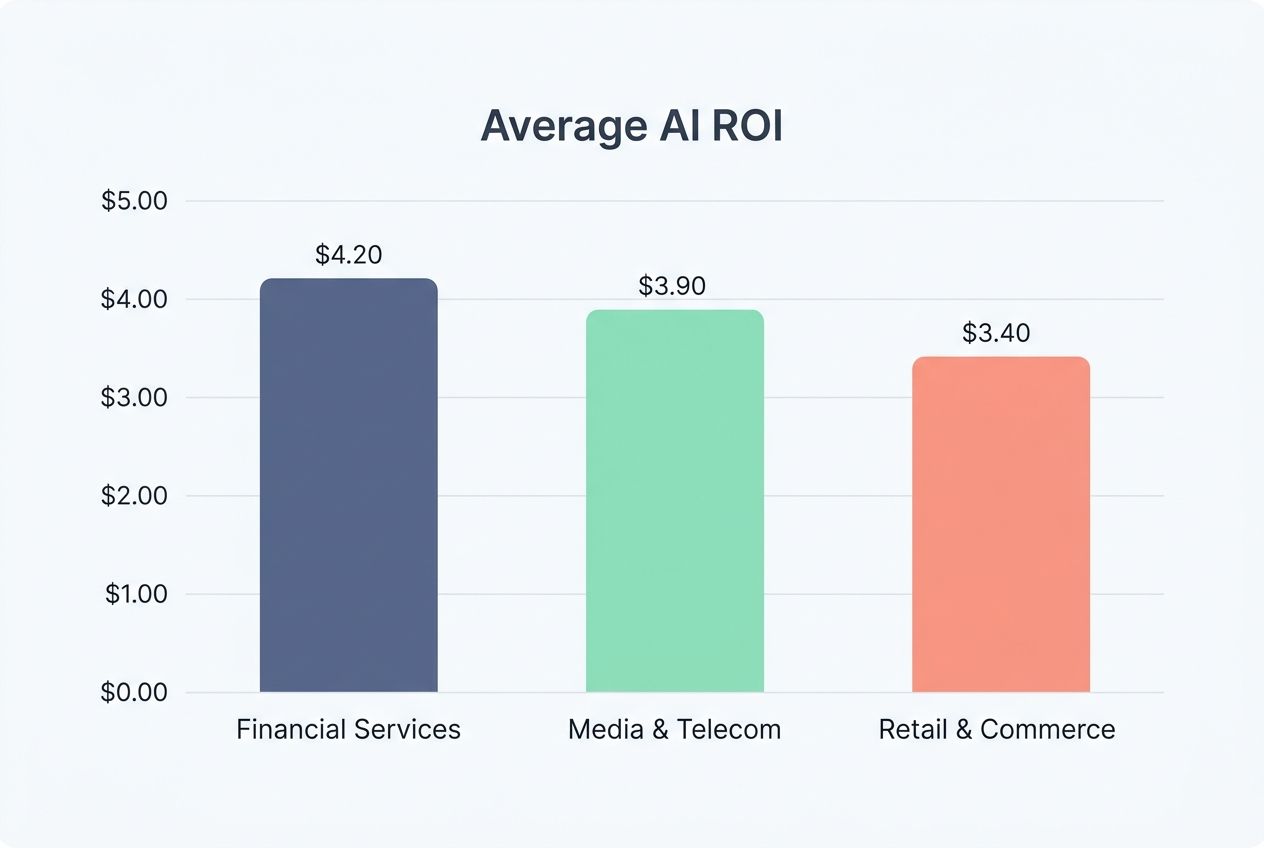
| Industry | Average AI ROI (Per $1 Invested) |
|---|---|
| Financial Services | $4.20 |
| Media & Telecom | $3.90 |
| Retail & Commerce | $3.40 |
Driving innovation and efficiency
AI helps companies speed up tasks, spot hidden trends, and create fresh ideas every single day. A clothing store can use machine learning to predict popular styles before the season even starts. This boosts sales and keeps shelves stocked with exactly what people want to buy.
Tools like automation cut down on mistakes, save precious time, and free your workers for bigger challenges. In fact, a 2026 AmplifAI report notes that workers using these tools save an average of 5.4% of their work hours every single week.
From writing reports to designing ads or forecasting business growth, smart AI models work faster than most teams could alone. Businesses using these tools see higher profits and happier customers because the technology does the heavy lifting behind the scenes.
Key Components of a Generative AI Strategy
What keeps an AI plan moving forward? You need to start with clear goals and a smart roadmap, and then watch your business shift gears fast.
Business alignment with AI objectives
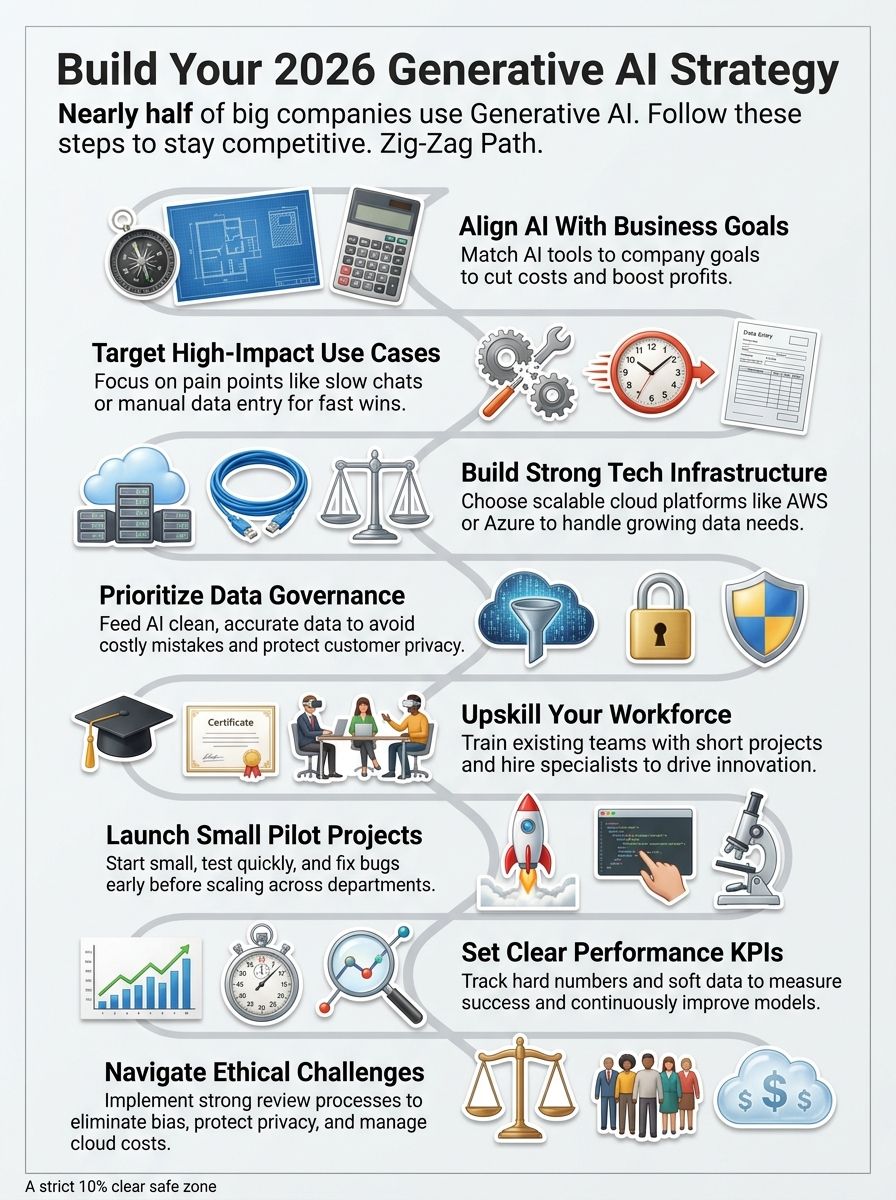
Your AI objectives absolutely must match your business goals. If your main drive is to boost profits, then you need to focus on AI tools that cut costs or attract new buyers. A smart retail manager could use predictive modeling to guess next season’s trends and adjust inventory using automation.
By matching digital transformation with company needs, you save effort and avoid wild goose chases. A 2025 MIT analysis titled “The GenAI Divide” found that 95% of generative AI pilots fail to deliver measurable profit impact because they are not tied to core business metrics.
AI behaves like an operating model change, not just a simple software update.
Every department can play a part in shaping strategy, from marketing teams hunting for customer insights to IT handling data management. Clear alignment between leadership and technology helps set very strong priorities.
Identifying high-impact use cases
Spotting where generative AI can add value is critical for any business strategy. You want your AI portfolio to focus on the changes that matter most and boost your results.
- Study pain points in current workflows, such as slow customer chats or manual data entry. These often show promising areas for automation.
- Check which tasks rely on creativity, prediction, or large-scale analysis, since generative AI shines at content creation, data analysis, and predictive modeling.
- Talk to team members across departments to gather ideas. Sometimes the best use cases come from daily job struggles.
- Analyze industry trends. Financial services see big gains with fraud detection models, while retail uses AI for product recommendations and dynamic pricing.
- Weigh possible gains against costs so you target efforts at jobs with high impact and feasibility within your digital transformation journey.
- Review partnerships with technology providers. Companies like Microsoft with Copilot and Google with Gemini offer tools that can shorten build times and expand customization options.
- Assess compliance needs. Select use cases where privacy laws and ethics are easy to manage so projects do not stall before launch.
- Run small pilot projects first. In 2023, many firms found early pilots helped flag risks while proving value fast.
- Track performance metrics like customer satisfaction boosts or cost savings after each project phase ends.
Assessing AI maturity within your organization
Start with a simple check of your current AI tools and skills. List out what systems, apps, or programs use Artificial Intelligence. Review how your staff feels about Machine Learning and Automation.
Small teams can use online surveys to see who uses AI in their daily work. Look at past projects or Business Intelligence reports to spot your wins and your gaps. Find out if data is easy to access for Predictive Modeling or Data Analysis.
A 2026 industry benchmark shows that 31% of North American companies now qualify as AI leaders. These leaders manage to deploy new AI tools in less than three months. Create an internal scorecard to track your own progress as you boost technology adoption across the business strategy.
How To Build A Generative AI Strategy For Your Business
A strong technical setup helps your AI projects run smoothly, much like fresh oil in a well-tuned machine. Pick the right foundation early, so your ideas do not get stuck at the starting line.
Selecting foundational AI models
Large language models like GPT-4, Claude, or open-source choices such as Llama 3 change how work gets done. These models handle tasks in natural language, code writing, and even deep data analysis.
Businesses pick these foundational AI models based on their goals and specific data needs. GPT-4 works well for deep customer insights, while a model like DeepSeek V3 can run in a private cloud for stronger control over company information.
| Model Type | Estimated 2025 Training Cost | Best Use Case |
|---|---|---|
| Frontier (e.g., GPT-4 class) | $100M+ | Complex, broad enterprise reasoning |
| Mid-size Open Source (e.g., Llama 3) | $25M | Custom internal tools and workflows |
| Fine-Tuned Small Models | $500 – $5,000 | Specific, highly focused daily tasks |
Ensuring scalable cloud and computing resources
Cloud platforms like AWS, Google Cloud, and Microsoft Azure help you grow incredibly fast. They offer on-demand computing power for AI workloads of any size. Your team can spin up extra servers or GPUs as needed, and then shut them down to save money.
Generative AI eats up lots of data and processing power. A 2026 NVIDIA survey found that 42% of companies name optimizing AI workflows and infrastructure as their absolute top spending priority for the year. Make sure your resources match demand so things do not slow down during busy hours.
Good planning here gives room for machine learning tools in every future project. Clear data rules help keep growth smooth and efficient. This leads straight into the next major focus, which is the importance of data governance.
The Importance of Data Governance
Good data habits keep your AI sharp. Messy information leads to confusion, mistakes, and missed chances, so you must clean it up before you hit the gas.
Prioritizing high-quality data
Strong AI models feed on clean, accurate data the way kids crave candy. Messy or incomplete information makes machines draw the wrong conclusions. It is exactly like getting lost with a broken GPS.
Leaders at Google and Meta stress that good data management sits at the core of every successful machine learning project. In fact, a 2023 IBM study found that 73 percent of businesses reported poor-quality data blocked their digital transformation.
If you use data for automation or business intelligence, even one bad number can throw your results off track in seconds. Smart companies set clear rules about what counts as high-quality data.
- Accuracy: Ensure every single number and name is correct.
- Completeness: Do not leave blank fields in your training sets.
- Timeliness: Feed your models the most recent information available.
- Consistency: Use the exact same formatting across all your databases.
Ensuring data privacy and compliance
Data privacy keeps your business safe from devastating data leaks. You must always keep customer details secure and protected. Follow rules like HIPAA for healthcare data or CCPA if you work with data from California.
These laws protect people’s information and set big fines for mistakes, so there is no cutting corners. In 2024, US private AI investment reached $109.1 billion, meaning more sensitive data is flowing through these systems than ever before.
Use strong passwords, strict access controls, and encryption to lock down important files. Regular training helps everyone in the company know what counts as sensitive data. Audit your systems often so nothing slips through the cracks during your digital transformation.
Talent and Workforce Enablement
People shape AI, and people grow with it. Give your team the right skills, spark their curiosity, and then watch fresh new ideas take flight.
Upskilling existing teams
Your team needs brand new skills to work with Generative AI effectively. Start small, with short training sessions or simple online courses on machine learning and data analysis. Use real business problems as practice, like setting up an automation for customer support.
A 2026 Qualtrics survey reveals that 83% of professionals actively use AI tools to learn new workplace skills. Short projects can spark immense curiosity and help your employees learn very fast.
This “learn by doing” style creates value quickly and turns change into progress instead of pain points.
Give your staff time to explore these tools during their usual workday. Encourage questions and knowledge sharing, even if it gets noisy at times. You will find hidden talent this way, maybe in folks who have never touched code before.
Hiring AI specialists
After teaching current employees new skills, companies clearly see the need for fresh talent. AI specialists bring deep knowledge in machine learning, automation, and data analytics. They keep up with the latest tools from groups like OpenAI or Google DeepMind.
Recruiters often look for candidates who have hands-on experience with Generative AI projects. A 2024 LinkedIn report showed job postings for AI roles jumped by 39 percent worldwide.
In 2026, highly skilled AI engineers and data scientists often demand salaries ranging from $80,000 to $150,000 or more. A strong team of experts helps a business gain a clear competitive advantage fast while driving innovation strategy each day they walk through the door.
Iterative Development and Deployment
Start small, test new ideas, and tweak your approach as you go. Good things happen when you learn quickly and keep improving along the way.
Piloting initial AI projects
Small AI projects work best at the very start. Pick one use case with clear value, like automating customer emails or creating product descriptions. In 2023, McKinsey found that early pilots helped 80% of growing companies learn faster and spot risks sooner.
Limit your scope, set a timeline, and measure progress with real numbers. Fix bugs as they appear instead of waiting for perfect code. Bring together people who know both technology and business strategy.
Hold regular check-ins to review results so you can adjust quickly if needed. Quick wins boost team morale and grab attention from company leaders.
- Pick a single metric: Focus on one specific goal, like cutting response time by 10%.
- Use internal testers: Have your own team try the tool before customers see it.
- Gather weekly feedback: Ask users what feels clunky or confusing.
- Be ready to pivot: If the pilot fails, shut it down quickly and try a new angle.
Scaling successful implementations
After piloting initial AI projects, it is time to take what works and bring it to the big stage. Roll out successful models across teams or departments so more people benefit from smarter automation and decision-making.
Large banks, like JPMorgan Chase, have boosted productivity in customer service by scaling chatbots that help millions each year. A 2026 NVIDIA survey confirms this trend, showing that 86% of companies plan to increase their AI budgets this year to scale these specific successes.
Set clear goals as you expand. Track results with real-time data analytics. If a model delivers value in one area, test it elsewhere before going all-in. Cloud platforms make this job easier by letting companies add extra computing power quickly as usage grows.
Monitoring and Optimization
Keep a close eye on your AI systems, because they can change in surprising ways. Small tweaks over time help you get the most value and avoid hiccups down the line.
Establishing KPIs for AI performance
KPIs, or Key Performance Indicators, show if your Artificial Intelligence projects actually add value. Set clear goals for each AI use case before launch. For example, track accuracy rates in machine learning models or measure response times in automation tools.
A 2026 Master of Code report highlights that 50% of executives consider achieving measurable ROI as the absolute primary success metric for AI projects. Monitor customer insights using feedback scores and see if predictive modeling reduces errors by a certain percentage.
Align every KPI with your business strategy to drive innovation and technology adoption. This combination shows both the human side and the bottom line of your AI portfolio’s success without getting lost in technical jargon.
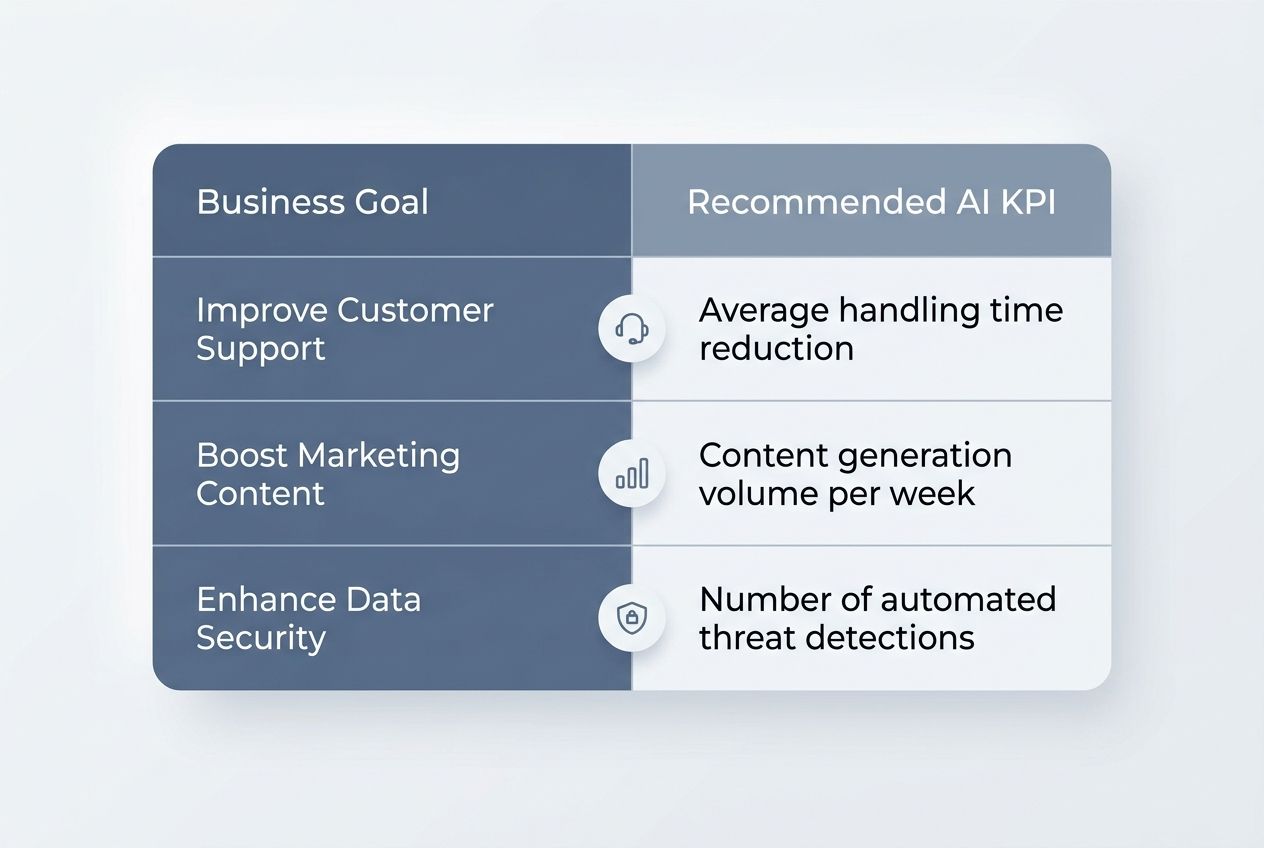
| Business Goal | Recommended AI KPI |
|---|---|
| Improve Customer Support | Average handling time reduction |
| Boost Marketing Content | Content generation volume per week |
| Enhance Data Security | Number of automated threat detections |
Continuously improving AI models
Business leaders know AI models need frequent updates. Data keeps changing, and so should your Machine Learning tools. Feed these models fresh data from daily operations or customer interactions.
Small tweaks can lead to massive jumps in performance. According to 2025 data from Local AI Master, the cost to fine-tune a model using modern adapters has dropped to just $500 to $5,000. This makes continuous improvement highly affordable for most businesses.
Compare results over time using real numbers, like click rates or error drops. Do not hesitate to swap out old algorithms for newer ones if they bring better business outcomes. Treat every update as a chance to sharpen your competitive edge.
Challenges in Implementing a Generative AI Strategy
You might run into a few bumps while putting your AI plans into action. Some problems can pop up fast, catching teams off guard and stirring up more questions than answers.
Addressing ethical considerations
AI tools learn from data, but not all data is fair or correct. Some systems can make choices that hurt people or show bias. Making AI ethical means strictly checking for hidden patterns that might be unfair.
In 2025, researchers identified a growing problem called “workslop,” which refers to low-quality, AI-generated work that requires massive human correction. Workers should know exactly how AI decisions are made, so they can spot these quality problems early.
Using clear rules, labels, and checks helps stop mistakes before they spread. Good ethics build trust with customers while keeping your business ahead of strict laws coming up in 2026 and beyond.
- Create an AI policy: Write down exactly what employees can and cannot do with AI.
- Form a review board: Gather a diverse team to check AI outputs for hidden biases.
- Audit training data: Make sure the information feeding your AI represents all your customers fairly.
- Include a human in the loop: Never let AI send sensitive messages without a person checking it first.
Managing costs and expectations
After handling ethics, facing money and expectations is your very next challenge. Generative AI can sound like a magic wand, but it comes with incredibly high costs. Training a single massive AI model can reach $50 million to $200 million and use massive amounts of electricity.
Set clear goals for your project right from the start. A 2025 Worklytics survey revealed that 74% of companies report they have yet to show tangible value from their AI investments because their initial expectations were completely misaligned with reality.
Make room for surprises in your budget, too. Hidden fees pop up fast, especially if cloud services or new hardware are needed for scaling or customization. Staying open to changes helps keep everyone moving forward without sticker shock or broken promises along the way.
Industry-Specific Applications of Generative AI
Generative AI steps into each sector with its own special flair, sparking new ideas and fresh solutions. Exploring these stories can help you spot exactly where your business might score big next.
Financial services
Banks use Generative AI to spot fraud, predict risk, and automate complex loan approvals. This saves time for workers and helps customers get significantly faster answers. In 2023 alone, U.S. banks reported that AI cut some manual tasks by almost 42 percent.
The financial payoff here is unmatched. According to a 2026 AmplifAI report, the financial services sector leads all other industries with a 4.2x return on its AI investments. Tools like predictive modeling help flag risky transactions in seconds instead of hours.
Many financial firms build their AI strategies around strict data management to stay ahead of hackers and changing rules.
Healthcare
Healthcare stands ready for massive change through generative AI. Hospitals use machine learning to spot diseases faster and with far more accuracy. In 2023, Mayo Clinic started using predictive modeling to lower patient wait times by an impressive 15 percent.
Chatbots answer routine health questions all day, giving nurses much more time for urgent cases. In a 2026 Forbes review of AI workflow redesigns, departments that properly integrated AI saw a 40% reduction in administrative burden and clinician hours spent on paperwork.
Doctors can harness data analysis to predict patient risks long before symptoms show up. Machine learning spots patterns across thousands of medical images that no human eye could catch alone, boosting diagnosis rates and saving lives daily.
Retail and e-commerce
Retail brands use Generative AI to sharpen product recommendations, answer customer questions fast, and keep their shelves stocked. For example, Walmart launched an AI-powered digital assistant named Sparky in late 2025, built in partnership with OpenAI.
This assistant shifts the experience from a simple search bar to “agentic commerce,” where the AI actually predicts what customers need to plan a party or restock a pantry. According to a PYMNTS report, when customers use Walmart’s AI-powered app in stores, they spend 25% more on average.
Inventory gets tracked more quickly with smart data analysis. Shop owners spot shopping trends as they happen using real-time dashboards powered by automation tools. Predictive modeling points out which items could fly off the shelves before holiday rushes even start.
- Dynamic Pricing: Adjusting item costs based on real-time demand.
- Virtual Try-Ons: Letting customers see how clothes fit using AI imagery.
- Smart Inventory: Predicting exactly when a product will run out of stock.
- Agentic Search: Guiding customers through a purchase with conversational AI.
Wrapping Up
A smart strategy can spark new ideas, boost efficiency, and create fresh value. Companies like Google and Amazon use machine learning, automation, and data analytics to push digital transformation forward. Every business can start small with pilot projects and build on early wins.
Sharp use case prioritization helps focus effort exactly where results matter most. AI adoption needs good partnerships, strong data management practices, and steady upskilling of your teams.
Jumping in now helps you master Generative AI Strategy. Trust the power of innovation, and grab your chance to lead with technology integration today.