If you ask most people what “biodiversity” means, they think of rare animals in distant forests. But the truth is much closer. From the food on your plate to the air you breathe, biodiversity quietly shapes almost every moment of your day. This is the real story of how biodiversity affects our daily lives.
Biodiversity is the variety of life on Earth: the genes that make crops resilient, the species that pollinate our food, and the ecosystems that filter our water and store carbon. Global assessments warn that up to one million species are now at risk of extinction, driven by habitat loss, pollution, climate change, overuse of natural resources, and invasive species.
That sounds alarming, but this article is not only about the crisis. It is about change. As governments, cities, companies, and communities work to protect and restore nature, everyday life will shift too. Your meals, your health care, your city design, your job, and even your mental well-being will feel the impact.
How biodiversity affects our daily lives: the big picture
Biodiversity is not an optional “extra” in the background of modern life. It is the living infrastructure that supports food, water, health, and the economy.
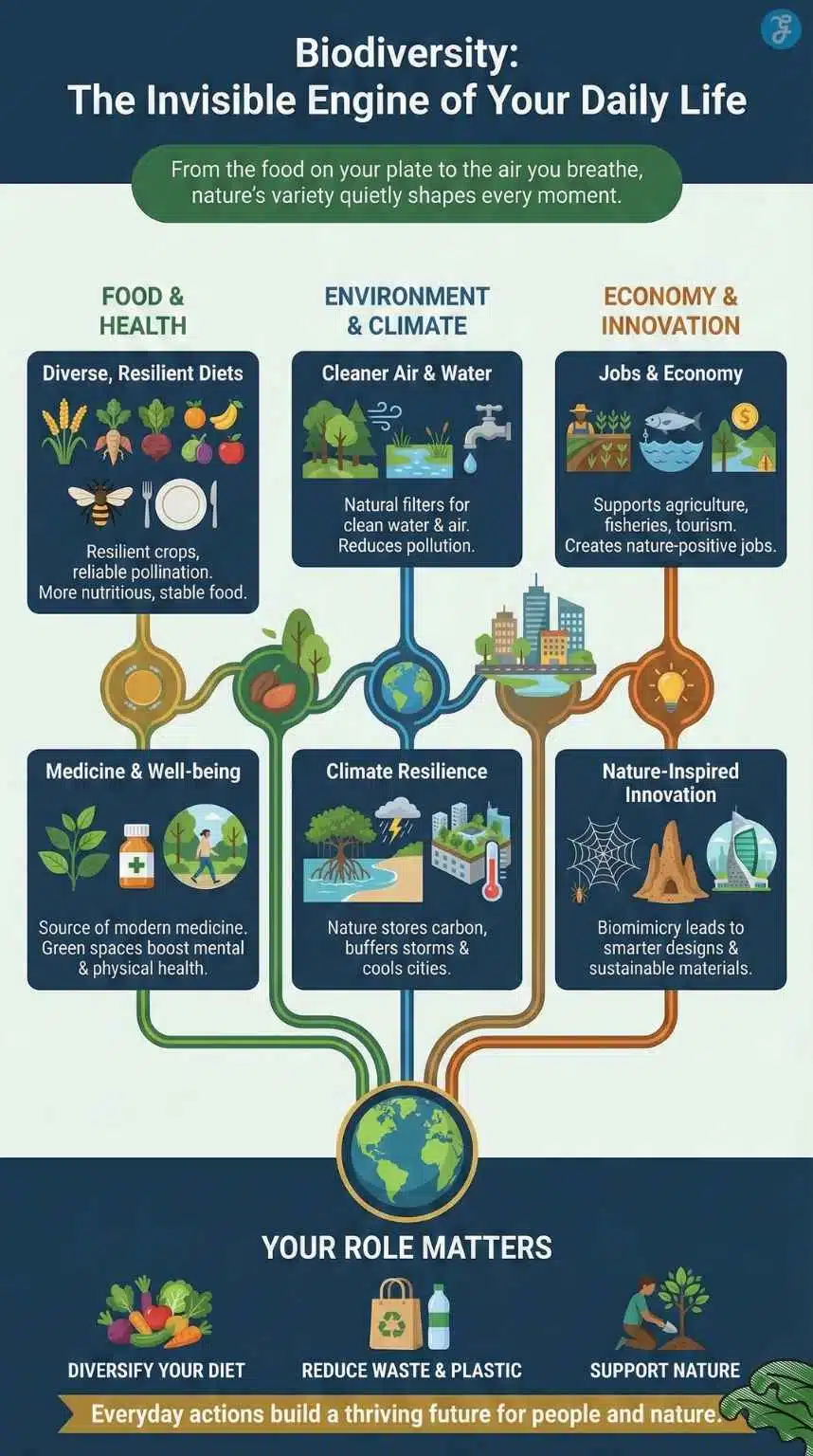
Researchers and international bodies describe biodiversity as the foundation of human wellbeing. Nature provides food, clean water, medicine, climate regulation, and cultural and mental health benefits. When biodiversity declines, these services become less reliable and more expensive to replace with technology.
In practical terms, this means:
- Fewer pollinators can mean less stable fruit and vegetable supplies.
- Degraded wetlands can mean more floods and polluted water for cities downstream.
- Losing wild species can mean losing future medicines and materials we have not yet discovered.
Governments have agreed on a landmark Global Biodiversity Framework that aims to halt and reverse nature loss, including a goal to protect at least 30% of land and sea and restore degraded ecosystems by 2030. The success or failure of these targets will directly shape the quality of everyday life in the coming decades.
How biodiversity supports core parts of daily life
| Aspect of life | Biodiversity’s role | What changes you may see |
| Food and nutrition | Diverse crops, livestock, and pollinators | More varied, resilient diets |
| Health | Source of medicines, healthy microbiomes, green space | More nature-based health solutions |
| Cities | Trees, wetlands, and parks regulate climate and water | Cooler, greener urban design |
| Economy and jobs | The basis of farming, fishing, tourism, and pharma | Growth of nature-positive careers |
| Culture and wellbeing | Nature shapes identity, traditions, and mental health | Stronger focus on access to nature |
Way 1 – A more diverse, climate-resilient diet on your plate
Our entire food system rests on biodiversity. Thousands of plant species can be eaten, but only a handful provide most of the world’s calories. At the same time, genetic diversity within crops and livestock protects them from pests, diseases, and extreme weather.
As climate change and soil degradation put pressure on farming, many countries and food companies are rediscovering “forgotten” or underused crops: hardy millets, pulses, root vegetables, indigenous fruits, seaweeds, and more. These foods often need fewer chemical inputs and are more resistant to heat and drought.
You are likely to notice:
- More local and traditional crops in supermarkets and restaurants.
- A wider range of plant-based proteins beyond soy and wheat.
- Labels that highlight “agroecological”, “regenerative”, “shade-grown”, or “biodiversity-friendly” farming.
This is one of the clearest ways which biodiversity affects our daily lives: it changes what we eat, how stable our food supply is, and how nutritious our diets can become.
Biodiversity and your diet
| Element | Biodiversity link | Everyday effect |
| Crop varieties | Different genes resist different stresses | Fewer crop failures, more stable prices |
| Pollinators | Bees, butterflies, bats, birds | Reliable supply of fruits, nuts, and vegetables |
| Soil life | Microbes, fungi, and insects in soil | Healthier crops with fewer chemicals |
| Traditional foods | Regional grains, fruits, spices | More diverse, nutrient-rich meals |
Way 2 – Healthier bodies and better disease protection
Biodiversity and health are deeply connected. Nature supports health in three big ways: by providing nutritious food, by supplying medicines, and by shaping the environments that keep our bodies and minds in balance.
The World Health Organization notes that nature and ecosystems provide essential products such as water, food, and medicine, and essential services such as climate regulation, nutrient cycling, and oxygen production. When ecosystems break down, health risks increase.
Key links between biodiversity and your health include:
- Diverse diets rich in fruits, vegetables, and whole foods help prevent non-communicable diseases like heart disease and diabetes.
- Access to green spaces is associated with lower stress, better mental health, and increased physical activity.
- Healthy ecosystems can reduce the risk of some infectious diseases, while ecosystem disruption can increase the chance of new diseases spilling over from animals to humans.
In many countries, doctors and public health services are starting to prescribe “nature exposure” as part of treatment plans: guided walks, gardening, or time in parks.
Biodiversity and human health
| Health area | Biodiversity connection | Impact on daily life |
| Nutrition | Variety of crops and wild foods | Better diet quality |
| Mental wellbeing | Contact with green and blue spaces | Lower stress, improved mood |
| Infectious disease | Healthy ecosystems regulate disease dynamics | Lower risk of outbreaks and vectors |
| Public health policy | “Nature-based” health programs and planning | More parks, trails, and wellness programs |
Way 3 – A new era of medicine and pharmaceuticals
Modern medicine relies heavily on biodiversity. Many widely used drugs come directly from natural sources or were first discovered in plants, fungi, or marine organisms. Estimates suggest that over half of modern medicines are derived from or inspired by natural products.
Examples include:
- Painkillers are originally derived from willow bark and the opium poppy.
- Cancer drugs were discovered in Pacific yew trees and Madagascar periwinkle.
- Antibiotics from soil bacteria and fungi.
Today, researchers are expanding the search to microbes in soils, oceans, and even extreme environments, hoping to find new antibiotics, antivirals, and anticancer compounds.
If species disappear before we study them, we lose potential treatments forever. This is one of the most serious long-term consequences of biodiversity loss. It will influence what medicines are available in pharmacies, how we fight new diseases, and how effective future treatments can be.
Biodiversity and medicine
| Aspect | Role of biodiversity | Daily impact |
| Drug discovery | Plants, fungi, and microbes as sources of compounds | New treatments for diseases |
| Traditional medicine | Indigenous and local knowledge of wild species | Herbal and complementary therapies |
| Future cures | Undiscovered species and molecules | Potential new antibiotics and anticancer |
| Research trends | Focus on microbiomes and natural products | More nature-derived drugs in clinics |
Way 4 – Greener, more livable cities
More people now live in cities than in rural areas. Urban life often feels disconnected from nature, but biodiversity is becoming central to city planning.
Urban trees, parks, ponds, and wetlands help cool hot neighbourhoods, store carbon, filter air, manage stormwater, and provide recreation spaces. Studies show that nature-based solutions in cities can reduce heat, improve air quality, and lower flood risk while improving quality of life.
City planners are increasingly:
- Planting diverse street trees and creating “green corridors” for people and wildlife.
- Restoring rivers and wetlands instead of relying only on concrete drainage.
- Designing green roofs and walls to insulate buildings and support pollinators.
For residents, this means more shade during heatwaves, more pleasant walking routes, and easier access to nature within walking or cycling distance. This is another clear way in which biodiversity affects our daily lives, especially in crowded urban centres.
Biodiversity and urban life
| City feature | Biodiversity element | Everyday benefit |
| Street trees | Multiple native species | Cooler streets, cleaner air |
| Parks and greenways | Mixed habitats (grass, shrubs, trees, wetlands) | Space to exercise, relax, socialize |
| Urban wetlands | Native plants and aquatic life | Flood control, water purification |
| Green roofs/walls | Flowering plants and grasses | Insulation, habitat for pollinators |
Way 5 – Cleaner water and air in your routine
Every time you turn on a tap, flush a toilet, or take a deep breath, you depend on ecosystems you may never see. Forests, wetlands, and healthy soils act as natural filters and regulators.
Forests can help regulate water flow, reduce erosion, and maintain water quality for downstream communities. Wetlands trap sediments and pollutants, recharge groundwater, and buffer floods. Healthy oceans and coastal ecosystems like mangroves and seagrasses also play a role in storing carbon and supporting fisheries that feed millions of people.
When these systems are degraded, cities must spend more on water treatment and engineered defenses, costs that eventually reach households through taxes or utility bills.
Ecosystems as natural service providers
| Service | Ecosystem involved | Everyday outcome |
| Clean drinking water | Forests, wetlands, healthy soils | Safe tap water, fewer treatment costs |
| Flood control | Wetlands, floodplains, mangroves | Less property damage, safer communities |
| Air quality | Urban and rural vegetation | Lower pollution, better lung health |
| Food from water | Rivers, lakes, oceans with healthy biodiversity | Stable fish and shellfish supplies |
Way 6 – Climate resilience you can feel
Climate change is one of the biggest threats to biodiversity, but biodiversity is also one of our strongest allies against climate change. Forests, peatlands, mangroves, and seagrass meadows store vast amounts of carbon and help regulate global and local climate.
Nature-based solutions for climate include:
- Restoring mangroves to protect coastal communities from storms and erosion.
- Rewilding degraded land to store carbon and support wildlife.
- Expanding urban green spaces to reduce heat and energy use.
For ordinary people, these actions matter in very direct ways. They can mean fewer homes flooded, fewer days of extreme heat in cities, and lower energy bills because buildings stay cooler or warmer naturally. As more countries implement the Global Biodiversity Framework and the “30×30” conservation target, these benefits should grow.
Biodiversity and climate resilience
| Climate risk | Nature-based response | Everyday benefit |
| Coastal storms | Mangroves, coral reefs, dune systems | Reduced storm surge and erosion |
| River flooding | Restored floodplains and wetlands | Fewer severe floods, safer infrastructure |
| Urban heat | Trees, parks, green roofs | Cooler streets and homes |
| Carbon emissions | Forest and peatland conservation | Slower global warming, more stable climate |
Way 7 – Jobs and nature-positive economies
Biodiversity is not just about nature lovers and scientists. It underpins major economic sectors: agriculture, fisheries, forestry, pharmaceuticals, and tourism.
As countries work to meet global biodiversity and climate goals, investment is rising in “nature-positive” business models.
Examples include:
- Regenerative agriculture that restores soil health and reduces chemical use.
- Ecotourism that supports conservation and local communities.
- Companies that track and report their nature-related risks and dependencies, similar to climate disclosures.
This shift is creating new jobs: urban ecologists, restoration practitioners, biodiversity data analysts, soil health advisers, and more. It is also changing existing roles, as farmers, planners, and engineers integrate biodiversity into daily decisions.
This economic transformation is another dimension of how biodiversity affects our daily lives, even when we are at work.
Biodiversity and the economy
| Sector | Dependence on biodiversity | Possible changes in jobs and business |
| Agriculture | Crop diversity, pollinators, soil life | Growth of regenerative and organic farming |
| Fisheries | Healthy aquatic ecosystems | Stronger focus on sustainable harvests |
| Tourism | Wildlife, landscapes, cultural heritage | Rise of ecotourism and community tourism |
| Finance and policy | Nature-related risk and reporting | New roles in ESG and biodiversity finance |
Way 8 – Innovation and technology inspired by nature
Engineers, architects, and designers increasingly look to biodiversity for ideas. This approach, known as biomimicry, studies how organisms solve problems and adapts those solutions to human needs.
Famous examples include:
- Building ventilation systems inspired by termite mounds to reduce energy use.
- Self-cleaning coatings based on lotus leaves.
- High-strength, lightweight materials inspired by spider silk and seashells.
As this field grows, you may see more products and buildings that stay cooler, use fewer chemicals, or last longer thanks to nature-inspired designs. Losing species and ecosystems means losing potential design “blueprints”. Preserving biodiversity keeps this library of ideas open for future innovations.
Biodiversity and innovation
| Problem | Natural model studied | Resulting or potential innovation |
| Energy-hungry buildings | Termite mounds, forest canopies | Passive cooling and smart ventilation |
| Dirty surfaces | Lotus leaves, shark skin | Self-cleaning or low-drag materials |
| Weak materials | Spider silk, mollusc shells | Ultra-strong fibres and composites |
| Wasteful production | Circular processes in ecosystems | More circular, low-waste industrial design |
Way 9 – Culture, wellbeing, and our connection to nature
Biodiversity is woven into culture. Local cuisines, festivals, stories, and spiritual practices often revolve around particular plants, animals, and landscapes.
When traditional crops disappear or ecosystems are degraded, communities can lose more than income. They can lose identity and heritage.
On the positive side, access to biodiverse green and blue spaces supports mental health. Studies link nature exposure with lower anxiety and depression, better mood, and stronger social connections.
You may see:
- More community gardens and urban farms.
- Programs that help children spend time in nature.
- Citizen science projects that invite people to record local wildlife.
These trends show yet another angle of how biodiversity affects our daily lives, not only through material needs but also through meaning and joy.
Biodiversity, culture, and wellbeing
| Dimension | Biodiversity link | Everyday expression |
| Food culture | Traditional crops and recipes | Local dishes, festivals, family meals |
| Spiritual life | Sacred groves, rivers, species | Rituals, pilgrimage, sacred sites |
| Mental health | Access to a diverse nature | Relaxation, recovery from stress |
| Community identity | Local landscapes and wildlife | Pride of place, local stories and art |
What happens if we ignore biodiversity?
So far, we have focused on opportunities. But what if the world fails to protect and restore biodiversity?
Global assessments warn of serious risks:
- Food systems are exposed to more pests, diseases, and climate shocks.
- Growing health threats, including unsafe water, malnutrition, and a higher risk of some infectious diseases.
- Economic disruption in sectors that depend on nature, from farming and fishing to tourism.
Recent analyses show that many countries are still not on track to meet their biodiversity commitments, even though public support for stronger nature protection is high.
If this gap between promises and action continues, biodiversity loss will accelerate, and the everyday impacts described above will tilt from opportunity toward crisis.
Consequences of failing to protect biodiversity
| Area of life | Likely consequence | How it may feel day to day |
| Food and farming | Unstable yields, higher prices | More price swings, less variety |
| Health | More environmental and infectious disease risks | More outbreaks, higher healthcare costs |
| Economy | Losses in nature-dependent sectors | Job losses, disrupted local economies |
| Climate resilience | Weaker natural defenses | More damage from storms, floods, and heat |
Everyday actions to protect biodiversity
The scale of the biodiversity crisis can feel overwhelming, but daily choices add up. Governments and companies have the biggest levers, yet individuals and communities matter too.
Here are practical steps you can take:
- Eat more variety
- Add different grains, pulses, fruits, and vegetables to your diet.
- Try local or traditional varieties when possible.
- Choose nature-positive products
- Look for credible eco-labels and certifications.
- Support brands that are transparent about their impact on nature.
- Reduce waste and pollution
- Cut food waste by planning meals and using leftovers.
- Reduce single-use plastics and chemicals that harm ecosystems.
- Support local nature
- Plant native species in gardens or balconies.
- Join local clean-ups or restoration projects.
- Use your voice
- Support policies and organizations that protect biodiversity.
- Ask employers, schools, and local authorities what they are doing for nature.
When you take these steps, you strengthen the positive side of how biodiversity affects our daily lives and help shift entire systems in a better direction.
Simple steps with big biodiversity benefits
| Action | Biodiversity benefit | Personal benefit |
| Diversify your diet | Supports diverse crops and farming systems | Better nutrition, new flavours |
| Cut waste and plastic | Less pollution and pressure on ecosystems | Savings, cleaner surroundings |
| Plant native species | Provides habitat and food for wildlife | Greener home, more birds and insects |
| Support policies | Helps fund conservation and restoration | More resilient, livable communities |
Final Thought: Why does ‘how biodiversity affects our daily lives’ truly matter?
Biodiversity is not just about rare species in distant places. It is as close as your kitchen, your local park, your pharmacy, and your job.
We have seen nine powerful ways in which biodiversity affects our daily lives:
- It shapes the diversity, stability, and nutrition of our food.
- It supports our physical and mental health.
- It supplies medicines and the raw materials for new treatments.
- It makes cities cooler, greener, and more pleasant.
- It filters our water and helps keep our air clean.
- It strengthens our resilience to climate extremes.
- It underpins jobs and emerging nature-positive businesses.
- It inspires new technologies and designs.
- It anchors cultures, identities, and well-being.
The choices made by governments, companies, and communities over the next few years will decide whether these links become a source of crisis or a source of strength. As an individual, you may not control global policy, but you do influence demand, culture, and local action.
By understanding how biodiversity affects our daily lives and acting on that knowledge, you help build a future where people and nature can thrive together.
Summary of key takeaways
| Theme | Key message | What to remember |
| Daily dependence | Life’s basics rely on biodiversity | Food, water, health, and jobs all need nature |
| Risks of loss | Biodiversity decline threatens wellbeing | Ignoring it raises costs and risks |
| Opportunity for change | Protecting nature improves everyday life | Nature-positive choices benefit everyone |
| Your role | Individual actions support systemic change | Small steps matter when multiplied |
FAQs on biodiversity and daily life
Is biodiversity really relevant to people who live in cities?
Yes. Urban residents rely on biodiversity for food, water, clean air, and climate regulation. Trees, parks, wetlands, and green roofs help cool cities, reduce pollution, and manage floods, while also providing space for exercise and relaxation.
What are the main benefits of biodiversity for humans?
Biodiversity supports food security, provides medicines, regulates climate, filters water and air, supports jobs in many sectors, and contributes to culture and mental well-being.
How is biodiversity linked to climate change and extreme weather?
Healthy ecosystems store carbon and act as buffers against storms, floods, droughts, and heatwaves. When forests, wetlands, and coastal ecosystems are damaged, both emissions rise and protection weakens, making extreme events more harmful.
Can protecting biodiversity reduce disease risk?
Yes, in many cases. Intact ecosystems can limit the spread of some diseases by regulating host and vector populations. Rapid land-use change and wildlife exploitation, on the other hand, can increase the risk of new diseases jumping from animals to humans.
What are some easy daily actions to support biodiversity?
You can eat a more diverse, plant-rich diet, reduce waste and plastic use, plant native species, support nature-positive businesses and policies, and take part in local conservation or citizen science projects.