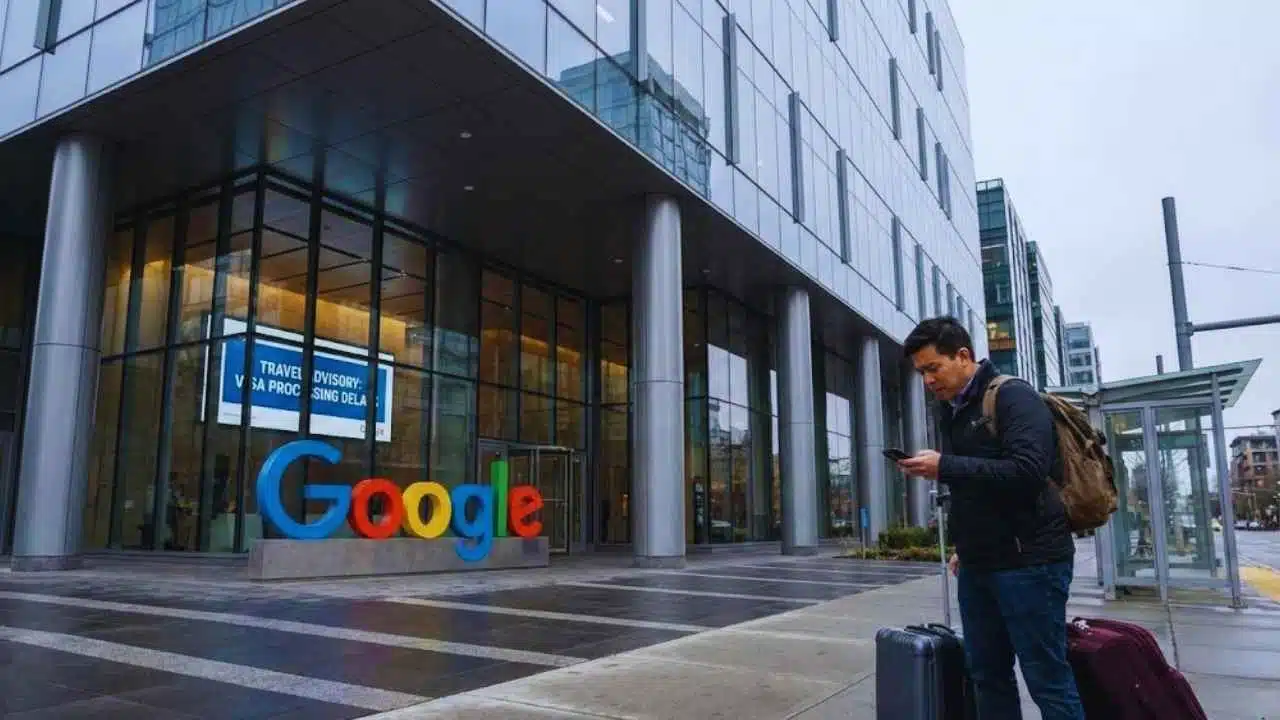
Google has warned some U.S.-visa employees to avoid international travel after reports of visa-stamping appointment delays that can stretch as long as a year, raising the risk of workers being stuck abroad while consulates apply new social-media screening rules.
What Google told visa holders, and why it matters
Google’s advisory was circulated internally through the company’s immigration counsel, which told employees who need a visa stamp to re-enter the United States that they could face “significant” appointment delays at U.S. embassies and consulates. The memo cautioned that traveling could mean an unexpectedly long stay outside the U.S., even if the employee’s underlying work authorization remains valid.
That distinction is critical for many noncitizens working in the U.S.: a person may have lawful status inside the country (for example, through an approved petition and an I-94 record) but still need a valid visa stamp in their passport to return after international travel. If visa appointments are scarce or pushed far into the future, a short trip can turn into a months-long disruption.
Google declined to comment publicly on the advisory, according to reporting on the memo.
The policy change driving the delays: expanded “online presence” reviews
The warning comes as U.S. consular posts implement a stricter “online presence review” policy that expands how officers screen visa applicants’ digital footprints.
Under the updated approach:
- Consular officers review social media activity and other publicly available online content during visa adjudication.
- Applicants in several nonimmigrant categories are instructed to set social media profiles to “public” during processing, so officers can view them as part of screening.
- The stated goal is to identify applicants who may be inadmissible or present national security or public safety concerns.
The change is especially consequential because it affects high-volume work and study visa categories used heavily by the technology sector and U.S. universities.
Visa categories affected
Reports surrounding the rollout indicate the screening and disruption are touching multiple categories, including:
- H-1B (specialty occupation workers)
- H-4 (dependents of H visa holders)
- F (academic students)
- J (exchange visitors)
- M (vocational students)
Where delays are being reported
Backlogs and rescheduling have been reported across multiple countries, with particular attention on high-demand posts.
India: rescheduled interviews and longer waits
U.S. consulates in India handle one of the world’s largest volumes of employment-based and student visa applicants. In recent weeks, many applicants have reported cancellations and automatic rescheduling of appointments originally set for mid-December and later, with new dates pushed to March 2026 or beyond. Some accounts describe even longer shifts into later 2026 depending on location and availability.
For workers traveling from the U.S. to India specifically to renew a visa stamp, a sudden reschedule can create a difficult bind: returning to the U.S. generally requires the visa foil, and changing plans on short notice can be expensive or impossible.
Other locations mentioned
Delays and postponements have also been reported in places such as Ireland and Vietnam, underscoring that the issue is not limited to one region.
Why tech employers are especially exposed
Large tech companies rely heavily on global recruiting and on immigration pathways that allow skilled workers to live and work in the United States. Any disruption in visa issuance can hit:
- Product schedules (if engineers or researchers cannot return on time)
- Team staffing (temporary coverage gaps)
- Talent retention (uncertainty for employees and their families)
- Business travel and client commitments
Google’s H-1B footprint
In fiscal year 2025, Google ranked among the top U.S. employers for approvals of new H-1B petitions for initial employment, according to an analysis of government data published by an immigration-focused policy organization. That scale helps explain why an internal travel advisory would be relevant to many teams.
A broader pattern: corporate travel warnings to visa holders
Google’s message is part of a wider corporate trend: when immigration rules or consular operations shift suddenly, employers often urge visa holders to avoid travel unless absolutely necessary.
In 2025, multiple employers have issued guidance during periods of heightened uncertainty—especially when changes affect:
- Appointment availability
- Interview-waiver policies
- Additional vetting steps that slow case throughput
- Fees or procedural changes that alter timelines
For employees, these warnings are typically framed as risk management, not a ban—encouraging people to consult internal immigration teams before booking travel.
What employees on U.S. visas can do now
Immigration attorneys and employer counsel commonly recommend practical steps during consular disruptions:
Before any travel (especially for visa stamping)
- Check appointment wait times at the specific consular post you’d use.
- Confirm whether you need a new visa stamp to return (many do).
- Plan for extended timelines if your appointment is rescheduled or placed into additional processing.
- Carry documentation that supports your role, employer, and status (as advised by counsel).
About social media settings and consistency
Because screening now emphasizes public online information:
- Ensure your social accounts can be viewed if the category and post require it.
- Avoid “cleaning up” in ways that could appear evasive; instead, focus on accuracy and consistency.
- Keep key details aligned across documents and public profiles (job title, employer, education), since inconsistencies can trigger questions.
Note: Individuals should follow advice from their employer’s immigration counsel or a qualified attorney, because requirements and risk levels vary by visa type, travel route, and personal history.
Key dates and what changed
Timeline of the disruption and policy rollout
| Date (2025–2026) | Development | Why it matters |
|---|---|---|
| Early December 2025 | U.S. State Department updates guidance on expanded online presence reviews | Sets the framework for broader digital screening |
| Dec. 15, 2025 | Expanded screening takes effect for additional visa categories, including H-1B/H-4 | Many appointments on/after this date were impacted |
| Dec. 2025 | Reports of cancellations and mass rescheduling at several posts | Applicants face longer wait times and travel uncertainty |
| March 2026 and beyond | Many rescheduled interviews reportedly pushed into this window | Creates risk of being stuck abroad for months |
The H-1B cap and why delays matter beyond tech
The H-1B program is capped by statute for most new cap-subject petitions each year. The cap structure is commonly described as:
- 65,000 under the regular cap
- 20,000 under the advanced-degree exemption (master’s cap)
Although visa stamping delays happen after a petition is approved, they can still create real-world bottlenecks—preventing workers and students from crossing borders even when they have otherwise valid approvals.
High-level snapshot of the affected system
| Item | What it is | Why it matters in this moment |
|---|---|---|
| Visa “stamping” at consulates | The passport visa required for re-entry after travel | Backlogs can strand workers and students outside the U.S. |
| Online presence review | Broader screening of public online content | Adds time and can reduce interview throughput |
| High-volume posts (e.g., India) | Handle massive applicant demand | Appointment scarcity can cascade quickly |
Takeaways
Google’s warning reflects a practical risk: consular appointment delays can keep visa holders outside the U.S. far longer than planned. Expanded online presence reviews are adding friction to already busy visa pipelines, with disruptions reported across multiple countries. The effects extend beyond one company—touching workers, students, and dependents in several major visa categories. For many visa holders, the safest approach right now is to avoid nonessential travel and coordinate closely with an immigration attorney or employer immigration team before leaving the U.S.