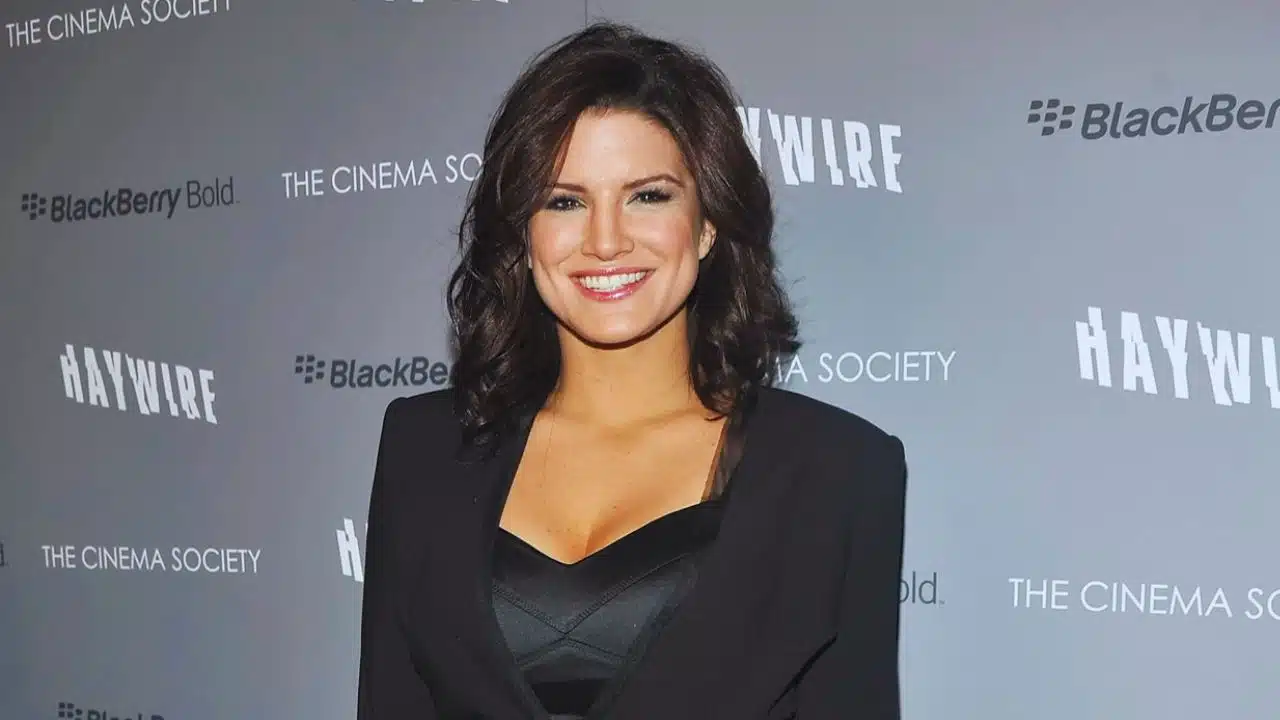
In a development that has attracted widespread public and media interest, Disney has reached a settlement agreement with actress Gina Carano over her highly publicized firing from The Mandalorian, the hit Star Wars series on Disney+. The lawsuit, filed in 2024, was financially supported by billionaire Elon Musk, marking yet another moment in the growing intersection between tech influence, entertainment, and free speech disputes.
A Lucasfilm spokesperson confirmed the settlement on Thursday, effectively closing one of the most controversial entertainment lawsuits in recent memory. While details of the settlement remain confidential, the tone of the official statements suggests a surprising shift from confrontation to potential collaboration.
Background: Gina Carano’s Rise and Fall on The Mandalorian
Gina Carano, a former mixed martial artist turned actress, rose to mainstream prominence through her portrayal of Cara Dune, a fan-favorite character in The Mandalorian. She had previously starred in action films such as Deadpool and Haywire. Her performance in the Star Wars series was widely appreciated, and plans for her own spin-off were reportedly in development before controversy derailed her career at Disney.
However, in February 2021, Lucasfilm announced that Carano would no longer be part of future Star Wars projects. The decision came shortly after she posted a controversial message on Instagram, which appeared to compare the political treatment of conservatives in America to the persecution of Jews in Nazi Germany.
“Because history is edited, most people today don’t realize that to get to the point where Nazi soldiers could easily round up thousands of Jews, the government first made their own neighbors hate them simply for being Jews. How is that any different from hating someone for their political views?”
This message was widely condemned, with many accusing Carano of trivializing the Holocaust. Within hours, #FireGinaCarano trended on social media, and Lucasfilm responded by issuing a strong statement calling her posts “abhorrent and unacceptable.”
Other Controversies: Social Media Patterns and Backlash
The Nazi comparison post was not Carano’s only controversy. Her social media presence had long been a source of tension between her and some fans:
- She mocked mask mandates during the height of the COVID-19 pandemic.
- She refused to display gender pronouns on her social media bio and posted tweets perceived as mocking the transgender community.
- She amplified unverified claims that the 2020 U.S. presidential election had been stolen from Donald Trump, a position widely debunked by multiple court rulings and audits.
These actions triggered widespread fan backlash, led to her being dropped by her talent agency (UTA), and ultimately, fired by Lucasfilm.
The 2024 Lawsuit: Carano’s Allegations Against Disney
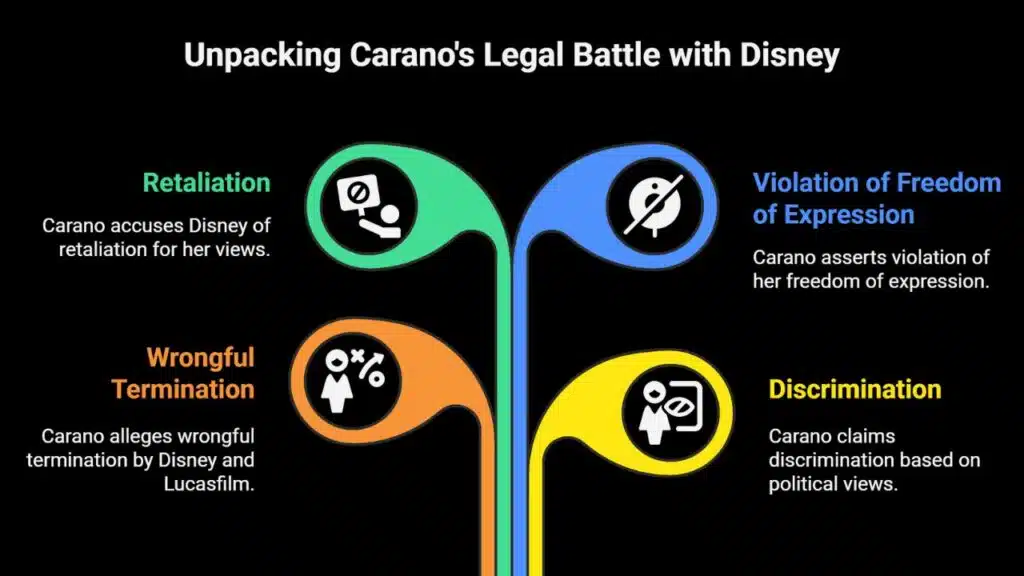
In 2024, Carano filed a lawsuit against Disney and Lucasfilm, accusing the companies of:
- Wrongful termination
- Discrimination
- Retaliation
- Violation of her rights to freedom of expression
She claimed that she was targeted for her conservative political views and that her social media activity was being monitored by Disney. In her lawsuit, Carano alleged that she was pressured to engage in a performative apology tour that she found to be ideologically biased.
LGBTQ+ Meeting Controversy
One of the central claims in the lawsuit was that Disney required Carano to meet with an LGBTQ+ advocacy group after her posts about gender pronouns sparked backlash. Carano refused, citing personal beliefs. Later, she also declined to meet with LGBTQ+ employees within Disney, a move she says led to her termination.
According to the suit, this amounted to “bullying, discriminatory, and retaliatory actions” on the part of Disney and Lucasfilm.
Carano shared her feelings publicly on Elon Musk’s social platform X, writing:
“The truth is I was being hunted down from everything I posted to every post I liked because I was not in line with the acceptable narrative of the time.”
Elon Musk’s Role: A Billionaire Steps In
The lawsuit gained massive attention not just because of Carano’s fame, but because of who financed it—Elon Musk, one of the world’s richest individuals and owner of X (formerly Twitter).
Musk had previously pledged legal support through X Corp to users who believed they were “discriminated against by employers” due to their social media activity on X. He honored that pledge in Carano’s case, stating it was a matter of principle to defend free speech and ideological diversity.
Carano publicly acknowledged Musk’s involvement after the settlement, calling him a “Good Samaritan”, and adding:
“I want to extend my deepest, most heartfelt gratitude to Elon Musk, a man I’ve never met, who did this Good Samaritan deed for me in funding my lawsuit.”
This marks the second major instance in recent years where a billionaire has bankrolled a legal battle against a media or entertainment company. In 2016, tech investor Peter Thiel, Musk’s former business partner, secretly funded Hulk Hogan’s lawsuit against Gawker, which ultimately led to the outlet’s bankruptcy.
Disney’s Statement After the Settlement
Interestingly, Lucasfilm’s statement on Thursday took a much softer tone compared to its 2021 remarks. The spokesperson acknowledged Carano’s contributions to the studio, saying:
“Gina Carano was always well respected by her directors, co-stars, and staff. She worked hard to perfect her craft and treated her colleagues with kindness and respect.”
In what could be seen as an olive branch, the spokesperson added:
“With this lawsuit concluded, we look forward to identifying opportunities to work together with Ms. Carano in the near future.”
This is a notable departure from Disney’s earlier stance, which was uncompromising in its criticism of Carano’s actions and swift in its decision to sever ties.
Gina Carano’s Response: “Healing to the Force”
In her own statement posted to X, Carano called the resolution:
“The best outcome for all parties involved.”
She closed her post with a nod to the Star Wars universe, saying:
“I hope this brings some healing to the force.”
The phrase reflects her enduring connection to the franchise, despite the controversy, and perhaps suggests an openness to future reconciliation.
The Bigger Picture: DEI Programs Under Fire
This legal episode comes at a time when diversity, equity, and inclusion (DEI) programs across corporate America are being intensely scrutinized.
A growing number of corporations are reassessing or rolling back DEI initiatives, amid backlash from conservative political figures and legal challenges. In this climate, many critics argue that “inclusion” policies are being weaponized to silence dissenting opinions, especially those perceived as conservative.
Earlier in 2025, Federal Communications Commission (FCC) Commissioner Brendan Carr, appointed by former President Donald Trump, said that the FCC was launching an investigation into whether the DEI practices of Disney and ABC violated U.S. employment regulations.
This federal scrutiny adds a new layer of complexity to Disney’s legal and public relations landscape, especially as the entertainment giant tries to balance brand values with legal compliance and audience perception.
What This Settlement Means for the Industry
The Carano vs. Disney settlement represents more than just the end of a personal dispute—it highlights the growing tension between corporate image management, employee freedom of expression, and ideological balance in public platforms.
It also shows how powerful figures like Elon Musk can shape the trajectory of public discourse and even legal battles when they step into cultural controversies.
With both parties expressing interest in moving forward amicably, this may not be the end of Gina Carano’s association with the Star Wars universe. Whether or not she returns to the screen, her case has already left a lasting impact on Hollywood’s handling of online expression, corporate accountability, and the evolving boundaries of free speech in the entertainment industry.
The Information is Collected from NBC News and NYPost.