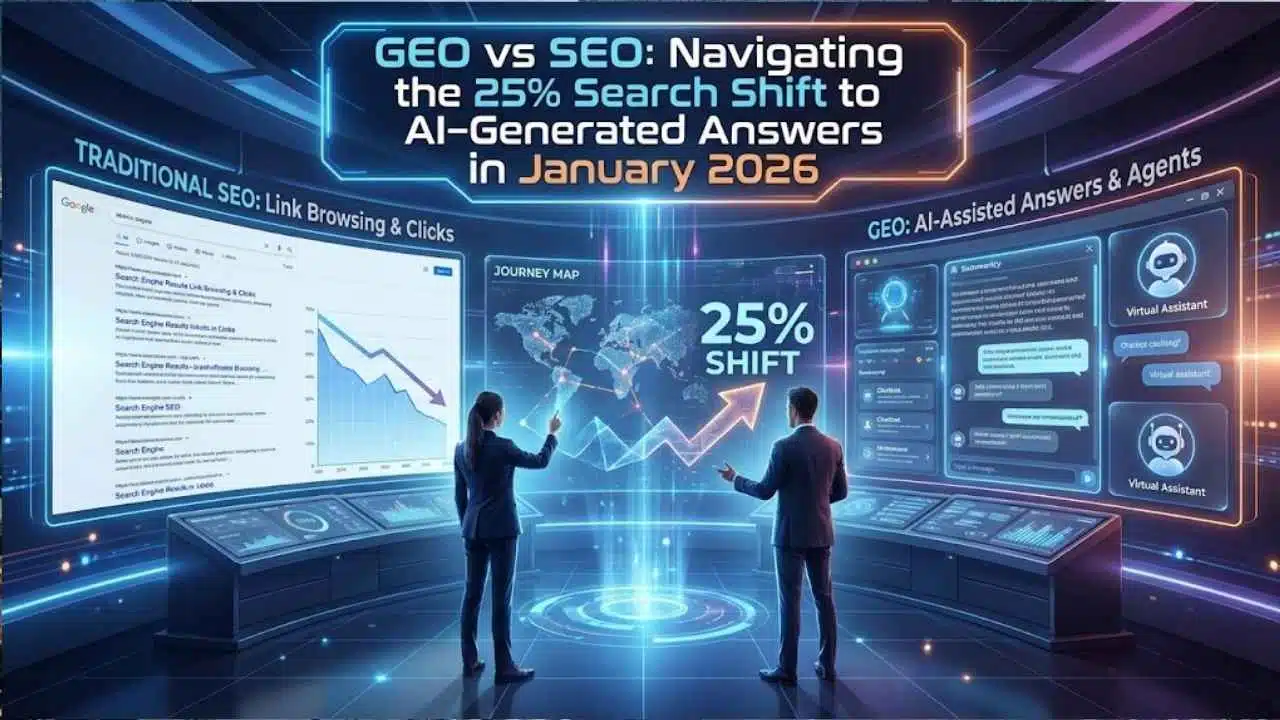
Search is changing faster than most content and growth teams can re-platform their playbooks. In January 2026, the “answer layer” is no longer a side feature. It is where a growing share of discovery, comparison, and decision framing now happens.
The headline claim powering many boardroom conversations is the “25% shift.” It traces back to a Gartner prediction (published February 19, 2024) that traditional search engine volume will drop 25% by 2026 as users move to AI chatbots and virtual agents. That prediction is not a January-only measurement. Still, it matches what many teams see in analytics: more queries end with an AI-generated answer, fewer clicks flow to the open web, and attribution gets harder as journeys fragment across assistants, search, and apps.
This is the moment where GEO vs SEO stops being a niche debate and becomes a budget line item.
Key Takeaways
- The “25% shift” is best treated as a directional forecast about attention moving from link browsing to AI-assisted answers and agents.
- SEO still matters for discovery and demand capture, but GEO matters for representation inside the answer itself.
- AI summaries can reduce clicks, especially for informational queries, which forces publishers and brands to measure influence, not only sessions.
- The biggest GEO risk is misrepresentation, including incorrect facts, unsafe health guidance, and brand-damaging errors.
- Winning in 2026 means building “source-of-truth” content that is easy to extract, consistently branded, and updated with clear ownership.
Why January 2026 Feels Like A Tipping Point
January 2026 feels different because three forces are moving at once. Product design is shifting toward AI-first answers in mainstream search interfaces. User habits are adapting quickly because AI summaries reduce effort. Public scrutiny is rising as high-profile mistakes turn AI answers into headline news.
Google’s AI-generated summaries, often referred to as AI Overviews, have become a highly visible example of this transition. They also illustrate the tradeoff that defines the era: convenience at scale, with real accuracy and safety risks. Early January 2026 reporting highlighted cases where AI Overviews surfaced misleading health advice, including guidance experts described as dangerous. That kind of coverage matters because it shapes trust, regulatory attention, and how aggressively platforms expand AI answers into high-stakes categories.
At the same time, Google’s roadmap points toward deeper conversational search experiences. Around Google I/O 2025, the company emphasized expanding AI experiences in Search, including “AI Mode” framing in industry coverage. Even when the exact feature names evolve, the direction stays consistent: search experiences that keep users inside an interactive answer flow.
What The “25% Search Shift” Actually Means
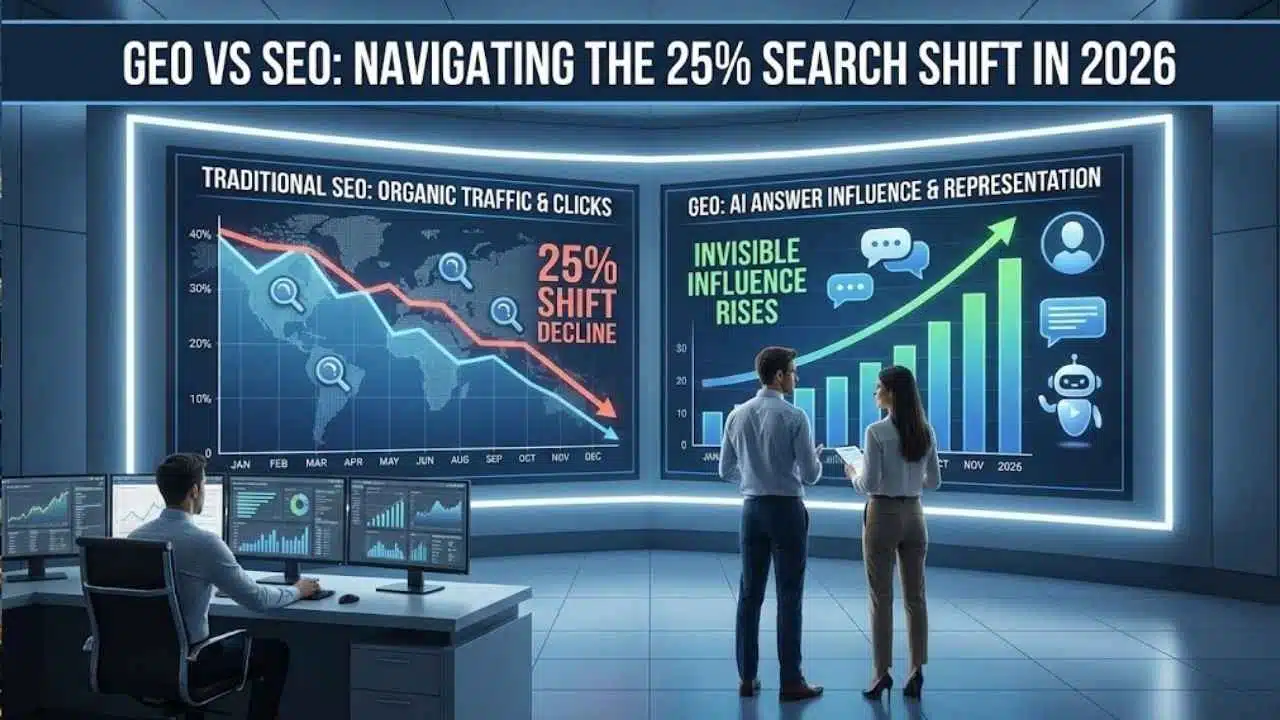
The “25%” number has become shorthand, but it needs careful interpretation. Gartner’s February 19, 2024 statement focuses on traditional search engine volume. It argues that AI chatbots and virtual agents will take share from classic search behavior by 2026.
That does not automatically translate into “25% less organic traffic for every website.” It also does not mean January 2026 saw an instant 25% collapse. Instead, it signals a structural change in how people solve problems.
In practice, the “25% search shift” shows up in three overlapping ways.
First, some query demand migrates to chat-style tools. Users ask an assistant to summarize, compare, or plan, rather than typing five separate searches. Second, more searches end without a click because the summary answers the question. Third, attribution becomes less linear because AI answers influence decisions without sending the user to a source page.
For marketers, the operational conclusion is simple. You must plan for more “invisible influence” and fewer measurable visits.
GEO vs SEO, The New Win Condition
SEO optimizes for ranking and clicks in a link-based ecosystem. GEO, or generative engine optimization, optimizes for inclusion and accurate representation inside AI-generated answers. In 2026, you usually need both.
SEO asks, “How do we rank for the query and win the visit?” GEO asks, “How do we become a trusted input to the model so our brand, facts, and positioning appear correctly in the answer?”
That difference changes what “winning” looks like. A page can lose traffic even as it gains influence if an AI summary references it, paraphrases it, or learns a product’s facts from it. Meanwhile, another page can rank well but fail GEO if its facts are inconsistent, its language is ambiguous, or its positioning is hard to extract.
This is why GEO vs SEO is not a theoretical conversation anymore. It is a shift in what you optimize for, how you measure impact, and how you protect brand accuracy.
How AI-Generated Answers Change The Economics Of Attention
The click economy shaped modern content strategy. You publish, you rank, you get sessions, you monetize through ads, leads, or sales. AI-generated answers compress that chain.
When a summary appears, users often finish their journey on the results page. Pew Research Center analysis discussed in 2025 found that Google users who encountered an AI summary were less likely to click links than users who did not see one. The same analysis also suggested users often ended their browsing session earlier when an AI summary appeared.
This does not mean all clicks disappear. It means informational and mid-funnel research queries become more “answerable” without a visit. That creates uneven impact by industry.
Publishers that depend on high-volume explainers feel the pressure first. Brands that rely on educational top-of-funnel content also feel it, especially when their pages answer common “what is” and “how to” questions. Transactional and local queries can remain click-heavy, but the direction of travel is clear: more intent gets satisfied inside the interface.
That forces a new question: if fewer users visit your site, how do you still earn mindshare and preference? GEO offers a partial answer, but it introduces new risks.
The Misinformation And Brand Safety Problem Is Not A Side Story
When an AI answer is wrong, the harm can be immediate. That is especially true for health, finance, and legal topics. January 2026 coverage highlighted examples where AI-generated summaries provided misleading health guidance and potentially harmful recommendations.
Even outside health, basic factual errors can go viral. In early January 2026, an incident involving an AI Overview response to a time-related question circulated widely on social media and drew commentary. These moments matter because they shape public perception of AI answers as something that can be confident and incorrect.
For brands, this is not just a platform problem. It becomes a brand safety issue when the model misstates your pricing, misrepresents your features, or confuses your product with a competitor. It becomes a compliance risk when an AI answer attributes regulated claims to your brand.
So the GEO challenge is two-sided. You want presence in answers, but you also need controls and monitoring so the answers do not distort your meaning.
What Counts As A Generative Engine In 2026
GEO can sound like a single tactic aimed at one platform. It is not. In 2026, “generative engines” span several environments.
First, there are AI layers inside traditional search engines. AI Overviews represent this category, where a summary sits above classic results and influences clicks. Second, there are answer-first engines that synthesize and cite sources as the main interface, rather than an add-on. Third, there are general chatbots used as discovery tools, where users ask for comparisons, recommendations, and step-by-step help. Fourth, there are agents that take actions, choose options, and automate parts of the journey.
The key point is that each environment changes the funnel. Link-based search routes attention outward. Answer-first systems route attention inward. Agentic systems may skip browsing almost entirely, especially for repeatable tasks like booking, procurement shortlists, and customer support troubleshooting.
That is why GEO vs SEO needs to be framed as a portfolio. You optimize for link discovery and for answer inclusion, depending on query type and audience behavior.
The Core Mechanics Of GEO
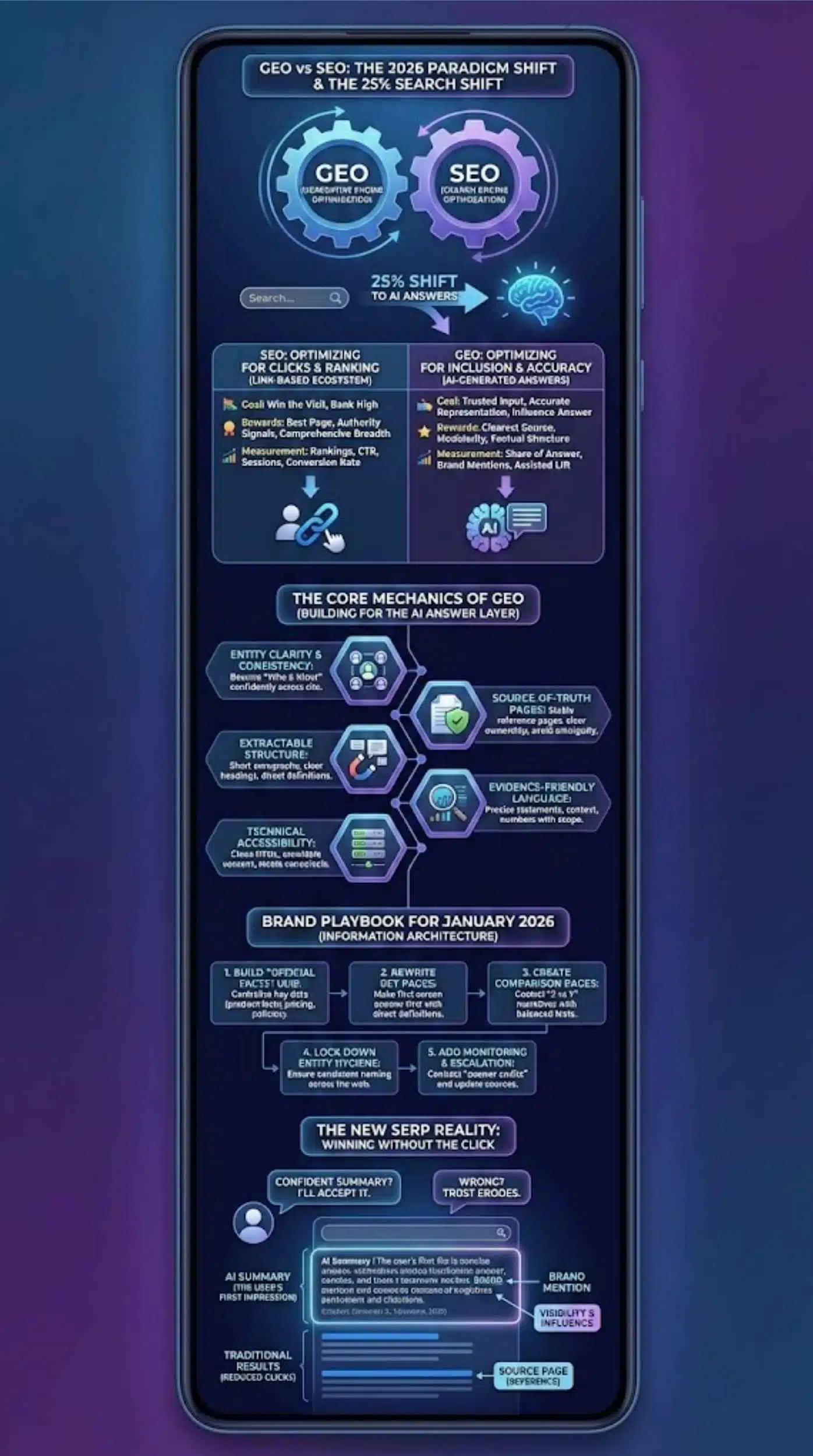
GEO is still evolving, but several mechanics show up repeatedly across systems.
Entity Clarity And Consistency
Generative systems need to resolve “who and what” confidently. You help them by maintaining consistent names, descriptions, leadership bios, and product taxonomy across your site. If you use multiple terms for the same feature or your brand appears differently across pages, models can infer the wrong thing.
Source-Of-Truth Pages That Do Not Drift
GEO rewards stable reference pages. These include pricing rules, product specs, compatibility, return policies, security documentation, and official comparisons. These pages should have clear ownership and update dates, and they should avoid marketing ambiguity that creates contradictory interpretations.
Extractable Structure
AI systems reuse content that is easy to lift. That means short paragraphs, clear headings, direct definitions, and scoped answers. A model can summarize a clean “What It Is” section faster and more safely than a long narrative with mixed claims.
Evidence-Friendly Language
Avoid vague superlatives when facts matter. Use precise statements with context. If you mention numbers, attach time frames and scope. That reduces the chance of the model generalizing your claim into something inaccurate.
Technical Accessibility
Classic technical SEO remains foundational. If your pages are slow, blocked, or poorly rendered, you lose both SEO and GEO inputs. Clean HTML structure, crawlable content, and stable canonical signals still matter because models and search systems rely on accessible source content.
GEO vs SEO In Practice, A Side-By-Side View
The easiest way to operationalize this shift is to compare what each discipline rewards.
SEO rewards content that matches intent, earns authority signals, and competes well on link-based result pages. GEO rewards content that can be summarized accurately, attributed correctly, and trusted as a stable reference.
In SEO, you often win by being the best page. In GEO, you often win by being the clearest source.
This changes content design. SEO content can succeed with comprehensive breadth, as long as it ranks. GEO content succeeds when it is modular, factual, and structured.
It also changes measurement. SEO teams look at rankings, CTR, sessions, and conversion rate. GEO teams need new indicators like share of answer, frequency of brand mentions, and assisted conversion lift.
None of this makes SEO obsolete. It simply means traffic is no longer the only output that matters.
The New SERP Reality, Where GEO And SEO Collide
The search results page now behaves like a product, not a list. When AI summaries appear, they become the user’s first impression of a topic. That impression shapes whether a user clicks, refines the query, or stops searching.
This creates a new kind of competition. You can “rank” without being seen if the summary satisfies intent. You can also be seen without being clicked if the summary references you. That is visibility without traffic, which breaks many legacy ROI models.
It also changes how users evaluate credibility. If the summary is confident, many users accept it. If it is wrong, trust erodes, and users may either click more or abandon the feature. The future likely includes constant iteration, with more guardrails in sensitive categories and more expansion in low-risk informational domains.
For teams planning in 2026, the tactical move is to map your highest-value queries into categories.
Informational queries face the highest “answer risk.” Comparison queries often get summarized. Troubleshooting gets compressed into steps. Transactional queries remain more click-oriented, but AI tools increasingly help users choose among options before they click.
Who Wins And Who Loses In 2026
Winners and losers depend on whether you sell products, publish content, or do both.
Brands with strong differentiation can win if they provide clear source-of-truth content. If an AI summary mentions your product as the best fit for a use case, that is high-value influence. Brands with weak entity signals and inconsistent claims lose because the model misrepresents them or ignores them.
Publishers face a sharper impact because they monetize attention directly. Commodity explainers become easy to summarize away. Original reporting, exclusive interviews, and proprietary data remain harder to replace. Opinionated analysis can also survive because it offers a distinctive frame, not just facts.
This is where editorial strategy matters. If your content is easily compressible, you need a new moat. That moat can be originality, community, or direct distribution like newsletters and subscriptions.
A Practical Playbook For Brands In January 2026
Brands should treat GEO as information architecture, not a hack.
Build A Small “Official Facts” Hub
Start with the pages AI systems most often misstate. Product facts, pricing logic, plan differences, return policies, security and compliance, and compatibility lists belong here. Give these pages clean headings and stable URLs so they act like references.
Rewrite Key Pages For Answerability
Take the top 20 pages that drive demand capture and make the first screen answer-first. Lead with a direct definition or value statement. Follow with scoped bullets that clarify who it is for, what it does, what it does not do, and the primary differentiator.
Create Comparison Pages That You Control
Users love “X vs Y” queries. If you do not provide an official comparison, AI summaries may invent one or reuse competitor framing. Publish a balanced comparison that states your strengths honestly and defines category terms clearly.
Lock Down Entity Hygiene Across The Web
Make sure your name, product names, leadership info, and category description match across your site and major profiles. Inconsistency is a compounding GEO tax.
Add Monitoring And Escalation
Set up periodic “answer audits” for your highest-value queries. If you see recurring errors, update your source-of-truth pages and publish clarifications. Treat it like brand reputation management for AI surfaces.
A Practical Playbook For Publishers And Media Sites
Publishers need to shift from “traffic only” thinking to “authority plus distribution.”
Prioritize Original Reporting Over Commodity Explainership
If a topic can be summarized from ten similar articles, it will be. Invest in reporting that adds new facts, not recycled context. Exclusives remain valuable because they become the source that summaries depend on.
Package Facts Into Reusable Reference Blocks
Even original reporting benefits from clear extraction. Add timelines, definitions, “what changed” sections, and structured background blocks that assistants can summarize without twisting meaning.
Build Direct Audience Channels
Newsletters, subscriptions, and community products reduce reliance on search. If AI summaries reduce clicks, direct channels keep your relationship with readers intact.
Establish Correction-Ready Workflows
AI answers can misattribute and distort. Publishers should make corrections and updates obvious. Clear corrections help humans and can also help systems that ingest updated pages.
Measurement In 2026, How To Track GEO Without Lying To Yourself
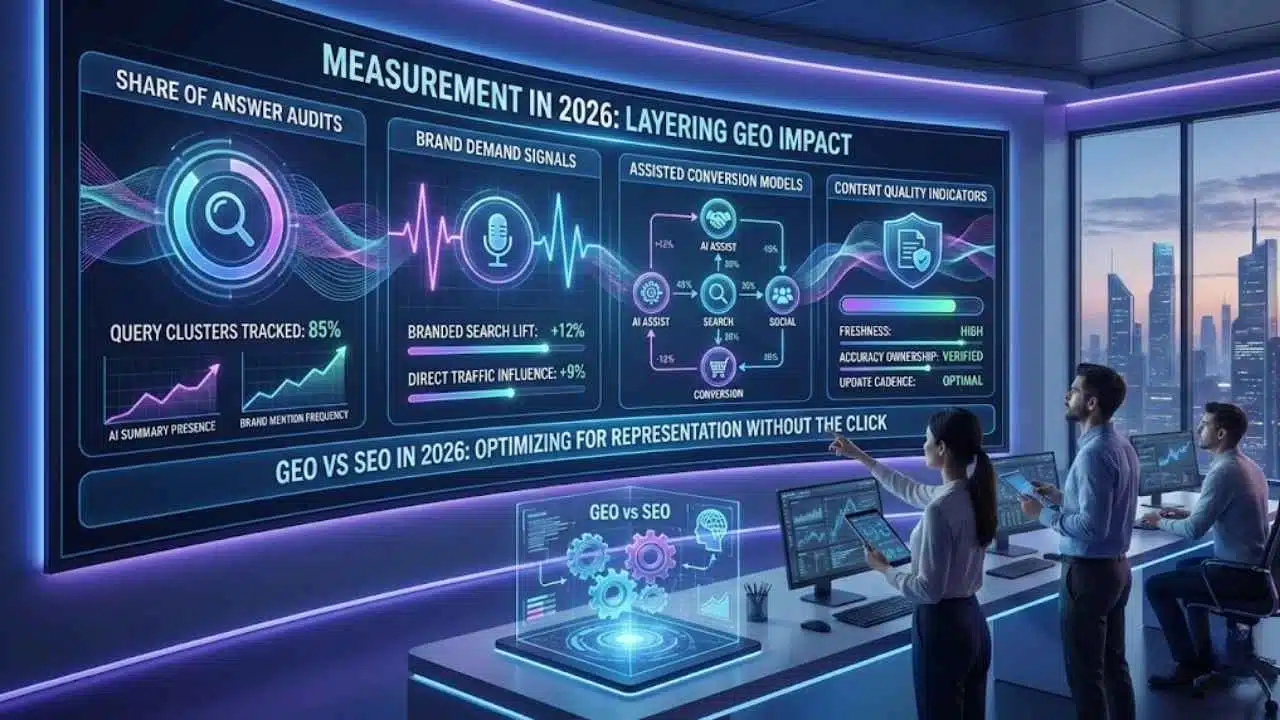
Most teams will underestimate GEO impact if they only track sessions. You need a layered measurement model.
Pick a fixed set of priority queries. Track whether AI summaries appear and whether you are mentioned or cited. Do this monthly. You will quickly see which query clusters are moving toward answer-first behavior.
Brand Demand Signals
If AI answers mention your brand, you may see more branded searches later. You may also see direct traffic lift. Treat these as part of the same influence chain, not unrelated noise.
Assisted Conversion Models
Update attribution to include assisted touchpoints. It will never be perfect, but you can still observe directional changes. If organic sessions fall but branded conversions rise, you may still be winning.
Content Quality Indicators
Track content freshness, accuracy ownership, and update cadence on source-of-truth pages. GEO depends on stable truth. If your “official” pages drift or conflict, your representation will degrade.
Around this point in the article, it helps to restate the strategic focus keyword clearly: GEO vs SEO in 2026 is about optimizing not only to rank, but to be correctly represented when the user never clicks.
The Most Common Mistakes Teams Make When Chasing GEO
Many teams will move fast and still miss the point. Here are the mistakes that cost the most.
First, they treat GEO as a prompt-writing exercise. Prompts help users, but they do not create durable visibility. Your durable visibility comes from having clear, accessible, consistent source content.
Second, they optimize only for inclusion and ignore accuracy. If the answer is wrong, visibility becomes liability. The January 2026 wave of coverage around health misinformation is a warning. Speed without safeguards creates reputational risk.
Third, they ignore entity consistency. If your product naming varies across pages, assistants may merge features, invent plan differences, or confuse your brand with another.
Fourth, they measure only last-click ROI. That guarantees they will cut investments that still build demand through answer surfaces.
What To Watch Next Through 2026
The search ecosystem will not stabilize quickly. Platforms will keep iterating.
Expect continued changes in how AI summaries show sources and links. Expect stricter guardrails in high-stakes categories, especially health. Expect more “agentic” experiences that reduce the role of browsing for repeat tasks. Expect growing debates about publisher value and compensation as summarization expands.
For strategy, this means two things. You should build resilient content systems that work whether the user clicks or not. You should also diversify distribution so your business does not depend on one interface layer.
Final Thoughts
The January 2026 shift is not a single product launch. It is a new default: more users receive answers, fewer users browse links, and more influence happens without a measurable visit.
The “25% by 2026” prediction matters most as a planning signal. It tells you that attention will continue moving toward chatbots and virtual agents, which changes the economics of search marketing. Your response should not be panic or denial. Your response should be a dual strategy that protects classic SEO while building GEO readiness.
In practical terms, GEO vs SEO is the difference between winning the click and winning the answer. In 2026, you often need to win both. Build source-of-truth pages, strengthen entity signals, structure content for extraction, and measure influence beyond sessions. Then put monitoring and brand safety on the same level as growth, because the cost of being wrong is rising.