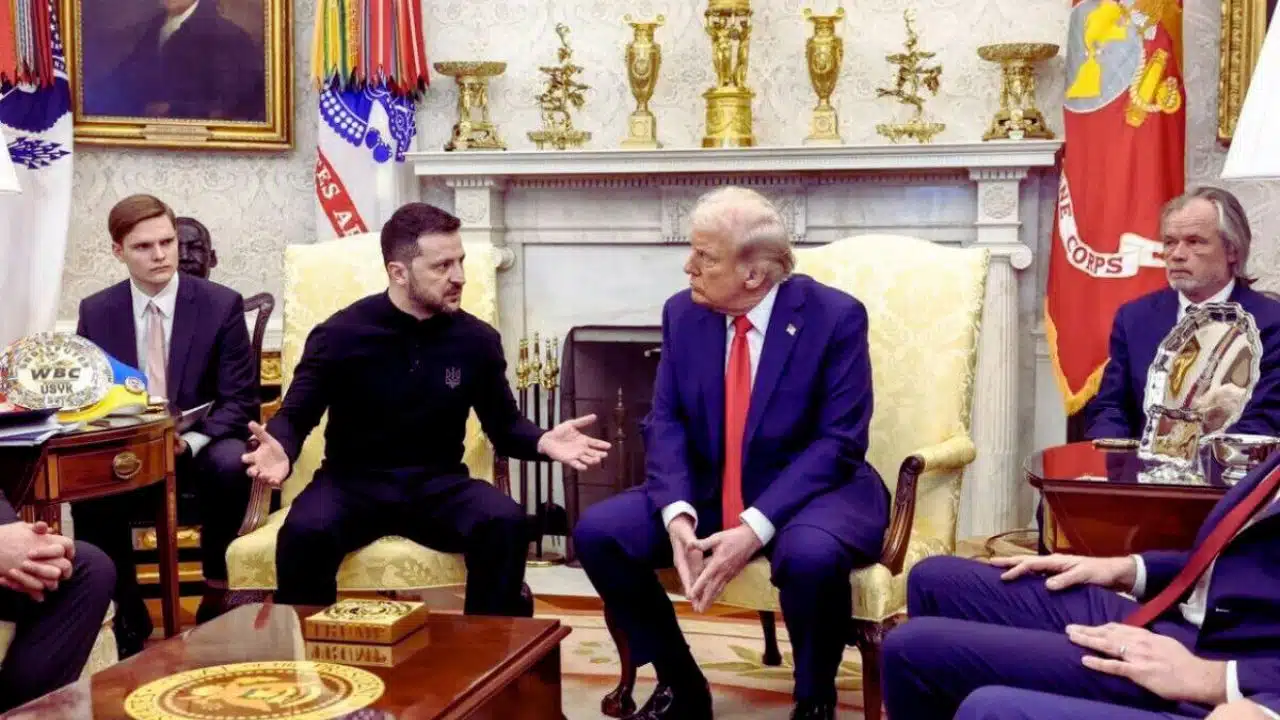
European leaders have entered a direct clash with U.S. President Donald Trump over his Ukraine peace plan, after a tense phone call exposed deep disagreements on how quickly to end the war and how much territory Kyiv should concede to Russia. The rift has raised fresh doubts about Western unity just as Ukraine sends a revised proposal to Washington and seeks firm backing from its main European allies.
Tense call over Ukraine peace
In recent days, European leaders clashed with Trump in tense Ukraine peace talks during a multi‑leader phone call that included German Chancellor Friedrich Merz, French President Emmanuel Macron and UK Prime Minister Keir Starmer. Trump later acknowledged that pretty strong words were exchanged as he pressed his counterparts to support a U.S. peace plan that Kyiv and several European capitals consider too favorable to Moscow. The call came after Trump publicly criticized Europe’s handling of the war and signaled he is tired of lengthy negotiations, warning he could skip a proposed weekend summit in Europe if he believes it would waste time.
The core dispute centers on a U.S.-backed proposal that would require Ukraine to surrender the entire Donbas region and sharply reduce the size of its armed forces in exchange for a formal end to the conflict. Many European governments and Ukrainian officials see those terms as close to capitulation, arguing they would reward aggression and undermine long‑term security on the continent. While Trump has insisted his plan is the fastest route to stop the fighting, his impatience with both Kyiv and European allies has fueled fears that Washington could step back if others do not quickly accept his framework.
European pushback and Ukraine’s stance
European leaders have been working to produce a joint response that acknowledges Trump’s initiative but rejects the most far‑reaching territorial concessions and military limits he is demanding from Kyiv. At a recent G20‑side gathering, Western leaders scrambled to coordinate language that thanked Washington for its efforts while firmly stating that Ukraine’s sovereignty and future security cannot be negotiated over its head. Several EU states have also promoted an alternative approach that starts with an immediate ceasefire along the current line of contact, followed by phased talks on political and security arrangements rather than a one‑shot deal.
Ukraine, for its part, has sent a revised counter‑proposal to the White House that seeks to narrow differences without accepting what officials describe as Russia‑leaning red lines. President Volodymyr Zelensky recently met Merz, Macron and Starmer in London to shore up a common front with Europe before responding to Trump, underlining that Kyiv does not want to face a U.S. ultimatum alone. Ukrainian sources have also pushed back on Trump’s claim that Zelensky did not study earlier drafts of the U.S. plan, saying they have already provided detailed written feedback and are prepared for honest work on a compromise that does not legitimize occupation.
Timeline and what comes next
A concise timeline of key diplomatic moves helps explain how European leaders came to clash with Trump in tense Ukraine peace talks:
| Date (2025) | Event | Key actors / significance |
| 20–21 Nov | U.S. peace plan and related documents circulate, outlining major territorial concessions and military cuts for Ukraine; European leaders react cautiously but many describe the package as close to capitulation in private and public commentary. | Trump administration, EU leaders, Zelensky; marks the start of an open split over how far Kyiv should be pushed to compromise. |
| 23 Nov | Policy and think‑tank analyses of Trump’s 28‑point plan argue it tilts toward Russian demands and warn this may be Europe’s last chance to defend its pledges to support Ukraine as long as it takes. | European strategists and diplomats begin drafting counter‑proposals and pressing for the use of frozen Russian assets to bolster Kyiv. |
| Late Nov | EU figures voice concern that an apparent U.S.–Russia thaw and Trump’s plan caught Brussels off guard, forcing the bloc into a reactive posture as it rushes to craft an alternative peace framework. | EU foreign ministers and leaders; pressure grows to show unity and strategic initiative rather than simply responding to Washington and Moscow. |
| 9–10 Dec | Zelensky meets key European leaders in London to coordinate ahead of a new exchange with Trump, while NATO’s chief warns allies they could be Russia’s next target if Ukraine is pushed into a weak deal. | Zelensky, Merz, Macron, Starmer, NATO Secretary‑General Mark Rutte; focus shifts to long‑term European security, not just ending the war quickly. |
| 10–11 Dec | Trump speaks by phone with Merz, Macron and Starmer; both U.S. and European accounts confirm a tense discussion, with Trump complaining about delays and Europeans urging joint work on revised proposals. | White House, Berlin, Paris, London; Ukraine and its allies send a written response to Washington, trying to keep the U.S. engaged while softening the most controversial points. |
Looking ahead, several scenarios are in play: Trump could agree to attend a European meeting if leaders show openness to his core ideas, he could demand further concessions from Ukraine and its allies, or he could start to walk away from mediation efforts altogether. European governments, meanwhile, are racing to finalize a common line that keeps the U.S. inside a united front while insisting that no peace deal can be imposed on Ukraine without its consent. NATO officials warn that the outcome of these talks will shape not just Ukraine’s future, but also whether Russia concludes that military pressure and political division can successfully redraw Europe’s borders.