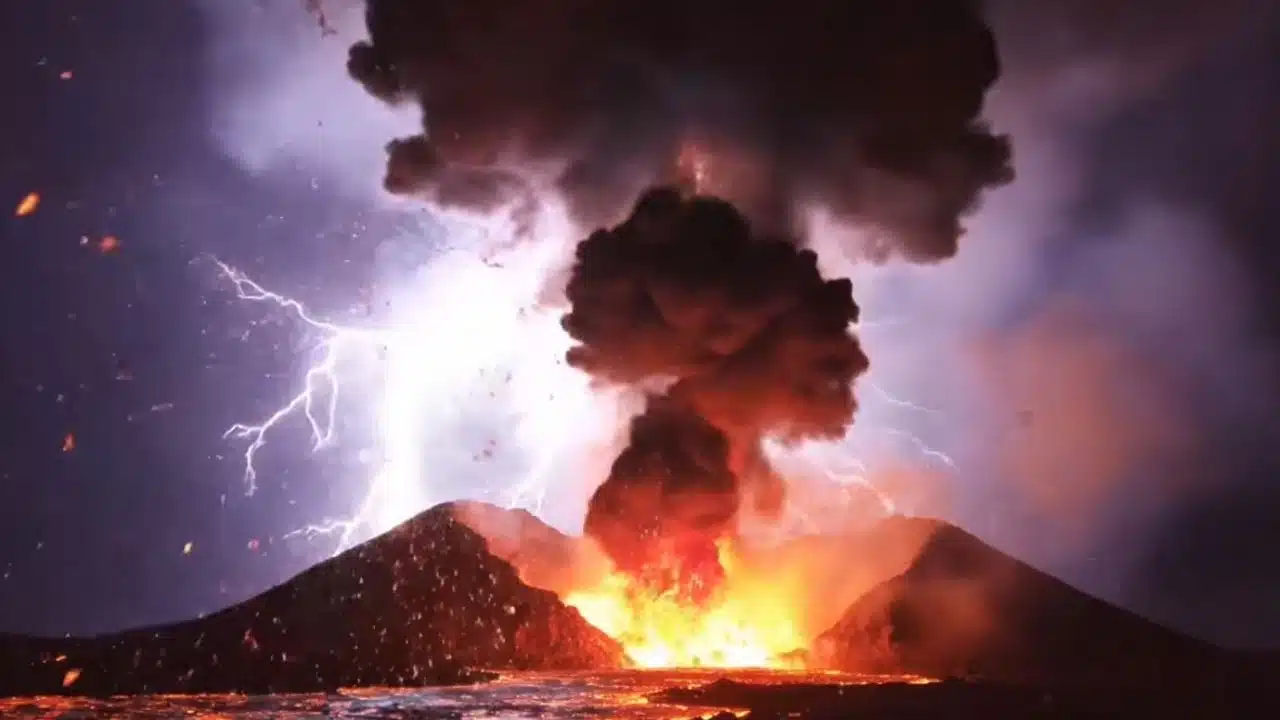
A volcano in northern Ethiopia, known as the Hayli Gubbi volcano, erupted for the first time in nearly 12,000 years, marking one of the region’s most significant geological events in modern history. The eruption occurred early Sunday morning in Ethiopia’s Afar region, a rugged and highly active geological zone where several tectonic plates gradually pull away from each other.
The volcano, which stands about 500 metres above the surrounding terrain, produced a sudden and powerful explosion that sent a towering column of smoke and ash up to 14 kilometres into the sky. Residents living in nearby villages described hearing a “massive blast” that felt like a shockwave ripping through the ground. One local compared it to “a bomb being dropped,” after which the sky rapidly turned grey as ash began to fall on their homes, livestock, and farmland.
This eruption is significant because Hayli Gubbi has not shown any recorded activity during the entire Holocene epoch—a period spanning roughly 12,000 years. Geological experts note that the region is known for earthquakes and slow volcanic processes, but sudden explosive events of this scale are extremely rare. The eruption also raises concerns about the long-term stability of the Rift Valley, one of the most important tectonic rift systems on the planet.
Images and videos captured from the area showed thick white and grey smoke rising straight into the atmosphere, forming a vast plume visible from dozens of kilometres away. Although some footage circulating online could not be independently verified immediately, scientists confirmed the plume height using satellite imagery.
Local authorities and emergency teams in Ethiopia quickly began assessing damage in the surrounding Afar settlements, particularly checking for ash-related contamination of water supplies and grazing fields. Volcanic ash can harm livestock and crops, making the situation potentially serious for communities that rely heavily on pastoral livelihoods.
Fortunately, there were no immediate reports of casualties, but experts warn that the impact on health, agriculture, and the environment may become clearer in the coming days. Monitoring efforts have been increased to determine whether additional eruptions or seismic activity may follow.
How the Ash Travelled Thousands of Kilometres to India
Once the plume reached high altitudes, the ash was caught by powerful westerly winds moving at around 100–120 km/h. These winds carried the volcanic material eastward across the Red Sea, sweeping it over Yemen, Oman, and the Arabian Sea before pushing it toward the Indian subcontinent.
The ash plume first entered the skies over Gujarat, where it was detected thousands of feet above ground level. It then drifted toward Rajasthan, eventually moving into Delhi, Haryana, and Punjab. Delhi, already suffering from severe air pollution, saw the arrival of ash late on Monday night, adding to the city’s ongoing air-quality concerns.
⚠️ Ethiopia: The Hayli Gobi volcano erupted today for the first time in ten thousand years and sent ash up to a height of 15 km.🔥🔥 pic.twitter.com/aiPVhhO4rr
— Dr. Fundji Benedict (@Fundji3) November 24, 2025
However, weather experts clarified that this volcanic ash cloud differs from typical pollution. While the plume contains sulphur dioxide (SO₂) and fine ash particles, its concentration at ground level in India remained low.
Meteorologists explained that:
- The ash was located mainly at high altitudes, not near the surface.
- It was unlikely to worsen Delhi’s Air Quality Index (AQI).
- The more notable impact would be elevated SO₂ levels in mountainous regions such as Nepal, the Himalayas, and the Terai belt of Uttar Pradesh, where atmospheric circulation could temporarily trap gases before they move eastward into China.
The India Meteorological Department (IMD) confirmed that the ash cloud was steadily drifting northeastward and would likely exit Indian airspace by 7:30 pm on Tuesday. The agency has been closely tracking the plume’s movement using satellite data and upper-air wind models.
Meteorologists noted that long-distance ash transport is not uncommon after volcanic eruptions of this scale, as fine particles can travel thousands of kilometres. The Hayli Gubbi eruption demonstrated how a localized natural event can have trans-continental effects, affecting weather monitoring and aviation across multiple countries.
Aviation Disruptions and Safety Measures Across India
Because volcanic ash poses a serious threat to aircraft—capable of damaging engines, reducing visibility, and interfering with navigation systems—India’s aviation authority responded swiftly. The Directorate General of Civil Aviation (DGCA) issued an advisory instructing airlines to avoid all areas and flight levels affected by volcanic ash. Airlines were told to reroute flights, adjust fuel calculations, and immediately report any ash encounters or suspected engine abnormalities.
The following Air India flights have been cancelled as we carry out precautionary checks on those aircraft which had flown over certain geographical locations after the Hayli Gubbi volcanic eruption.
Our ground teams across the network are keeping passengers…
— Air India (@airindia) November 25, 2025
As a precaution, Air India cancelled eleven flights, primarily those operating on long international routes that may have passed near the ash plume. These included:
- Newark to Delhi
- New York to Delhi
- Dubai to Hyderabad
- Doha to Mumbai
- Dubai to Chennai
- Dammam to Mumbai
- Doha to Delhi
- Chennai to Mumbai
- Hyderabad to Delhi
The airline explained that it needed to conduct special safety inspections on aircraft that had recently flown through potentially affected air corridors. Air India emphasized that passenger and crew safety remained its highest priority and apologized for the unavoidable inconvenience.
Other carriers, including IndiGo and SpiceJet, also reported disruptions and said they had initiated internal safety protocols while maintaining active communication with international aviation monitoring agencies. IndiGo issued a detailed statement reassuring passengers that its teams were tracking the situation hour-by-hour and implementing all necessary protective measures.
Aviation experts highlighted that even small amounts of volcanic ash can melt inside aircraft engines, forming glass-like deposits that can cause power failure. Thus, avoiding ash-laden zones is a standard global practice.
airports in India were also advised to be prepared for sudden visibility changes or operational updates, although no major airport closures were reported.
As the ash plume continues moving away from the region, aviation authorities expect operations to gradually normalize. Still, airlines will likely remain cautious for the next day or two until all affected air routes are completely cleared.