
Stuck staring at error code 8379xnbs8e02328ws right when you need to sync an app or log in? That moment is frustrating, especially when you just want a quick fix that gets you back to work.
This guide walks you through a simple, proven troubleshooting flow: quick checks first, deeper repairs second, and a few “don’t waste your time” tips along the way.
Grab your device, and we’ll troubleshoot this together.
Key Takeaways
- Start with the fast wins: restart the app, your computer, and your modem or router, then double-check your login details and internet access.
- On Windows, repair system files with
DISM.exe /Online /Cleanup-Image /RestoreHealthandsfc /scannow. - Use a clean boot to find conflicts from startup apps, drivers, extensions, VPNs, or security tools.
- If you suspect malware, Microsoft notes its Defender Offline scan runs outside normal Windows and takes about 15 minutes, then restarts your PC.
Common Reasons for the 8379xnbs8e02328ws Error Code
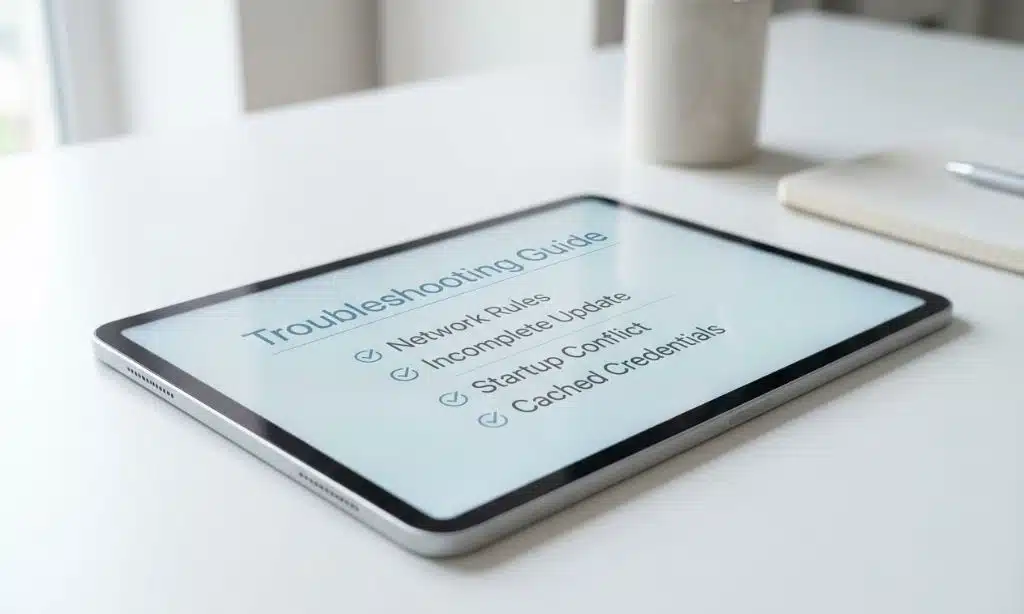
The 8379xnbs8e02328ws error code usually shows up when something blocks authentication (sign-in) or a data sync. In plain English, your app can’t complete a “handshake,” so it throws an error message and stops the workflow.
Most of the time, the root cause fits into a few buckets: corrupted system files, software conflicts, incomplete updates, or network and permission issues.
| What you notice | Most likely cause | Best first check |
|---|---|---|
| Error appears only on one network | Router, DNS, VPN, proxy, or firewall rules | Switch networks (Wi-Fi to hotspot) and retry |
| Error starts after an update | Incomplete update or mismatched system files | Run DISM, then SFC (Windows), or First Aid (Mac) |
| Error happens after installing new software | Startup conflict, extension, driver, or security tool | Clean boot (Windows) or disable background tools |
| Repeated login failures even with correct password | Cached credentials, time/date drift, blocked authentication | Clear saved credentials, verify time/date, retry sign-in |
What Causes Corrupted System Files?
Corrupted system files can break the background services your app relies on, like networking components, encryption libraries, and update services. Malware can also tamper with protected files, which is why “random” system error codes tend to show up after a sketchy download or a browser pop-up scare.
Disk problems can play a role too. If your computer has had sudden shutdown events (power outage, forced power-off, battery failure), it can interrupt a write and leave files half-finished.
- Run a disk check (Windows): If you suspect disk errors, schedule a repair with
chkdsk C: /f. Microsoft’s command reference notes/ffixes file system errors, and you may need to reboot so Windows can lock the drive. - Use Microsoft Defender Offline if malware is a concern: Microsoft explains this scan runs outside the usual Windows environment and takes about 15 minutes, then restarts your device.
- Repair Windows system files: Run DISM, then SFC (steps below). This combination often resolves “corrupt system files” problems without reinstalling Windows.
How Do Software Conflicts Trigger This Error?
Software conflicts happen when another tool hooks into your browser or network traffic, blocks a login window, or prevents an app from reaching its server. In real life, this is often caused by a VPN, a proxy, a password manager, an ad blocker, or endpoint security software that inspects encrypted traffic.
If the error 8379xnbs8e02328ws code shows up right after you installed something new, treat that timing as a clue.
- Try a clean environment: A Windows clean boot starts the system with only essential services and helps you spot the specific software causing the conflict.
- Check extensions: In browsers like Google Chrome, temporarily disable extensions (especially ad blockers, script blockers, and privacy tools), then retry the login or sync.
- Use Windows Reliability Monitor to connect the dots: Dell documents that you can open “View reliability history” or run
perfmon /relto see a timeline of app failures and recent installs, which helps with root cause analysis.
Why Do Incomplete Updates Lead to This Issue?
Updates can fail mid-install when your connection drops, storage is low, or a restart gets interrupted. That can leave the operating system or application software in a “mismatch” state, where some files are new and others are old.
When that happens, authentication components, network services, or app dependencies may not load correctly, and the error is returned during a sync or login attempt.
- Finish pending updates: Install updates for your operating system and the specific software that’s failing, then restart.
- Free up space before retrying: Microsoft notes Storage Sense can automatically clean temporary files when your device is low on disk space, which can make updates more reliable.
- On macOS: Apple Support recommends running Disk Utility’s First Aid to check and repair directory and formatting issues that can cause unexpected app behavior.
Quick Solutions for Fixing the Error
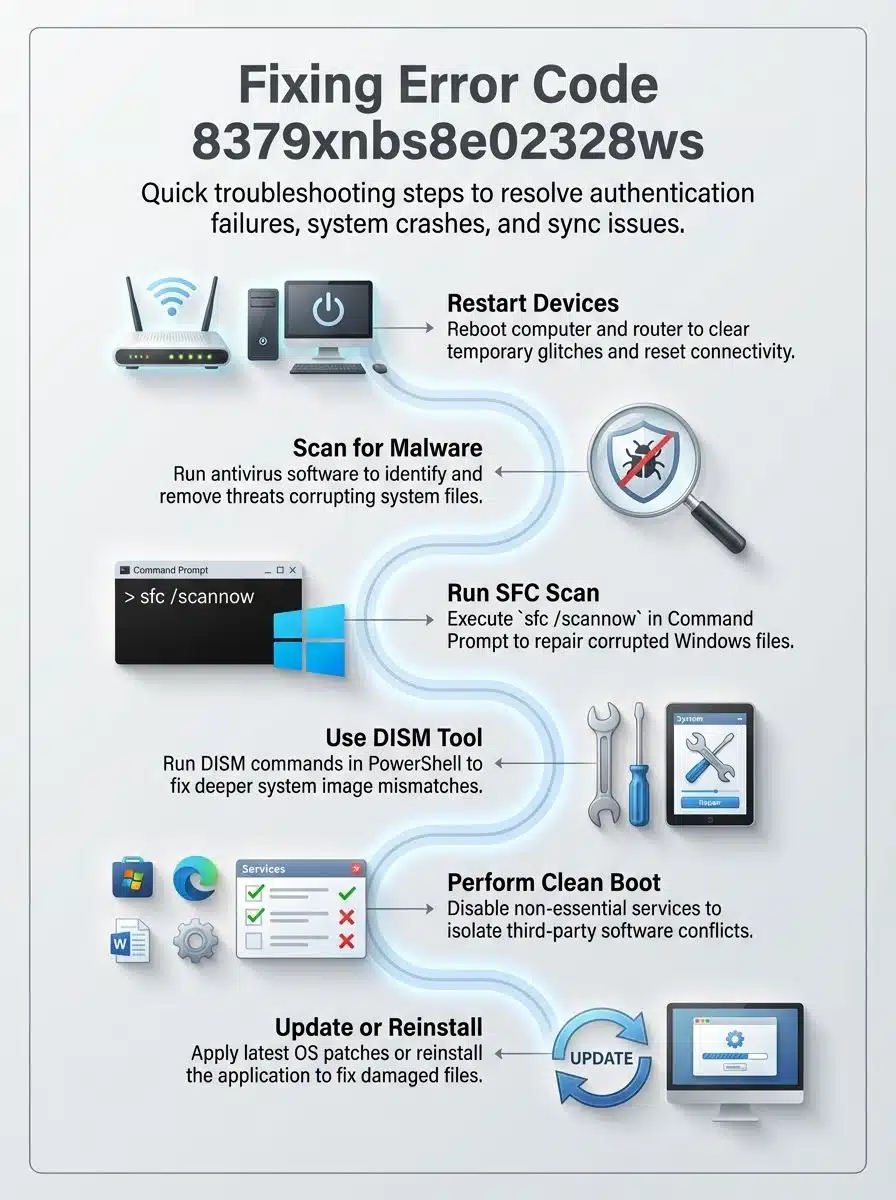
If you want the shortest path to “fixed,” work top to bottom. Stop once the error disappears.
Start Here: A 10-Minute Troubleshooting Checklist
- Close the app completely, then reopen it and try again.
- Restart your computer.
- Confirm you have internet access (load a couple of sites, then retry the app).
- Switch networks (Wi-Fi to phone hotspot) to isolate router or ISP issues.
- Temporarily turn off VPN and proxy tools, then test.
- Verify your device time and time zone are correct (authentication can fail when time is way off).
- Try the same account in a different browser or on a different device to see if it’s device-specific.
How Can Restarting Your System Help?
A restart clears temporary software glitches, resets background services, and often fixes a one-time crash during authentication updates or data sync.
- Restart the PC first: This clears stuck processes and releases locked files.
- Power-cycle your modem and router: Many ISP support guides recommend unplugging the modem for at least 30 seconds, plugging it back in, then waiting about 1 to 2 minutes for it to reconnect before powering the router back on.
- Quick network sanity check: If mobile hotspot works but home Wi-Fi fails, your router, DNS settings, or firewall rules are the likely trigger.
How Do You Run System File Checks?
System file checks can repair damaged Windows components that apps depend on. This is especially useful after malware cleanup, a power outage, or a failed patch (computing) install.
- Run DISM first: Microsoft Support’s system repair steps recommend running
DISM.exe /Online /Cleanup-Image /RestoreHealthbefore SFC so Windows has a healthy source for repairs. - Then run SFC: Open an elevated Command Prompt and run
sfc /scannow. Let it finish to 100% before closing the window. - If disk errors are likely: Run
chkdsk C: /fand accept the restart prompt to schedule repairs.
What Is a Clean Boot and How Do You Perform It?
A clean boot starts Windows with only essential Microsoft services and drivers. It’s one of the fastest ways to diagnose which specific software is triggering the error 8379xnbs8e02328ws.
- Sign in as an administrator.
- Open System Configuration by searching for msconfig.
- On the Services tab, select Hide all Microsoft services, then choose Disable all, and select Apply.
- On the Startup tab, select Open Task Manager, then disable each enabled startup item.
- Restart and test the app again.
- If the error disappears, re-enable services and startup items one at a time until you identify and fix the conflict.
Microsoft Support warns that some functionality may be temporarily reduced in a clean boot environment, and workplace devices may block these changes due to policy settings.
Advanced Troubleshooting Steps (If the Error Persists)
If you’ve already restarted, repaired system files, and tested a clean boot, you’re left with higher-impact moves. These are still safe, but they change system settings more noticeably.
| Action | What it helps you diagnose | Trade-off |
|---|---|---|
| Network reset (Windows) | Corrupt adapter settings, broken DNS, stuck proxy, bad virtual adapters | Removes and reinstalls adapters, you may need to re-add Wi-Fi and VPN settings |
| Allow the app through Windows Defender Firewall | Firewall blocking the app’s data communication | Only do this for apps you trust |
| Clear saved credentials | Wrong cached username, password, or token | You’ll sign in again everywhere that used those credentials |
| Reinstall the specific software | Corrupted app files, damaged cache, bad patch | Takes time, may require reconfiguring settings |
Reset network settings (Windows 11 or Windows 10): Microsoft’s network troubleshooting steps note that a network reset reinstalls network adapters and restores their settings to defaults after your PC restarts. Use Settings, then Network & internet, then Advanced network settings, then Network reset.
Check firewall rules the safer way: Microsoft Support notes it’s generally safer to add an app to the allowed apps list than to open a port, because an allowed app only opens required ports when needed.
Clear stored sign-in details: On Windows, you can open Credential Manager from Control Panel and delete saved credentials tied to the affected app or service, then try to log in again.
Preventive Tips to Avoid the Error Later
You can’t prevent every system error code, but you can lower how often you hit issues like this.
- Keep updates boring: Install operating system and app updates when you have stable internet access and enough battery or wall power, then restart to finish the install cleanly.
- Protect against corruption: Turn on built-in disk cleanup tools. Microsoft notes Storage Sense can remove temporary files automatically when storage runs low.
- Back up your data: Microsoft describes File History as an automatic backup feature for personal files to an external drive or network location. On Mac, Apple documents Time Machine as a built-in backup option that can run on external drives and supported network destinations.
- Be picky about startup apps: Fewer auto-start tools means fewer conflicts during login and sync workflows.
- Do a periodic malware check: Use your antivirus software’s full scan, and use an offline scan when you suspect a deeper infection.
Frequently Asked Questions
Is error 8379xnbs8e02328ws a Windows-only problem?
No. You might see the error on Windows or macOS, because it often behaves like an application error tied to authentication, sync, or network connectivity.
That said, Windows system files and startup conflicts are common triggers, so Windows-focused troubleshooting steps (DISM, SFC, clean boot) tend to help more often.
What’s the fastest way to diagnose whether it’s my network or my computer?
Switch networks.
If the app works on a phone hotspot but fails on home Wi-Fi, focus on the router, DNS, VPN, proxy, and firewall (computing) settings.
If DISM and SFC find corruption, does that mean my hardware is failing?
Not always. Corruption can come from power loss, interrupted updates, malware, or a crash (computing).
If corruption keeps returning after repairs, then it’s smart to check disk health and consider hardware diagnostics, especially on older drives.
Should I disable my firewall to fix the error?
It’s better to avoid turning off protection. If the firewall is the trigger, allowing the specific app through the firewall is a more controlled fix than disabling it entirely.
When should I seek professional help?
If the error appears across multiple apps, returns right after repairs, or you suspect data loss or a failing drive, it’s time to seek professional help. For work devices, contact your administrator so you don’t break company security policies.
Takeaways
You can usually fix the error 8379xnbs8e02328ws code with a short troubleshooting loop: restart, confirm connectivity, and clear conflicts.
If that doesn’t resolve the error, run DISM and SFC, try a clean boot, and reset network settings if needed.
Scan for malware, check disk health, and keep backups in cloud storage or external drives so a bad update or crash doesn’t turn into data loss.
If it still won’t cooperate, contact app support with the exact error message and the steps you already tried.
FAQs on Fixing The Error 8379xbns8e02328ws Code
1. What is error 8379xnbs8e02328ws?
This error is returned by a system or application, and it gives information about the nature of the error. This FAQ is one of the faqs, a frequently asked questions item about understanding this error in your Technology.
2. What type of error is it?
It is a common error tied to a bad data file (Computer file), a Crash (computing), or a glitch in the network (Computer network). This type of error often points to a Data communication fault.
3. Why do I see this error?
You may see this error after a failed update, corrupted data file, or when an api call fails. Try installing the latest fix file (Patch (computing)) and restarting the app.
4. How do I fix it quickly?
Start with simple, effective solutions: restart the app, reboot the device, check the version of windows, and install updates. Check the security gate (Firewall (computing)), the network box (Router (computing)), Wi-Fi, and RAM (Random-access memory), free Memory if it is low. If a fix seems like a wrench in the gears, use cloud storage or external drives for your data.
5. Do I need advanced technical skills?
Most fixes use basic steps, but if the error hits the api or the hardware parts (Computer hardware), you may need advanced technical skills. Call support when you cannot fix the issue safely.