In a significant diplomatic move, Egypt welcomes the ceasefire agreement reached between Pakistan and Afghanistan, throwing Cairo’s considerable weight behind efforts to de-escalate a conflict that last week brought the two neighbours to the brink of all-out war.
The Egyptian Ministry of Foreign Affairs, in a statement released Tuesday (October 21, 2025), called the truce a “vital step” and urged both sides to “build upon this understanding to achieve durable peace and stability.”
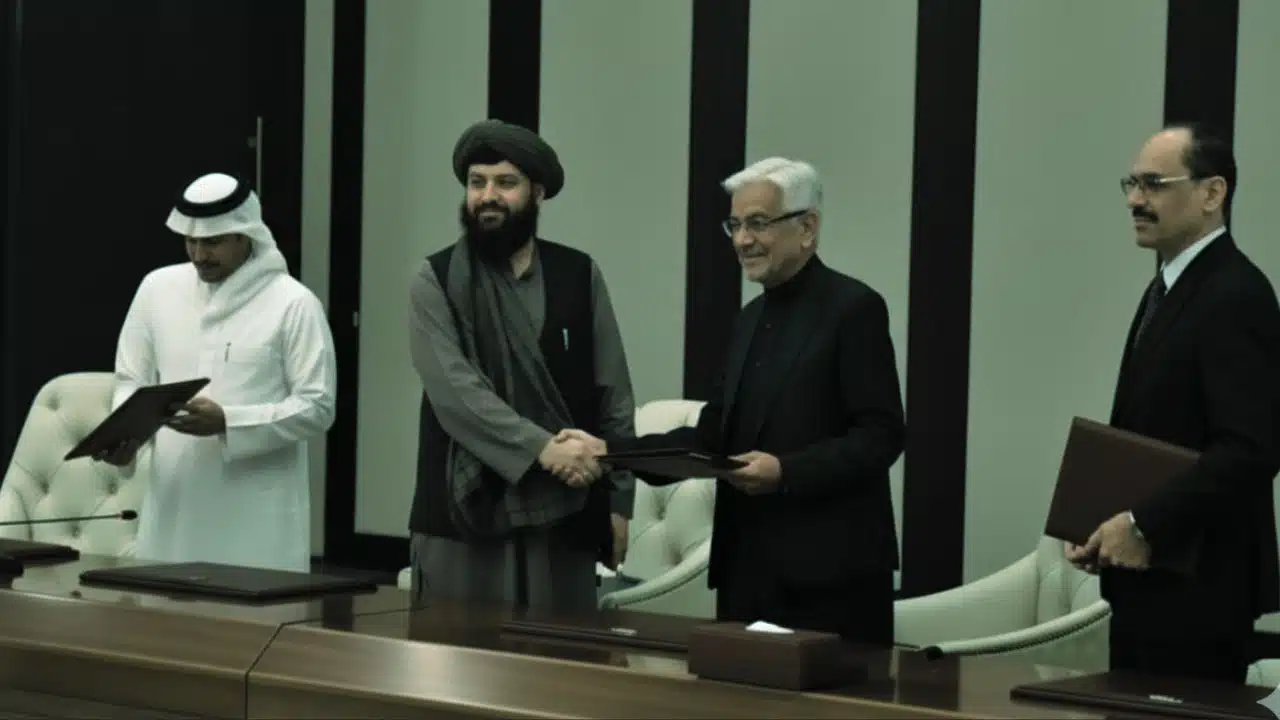
This welcome from Cairo, a key pillar of the Arab world and the Organisation of Islamic Cooperation (OIC), comes just 48 hours after a high-stakes deal was brokered by Qatar and Turkiye in Doha. That agreement (Sunday, October 19) halted more than a week of the most intense cross-border fighting seen in years, which involved airstrikes, heavy artillery, and claims of hundreds of casualties.
While Egypt was not a direct mediator, its formal statement elevates the crisis from a bilateral dispute to a matter of urgent pan-Islamic and international concern. It signals that major regional powers are deeply unsettled by the spiraling instability on the Durand Line, driven by Pakistan’s campaign against the Tehrik-i-Taliban Pakistan (TTP) and the Afghan Taliban’s refusal to recognize the border.
The Torkham-Chaman Crisis
- The Ceasefire: A new, comprehensive ceasefire between Pakistan and Afghanistan was mediated by Qatar and Turkiye in Doha on October 19, 2025.
- Egypt’s Stance: Egypt’s Ministry of Foreign Affairs issued a formal statement on October 21, 2025, welcoming the deal and calling for “sustained dialogue.”
- The Spark: The truce followed a severe 10-day escalation (Oct 9-19, 2025) involving Pakistani airstrikes on alleged TTP camps inside Afghanistan and retaliatory shelling and ground assaults by Afghan Taliban forces at the Torkham and Chaman borders.
- Core Grievance: Pakistan cites a massive surge in TTP terrorist attacks, which it alleges are planned and operated from “safe havens” inside Afghanistan—a claim Kabul denies.
- The Human Cost: The recent clashes killed dozens, including civilians. The United Nations Assistance Mission in Afghanistan (UNAMA) recently noted 37 civilians had been killed and 425 injured in cross-border violence.
- Regional Alarm: Egypt’s statement follows earlier calls for restraint from Saudi Arabia, Iran, and Qatar, indicating widespread alarm over a potential war between two major Muslim nations.
The Ceasefire: A Deal Brokered in Doha
The truce that Egypt welcomed was not easily won. It came after a previous 48-hour “temporary” ceasefire on October 15 collapsed, leading to renewed, intense fighting.
The successful negotiations in Doha, confirmed by both sides on Sunday, October 19, represent a significant diplomatic intervention by Qatar and Turkiye.
In a post on X (formerly Twitter) following the agreement, Pakistan’s Defence Minister Khawaja Asif stated the new understanding was contingent on one core issue: “Cross-border terrorism from Afghan territory will cease immediately.
His Afghan counterpart, represented by Taliban spokesperson Zabihullah Mujahid, also confirmed the deal, posting that “Both sides are committed to resolving issues and disputes through dialogue” and had agreed “not to undertake any hostile actions against the other.
A follow-up meeting is reportedly scheduled for later this month in Istanbul to establish a more concrete monitoring mechanism, a sign that mediators understand the extreme fragility of the truce.
A Border on Fire
The October crisis was the culmination of two years of rapidly deteriorating relations. The core drivers are threefold: the TTP insurgency, the disputed border, and a refugee crisis.
The TTP: Pakistan’s Primary Security Threat
The central cause of the conflict is Pakistan’s domestic war against the TTP. Islamabad has long alleged the TTP uses Afghan soil to launch attacks, a charge that has intensified since the Taliban’s 2021 takeover.
Verifiable data supports the scale of Pakistan’s security challenge.
- 70% Rise in Terror Attacks: A comprehensive security report covering 2024 by the Pak Institute for Peace Studies (PIPS), an Islamabad-based think tank, revealed a catastrophic surge in violence. The country witnessed a 70% increase in terrorist attacks in 2024 compared to 2023.
- Border Provinces as Hotspots: The violence is concentrated on the Afghan border. The PIPS report noted that Khyber Pakhtunkhwa province saw a 69% rise (295 attacks) and Balochistan saw an 84% rise (202 indents) in terrorist attacks during 2024.
- UN Corroboration: Pakistan’s claims of Afghan-based support for the TTP are backed by international bodies. A UN Security Council report from July 2025 noted that the TTP enjoyed “logistical and operational support” from elements within the Taliban administration, which has emboldened the group.
This surge in violence led Pakistan to adopt a more aggressive “hot pursuit” policy, culminating in the controversial airstrikes inside Afghanistan between October 9 and 15, 2025, which triggered the Taliban’s full-scale military response at the border.
The Durand Line and Economic Fallout
Compounding the TTP issue is the 19th-century Durand Line, the 2,670-km border that no Afghan government, including the Taliban, has ever recognized. This leads to constant, localized disputes over fencing and border posts, which in the current high-tension environment, escalate instantly.
The conflict has devastated the already fragile bilateral trade.
- Bilateral Trade Volume (H1 2025): $1.108 billion
- Bilateral Trade Volume (H1 2024): $1.117 billion
While this appears to be a minor dip, it masks the extreme volatility caused by frequent and punitive border closures at Torkham and Chaman. These closures, often lasting for weeks, strand thousands of trucks, rot perishable goods, and spike food prices in landlocked Afghanistan, which relies on Pakistan for transit and imports.
Analysis: Why Does Egypt Care?
On the surface, Egypt is geographically distant from the Hindu Kush. However, Cairo’s decision to formally welcome the ceasefire is a calculated diplomatic signal rooted in three strategic interests.
1. Leadership Within the OIC
As the host of Al-Azhar University and a founding member of the Organisation of Islamic Cooperation (OIC), Egypt views itself as a key guarantor of stability within the “ummah” (global Muslim community).
A full-blown war between Pakistan, the Muslim world’s second-most populous nation and only nuclear power, and Taliban-run Afghanistan would be a political and humanitarian catastrophe that would paralyze the OIC. Egypt’s statement aligns with the OIC charter to “promote international peace and harmony” and signals to its fellow OIC members (particularly Saudi Arabia and the UAE) a united front against further escalation.
2. A Shared Struggle Against Terrorism
Egypt has spent a decade fighting its own brutal counter-insurgency against ISIS-affiliated militants in the Sinai Peninsula. This gives Cairo a unique and sympathetic perspective on Pakistan’s war against the TTP.
“The inability of the Taliban administration to take concrete action against the TTP has significantly strained relations,” Tahir Khan, an Islamabad-based analyst, noted recently.
Egypt’s foreign policy is built on the principle of state sovereignty and non-interference, especially by non-state actors. Cairo’s welcome is an implicit endorsement of the principle that the Afghan government has a responsibility to police its territory and prevent it from being used to attack its neighbours—a principle Egypt demands in its own region.
3. A Non-Aligned Pillar Seeking Stability
Egypt’s foreign policy under President Abdel Fattah el-Sisi has focused on re-establishing Cairo as a major non-aligned regional power. It balances complex relationships with the US, Russia, China, and Gulf powers.
This crisis, mediated by Qatar and Turkiye, threatens to draw in rival powers. Egypt’s statement serves to “multilateralize” the peace effort. It reinforces the mediation by non-Western powers (Qatar and Turkiye) and adds the diplomatic weight of the most powerful Arab state. This is a move to ensure the conflict is “contained” and resolved regionally, without creating a vacuum for external (i.e., Western) intervention.
What to Watch Next
The ceasefire is a positive, if tentative, development. The key tests will be:
- The Istanbul Meeting: Will the follow-up meeting in Turkiye produce a verifiable, joint border-monitoring mechanism? Or will it stall on the same issues of sovereignty and TTP denial?
- The TTP’s Next Move: The TTP has historically operated independently of Kabul’s wishes. A major attack by the TTP inside Pakistan in the coming days could shatter the truce and prove to Islamabad that the Taliban’s guarantees are worthless.
- Humanitarian Access: Will the Torkham and Chaman borders fully reopen to trade and civilian traffic? This is the most immediate barometer of de-escalation.
For now, the guns are silent. But as Egypt’s cautious welcome implies, the international community recognizes that the underlying drivers of the Pak-Afghan conflict—terrorism and territory—remain dangerously unresolved.