The United States continues to be a primary destination for global investors seeking a stable environment for their families and capital. As we move through the 2025 and 2026 fiscal years, the EB-5 Investor Visa 2025 landscape has become increasingly defined by the regulations of the Reform and Integrity Act (RIA). This program offers a direct pathway to a U.S. Green Card, provided that investors navigate the specific requirements of capital thresholds and job creation with extreme diligence.
Understanding the current shifting priorities of the U.S. Citizenship and Immigration Services (USCIS) is the first step toward a successful residency application.
How We Selected Our 11 Best EB-5 Investor Visa 2025 Tips
To curate these essential strategies, we analyzed the latest processing data from the 2025 fiscal year and the projected trends for 2026. Our selection criteria focused on three primary pillars: speed of adjudication, security of capital, and compliance with the 2022 RIA mandates. We prioritized tips that offer the greatest “time-to-Green Card” advantage, especially for applicants from high-demand countries like India and China. Each tip was filtered to ensure it addresses the most common causes of petition delays or denials in the current regulatory environment.
Expert Insights: 11 EB-5 Investor Visa 2025 Strategies for Success
The following guide breaks down the most practical steps an investor can take to ensure their petition is both compliant and optimized for the fastest possible processing times.
1. Prioritize Rural Projects for Faster Processing
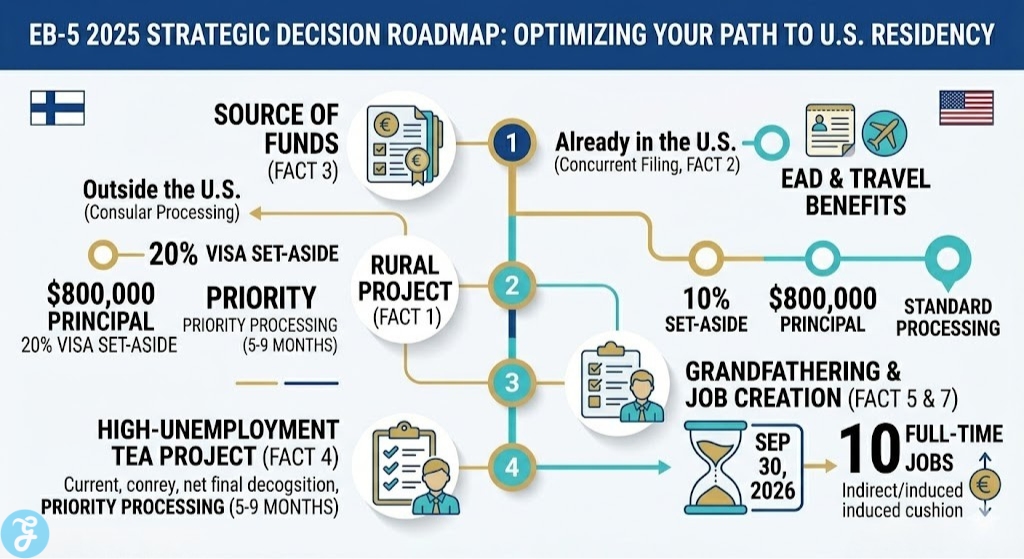
Under the RIA, rural projects now receive priority processing and a massive 20% visa set-aside. In 2025 and 2026, this means that investors in rural areas are seeing I-526E approvals in as little as five to nine months, compared to the years-long waits typical of standard urban projects.
Best for: investors from backlogged countries like India and China.
Why We Chose It:
-
It offers the single fastest legal route to a U.S. Green Card available today.
- The reserved visa category prevents applicants from being stuck in long “unreserved” lines.
Things to consider:
-
Rural projects often involve different economic risks than established urban developments.
2. Utilize Concurrent Filing if Already in the U.S.
For those already in the U.S. on other visas like H-1B or F-1, concurrent filing allows you to submit your I-526E petition and your I-485 adjustment of status application at the same time. This grants you interim benefits like an Employment Authorization Document (EAD) and Travel Document (Advance Parole) while your Green Card is pending.
Best for: students, tech workers, and professionals currently residing in the United States.
Why We Chose It:
-
It provides immediate legal status and work flexibility within the U.S.
-
It eliminates the need for employer sponsorship while the EB-5 is being processed.
Things to consider:
-
You must ensure your country’s visa category is “Current” in the monthly Visa Bulletin to use this option.
3. Document a Meticulous “Source of Funds” Trail
USCIS requires a comprehensive paper trail showing that your investment capital was obtained through lawful means. This includes at least five years of tax returns, bank statements, and legal documents for any gifted or inherited funds.
Best for: individuals with complex financial backgrounds or multiple income streams.
Why We Chose It:
-
Source of Funds (SoF) issues are the leading cause of EB-5 petition denials.
-
A clean SoF report significantly reduces the likelihood of a Request for Evidence (RFE).
Things to consider:
-
Administrative and legal fees must also be documented as being sourced from clean capital.
4. Target the $800,000 TEA Threshold
Investing in a Targeted Employment Area (TEA) allows you to qualify for the lower investment threshold of $800,000 rather than the standard $1,050,000. These areas are defined as either rural or locations with high unemployment rates at least 150% of the national average.
Best for: capital-conscious investors looking to minimize their principal commitment.
Why We Chose It:
-
It saves the investor $250,000 in upfront capital.
-
Most professionally managed regional center projects are purposefully located in TEAs.
Things to consider:
-
You must verify that the project’s TEA designation is current at the time of your filing.
5. Respect the September 30, 2026 Grandfathering Deadline
A critical provision of the RIA protects investors who file their petitions on or before September 30, 2026. If you file by this date, your petition remains protected under current rules even if the regional center program later faces a temporary lapse or legislative changes.
Best for: investors who value long-term legal certainty and predictability.
Why We Chose It:
-
It provides a “safe harbor” against future political or legislative shifts.
-
It ensures your application is processed under the rules that existed when you signed.
Things to consider:
-
Delaying your filing past this date introduces unnecessary administrative risk.
6. Confirm the “At-Risk” Status of Your Investment
To qualify for the EB-5, your capital must be “at-risk,” meaning there can be no guaranteed return of principal or contractual buy-back agreement. However, “at-risk” does not mean “reckless,” and choosing a project with a strong capital stack is vital.
Best for: risk-averse investors who want to protect their principal investment.
Why We Chose It:
-
It is a non-negotiable legal requirement for the I-526E and I-829 stages.
-
Understanding this rule helps you identify non-compliant “guaranteed” investment scams.
Things to consider:
-
High-quality projects use senior debt or preferred equity to manage this risk safely.
7. Verify Job Creation Projections for I-829 Success
Your Green Card only becomes permanent if the investment creates at least 10 full-time jobs for U.S. workers. Regional centers often use economic modeling to count “indirect” and “induced” jobs, which provides a safer cushion than relying solely on direct hires.
Best for: long-term planners focused on the final removal of Green Card conditions.
Why We Chose It:
-
Job creation is the ultimate metric for securing a permanent Green Card.
-
Projects with a “job cushion” (creating more than 10 jobs per investor) are much safer.
Things to consider:
-
Ask for the project’s economic impact report during your initial due diligence.
8. Account for “Soft Costs” Beyond the Principal
The $800,000 or $1,050,000 is only the investment principal. You must also budget for administrative fees charged by regional centers (typically $50,000 to $80,000), immigration attorney fees, and USCIS filing fees.
Best for: families setting a realistic total budget for their immigration journey.
Why We Chose It:
-
It prevents unexpected financial strain during the middle of the process.
-
Knowing the full cost allows for more accurate capital sourcing.
Things to consider:
-
USCIS fees for the EB-5 program are among the highest in the agency’s schedule.
9. Evaluate the Developer’s Track Record
The success of your EB-5 petition is tied directly to the success of the project. Research the developer’s history of completing projects and, most importantly, their history of successful I-526 and I-829 approvals for previous investors.
Best for: investors who prioritize the safety of their capital and their status.
Why We Chose It:
-
A developer’s past performance is the best indicator of future project viability.
-
Experienced developers are more likely to be familiar with RIA compliance.
Things to consider:
-
Be wary of first-time developers or projects that rely too heavily on EB-5 capital.
10. Include Eligible Dependents Early
Your spouse and unmarried children under 21 can be included in your EB-5 petition. It is crucial to file before children “age out” (turn 21), though the Child Status Protection Act (CSPA) offers some relief once the I-526E is filed.
Best for: families with children nearing adulthood or entering college.
Why We Chose It:
-
It ensures the entire family receives Green Card benefits simultaneously.
-
Early filing locks in the age of your children for immigration purposes.
Things to consider:
-
Children must remain unmarried to maintain their derivative status throughout the process.
11. Prepare for the Two-Year Conditional Window
The initial Green Card granted is “conditional” for two years. During the final 90 days of this period, you must file Form I-829 to prove the investment was maintained and the 10 jobs were created to receive your 10-year permanent Green Card.
Best for: all EB-5 applicants as they transition into U.S. residency.
Why We Chose It:
-
This is the final legal hurdle in the EB-5 journey.
-
Maintaining records during these two years is essential for a smooth I-829 approval.
Things to consider:
-
You must remain in the U.S. as a permanent resident during this conditional period.
An Overview Of 11 EB-5 Investor Visa 2025 Success Factors
Successfully obtaining an EB-5 visa in 2025 is less about the amount of money you have and more about the precision of your documentation and the strategic choice of your project. The shift toward rural priority processing has created a “fast track” that didn’t exist a few years ago, making the timing of your investment a critical factor in how quickly your family can move to the United States.
Overview Of 11 EB-5 Investor Visa 2025: A Strategic Comparison
The table below provides a high-level summary of the two primary paths an investor can take under the current rules. Choosing between these paths will determine your budget, your timeline, and your priority in the visa queue.
Overview Comparison Table
The following comparison illustrates how project location significantly impacts the requirements and benefits for an investor in the current fiscal environment.
| Investment Path | Minimum Principal | Visa Set-Aside | Processing Priority |
| Rural TEA | $800,000 | 20% (High) | Priority (Fastest) |
| High-Unemployment TEA | $800,000 | 10% (Moderate) | Standard |
| Infrastructure Project | $800,000 | 2% (Low) | Standard |
| Non-TEA (Standard) | $1,050,000 | 0% (Unreserved) | Standard |
Our Top 3 Picks and Why?
-
Rural TEA Investment: This is our top pick because the combination of a lower $800,000 threshold and priority processing makes it the most efficient path for any investor today.
-
Concurrent Filing: We chose this as a top pick for its immediate impact on quality of life. For those already in the U.S., the ability to get an EAD and travel permit within months is a game-changer.
-
Meticulous Source of Funds: While it sounds like a chore, we pick this because it is the “make or break” factor. No matter how good the project is, a weak SoF report will end your journey before it starts.
How to Choose the Right EB-5 Investor Visa 2025 Project by Yourself?
Choosing a project is a personal decision that balances your financial comfort with your immigration goals. While most investors use regional centers for simplicity, the due diligence process remains your responsibility to ensure your capital and your Green Card are protected.
The Selection Framework
-
Review the Capital Stack: Look for projects where EB-5 capital makes up only a portion (20 to 30 percent) of the total cost. If a project relies too heavily on EB-5, it may be at higher risk.
-
Assess Construction Status: Projects that have already broken ground or have secured senior construction financing are generally considered lower risk for job creation.
-
Analyze the Exit Strategy: How will the project return your capital after the required sustainment period? Look for clear refinancing plans or asset sale projections.
-
Verify Regional Center Status: Ensure the regional center is in good standing with USCIS and has no history of regulatory or integrity issues.
The matrix below will help you decide which type of project aligns best with your specific needs and current location.
Decision Matrix Table
The decision matrix compares common investor profiles with the most suitable project types available in the 2025 landscape.
| If your priority is… | Choose X if… | Choose Y if… |
| Speed of Green Card | Choose Rural TEA if you are from India/China. | Choose Urban TEA if you are from a non-backlogged country. |
| Immediate U.S. Status | Choose Concurrent Filing if you are on an H-1B. | Choose Consular Processing if you are living outside the U.S. |
| Investment Safety | Choose Senior Debt if you want first-lien protection. | Choose Preferred Equity if you are looking for higher potential returns. |
| Total Cost Control | Choose a TEA Project for the $800,000 entry. | Choose Non-TEA if you have a specific business you want to manage. |
The Final Checklist: 5-Point Success Plan
-
Confirm your investment amount ($800,000 vs $1,050,000) based on the project’s TEA letter.
-
Gather 5 years of personal and business tax returns to build your Source of Funds trail.
-
Hire an immigration attorney with a specific focus on post-RIA EB-5 cases.
-
Verify that your chosen project has a “job creation cushion” of at least 20 percent.
-
Set a target filing date before the September 30, 2026, grandfathering deadline.
Securing Your Future Through Strategic U.S. Investment
Navigating the EB-5 program in 2025 and 2026 requires a focus on the “reserved” categories and the strict transparency rules of the RIA. By prioritizing rural projects and ensuring your source of funds is beyond reproach, you can take advantage of the fastest processing times in the program’s history. The EB-5 visa remains a complex but highly rewarding path, offering a permanent stake in the American economy for you and your family for generations to come.