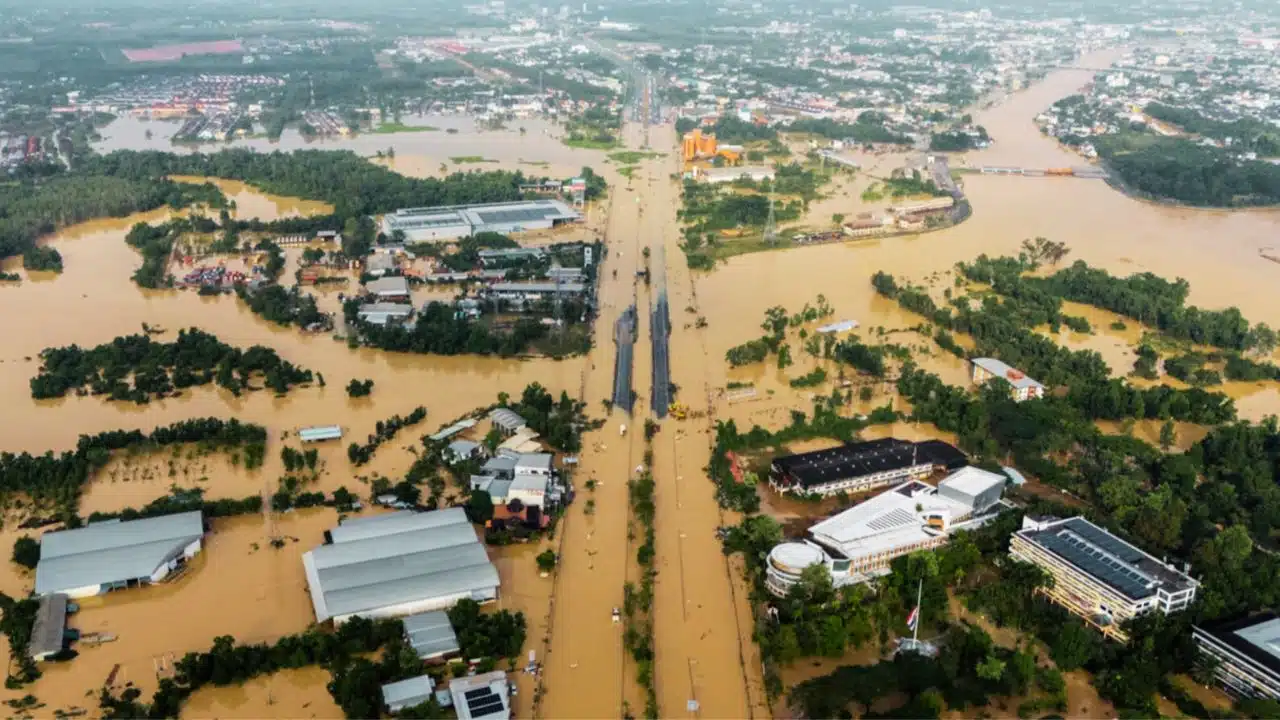
Deadly flooding across South and Southeast Asia in recent weeks has killed more than 1,200 people and displaced millions, as swollen rivers, landslides and storm surges have torn through communities from Indonesia to Sri Lanka and Thailand. Climate scientists say the scale and timing of the disaster are not a freak anomaly but a stark preview of how a hotter planet is reshaping the region’s monsoon and storm patterns.
A season of relentless rain
The current flooding has been driven by a string of late-season cyclones, typhoons and tropical storms that dumped extreme amounts of rain over already saturated river basins and coastal plains. Officials report that entire towns in Indonesia’s Sumatra, parts of southern Thailand, Sri Lanka and low-lying areas of Malaysia and Vietnam have been inundated, with roads cut off, crops destroyed and tens of thousands forced into temporary shelters.
In Thailand, meteorological records show single‑day rainfall totals in some southern cities among the highest in centuries, overwhelming drainage systems and triggering flash floods that left residents little time to escape. Rescue teams across the region are still searching for hundreds of people listed as missing, raising fears that the death toll will continue to climb.
Scientists see climate’s fingerprints
Researchers say the disaster fits a clear pattern: as greenhouse gas concentrations rise, Asia is warming almost twice as fast as the global average, loading more heat and moisture into the atmosphere and oceans. According to the UN’s World Meteorological Organization, atmospheric carbon dioxide jumped by a record amount in 2024, effectively turbocharging the climate system and helping to set the stage for 2025’s extreme rainfall events.
Warmer seas in the Indian and Pacific Oceans provide extra energy for tropical storms, making them stronger and capable of carrying more water, which then falls as intense, localized downpours. One recent attribution analysis by researchers linked to the Grantham Institute found that climate change likely boosted rainfall in a typhoon that struck the Philippines by around 10 percent, underscoring how even small shifts in averages can produce far more destructive floods on the ground.
Fragile infrastructure, exposed communities
The floods have highlighted the fragility of critical infrastructure in many Asian cities, where rapid urbanization has outpaced investment in drainage, river embankments and early‑warning systems. Informal settlements along rivers and hillslopes, often occupied by poorer households with few savings, have borne the brunt of the destruction as homes built with light materials were swept away or buried by landslides.
Health experts warn that beyond the immediate deaths and injuries, stagnant water, damaged sanitation and crowded shelters increase the risk of water‑borne diseases, malnutrition and long‑term mental health impacts. Economic losses from the current floods are expected to run into the billions of dollars, straining national budgets already facing rising costs from repeated climate‑related disasters.
A warning for the years ahead
Climate and policy researchers describe Southeast Asia as being at a crossroads: governments are expanding renewable energy but still rely heavily on coal, oil and gas, leaving emissions high and adaptation funding far below what scientists say is needed. They argue that without faster investment in resilient housing, flood‑proof infrastructure, early‑warning networks and nature‑based defenses such as mangrove restoration, disasters like this year’s floods will become even more deadly.
Experts caution that 2025’s deluge is not an outlier but part of a new normal in which extreme rainfall, floods and storm surges repeatedly hit the same vulnerable communities, deepening inequality and forcing more people to migrate. For many scientists and local advocates, the message from the latest floods is blunt: the region’s window to both cut emissions and adapt to a rapidly changing climate is closing fast, and ignoring that warning will carry an ever‑rising human cost.