

Cryptocurrency has moved from a fringe experiment to a mainstream asset class. New investors are entering the market every day, drawn by stories of overnight gains, viral coins, and big institutional moves. But behind the headlines is a quieter reality. Many new investors lose money not because crypto is “rigged,” but because they repeat the same basic crypto investing mistakes.
They risk too much, follow hype, ignore security, or simply don’t have a plan. If you treat crypto like a lottery ticket, the odds are against you. Treat it like a high-risk, high-volatility asset class, and you give yourself a chance to stay in the game.
Key Takeaways
-
Crypto mistakes often stem from emotional decisions, not a lack of opportunity.
-
FOMO, poor risk management, and weak security cause most investor losses.
-
A clear strategy matters more than chasing short-term price moves.
-
Protecting your assets is as important as choosing the right coins.
-
Long-term discipline consistently beats impulsive trading in crypto.
Why Crypto Mistakes Are So Common

Cryptocurrency investing moves faster than traditional markets. Prices shift rapidly, news spreads instantly, and trading is available 24/7. This speed, combined with constant online commentary, makes impulsive decisions easy and costly.
Another reason crypto mistakes are common is accessibility. Anyone can buy digital assets within minutes, often without fully understanding volatility, security risks, or market cycles. There are fewer barriers to entry, but also fewer safeguards. Information overload adds to the problem. Social media, influencers, and trending narratives often blur the line between research and hype, especially during bull markets.
Finally, emotion plays a major role. Fear, greed, and overconfidence frequently override logic, leading investors to buy high, sell low, or take unnecessary risks. Understanding these underlying factors helps explain why mistakes happen—and prepares you to avoid them.
Mistake 01: Investing in Hype and FOMO, Not in Research
One of the biggest crypto mistakes beginners make is buying coins purely because “everyone” is talking about them.
You see a coin trending on social media. Influencers are calling it “the next Bitcoin.” Friends claim they doubled their money in a week. You feel a surge of FOMO (fear of missing out) and jump in at any price.
This usually ends badly.
Why FOMO Buying Is So Dangerous
- You often buy near the top after a big, fast pump.
- When the excitement fades, early buyers take profits.
- Prices drop sharply, and new investors panic-sell at a loss.
That cycle can repeat over and over, destroying capital and confidence.
How to Avoid the FOMO Trap
Before you invest in any coin or token, pause and ask:
- What problem does this project solve?
- Who is behind it? Do they have a real track record?
- Is the tokenomics reasonable? How many tokens exist, and who controls them?
- Is there real usage, or only noise?
This is basic DYOR (do your own research). Hype can spark your interest, but it should never be your only reason to buy.
Quick rule: If your only explanation for buying a coin is “everyone says it will go up,” you’re not investing – you’re gambling.
Mistake 02: Ignoring Risk Management and Position Sizing
Another common crypto mistake to avoid is thinking only in terms of upside.
Crypto is a high-volatility market. Large price swings within hours or days are normal. If you invest as if every coin is guaranteed to “go to the moon,” you set yourself up for brutal drawdowns.
What Bad Risk Management Looks Like
- Putting most of your savings into a single coin.
- Using money needed for rent, food, or tuition.
- Allocating almost your entire portfolio to speculative micro-cap tokens.
When you do this, one wrong move can change your life in the worst way.
Basic Risk Management Principles
You don’t need complex models. Even simple rules can protect you:
- Only invest what you can afford to lose: If a 50–70% drop would ruin you financially, your position is too large.
- Use sensible position sizing: Decide on a maximum percentage of your overall portfolio to allocate to crypto. Then set a maximum per coin or token.
- Diversify within crypto: Consider splitting between more established assets (like Bitcoin and Ethereum) and a smaller portion in higher-risk altcoins.
Think in terms of survival first, growth second. Crypto offers a powerful upside, but only if you are still here tomorrow.
Mistake 03: Overtrading and Chasing Short-Term Noise
Constantly buying and selling may feel productive. You watch the chart tick, read every headline, and fire off trades all day. But in reality, overtrading is one of the most common crypto trading mistakes.
The Hidden Cost of Overtrading
- You pay more in trading fees and spreads.
- You make decisions based on emotion, not strategy.
- You exhaust yourself trying to “beat” every move.
Most retail traders do not have the tools, speed, or experience that professional traders or automated systems use. Trying to trade like a full-time pro on a phone app is usually a losing game.
How to Trade Less and Think More
Ask yourself:
- Am I trading because I have a clear signal or because I’m bored?
- Did I decide my plan before the move, or am I reacting after the fact?
You can adopt a calmer approach:
- Use DCA (dollar-cost averaging) to build long-term positions.
- Set price alerts instead of staring at the screen.
- Decide in advance how often you will review your portfolio (for example, once a week or once a month).
Fewer, more deliberate decisions can lead to better results than constant, emotional trading.
Mistake 04: Misusing Leverage and Derivatives
Leverage is one of the fastest ways to blow up an account. Leverage allows you to control a larger position with a smaller amount of capital. For example, with 10x leverage, a 10% move in the coin can mean a 100% gain – or a 100% loss – on your position. That sounds exciting. In practice, it is extremely risky.
How Leverage Turns Volatility Against You
Crypto markets move fast. Even a normal price swing can trigger liquidation for a highly leveraged position. You may be “right” about the long-term direction, but still lose everything because your position was too large and too leveraged.
Common crypto mistakes include:
- Using 20x, 50x, or even 100x leverage on speculative coins.
- Adding more margin to a losing position instead of cutting the loss.
- Treating derivatives like a casino, not a tool.
A Conservative Approach to Leverage
For most beginners and even many intermediate investors, the safest leverage strategy is simple:
If you don’t fully understand how leverage works, don’t use it at all.
If you still choose to use it:
- Keep leverage low.
- Use a small portion of your total crypto portfolio.
- Set clear stop-loss levels and respect them.
Leverage amplifies both skill and mistakes. Until you have a robust strategy and deep experience, it usually amplifies the latter.
Mistake 05: Leaving All Your Crypto on Exchanges
Another key crypto mistake to avoid is treating exchanges like long-term wallets.
Exchanges are convenient. You can buy, sell, swap, and access many different coins in one place. But they also introduce a major risk: you don’t control the private keys.
In simple terms, if you leave your coins on an exchange, you are trusting that platform to stay secure, solvent, and accessible.
Risks of Keeping Everything on Exchanges
- Exchange hacks or security breaches.
- Frozen withdrawals due to technical or regulatory issues.
- Insolvency or mismanagement behind the scenes.
Even large, well-known exchanges can encounter problems. While many have strong security measures, the risk is never zero.
Safer Storage: Not Your Keys, Not Your Coins
For significant long-term holdings, consider:
- Hardware wallets for maximum control and security.
- Reputable software wallets where you hold your own seed phrase.
Use exchanges mainly as gateways:
- Deposit fiat, buy crypto, then withdraw a portion to your own wallet for long-term storage.
- Keep only what you need for active trading or short-term moves on the exchange.
Balance convenience and security, but remember: if an exchange fails, you have very little control.
Mistake 06: Weak Security Habits and Falling for Scams
Crypto is digital. That means your coins can be stolen without anyone physically touching your wallet or card.
Scammers and hackers focus heavily on crypto users because transactions are often irreversible, and inexperienced investors can be more easily tricked.
Common Crypto Security Mistakes
- Reusing the same password across exchanges and wallets.
- Not enabling two-factor authentication (2FA).
- Using only SMS 2FA can be vulnerable to SIM swaps.
- Downloading fake wallet apps or visiting look-alike phishing sites.
- Signing unknown smart-contract transactions in DeFi without reading what they do.
- Trusting “support” accounts in chats or DMs asking for your seed phrase.
How to Strengthen Your Crypto Security
- Use unique, strong passwords for every exchange and wallet. A password manager helps.
- Enable app-based 2FA (e.g., authenticator apps) or hardware security keys where possible.
- Always double-check URLs and app publishers before entering your login or seed phrase.
- Never share your seed phrase or private key with anyone, under any circumstances.
- For DeFi users, read transaction prompts carefully and regularly review permissions granted to dApps.
Quick Scam Red Flags
Be extremely cautious if you see:
- Guaranteed high returns with no risk.
- Pressure to “act now before it’s too late.”
- Anyone asking you to install remote access software or send screenshots of recovery phrases.
When in doubt, slow down. It’s better to miss a “chance” than to lose everything to a scam.
Mistake 07: Having No Clear Strategy or Time Horizon
Many people enter crypto without a clear plan. They buy coins at random, respond to social media, and change their approach every few weeks.
One day, they are long-term “HODLers.” The next day, they are day traders. Then they chase yield in DeFi. This lack of consistency is itself one of the biggest cryptocurrency mistakes beginners make.
Why a Strategy Matters
Without a strategy:
- You don’t know why you entered a position.
- You don’t know when to take profits or cut losses.
- You don’t know whether a price drop is a buying opportunity or a sign to exit.
A simple written plan can prevent panic in volatile moments.
Elements of a Simple Crypto Plan
You can keep it to one page.
Include:
- Your goal: Are you aiming for long-term growth, diversification, or speculative trades?
- Time horizon: Are you thinking in months, years, or decades?
- Allocation: What percentage of your total net worth will you put into crypto?
- Asset mix: How much in major coins vs. smaller altcoins?
- Rules for taking profit: At what levels will you sell part of a position?
- Rules for cutting losses: At what point will you accept that a thesis has failed?
Review this plan periodically, but don’t rewrite it every time the market has a bad week.
A clear strategy turns random moves into informed decisions.
Mistake 08: Ignoring Fees, Taxes, and Regulations
When people think of crypto mistakes to avoid, they often focus on price moves and security. But hidden costs and obligations can also hurt your returns.
Trading and Network Fees
Every trade and transfer can carry a fee:
- Exchange trading fees and spreads.
- Withdrawal fees.
- On-chain gas fees, especially high on busy networks.
Frequent trading in low-liquidity coins can add up to substantial costs, even if you don’t notice them at first.
Tax and Regulatory Issues
In many countries, crypto is treated as taxable property or a form of investment.
That means:
- Selling crypto for fiat may be a taxable event.
- Swapping one coin for another can also be taxable.
- Short-term gains may be taxed differently from long-term gains.
Ignoring these rules can result in surprise tax bills or penalties later.
How to Stay on Top of Fees and Rules
- Track your trades and transfers with a spreadsheet or portfolio tracker.
- Before you start active trading, understand the basic tax treatment in your country.
- Consider the impact of fees on your strategy. Sometimes, fewer, larger moves are more efficient than many small trades.
- Be cautious with platforms or products that seem to ignore local regulations. Regulatory changes can affect access or withdrawals.
You don’t need to become a tax expert, but you do need to know enough to avoid trouble.
Mistake 09: Forgetting That Bull and Bear Markets Need Different Behaviours
Crypto runs in cycles. There are explosive bull runs and painful bear markets. Treating every phase the same is another often-overlooked crypto investing mistake.
Bull Market Errors
In bull markets:
- Prices may rise for months.
- New projects launch daily.
- Social media is filled with success stories.
Common mistakes in this phase:
- Believing gains will continue forever.
- Using more and more leverage because “it always goes up.”
- Refusing to take profits on winning positions.
When the trend reverses, those who never took profits often watch their gains evaporate.
Bear Market Errors
In bear markets:
- Prices fall or move sideways for long periods.
- Negative news dominates the discussion.
- Many new investors lose interest and leave.
Common mistakes in this phase:
- Panic selling at or near the bottom.
- Abandoning a sound long-term thesis in pure emotion.
- Ignoring the market completely and missing opportunities to buy quality assets at better prices.
Adapting Your Behaviour to the Cycle
You can’t perfectly time every top and bottom, but you can follow basic cycle-aware habits:
- Take partial profits after strong runs instead of hoping for infinite upside.
- Keep some cash or stablecoins to deploy when valuations look more reasonable.
- Revisit your long-term thesis regularly, but don’t rewrite it based only on recent price action.
Remember: you don’t need to catch every wave. You just need to avoid the wipeouts that take you out of the market entirely.
Quick Checklist: How to Invest in Crypto More Safely
Use this checklist before you hit the “buy” button:
- Do I understand this project and its risks?
- Is this money I can afford to lose without harming my essential needs?
- Is my position size reasonable within my overall portfolio?
- Am I using leverage? If yes, do I truly need it, and do I understand the downside?
- Where will I store this crypto – on an exchange or in my own wallet?
- Are my passwords, 2FA, and devices secure?
- What is my time horizon and exit plan for this position?
- Have I considered the tax and fee impact of this trade?
If you can’t answer these questions clearly, pause. Clarifying your decisions first is far better than trying to fix crypto mistakes later.
Frequently Asked Questions
1. What is the biggest crypto mistake beginners make?
The biggest mistake beginners make is investing based on hype or fear of missing out instead of doing proper research and understanding the risks involved.
2. Is it safe to invest in cryptocurrency?
Crypto can be invested in safely if you manage risk carefully, use secure wallets, avoid scams, and only invest money you can afford to lose.
3. Should I keep my crypto on an exchange?
Keeping small amounts on an exchange for trading is common, but long-term holdings are generally safer in wallets where you control the private keys.
4. How much of my portfolio should be in crypto?
There is no universal rule, but many investors limit crypto exposure to a small percentage of their total portfolio to manage volatility and risk.
5. Can crypto mistakes be fixed after they happen?
Some mistakes can be corrected through better planning and security, but losses from scams, hacks, or emotional trades are often irreversible, making prevention critical.
Bottom Line: Crypto Is Here to Stay – But Your Capital Doesn’t Have to Leave
Cryptocurrencies are likely to remain part of the global financial landscape. New technologies, regulations, and use cases will continue to emerge. But none of that guarantees profit for individual investors. The difference often comes down to behaviour.
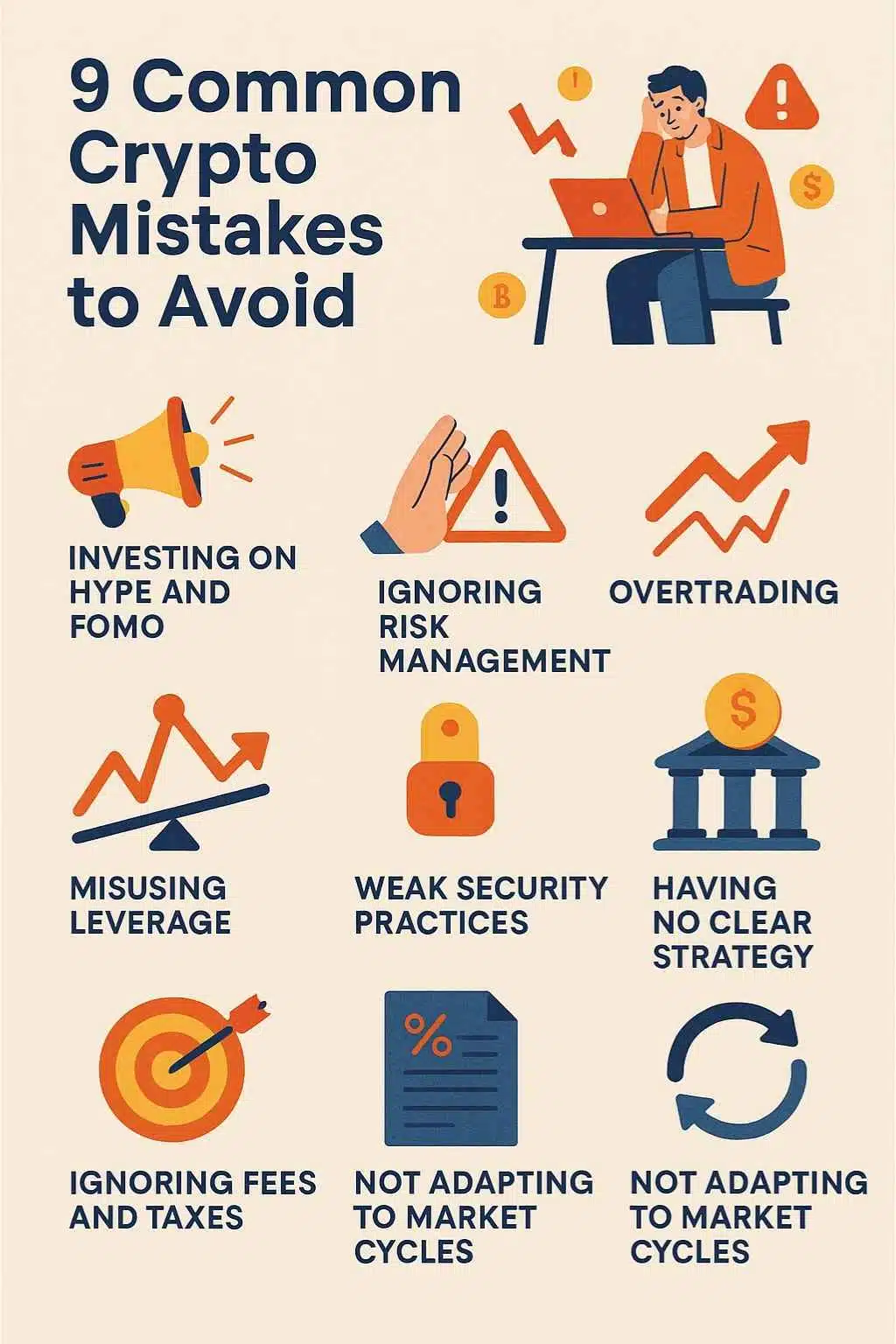
Avoiding these 9 common crypto mistakes – FOMO buying, poor risk management, overtrading, reckless leverage, unsafe storage, weak security, lack of strategy, ignoring fees and taxes, and misunderstanding market cycles – puts you ahead of many participants in the space.
You can’t control the market. You can control how you enter, manage, and protect your positions.