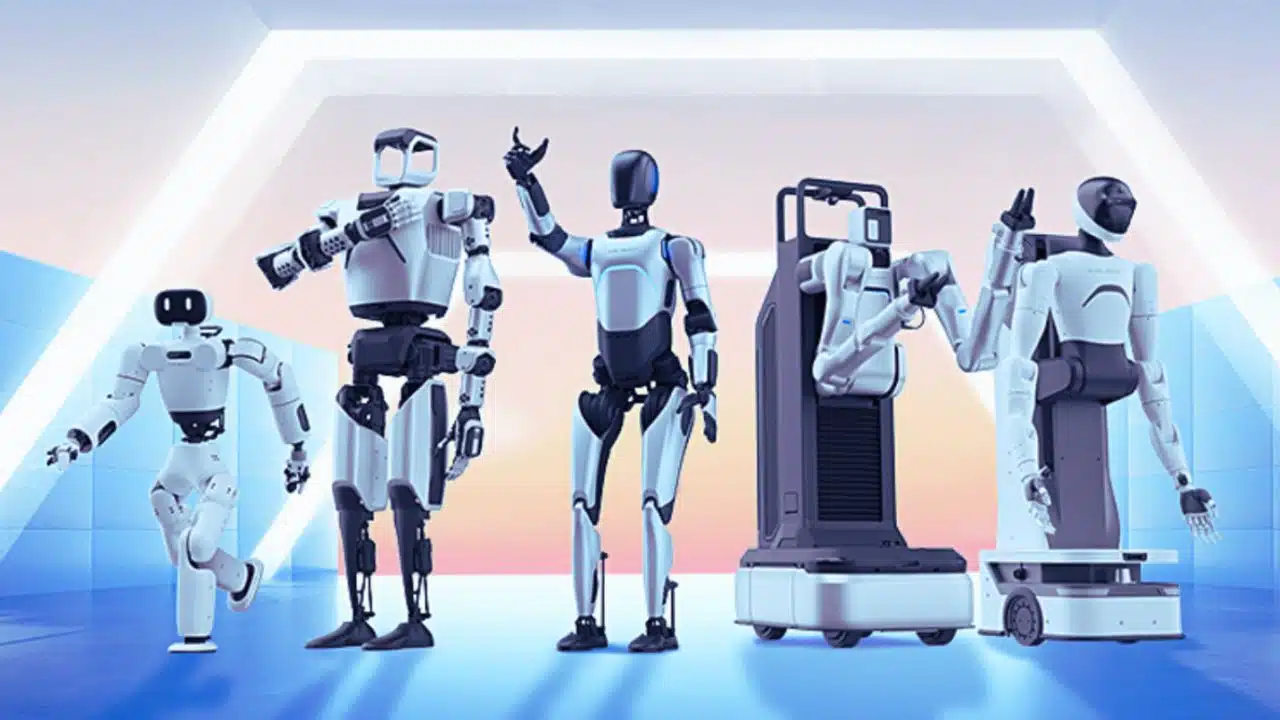
Shanghai-based robotics company Agibot has announced the rollout of its 5,000th mass-produced humanoid robot during a factory event, marking one of the fastest production ramps in the emerging embodied AI sector since the firm’s founding in 2023.
The company revealed the milestone via a livestream from its facility, positioning the achievement as proof that humanoid robots are moving from pilot tests to large-scale commercial deployment.
The 5,000th unit off the line was a Lingxi X2 humanoid, which Agibot ceremonially delivered to the studio of Chinese film star Huang Xiaoming, underlining how humanoid robots are being used both as industrial tools and as high-impact marketing symbols in China’s consumer and entertainment economy. Co‑founder, president, and CTO Peng Zhihui, a high-profile engineer known for his work in China’s Genius Youth talent program, framed the milestone as the result of years spent improving stability, reliability, and durability in real-world environments.
Robot lineup, deployments and key data
Agibot’s 5,000-unit fleet spans three main product lines: the lighter Lingxi X-series, the full-size Expedition A-series, and the task-optimized G-series, rather than a single flagship humanoid. This mixed-fleet strategy allows the company to target a wide range of use cases, from dynamic demonstrations and reception work to logistics, cleaning, and factory tasks.
Agibot robot production breakdown (5,000 units total)
| Series / Model | Units (approx.) | Main role or design focus | Notable highlight |
| Lingxi X-Series | 1,846 units | Agile bipedal humanoids for dynamic movement and demos | X2 model showcased advanced flips and served as the 5,000th unit. |
| Expedition A-Series | 1,742 units | Full-size general-purpose humanoids for broader task coverage | A2 variant completed a roughly 106 km trek from Suzhou to Shanghai. |
| G / Genie Series | 1,412 units | Task-optimized platforms, often with wheels, for industry/logistics | Deployed in factories and logistics centers for repetitive workflows. |
Beyond model types, Agibot says its humanoids are already operating in at least eight commercial scenarios, including guided reception and exhibition hosting, entertainment performances, intelligent manufacturing, logistics sorting, security inspection, commercial cleaning, data-collection and training, and scientific research and education. The A2 humanoid recently gained additional visibility after walking more than 66 miles over three days—from Suzhou’s Jinji Lake to Shanghai’s Bund waterfront—earning a Guinness World Record for the longest journey completed by a humanoid robot and demonstrating endurance under varied real-world conditions.
China’s humanoid robotics push
Agibot’s 5,000-unit mark comes as Chinese policymakers and investors push humanoid robots as a strategic “next platform” for automation, placing the company alongside peers such as Galbot and UBTECH in a crowded but rapidly scaling field. Industry reporting indicates that Agibot partners with major electronics manufacturers and systems integrators, including Longcheer and other industrial customers, to place close to 1,000 G-series robots in factories and to prepare for larger deployments as costs come down.
China’s broader robotics statistics help explain why this milestone matters: industrial robot output in the country rose sharply at the start of 2025, while service robot shipments surpassed 1.5 million units, giving domestic humanoid startups a large component and talent supply base. Agibot also works with global chip and AI ecosystem partners—alongside other Chinese humanoid makers—to leverage high-performance computing platforms for perception and control, further embedding its robots in China’s wider embodied AI strategy.
What this means and what comes next
By producing 5,000 humanoid robots in less than three years, Agibot is signaling to investors and rivals that humanoids are leaving the prototype stage and entering scaled deployment, even as key questions remain about long-term reliability, support, and real-world productivity. The company has already moved from its initial Lingang base to planning additional capacity in Shanghai’s Pudong district, with targets of more than 400 units per month and ambitious roadmaps from manufacturing partner LingyiTech that envision automated lines capable of hundreds of thousands of robots annually.
Analysts following the company say Agibot is exploring a potential Hong Kong initial public offering around 2026, using its production numbers and high-profile demos—such as the A2’s record walk and Huang Xiaoming’s custom X2 robot—as proof points for both technical maturity and market demand. For China’s wider economy, widespread deployment of such humanoids in logistics hubs, factories, malls, and public venues could ease labor shortages in repetitive or hazardous work, while raising policy debates about skills, retraining, and the pace at which embodied AI should be integrated into everyday life.