

China is witnessing a significant resurgence in international tourism in 2024, thanks to its expanded visa-free entry policy targeting 74 countries. This strategic decision, driven by the Chinese government’s efforts to rebuild the tourism sector post-pandemic, is having a noticeable impact. The move is also part of a broader campaign to stimulate economic recovery and boost China’s image on the global stage through people-to-people exchange and cultural diplomacy.
By July 16, 75 countries will be eligible for visa-free entry into China for stays up to 30 days. This broad exemption program is a dramatic expansion compared to pre-pandemic norms and is already transforming China’s tourism landscape. The visa-free access, however, is currently on a one-year trial basis for most countries, signaling a cautious but optimistic approach from Chinese authorities.
Visitor Numbers Double, Reaching Pre-Pandemic Momentum
Data released by China’s National Immigration Administration shows that over 20 million foreign travelers entered China without a visa in 2024. This figure is more than double the visa-free arrivals recorded in 2023 and represents almost one-third of all inbound foreign visitors this year.
Although the country still hasn’t reached its 2019 peak of 31.9 million foreign tourists, 2024’s numbers have already surpassed last year’s total of 13.8 million, a year when borders reopened but traveler hesitation remained high. The dramatic increase signals growing global confidence in traveling to China and reflects the policy’s success.
Europe Leads the Surge in Arrivals
European nations are playing a leading role in this uptick. In late 2023, China extended 30-day visa-free access to France, Germany, Italy, the Netherlands, Spain, and several other EU countries. These early adopters have since seen a strong rebound in Chinese-bound tourism, especially from leisure travelers and culture enthusiasts.
China’s tourism authorities have noted that European visitors now make up a growing segment of total arrivals, a shift from previous years when Southeast Asia dominated inbound traffic. Travel agencies and tour operators catering to high-end experiences, such as WildChina, have reported record growth. European clientele, once accounting for only about 5% of their customer base, now represent close to 20% of bookings. This sharp rise is directly attributed to easier visa access and improving flight connectivity.
Access Extends to Latin America, the Middle East, and Asia
The visa-free policy is not limited to Western Europe. Countries from Latin America, such as Brazil and Argentina, and several Middle Eastern nations, including the UAE and Qatar, now enjoy similar benefits. In Asia, countries like Malaysia, Thailand, Singapore, and Kazakhstan have been included, reflecting China’s ongoing focus on regional cooperation under initiatives such as the Belt and Road.
The selection of countries appears to be a mix of strategic tourism markets, economic allies, and diplomatic priorities. China’s aim is to build long-term tourism ties with nations that are considered friendly or economically significant to its development agenda.
Notable Absences Raise Diplomatic Questions
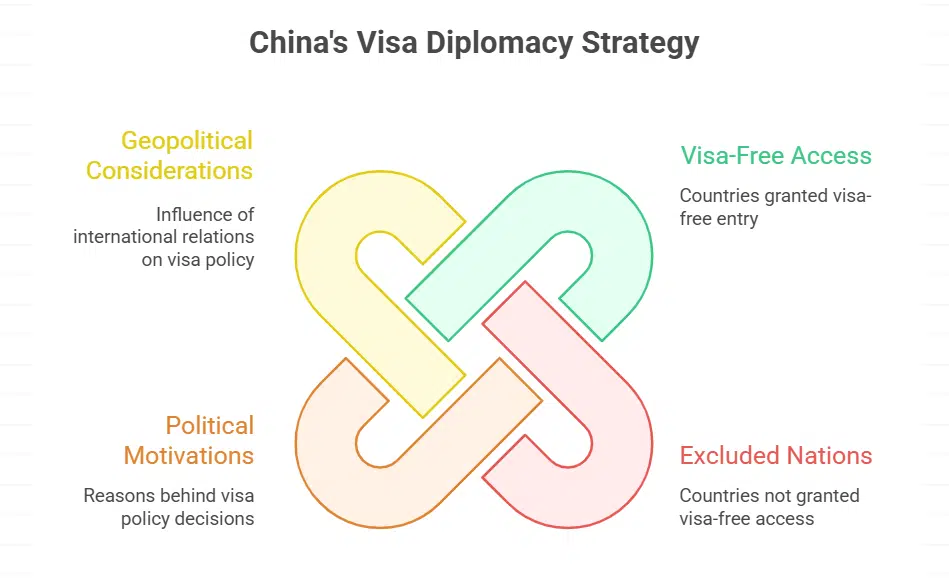
Despite the expansion, not all countries have been granted visa-free access. The exclusion of certain nations appears to be politically motivated, particularly in the case of Sweden, the only high-income European country not included in the policy. Bilateral tensions between Beijing and Stockholm, stemming from human rights and legal disputes involving Swedish nationals, have reportedly contributed to Sweden’s omission.
Observers note that China is using visa diplomacy not only to attract tourists but also to reward countries with which it shares stable relations. This approach signals that geopolitical considerations remain central to Beijing’s international engagement strategies.
10-Day Transit Without Visa: An Alternative for Some Countries
While some countries are not part of the 30-day exemption scheme, a 10-day visa-free transit policy is available to citizens from ten countries, including the United States, United Kingdom, Canada, Australia, and South Korea. This rule applies if travelers enter and leave China through different countries within the transit period.
The program is especially useful for business travelers and tourists passing through major Chinese hubs like Beijing, Shanghai, Guangzhou, and Shenzhen on multi-country itineraries. The goal is to encourage short visits and stopovers that could convert into longer tourism stays in the future.
Travel Industry Responds with Optimism and Investment
Tourism companies in China are preparing for an even bigger wave of arrivals in 2025. Agencies such as WildChina, which specialize in premium cultural and nature-focused tours, have reported a 50% increase in business compared to pre-COVID levels. This includes rising interest in destinations such as Yunnan, Sichuan, and Tibet, where sustainable and immersive travel experiences are in demand.
Hotels, airlines, and travel platforms like Trip.com have also reported a surge in international bookings. Airlines are rapidly restoring routes suspended during the pandemic, with new direct flights launched between China and cities in Europe, the Middle East, and Southeast Asia.
In response, local governments and tourism bureaus in cities like Beijing, Shanghai, Xi’an, and Guilin are introducing English-language services, cultural festivals, and digital tools to enhance the visitor experience and support the growing influx.
What’s Next for 2025?
As 2025 approaches, tourism analysts expect China to maintain or expand the policy based on its strong early results. If the program continues to deliver high visitor volumes and economic benefits, longer visa-free stays or permanent inclusion in the policy for key countries may follow.
China’s tourism officials are also working on digital visa processing, simplified customs checks, and localized language support to further improve accessibility. These efforts are part of China’s broader economic recovery strategy and ambition to reclaim its position as one of the world’s top travel destinations.