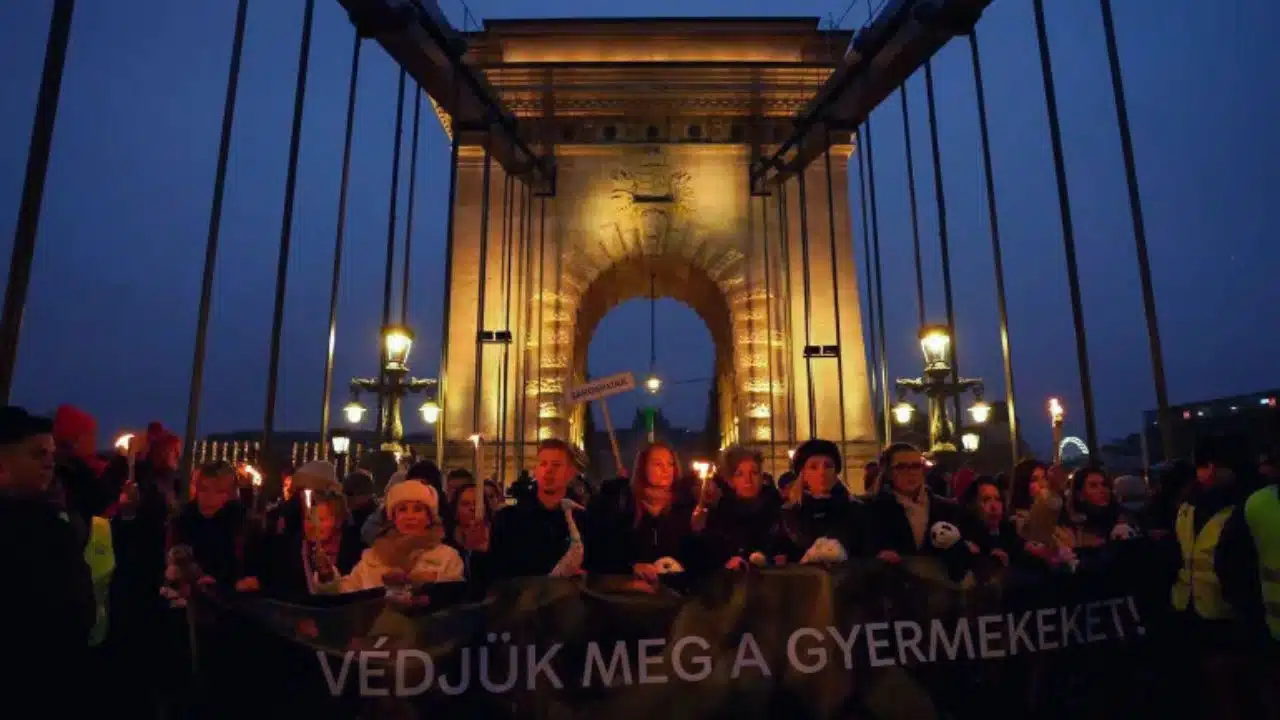
Demonstrators led by opposition figure Peter Magyar marched to Viktor Orbán’s offices after new revelations and arrests linked to alleged abuse at a state-run juvenile detention facility in Budapest.
Budapest march Orban resign abuse scandal protests drew tens of thousands in Hungary’s capital on Saturday, with demonstrators demanding Prime Minister Viktor Orbán resign over alleged abuse inside a state-run juvenile detention centre. The rally, led by opposition figure Peter Magyar, escalated political pressure on Orbán as authorities investigate the case and the government tightens oversight of juvenile institutions.
What happened in Budapest
Protesters marched through cold streets in Budapest toward the prime minister’s offices, carrying children’s toys and other symbols meant to highlight the case’s impact on minors in state care. Reports from AFP correspondents put the turnout at at least 50,000 people, underscoring broad public anger over the allegations and the state’s handling of them.
The demonstration was organized by Peter Magyar, whose Tisza (TISZA) party has been described as leading in opinion polls ahead of parliamentary elections expected in the spring. Reuters also reported that Orbán—who has been in power since 2010—faces what could be his toughest electoral test in years, with an election expected around April.
The abuse scandal at the center
The latest outrage has focused on a Budapest juvenile detention facility, with media reports describing surveillance footage that showed a facility director physically assaulting a boy. The scandal has also intersected with wider allegations tied to the institution’s leadership and potential criminal wrongdoing beyond abuse, heightening scrutiny on how juvenile facilities are managed and monitored.
According to prosecutors cited by Reuters, seven people had been detained in connection with the case at the state-run Budapest juvenile centre as the investigation continued. AFP reporting also described a sequence of arrests—four staff detained earlier in the week plus additional detentions linked to prior allegations—aligning with the broader picture of a widening criminal probe.
Government response and emergency oversight
In response to the scandal, the Hungarian government placed juvenile correctional institutions under direct police oversight, a move presented as an effort to stabilize control while investigations proceed. Reuters reported the government’s decision applied across Hungary’s juvenile institutions as political fallout grew.
Orbán publicly condemned the abuse, with AFP reporting that he said even juvenile offenders should not be treated in such a way. Reuters also reported Orbán denounced what happened in an interview, framing the conduct as criminal and unacceptable.
Why the protest became political
Magyar has used the case to argue that systemic failures in state care reflect a deeper governance problem and to call for Orbán’s resignation. The protest also highlighted growing momentum behind Magyar’s challenge to Orbán, with multiple outlets linking the rally to shifting political dynamics ahead of the next election.
The scandal revived debate over the credibility of Orbán’s long-running political message centered on protecting children, which critics say clashes with repeated abuse controversies connected to state institutions. Protesters’ demands focused on accountability, including consequences for leadership and stronger safeguards for minors in institutional care.
New disclosures and broader concerns about state care
AFP reported that Magyar publicized an official report dated 2021 indicating that more than 20% of children in state care experienced abuse, adding fuel to claims that problems extend beyond a single facility. Hungary’s interior ministry said the 2021 report was forwarded to relevant authorities in 2022, describing this as support for their work.
These disclosures widened the issue from an individual criminal case to questions about state oversight, reporting mechanisms, and whether prior warnings were acted on quickly enough. The controversy has also increased pressure on agencies responsible for child protection, juvenile justice, and institutional supervision.
Timeline of key events
| Date | Key development |
| 2021 | Official report later cited by AFP indicated over 20% of children in state care experienced abuse. |
| 2022 | Interior ministry said the 2021 report was forwarded to authorities. |
| Feb 2024 | President Katalin Novák resigned after backlash over clemency tied to a child sexual abuse cover-up case; it triggered a major political shock to Orbán’s camp. |
| Early Dec 2025 | A video published by an opposition-linked activist prompted leadership fallout at the juvenile facility, according to Reuters reporting summarized by other outlets. |
| Dec 10, 2025 | Prosecutors said seven people had been detained in the Budapest juvenile-centre case. |
| Dec 13, 2025 | Tens of thousands marched in Budapest, led by Peter Magyar, demanding Orbán resign over the abuse scandal. |
What comes next
Investigations are ongoing, with prosecutors and police pursuing the case while the government’s temporary police oversight of juvenile institutions remains in effect. The political impact is likely to continue, as the scandal strengthens opposition messaging focused on institutional accountability and child protection ahead of Hungary’s next parliamentary election expected in the spring.
Orbán’s government is attempting to contain the fallout through enforcement steps and public condemnation, but continued disclosures—such as the 2021 report referenced by AFP—could keep the issue in the headlines. Further arrests, prosecutions, or findings about institutional practices may shape both public trust and campaign narratives in the months leading into the vote.