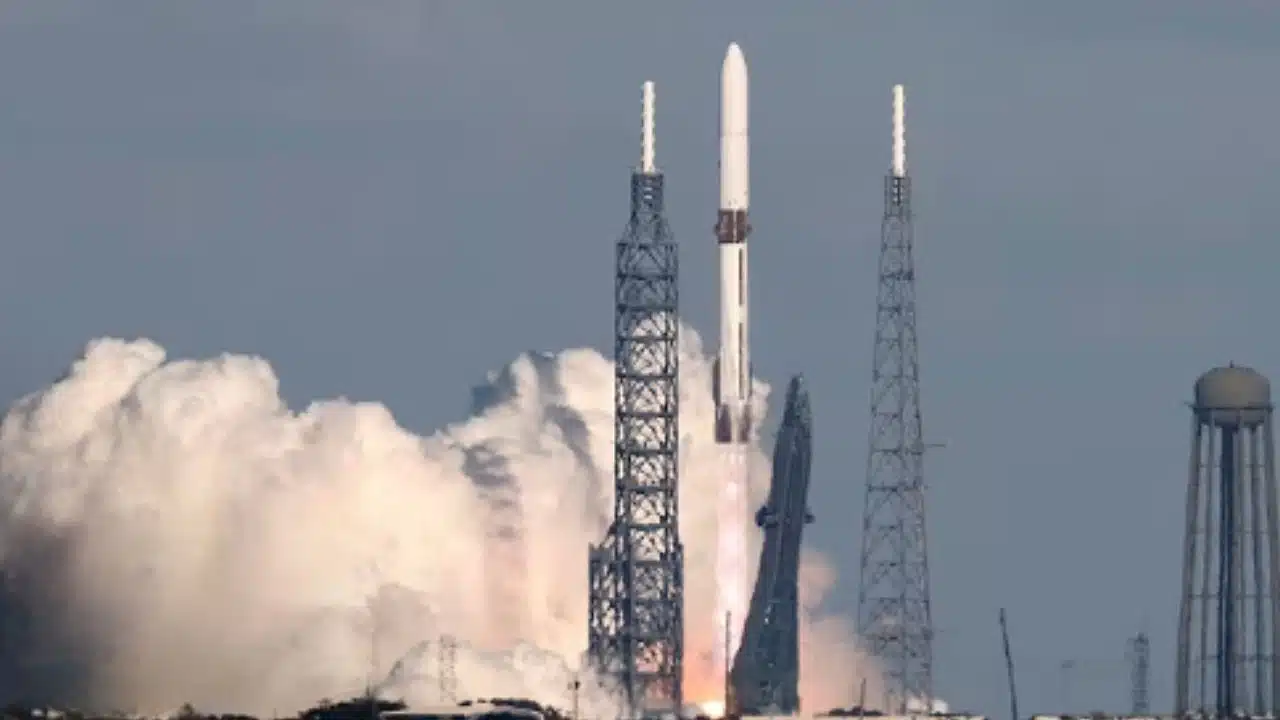
Blue Origin — the space company founded by Jeff Bezos — completed one of the most significant flights in its history with the successful launch of its massive New Glenn rocket. This mission was more than just another test. It marked the first time New Glenn carried a customer payload on a deep-space science mission, and it showcased the company’s bold ambitions to become a major competitor in the global commercial launch market.
The rocket lifted off from Cape Canaveral Space Force Station shortly before 4 p.m. ET, pushing through the Florida sky with a powerful thrust generated by its advanced engine system. Onboard were two identical satellites headed for a long and complex journey to Mars. This launch was originally planned for the previous Sunday, but it was delayed due to poor weather conditions. Blue Origin then had to work closely with the Federal Aviation Administration to secure a new launch window during a period of strict daytime launch restrictions that were in place due to the ongoing government shutdown.
What made this flight historic was not only the payload but also the rocket’s performance. For the first time, Blue Origin successfully landed New Glenn’s massive first-stage booster on a floating ocean platform. The barge — named Jacklyn in honor of Jeff Bezos’ mother — served as the landing site for the 23-story booster. During New Glenn’s first flight earlier in the year, Blue Origin did not manage to recover the booster because its engines failed to reignite. The company spent nearly 10 months upgrading and testing the rocket to prevent such issues from recurring. The result was a clean, precise landing that demonstrated Blue Origin’s serious progress in building a reusable launch system.
Reusable boosters are essential for lowering the cost of spaceflight. SpaceX has dominated this area for years, but Blue Origin is now showing that it can challenge that leadership with heavy-lift vehicles capable of both deep-space missions and full booster recovery. While booster recovery is not required for mission success — the primary goal is always to deliver payloads safely to orbit — achieving it is central to Blue Origin’s long-term business strategy.
The successful booster landing, combined with the rocket’s flawless ascent, marks an important step in Blue Origin’s plan to join the top tier of commercial launch providers, expand its customer base, and support a wider range of science, commercial, and exploration missions.
Inside the Escapade Mission: A New Path Toward Mars
The mission launched on New Glenn carried two small, identical satellites for NASA’s ESCAPADE project — short for Escape and Plasma Acceleration Dynamics Explorers. These spacecraft are part of a growing movement within NASA to conduct major scientific research using smaller, lower-cost missions. ESCAPADE falls under NASA’s SIMPLEx program, which encourages universities and research teams to design creative, affordable approaches to planetary science.
The destination for these twin satellites is Lagrange Point 2, a gravitational balance point located roughly 1.5 million kilometers from Earth. Instead of flying straight to Mars, the satellites will first travel to L2, where they will wait in a stable orbit. This location serves as a kind of rest stop in space, allowing the satellites to conserve fuel while Mars moves into a more favorable position. In late 2026, when Earth and Mars are properly aligned, ESCAPADE will leave L2, swing past Earth for a final boost, and then begin its transit to Mars. Both spacecraft are expected to enter orbit around the Red Planet in September 2027.
Once in Martian orbit, the two satellites will begin a coordinated scientific study of Mars’ upper atmosphere and magnetosphere. They will fly simultaneously through different regions of the planet’s atmospheric layers, ranging from as low as around 160 kilometers to as high as 10,000 kilometers above the surface. This multi-point measurement approach is essential for understanding how Mars interacts with solar wind and why it lost most of its early atmosphere billions of years ago.
Scientists have long suspected that Mars once had a thicker atmosphere capable of supporting liquid water on the surface. Over time, however, the planet’s protective magnetic field weakened, allowing solar radiation to strip away the atmosphere. ESCAPADE aims to track the chain of events that leads to atmospheric loss, helping researchers understand how Mars changed and what that means for the potential habitability of rocky planets.
The mission’s findings will also be critical for future human travel. Understanding radiation exposure, solar activity, and the behavior of Mars’ thin atmosphere helps planners design safer flight paths, communication systems, and living environments for eventual crewed missions.
One of the most remarkable aspects of ESCAPADE is its cost. The entire mission is estimated to cost less than $100 million — far lower than the typical $300–$600 million budget required for traditional Mars orbiters. By proving that small spacecraft can perform meaningful science at distant locations, ESCAPADE could reshape the economics of planetary exploration for decades to come.
Why This Launch Signals a New Era for Blue Origin and Exploration
This mission represents a significant shift in Blue Origin’s capabilities. Until recently, the company was best known for its suborbital New Shepard flights, which focus on short, high-altitude missions suitable for tourism and small research payloads. New Glenn, by contrast, is a heavy-lift, orbital-class rocket designed to carry large satellites, scientific missions, and potentially cargo for future deep-space exploration.
By successfully launching ESCAPADE and recovering the booster, Blue Origin demonstrates that New Glenn is not just operational but competitive with the world’s top launch vehicles. The company’s long-term success depends on reliable reusability, competitive pricing, and the ability to deliver missions across Earth orbit, lunar destinations, and beyond. This launch directly strengthens Blue Origin’s position in all of those areas.
For NASA, the mission expands the diversity of American launch providers capable of supporting planetary exploration. More competition leads to lower costs, more frequent missions, and faster scientific progress. ESCAPADE also highlights NASA’s willingness to rely on smaller spacecraft to answer big scientific questions — a strategy that frees up funding for future Mars rovers, lunar landers, and human exploration technologies.
For the broader commercial space industry, this mission signals that Blue Origin is entering a new phase. The combination of a massive reusable rocket, a high-value scientific payload, and a precision ocean landing shows that the company has reached a level where it can participate in the most complex and strategically important launches. This raises expectations for future missions, including satellite deployment for private companies, national security launches, and potential lunar support under NASA’s Artemis program.
Economic implications are also significant. A mature New Glenn program could reshape launch pricing, offer an alternative to SpaceX’s dominant Falcon Heavy market, and attract customers seeking multiple launch providers for redundancy and flexibility. Reusable boosters, in particular, can drastically reduce long-term costs, allowing more organizations — from universities to startups — to send scientific and commercial missions into space.
Overall, this mission marks a turning point not only for Blue Origin but for the trajectory of deep-space research. ESCAPADE’s success could inspire a new wave of cost-efficient scientific missions, and New Glenn’s performance indicates that Blue Origin is ready to play a central role in delivering them.