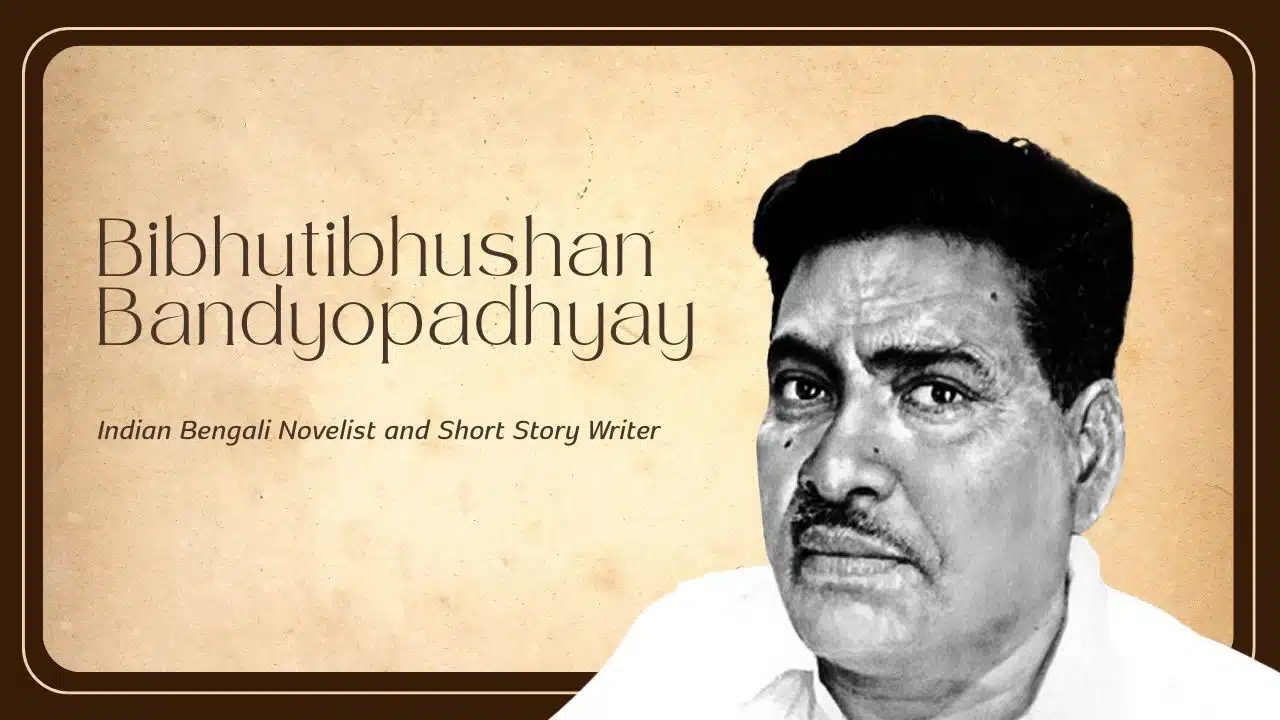
Have you ever wanted to explore the classic stories of Bengali literature but felt a little lost on where to begin? You’re not the only one. Many readers hear people praise authors like Bibhutibhushan Bandyopadhyay but don’t know much about him or his incredible work.
Today is 75th death anniversary of Bibhutibhushan Bandopadhyay. I’m here to help you get started. We’ll walk through his life, his most famous books, and why his stories still feel so fresh and important today.
So, let’s get to know the man who brought the soul of rural Bengal to the world.
What was Bibhutibhushan Bandyopadhyay’s early life and education like?
Bibhutibhushan Bandyopadhyay was born on September 12, 1894, in Muratipur, a village in the Bengal Presidency. His early life was shaped by both intellectual curiosity and persistent poverty. His father, Mahanando Bandyopadhyay, was a Sanskrit scholar and a traveling storyteller, a “Kathak,” whose craft likely planted the seeds of narrative in young Bibhutibhushan’s mind.
His family had roots in Barakpur village in Bongaon, where his great-grandfather, an Ayurvedic doctor, had settled. Despite the family’s respected background, they faced constant financial struggles. This didn’t stop him from being a gifted student, first at Gopalnagar School and later at Bongaon High School, one of the oldest schools in British India.
Tragedy struck his personal life early. His first wife, Gouri Devi, died just a year after their marriage, an event that cast a long shadow of loneliness and became a recurring theme in his early writing. He found companionship again much later, marrying his second wife, Rama Chattopadhyay, at the age of 46. Together, they had a son, Taradas, in 1947.
Driven by a love for learning, he went on to study at Ripon College (now Surendranath College), which is affiliated with the University of Calcutta. Though he excelled in his studies, financial hardship prevented him from pursuing a postgraduate degree. This forced him into a series of jobs, from a teacher in Hooghly and Barrackpore to a secretary for Khelatchandra Ghosh, where he managed an estate in Bhagalpur. These varied experiences, especially his time in rural areas, became the rich soil from which his literary works would grow.
Notable Works of Bibhutibhushan Bandyopadhyay
His stories are like beautiful paintings of rural Bengal, capturing the simple joys and deep struggles of everyday life. Through his novels and tales, Bibhutibhushan Bandyopadhyay shaped Bengali literature in a way few others have.
What is the story and significance of Pather Panchali?
Pather Panchali (Song of the Little Road) tells the unforgettable story of Apu and his sister Durga growing up in their ancestral village. Published in 1929, the novel immerses you in their world of poverty, wonder, and loss. It beautifully captures the small, magical moments of childhood, from chasing candy sellers to watching trains rumble past the rice fields.
This novel was a game-changer for Bengali literature. It turned away from tales of kings and heroes to focus on the quiet dignity of ordinary village life. Its semi-autobiographical nature, drawn from Bandyopadhyay’s own childhood, gives it a powerful and honest voice.
Satyajit Ray’s 1955 film adaptation of Pather Panchali became a global phenomenon, winning the Best Human Document award at the 1956 Cannes Film Festival. This film was the first installment of the acclaimed Apu Trilogy, which also includes Aparajito (The Unvanquished) and Apur Sansar (The World of Apu).
The success of the book and the film cemented Bibhutibhushan Bandyopadhyay’s legacy, proving that stories about the simplest of lives could touch hearts around the world.
What themes are explored in Aranyak?
Published in 1939, Aranyak (Of the Forest) is a breathtaking tribute to nature and a sad farewell to its destruction. The novel is based on Bandyopadhyay’s own experiences working as an estate manager in the dense forests near Bhagalpur, Bihar. It follows the narrator, Satyacharan, as he falls in love with the wilderness and its people.
The story explores the deep conflict between “progress” and tradition. Satyacharan is hired to clear the forest for commercial development, but he becomes deeply connected to the land and the tribal communities, like the Santals and Oraons, who live in harmony with it. The book is often called a “prose-poem” for its lyrical descriptions of the natural world.
Aranyak was ahead of its time, raising ecological concerns long before they became a global conversation. It’s a powerful story about beauty, loss, and the irreplaceable value of the wild.
Why is Chander Pahar an important work?
Chander Pahar (Mountain of the Moon), published in 1937, is a thrilling adventure that broke new ground in Bengali literature. At a time when most stories were set in Bengal, Bandyopadhyay took his readers on an exciting journey to the heart of Africa with a young adventurer named Shankar.
The novel is filled with suspense, from encounters with lions to the search for a legendary diamond mine. It became one of the most beloved adventure stories for young readers in Bengal and remains a classic today. Its imaginative spirit showed that Bengali literature could explore worlds far beyond its own borders.
The story’s popularity has endured, leading to a major film adaptation in 2013 directed by Kamaleshwar Mukherjee. Made with a budget of around ₹15 crore, it was one of the most expensive Bengali films of its time, showing the timeless appeal of this classic adventure tale.
What are his other major novels?
Beyond his most famous works, Bibhutibhushan Bandyopadhyay wrote several other novels that are treasured in Bengali literature.
- Adarsha Hindu Hotel (1940): This novel tells the inspiring story of Hajari Thakur, a humble Brahmin cook who dreams of opening his own hotel. It’s a tale about honesty, hard work, and maintaining one’s integrity in the face of greed.
- Ashani Sanket (Distant Thunder): Set during the horrific Bengal famine of 1943, this novel shows how the global events of World War II devastated rural communities. It’s a moving account of human resilience and tragedy. In 1973, Satyajit Ray adapted it into a film that won the prestigious Golden Bear at the Berlin International Film Festival.
- Ichhamati: This novel, centered on life along the Ichhamati River, is celebrated for its beautiful depiction of the bond between humans and nature. For this work, Bandyopadhyay was posthumously awarded the Rabindra Puraskar in 1951, West Bengal’s highest literary honor.
How has Bibhutibhushan Bandyopadhyay’s work influenced literature and culture?
Bibhutibhushan Bandyopadhyay’s influence on Bengali culture is immense and continues to grow. His stories, rooted in the sights and sounds of rural Bengal, have become a timeless part of the literary landscape.
His most significant impact came through the films of Satyajit Ray. When Ray adapted Pather Panchali in 1955, he introduced Bandyopadhyay’s world to an international audience, and the Apu Trilogy is now considered a landmark of world cinema. But the adaptations didn’t stop there. His novels have inspired many other films, television shows, and even radio programs.
Here are just a few of the notable film adaptations of his work:
| Novel | Film Adaptation | Director | Year | Noteworthy Fact |
|---|---|---|---|---|
| Pather Panchali | Pather Panchali | Satyajit Ray | 1955 | Won the Best Human Document award at the 1956 Cannes Film Festival. |
| Ashani Sanket | Ashani Sanket | Satyajit Ray | 1973 | Won the Golden Bear for Best Film at the Berlin International Film Festival. |
| Chander Pahar | Chander Pahar | Kamaleshwar Mukherjee | 2013 | One of the highest-budget films in Bengali cinema history at the time. |
His stories are a core part of the Bengali literature curriculum in schools across West Bengal, ensuring that new generations continue to connect with his work. Popular audio story programs like “Sunday Suspense Bangla” frequently feature his tales, bringing his imaginative worlds to life for modern listeners.
From graphic novels of Chander Pahar to academic studies of his ecological consciousness, the work of Bibhutibhushan Bandyopadhyay remains a vital and celebrated part of India’s cultural heritage.
Takeaways
Bibhutibhushan Bandyopadhyay did more than just write stories; he gave a voice to the quiet, beautiful, and often difficult life of rural Bengal. Whether you’re following Apu’s journey in Pather Panchali or dreaming of adventure in Chander Pahar, his words have a way of staying with you.
His work helped define Bengali literature for the modern era, and thanks to filmmakers like Satyajit Ray, his stories have touched hearts all over the globe.
Generations of readers keep turning his pages, finding a timeless magic that only a true storyteller can create.
FAQs on Bibhutibhushan Bandyopadhyay
1. Who was Bibhutibhushan Bandyopadhyay, and what makes his work important in Bengali literature?
Bibhutibhushan Bandyopadhyay was an iconic Bengali author known for his incredibly moving stories about life in rural Bengal. His work, especially the novel Pather Panchali from 1929, is so important because it beautifully captures the simple joys and deep struggles of village life.
2. What are some famous works by Bibhutibhushan Bandyopadhyay?
His most famous novel is Pather Panchali, which the legendary director Satyajit Ray turned into the first film of the Apu Trilogy. He also wrote the beloved adventure novel Chander Pahar (1937), the poignant Ashani Sanket about the 1943 famine, and the compelling Adarsha Hindu Hotel.
3. How did his education influence his writing style?
After attending Bongaon High School, he studied history and Sanskrit at Ripon College, giving him a deep appreciation for India’s culture and people. This background helped him write characters that felt incredibly real and authentic.
4. Did any historical events shape his stories or themes?
Yes, the struggles of rural life, influenced by events like the 19th-century Indigo Revolt, are central to many of his tales. His job as a traveling promoter for the Khelatchandra Ghosh estate gave him a firsthand look at the poverty and resilience of the people he wrote about.
5. Has he received any awards or recognition for his contribution to Bengali literature?
He was posthumously awarded West Bengal’s highest literary honor, the Rabindra Puraskar, in 1951 for his novel Ichhamati.