Deciding where to study AI and robotics often feels like trying to solve a complex puzzle without all the pieces. You want a school that doesn’t just teach you the basics but actually prepares you for a career that’s changing by the minute. With so many rankings and degree options out there, it’s easy to get overwhelmed.
But here is the good news: the demand for these skills is skyrocketing. In fact, reports from the World Economic Forum predict that AI and robotics could generate a net growth of over 70 million new jobs by 2030. This means your choice of university is the single most important step you’ll take toward a future-proof career.
I’m going to walk you through the best Universities For AI And Robotics Degrees that are actually shaping the industry right now. We’ll look at the labs innovating in 2026, the specific degrees that employers trust, and the campuses where the real work happens.
Why Pursue a Degree in AI and Robotics?
Smart machines are no longer just science fiction; they are the engines driving our modern economy. If you are looking for a career that offers stability and the chance to build something new, this field is your best bet.
The growing importance of AI and robotics
Artificial intelligence has moved beyond simple tasks and into critical decision-making roles. Today, you see it in everything from generative AI tools like ChatGPT helping coders write software faster, to complex logistics networks that ensure packages arrive on time.
By 2026, the integration of these technologies will be even deeper. For instance, in healthcare, AI algorithms are now assisting radiologists in identifying early signs of cancer with greater accuracy than ever before. In the energy sector, smart grids use machine learning to balance renewable energy loads, preventing blackouts and saving costs.
Career opportunities in AI and robotics
The job market for skilled engineers is aggressive and lucrative. Companies aren’t just looking for “tech people”; they need specialists who understand the nuances of machine learning and physical automation.
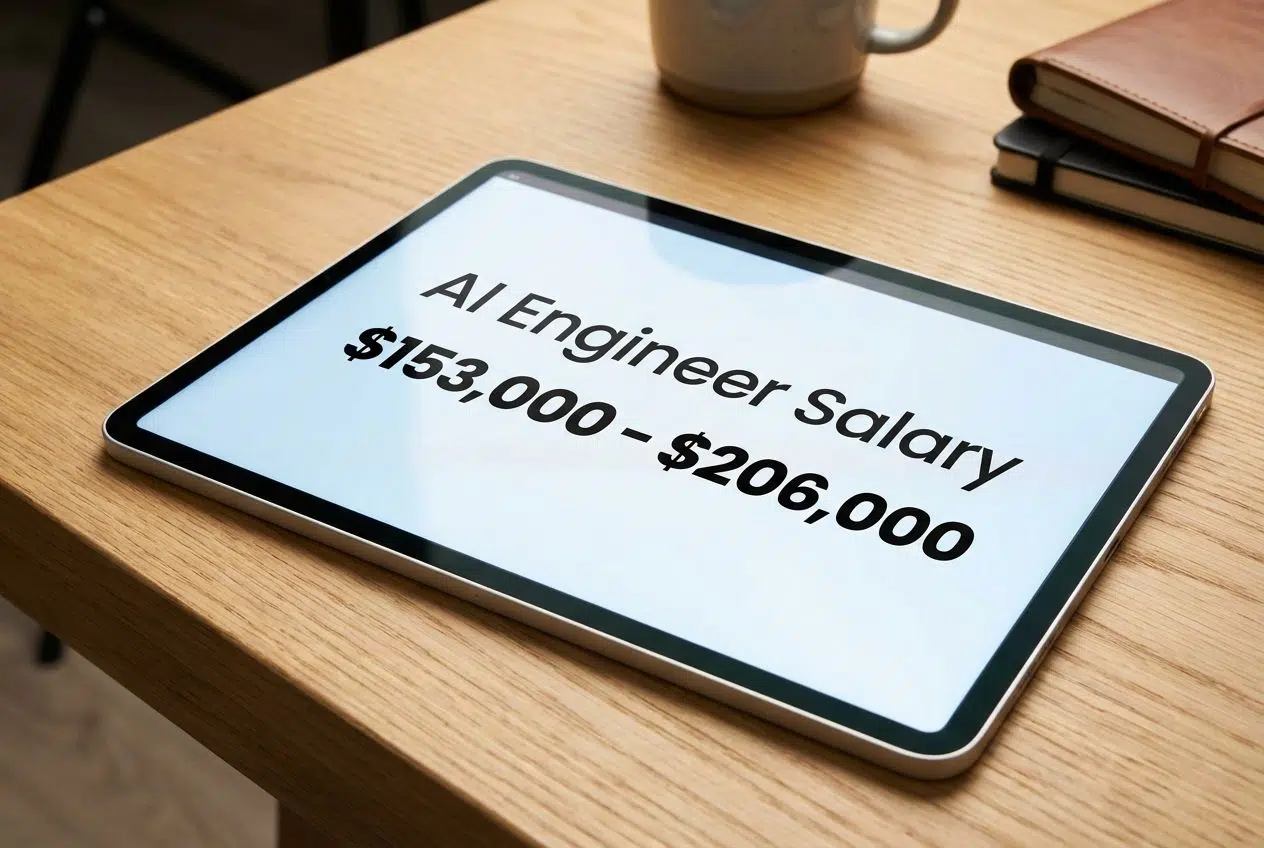
Market Watch: According to 2025 data, the average salary for an AI Engineer in the U.S. ranges between $153,000 and $206,000, with senior roles at major tech firms often exceeding $300,000.
You can find roles in a variety of exciting sectors:
- Machine Learning Engineer: Building the models that allow computers to “learn” from data.
- Robotics Software Developer: Writing the code that tells a robot arm how to weld a car part or pack a box.
- Data Scientist: Analyzing massive datasets to find trends that humans would miss.
- Autonomous Systems Engineer: Creating the safety protocols for self-driving vehicles and drones.
Major hubs in the U.S., Europe, and Asia, specifically Singapore and South Korea, are actively recruiting for these roles. The chance to work on innovations that impact millions of people has never been higher.
Factors to Consider When Choosing a University for AI and Robotics
Selecting a university is about more than just the name on the diploma. You need to look at what you will actually be doing day-to-day. The best programs offer a mix of rigorous theory and messy, hands-on practice.
Curriculum and research opportunities
Look for a curriculum that goes beyond the basics of Python and statistics. The top schools offer specialized tracks. For example, Carnegie Mellon University offers a specific Bachelor of Science in Artificial Intelligence (BSAI), which includes unique courses like “Cognitive Robotics” and “Visual Cognition.”
Research access is equally critical. You want to be at a place where undergraduates can get their hands dirty. At MIT, students often collaborate with the Computer Science and Artificial Intelligence Laboratory (CSAIL) on projects ranging from self-adapting language models to robotic grippers that can handle delicate objects.
Faculty expertise
Great professors do more than lecture; they lead the industry. You want to learn from the people writing the textbooks and filing the patents.
At Stanford University, you might find yourself in a lecture hall with researchers from the Institute for Human-Centered AI (HAI), who are currently defining the ethical standards for the next decade of tech. Their 2025 AI Index Report is a standard reference for the entire industry.
Similarly, at UC Berkeley, faculty members are often split between teaching and leading teams at the Berkeley Artificial Intelligence Research (BAIR) lab. This means the concepts you learn in class are often tested in real-time on breakthrough projects, like their recent work on video prediction models.
Networking and Internship Programs in the AI Sector
Your network is often just as valuable as your GPA. The best universities have deep ties to the private sector, making it easier to land that first internship.
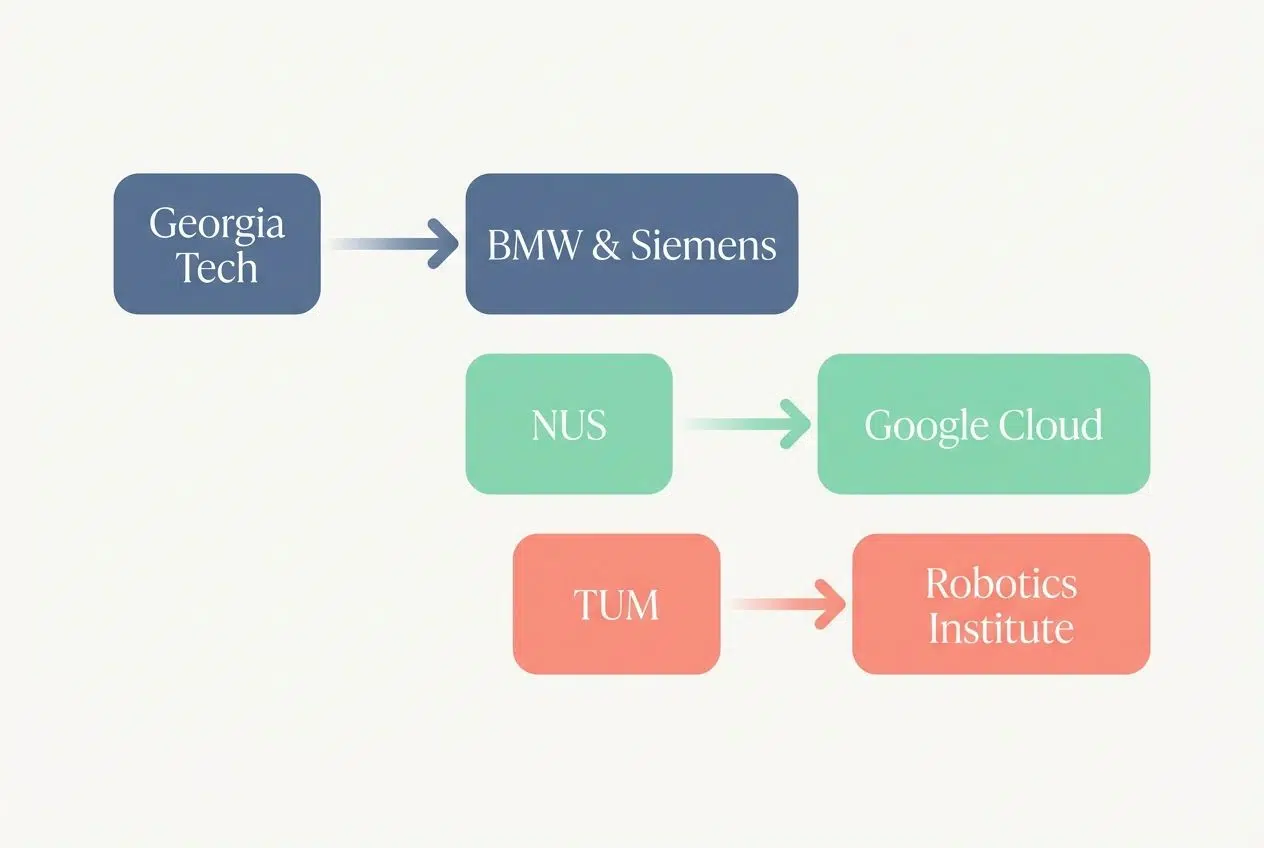
| University | Key Industry Connection | Student Benefit |
|---|---|---|
| Georgia Tech | Robotics Industry Partners Program | Direct access to companies like BMW and Siemens for internships. |
| NUS (Singapore) | Google Cloud Partnership (2025) | Joint research centers and certification pathways for students. |
| TUM (Munich) | Robotics Institute Germany | Close collaboration with Germany’s massive automotive and manufacturing sectors. |
These partnerships often lead to summer positions where you solve real problems. For instance, Carnegie Mellon places a huge percentage of its robotics students in paid internships, often leading to full-time offers before graduation.
Best Universities for AI and Robotics Degrees in 2026
Some names always appear on these lists, but the details of why they are the best change every year. Here is who is leading the pack right now.
Massachusetts Institute of Technology (MIT)
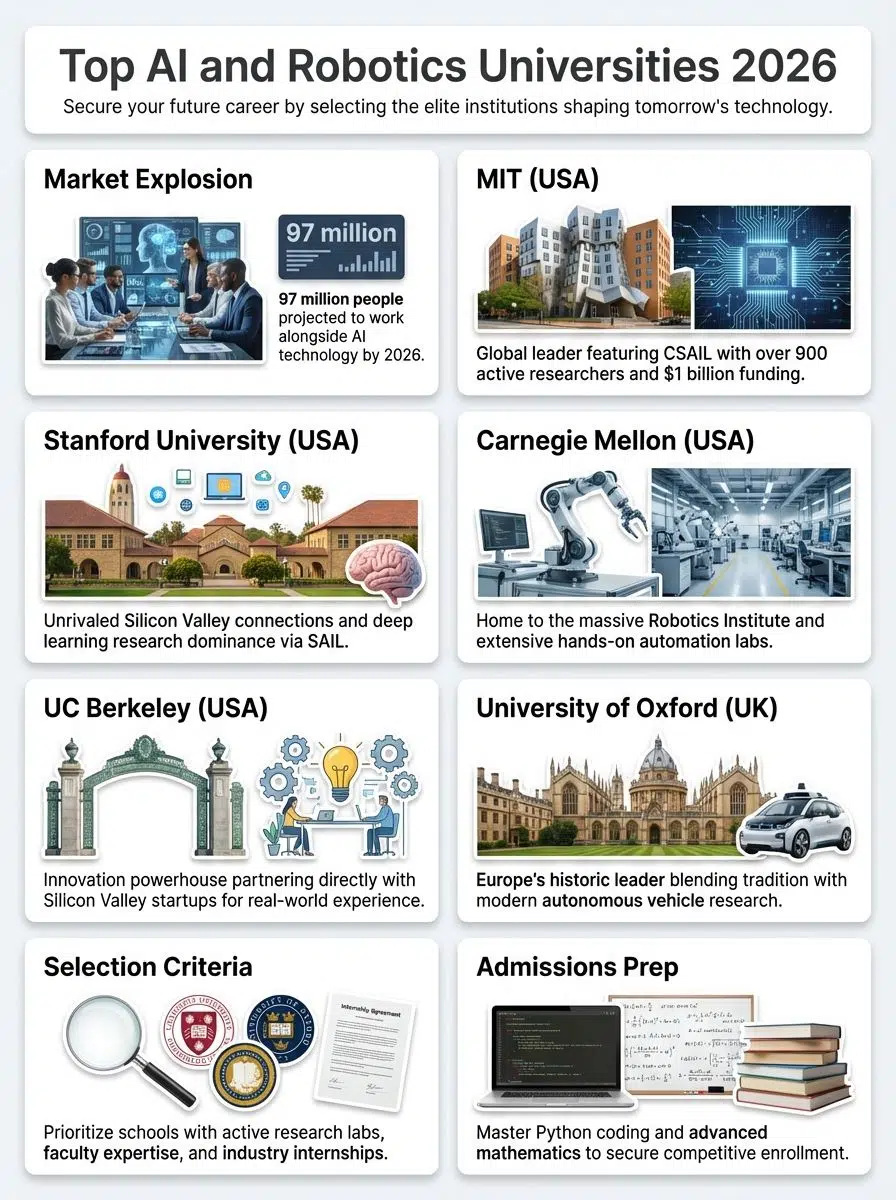
MIT remains a titan in the field. The heart of its innovation is the Schwarzman College of Computing, which integrates AI studies across all disciplines. Students here don’t just learn code; they apply it to biology, physics, and urban planning.
The CSAIL lab is where the magic happens. In 2025, researchers there made headlines with the “SEAL” framework, a new method allowing large language models to self-improve and correct their own mistakes. Undergraduates often have the chance to contribute to these high-level projects through the Undergraduate Research Opportunities Program (UROP).
Stanford University
Stanford is synonymous with Silicon Valley. Its proximity to tech giants like Google, Meta, and NVIDIA offers an unmatched advantage. The university’s Symbolic Systems major is a hidden gem for AI enthusiasts, blending computer science with linguistics, philosophy, and psychology.
The Stanford Institute for Human-Centered AI (HAI) drives the research culture here. Their focus isn’t just on making smarter machines, but on ensuring those machines align with human values. This holistic approach makes Stanford graduates highly sought after for leadership roles in tech policy and product management.
Carnegie Mellon University
If you want to focus purely on the nuts and bolts of intelligent systems, Carnegie Mellon (CMU) is arguably the best place in the world. It was the first university to offer a dedicated Bachelor of Science in Artificial Intelligence.
The curriculum is intense and specialized. You will take classes in the “Decision Making and Robotics Cluster,” learning how to program autonomous agents that can navigate unpredictable environments. The Robotics Institute at CMU is massive, with students currently working on projects ranging from lunar rovers to AI that can track endangered species in the wild.
University of California, Berkeley (UC Berkeley)
UC Berkeley is a powerhouse for public research. The Berkeley Artificial Intelligence Research (BAIR) lab is one of the most productive academic labs in the country. Recently, their team developed the PEVA (Predicting Ego-centric Video from Actions) model, which pushes the boundaries of computer vision.
Students here benefit from a dual focus on engineering excellence and social impact. The EECS (Electrical Engineering and Computer Sciences) department is known for its rigorous “CS 188: Introduction to Artificial Intelligence” course, which is considered a rite of passage for future leaders in the field.
University of Oxford
Oxford combines centuries of academic tradition with cutting-edge tech. The Oxford Robotics Institute (ORI) is a leader in mobile autonomy. In late 2025, they successfully deployed their “Spot” quadruped robot to autonomously map hazardous subterranean environments, showcasing their focus on field robotics.
The university’s collegiate system means you get personalized attention while having access to world-class resources. Their spinout company, Oxa (formerly Oxbotica), is a prime example of how student and faculty research transitions directly into commercial autonomous vehicle technology.
Georgia Institute of Technology
Georgia Tech is where research meets the factory floor. The Institute for Robotics and Intelligent Machines (IRIM) is central to their program, focusing on how robots interact with the physical world. Their “Georgia Artificial Intelligence in Manufacturing” (Georgia-AIM) project is currently working to integrate AI directly into industrial production lines.
For students, this means a curriculum heavy on practical application. You won’t just simulate a robot; you will likely program one to perform a task in a real manufacturing setting. The cost of attendance is also generally lower than that of its private counterparts, offering incredible value.
University of Cambridge
Cambridge sits at the center of “Silicon Fen,” Europe’s answer to Silicon Valley. The Department of Computer Science and Technology has a deep history of computing innovation. The university is a key partner in the Alan Turing Institute, the UK’s national institute for data science and AI.
Students here are encouraged to think entrepreneurially. Many successful AI startups in the UK trace their roots back to Cambridge labs. The curriculum emphasizes the mathematical foundations of machine learning, ensuring you understand the “why” behind the algorithms.
Emerging Universities to Watch in AI and Robotics
While the giants hold their ground, other institutions are making rapid progress with fresh funding and bold new partnerships.
National University of Singapore (NUS)
NUS is quickly becoming Asia’s premier hub for AI. In August 2025, the university announced a major strategic partnership with Google Cloud to launch a joint research center focused on applied AI. This gives students access to industrial-grade cloud infrastructure that few other schools can match.
Their “AI in Public Health” (AI4PH) initiative is another highlight, where students and researchers use machine learning to predict disease outbreaks and improve patient care in Singapore’s smart hospitals.
Technical University of Munich (TUM)
Germany is famous for engineering, and TUM is its crown jewel. The Munich Institute of Robotics and Machine Intelligence (MIRMI) is pushing the envelope with its “KI.Fabrik” project, a fully AI-integrated factory of the future.
TUM stands out for its “industry-on-campus” approach. At the recent Automatica 2025 trade fair, TUM students showcased over 25 different robotics demonstrations, proving that their education is deeply rooted in creating functional, market-ready technology.
Ranking Methodology for Top AI and Robotics Programs
Understanding how these lists are built helps you see what matters. Experts don’t just look at prestige; they look at output and resources.

Evaluation Criteria for AI and Robotics Programs
Rankings like CSrankings.org rely heavily on hard data. They count the number of research papers faculty publish in top-tier conferences like NeurIPS (Neural Information Processing Systems) and ICRA (International Conference on Robotics and Automation). A school with high output here is actively defining the future of the field.
Another key metric is the ratio of students to active projects. The best programs, like those at MIT and CMU, ensure that even undergraduates have a clear path to join a lab. They also look at specialized facilities; having a standard computer lab isn’t enough anymore; top schools need drone flight cages, motion-capture studios, and high-performance computing clusters.
Preparing for Admission to Top AI and Robotics Programs
Admission to these programs is competitive, but you can build a profile that demands attention. It’s about showing you have the raw skills to handle the work.
Strengthening Skills in Mathematics and Computer Programming
AI is built on math. You need a rock-solid foundation in Linear Algebra, Calculus, and Probability. These aren’t just prerequisites; they are the language used to describe neural networks.
For coding, Python is the non-negotiable standard. You should be comfortable using libraries like PyTorch or TensorFlow before you even arrive on campus. Platforms like LeetCode are great for sharpening your algorithmic thinking, while Kaggle allows you to work on real data science problems and see how you stack up against other developers.
Engaging in Projects and Competitions in AI
Admissions officers love to see what you have built. Don’t just list your grades; show them a portfolio. Participating in the FIRST Robotics Competition is a classic way to demonstrate engineering and teamwork skills.
For a more software-focused edge, try building a simple chatbot or a computer vision tool that organizes your photos. Documenting this process on GitHub shows that you are a “doer.” If you are in high school, look for summer intensives like the BAIR High School Summer Program at Berkeley, which can give you a massive leg up in the application process.
Final Thoughts
Top universities for AI and robotics offer strong programs, expert teachers, solid research chances, and real-world projects. Choosing the right school comes down to your goals and interests; use these tips to help you pick a path that fits.
These ideas are easy to follow and can lead you straight into fields full of new jobs, smart tech, and cool discoveries. Learning here can change lives because technology shapes our day-to-day world faster than ever before.
You might want to check out online courses or join local clubs if you want even more hands-on skill-building. Chase your passion, one small step today could mean giant leaps in tomorrow’s tech future.