Nostalgia is a powerful economic force. Best forgotten 90s cars to buy that Gen X and Millennials grew up seeing in magazines or driving in Gran Turismo have officially aged into classic territory. We are living in the “Radwood” era of collecting—a time when boxy styling, pop-up headlights, and analog driving experiences are outpacing traditional muscle cars in appreciation.
But while the Toyota Supra and Acura NSX have already hit stratospheric price points, there is still a “Goldilocks” zone of undervalued gems. These are the cars that were once dismissed as “weird,” “too complicated,” or simply overshadowed by their siblings. Today, they represent the sweet spot of the collector market: modern enough to be reliable (hello, fuel injection), but old-school enough to offer a mechanical connection you can’t get in modern vehicles.
Key Takeaways
-
The Market Has Shifted: 90s Japanese and European cars are currently appreciating faster than many 60s muscle cars.
-
Reliability: These cars offer a great balance of modern reliability (EFI, ABS) and analog driving feel.
-
Top Investment Picks: The Volvo 850 T-5R (for rarity), Chevy Impala SS (for presence), and Toyota Celica GT-Four (for rally heritage) show strong long-term value potential.
-
Buy Now: As the “Radwood” generation hits peak earning years, prices for these specific models are trending upward.
Why the 90s are the “Golden Era” for Car Collectors
Before diving into the specific models, it is important to understand why the market is shifting so aggressively toward this decade. For years, the collector car world was dominated by 1960s American muscle and 1950s cruisers. But as generational wealth shifts, so does nostalgia. The “Youngtimer” market—a term used for cars aged 20 to 30 years—is currently the most dynamic segment in the automotive world.
This shift isn’t just about nostalgia; it’s about the driving experience. The best forgotten 90s cars to buy occupy a unique technological sweet spot. They were built in an era that offered reliable electronic fuel injection and decent rust protection, yet they predate the heavy safety regulations and numbing driver-assist systems of the 2000s. In a 90s car, the steering is often hydraulic (providing better road feel), the throttle is cable-driven (offering instant response), and the visibility is excellent thanks to thin pillars. You aren’t just buying a car; you are buying the last era of truly analog driving.
Criteria: What Defines a “Cool” Forgotten Classic?
Not every clunker from 1995 is worth saving. To make our list of the best forgotten 90s cars to buy, a vehicle had to meet specific criteria that signal future appreciation potential. We looked beyond the obvious choices (like the Toyota Supra or Acura NSX) to find the hidden gems that offer similar thrills for a fraction of the cost.
We selected these vehicles based on three key factors:
-
Technological Ambition: Many of these cars featured “world-first” technologies, from active aerodynamics to complex 4-wheel steering systems.
-
Design Uniqueness: The 90s were a time of experimentation. We prioritized cars with distinct silhouettes that could never be produced today due to modern safety standards.
-
The “Survivor” Factor: These models were often driven hard and depreciated fully. Finding a clean example today is rare, which is the primary driver of value in the collector market.
Here are the Best Forgotten 90s Cars to Buy right now—before the secret is fully out.
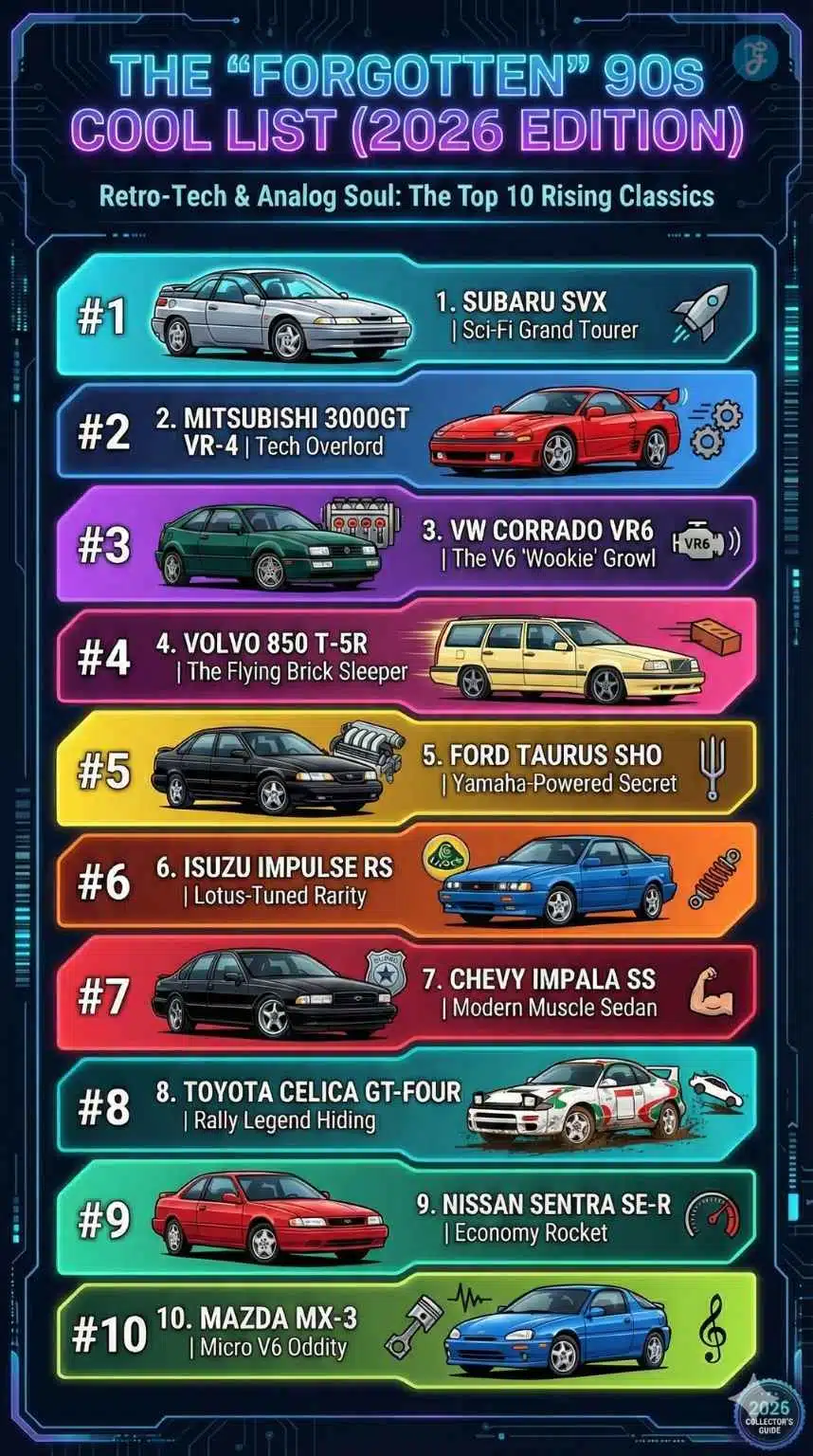
1. Subaru SVX (1991-1996)
The Sci-Fi Grand Tourer
Designed by the legendary Giorgetto Giugiaro, the Subaru SVX looked like it landed from a different planet. With its “window-within-a-window” canopy design and futuristic lines, it was a radical departure for a brand known for utilitarian farm wagons. At the time, it was too expensive and misunderstood; today, it is a masterpiece of 90s optimism.
-
Why It’s Cool: It offers a driving experience unlike anything else from the era—smooth, planted, and distinctively weird. It’s a guaranteed conversation starter at any car meet.
-
Driving Experience: The 3.3L flat-six engine provides a low center of gravity and a turbine-like smoothness. It’s a Grand Tourer in the truest sense—built for crushing continents, not autocross courses.
| Key Specs | Details |
| Engine | 3.3L EG33 Flat-Six |
| Power | 230 HP / 228 lb-ft |
| Drivetrain | AWD |
| Collector Alert | Look for the “LSi” trim with Alcantara interior. |
Buyer’s Tip: The 4-speed automatic transmission is the weak link. Install an external transmission cooler immediately to prolong its life.
2. Mitsubishi 3000GT VR-4 (1990-1999)
The Tech Overlord
Often overshadowed by the Supra and Skyline GT-R, the Mitsubishi 3000GT VR-4 (and its Dodge Stealth R/T Turbo twin) was technically superior to almost everything else on the road. It featured active aerodynamics (spoilers that moved!), four-wheel steering, and electronically controlled suspension—technology that is standard on supercars today but was witchcraft in 1991.
-
Why It’s Cool: It represents the absolute peak of “Bubble Era” Japanese ambition. It’s a rolling computer from a time when that was a compliment.
-
Driving Experience: Heavy but incredibly fast. The twin-turbo V6 delivers a massive surge of torque, and the AWD system claws at the pavement.
| Key Specs | Details |
| Engine | 3.0L Twin-Turbo V6 |
| Power | 320 HP (later models) |
| 0-60 MPH | ~5.0 Seconds |
| Tech Highlight | Active Aero & Exhaust |
Buyer’s Tip: Complexity is the enemy here. Ensure the “Active Aero” front and rear spoilers actually work, as fixing them is labor-intensive.
3. Volkswagen Corrado VR6 (1992-1995)
The V6 Compact Coupe
The Corrado was a sales flop due to its high price, but it was an engineering triumph. The crown jewel was the VR6 engine—a narrow-angle V6 that fit into a 4-cylinder engine bay. It provided a unique, baritone exhaust note that enthusiasts claim is one of the best sounds in automotive history.
-
Why It’s Cool: The active rear spoiler (which deploys at 45 mph) and that distinct “Wookie” engine growl make it a cult classic.
-
Driving Experience: It combines the tossability of a hot hatch with the torque of a grand tourer. The handling is sharp, communicative, and addictive.
| Key Specs | Details |
| Engine | 2.8L VR6 |
| Power | 178 HP |
| Rarity | High (Low production numbers) |
| 0-60 MPH | 6.4 Seconds |
Buyer’s Tip: Check the timing chains. If they rattle, it’s an engine-out service that can cost thousands.
4. Volvo 850 T-5R (1995)
The Flying Brick
Volvo was synonymous with safety, not speed—until they released this limited-edition “Cream Yellow” wagon. With engineering help from Porsche on the engine and suspension, they created a sleeper that could embarrass sports cars while carrying a wardrobe in the back.
-
Why It’s Cool: Fast wagons are universally loved by enthusiasts. The T-5R is the grandfather of the modern performance estate.
-
Driving Experience: Unexpectedly stiff and aggressive. The turbo lag is present, but when the boost hits, this box moves with serious authority.
| Key Specs | Details |
| Engine | 2.3L Turbo 5-Cylinder |
| Power | 240 HP (with overboost) |
| Colors | Cream, Yellow, Black, Green |
| Legacy | BTCC Racing Legend |
Buyer’s Tip: “Cream Yellow” sedans and wagons are the “Unicorns” (holy grails). Verify the paint code to ensure it’s a genuine T-5R and not a clone.
5. Ford Taurus SHO (1989-1995)
The Yamaha-Powered Sleeper
To the untrained eye, it looked like a rental car. But under the hood sat a beautiful, high-revving V6 engine designed and built by Yamaha. It was famously one of the only American sedans of the era that could keep up with a BMW 5-Series, earning it the nickname “The Executive Express.”
-
Why It’s Cool: It’s the ultimate “If you know, you know” car. The intake manifold is a piece of industrial art that owners often polish to a mirror shine.
-
Driving Experience: The engine loves to rev to its 7,000 RPM redline. It’s a front-wheel-drive car that feels eager and energetic.
| Key Specs | Details |
| Engine | 3.0L Yamaha V6 |
| Power | 220 HP |
| Transmission | 5-Speed Manual (Mandatory for fun) |
| Redline | 7,000 RPM |
Buyer’s Tip: Rust is the killer of these cars. Check the rocker panels and rear wheel arches thoroughly.
6. Isuzu Impulse RS (1991)
The Lotus-Tuned Rarity
GM owned both Isuzu and Lotus in the 90s, leading to this strange marriage. The Impulse RS featured a “Handling by Lotus” badge, All-Wheel Drive, and a turbocharger. It was sold in extremely low numbers (approx. 800 in the US), making it a true unicorn.
-
Why It’s Cool: You will likely be the only person at the car show with one. It is a masterclass in weird ‘90s badge engineering.
-
Driving Experience: Sharp and agile, thanks to the Lotus suspension tuning. It feels like a rally car that shrank in the wash.
| Key Specs | Details |
| Engine | 1.6L Turbo |
| Power | 160 HP |
| Drivetrain | AWD (Viscous Coupling) |
| Suspension | Tuned by Lotus |
Buyer’s Tip: Body parts are virtually impossible to find. Do not buy a car that is missing trim pieces or has body damage.
7. Chevrolet Impala SS (1994-1996)
The Modern Muscle Sedan
Chevy took the police-spec Caprice, blacked out the chrome, added 17-inch alloy wheels, and stuffed a Corvette-derived LT1 V8 under the hood. It was menacing, huge, and instantly iconic.
-
Why It’s Cool: It exudes “Lord Vader” energy. It marks the last gasp of the traditional full-frame, rear-wheel-drive American muscle sedan.
-
Driving Experience: It drives like a couch strapped to a rocket. It’s comfortable, floats over bumps, but pulls like a freight train when you step on it.
| Key Specs | Details |
| Engine | 5.7L LT1 V8 |
| Power | 260 HP / 330 lb-ft |
| Layout | Body-on-Frame, RWD |
| Status | Blue-Chip Collectible |
Buyer’s Tip: 1996 models are the most desirable due to the floor shifter and analog gauge cluster (previous years had column shifters).
8. Toyota Celica GT-Four (ST185/ST205)
The Rally Legend in Hiding
While the Supra became a movie star, the Celica GT-Four was busy winning World Rally Championships. It featured a complex AWD system and a punchy turbo engine. The “Homologation Special” versions are genuine race cars for the road.
-
Why It’s Cool: Rally heritage is huge right now. It offers similar thrills to a Lancia Delta Integrale for a fraction of the price.
-
Driving Experience: Grippy and explosive. The turbo hits hard, and the AWD system makes you feel like a WRC driver on gravel.
| Key Specs | Details |
| Engine | 2.0L Turbo (3S-GTE) |
| Power | 200-239 HP |
| Heritage | WRC Champion |
| Drivetrain | Permanent AWD |
Buyer’s Tip: Look for the “ST205” generation (1994-1999) for the best performance, though many must be imported as they weren’t sold in all markets.
9. Nissan Sentra SE-R (1991-1994)
The Economy Rocket
Often called the “BMW 2002 of the 90s,” this unassuming economy car hid a legendary SR20DE engine and a limited-slip differential. It was cheap, light, and incredibly fun to toss around corners.
-
Why It’s Cool: It represents pure, mechanical driving joy before cars became heavy and computerized. It is the definition of a “driver’s car.”
-
Driving Experience: Telepathic steering and a rev-happy engine. It’s not fast by modern standards, but it is incredibly fun at legal speeds.
| Key Specs | Details |
| Engine | 2.0L SR20DE I4 |
| Power | 140 HP |
| Weight | ~2,500 lbs |
| Differential | Viscous LSD |
Buyer’s Tip: Finding a stock example is the challenge. Avoid cars that have been heavily modified or “riced” out.
10. Mazda MX-3 (1991-1998)
The Micro V6 Oddity
Mazda was experimenting wildly in the 90s. The MX-3 was a small hatchback that featured one of the smallest mass-produced V6 engines ever made—a tiny 1.8L unit.
-
Why It’s Cool: The engine sound is exotic and smooth, completely out of character for an economy hatch. It’s a quirk of engineering that will likely never be repeated.
-
Driving Experience: Balanced handling and a unique soundtrack. It’s a momentum car—you need to keep your speed up in the corners.
| Key Specs | Details |
| Engine | 1.8L V6 (K8-DE) |
| Power | ~130 HP |
| Redline | 7,000 RPM |
| Body Style | 3-Door Hatchback |
Buyer’s Tip: The distributor is a known weak point. Keep a spare or upgrade to a modern ignition solution if available.
How to Spot a “Future Classic” (Buying Advice)
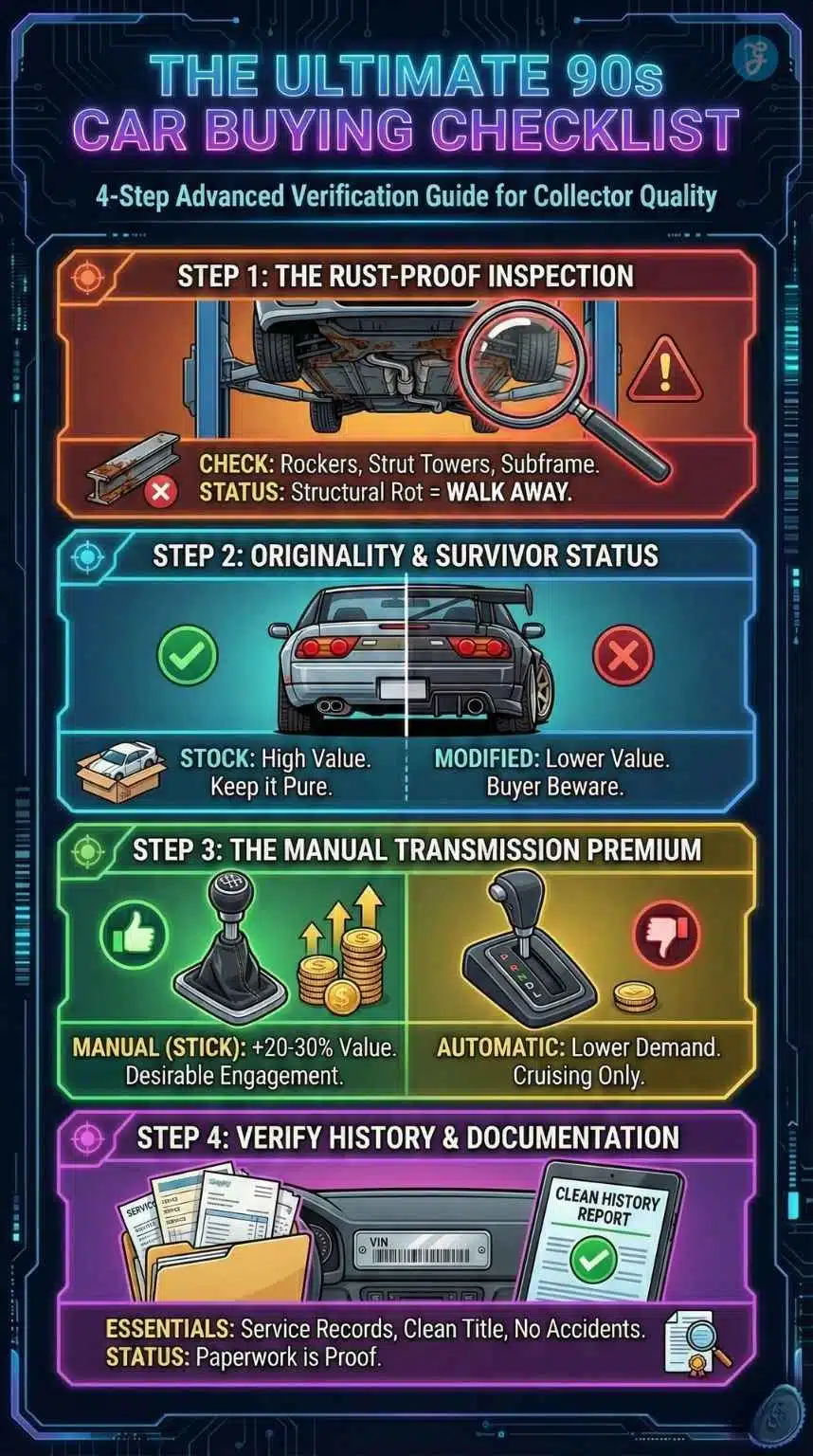
If you are looking to invest in the Best Forgotten 90s Cars to buy, keep these three golden rules in mind:
-
Rust is the Dealbreaker: In the 90s, rust-proofing was better than in the 70s, but not perfect. Always inspect the “structural” areas: strut towers, subframes, and rocker panels. Surface rust is fixable; structural rot is a money pit.
-
Originality is King: A car with original factory paint and stock wheels is worth significantly more than one with aftermarket mods. “Survivor” condition cars (unrestored but well-maintained) are seeing the highest appreciation.
-
The Manual Transmission Premium: For almost every car on this list, the manual transmission version is worth 20-30% more than the automatic. It’s what collectors want.
Living with a Legend: The Reality of Parts & Maintenance in 2025
Buying a 30-year-old “forgotten” car is romantic; maintaining one requires strategy. Unlike a Mustang or Civic, where you can buy parts at any local auto store, vehicles like the Isuzu Impulse or Subaru SVX present unique challenges. However, the 2025 landscape offers new solutions for keeping these legends on the road.
-
The “Heritage Parts” Movement: Major manufacturers have woken up to the value of their back catalog. Nissan (Nismo), Toyota (Gazoo Racing), and Mazda have all launched “Heritage Parts” programs, re-manufacturing critical components for cars like the Skyline, Supra, and RX-7. Always check the OEM catalog first—you might be surprised to find a brand-new factory part is available again.
-
3D Printing to the Rescue: For interior trim, plastic clips, and dashboard buttons—the parts that famously crack on 90s cars—3D printing has become a lifesaver. Communities like Thingiverse and specific car forums often host “print files” for rare parts. If you can’t buy it, you can now print it.
-
The ECU Capacitor Plague: If there is one mechanical Achilles’ heel of the 90s, it is the ECU (Engine Control Unit). The capacitors inside these early computers are prone to leaking after 30 years, which can cause phantom electrical issues. A pro-tip for any new owner is to have the ECU professionally recapped immediately—it’s cheap insurance against a stranded car.
Smart Buying: Why “Agreed Value” Insurance is Non-Negotiable
This is the single most important financial advice for owning a rising classic. If you insure your pristine 1991 Nissan Sentra SE-R with a standard budget insurance carrier, their algorithm will likely view it as just “a deeply used 1991 Nissan” and value it at $500.
If that car gets totaled, you will receive a check for scrap value, losing the $15,000+ investment you actually paid.
You must get “Agreed Value” insurance. Specialty providers (like Hagerty, Grundy, or American Collectors) understand the collector market. You and the insurer agree upfront that the car is worth $20,000 (or whatever the market rate is). If the worst happens, you get that exact amount, with zero depreciation arguments. Bonus: These policies are often cheaper than standard insurance because they assume you will drive the car less and pamper it more.
Honorable Mentions: 5 More Sleepers to Watch
If the top 10 list didn’t have quite the right flavor for you, keep an eye on these five runners-up. They are bubbling just under the surface of the mainstream collector market:
-
Lexus SC300/400: The “Japanese Mercedes” with a bulletproof engine (2JZ in the SC300) and timeless design.
-
Audi TT (Mk1): While technically late 90s/early 2000s, its Bauhaus design is aging beautifully, and prices are bottoming out.
-
Merkur XR4Ti: A strange, turbocharged Ford Sierra sold in the US. Weird, rare, and very 80s/90s crossover cool.
-
Honda Prelude (4th Gen): The one with the futuristic digital dashboard. VTEC engines and 4-wheel steering make it a tech showcase.
-
Saab 9000 Aero: The ultimate architect’s car. quirky, incredibly comfortable, and surprisingly fast thanks to a high-pressure turbo.
Frequently Asked Questions (FAQ)
1. Are 90s cars reliable enough to be daily drivers?
Yes, generally. Unlike cars from the ’60s or ’70s, most ’90s cars feature electronic fuel injection and modern rust-proofing. However, rubber components (hoses, bushings) will need replacing due to age. A “sorted” ’90s car can be a reliable daily driver.
2. Which ’90s car is the best investment for under $10,000?
The Subaru SVX and Mazda MX-3 can still be found in good condition for under $10k. They are currently undervalued compared to their scarcity and uniqueness.
3. Is it hard to find parts for these “forgotten” cars?
It can be. While mechanical parts (brake pads, filters) are usually shared with other models, “cosmetic” parts (trim, lights, glass) for cars like the Isuzu Impulse or Subaru SVX can be extremely difficult to source. Join owner forums before buying to check part availability.
4. Why are manual transmissions so important for value?
Collectors buying ’90s cars are looking for an experience—specifically, the analog engagement that modern cars lack. The manual transmission is central to that experience, making stick-shift models much more desirable and valuable.
5. What does “Radwood” mean?
“Radwood” is a car show and lifestyle movement that celebrates the automotive culture of the 1980s and 1990s. It has become a shorthand term for cars from this era that feature period-correct styling (boxy shapes, bright colors, synth-wave aesthetics).
Final Thoughts: The Analog Sweet Spot
Buying a forgotten classic isn’t just about investment potential; it’s about preserving a unique era of automotive history. These cars come from a time when engineers were allowed to take risks—putting a V6 in a compact hatch or active aero on a Mitsubishi. Whether you want the muscle of the Impala SS or the quirkiness of the SVX, the best forgotten 90s cars to buy offer a driving soul that is increasingly rare in our digital world.