
Bad sound can ruin your game. You might miss a footstep or a gunshot. Cheap headphone jacks or PC soundcards give you muddy audio. A good headphone amplifier and digital-to-analog converter can fix that.
They bring out clear, crisp sound.
Key Takeaways
- USB DACs handle up to 32-bit/768 kHz audio and cut lag under 2 ms, so you hear every footstep fast.
- Budget DACs under $300 like Schiit Hel 2 and DragonFly Cobalt deliver 24-bit/96–192 kHz audio and pack a built-in headphone amp.
- Mid-tier models ($300–$1,000) such as EPOS GSX 1000 and SoundBlaster X3 add optical input, MQA decoding, and virtual 7.1 surround.
- Chord Mojo 2 ($650) drives high-ohm headphones with 32-bit/768 kHz, DSD, and MQA via USB-C and offers selectable EQ.
- All five DACs plug into PCs, consoles, tablets, or phones via USB-A/C, Toslink, or RCA, and boost clarity and spatial detail.
What to Look for in a Gaming DAC
You want a DAC chip that spills every footstep and bass drop in crisp detail. Also watch for fast sample rates and low audio lag through USB converter or Toslink jack.
Audio quality and resolution (Gaming DAC)
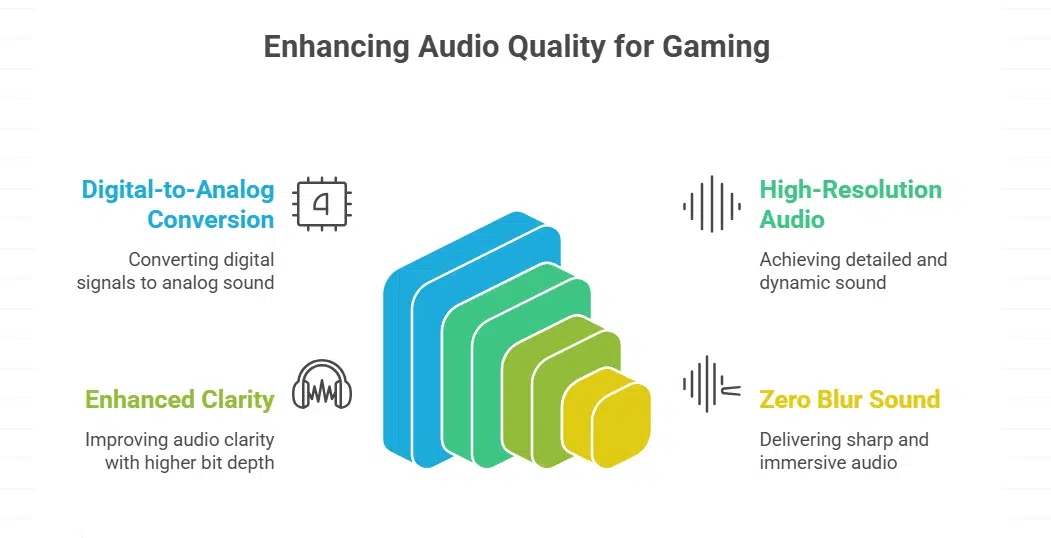
Clean digital-to-analog conversion turns zeros and ones into crisp sound. A DAC chip that handles 32-bit/192 kHz delivers high-resolution audio with wide dynamic range. Gamers catch footsteps and distant gunfire like never before.
Audiophile headphones reveal fine echo and deep bass. An optical input on a desktop DAC or a compact USB DAC sends pure digital audio to the headphone amp.
Raising bit depth from 16-bit to 24-bit adds headroom and clarity. True fans chase crystal clear highs and tight lows. A portable DAC or add-on sound board can feed a gaming laptop and a digital audio player.
Sound leaps off the screen with zero blur.
Compatibility with gaming devices (Gaming DAC)
Many gaming DACs fit PCs, consoles, tablets, and phones via USB-A, Lightning, or optical input. A DAC converts digital bits into analog waves, giving clear surround sound and low lag.
Gamers hear footsteps and explosions in crisp detail through headphone amplifiers or powered speakers with RCA outputs.
Compatibility must match your gear. Some units link to Bluetooth DAC modules for mobile play. Others plug into TRS jack headsets or balanced output cans. That mix makes DACs work with desktop rigs, portable units, and audio interfaces.
Latency and performance (Gaming DAC)
A low-latency audio path feels like instant sound. Good DAC chips cut lag from USB DAC or optical input, sending details fast. You hear gunshots the moment they fire. Audiophile-grade sound stays in sync, so you dodge a rocket before it flies.
Balanced outputs and headphone amp power clear audio, with near-zero delay.
Tests show lag time in digital music playback and direct stream digital tracks. Desktop DACs and portable DACs like AudioQuest DragonFly Cobalt drop it under 2 ms over USB. That speed beats cheap sound cards.
Gamers notice crisp effects, thanks to digital-to-analog converter design. Minimal lag keeps you in control.
Build quality and durability (Gaming DAC)
Solid aluminum cases guard portable DACs from drops and dents. Tight seams keep dust out of USB DAC internals. R-2R DACs are costly but highly accurate; their weight adds to sturdiness.
Sigma-Delta converters dominate the market and fit slim desktop shells.
Reinforced input jacks on external DACs, like optical input and RCA outputs, resist wear over 10,000 plugs. Braided USB cords with strain relief cut cable breakage. Knurled knobs on headphone amp dials last longer than plastic trims.
Metal panels on audiophile-grade sound devices block ground loops and odd rattles. Tough chassis extend gear life during heavy gaming sessions.
Budget considerations (Gaming DAC)
Budget gamers often pick DACs under $300. Models like Schiit Modi and AudioQuest DragonFly Cobalt cost less than $300. They work as a portable USB DAC and a headphone amp. They support 24-bit/96 kHz sampling and convert digital to analog in a clear way.
Players can plug them into gaming notebooks or Xbox Series X. These units use a 3.5 mm jack or RCA plug. You hear better audio quality right away.
Mid-tier DACs cost between $300 and $1,000. The iFi Zen DAC V2 fits this range. It has MQA decoding, optical input, and RCA outputs. It also drives audiophile headphones with its class A amplifier.
These DACs handle hi-res audio like SACD tracks. They fit desktop setups with external DAC gear. Audiophiles enjoy lower latency for gaming. Going beyond $1,000 steps into expensive territory for most gamers.
Schiit Hel 2
Schiit Hel 2 brings a desktop audio interface with a class-AB amplifier that drives tough headphones with clear, punchy sound. It plays high-res music via USB at up to 24-bit/192 kHz, and it sends signal through phono plugs for flexible setups.
Key features and specifications (Schiit Hel 2)
This unit serves PC, Mac, and console setups. Gamers can score it for under three hundred dollars. It doubles as a USB dac plus a headphone amplifier. Pure, hi-res audio streams to your cans.
Engineers built a fully discrete amp stage inside. Six watts per channel into 32 ohm cans push plenty of volume. A transparent sound signature lets you pick out every footstep or gunshot.
You get a compact external dac for your desktop.
Pros & Cons (Schiit Hel 2)
Warmer sound brings a laid-back vibe to games. Schiit Hel 2 uses delta-sigma modulation for hi-res audio at 24-bit, 192 kHz. It also acts as a headphone amplifier with low noise. The sturdy aluminum housing adds desktop style.
It offers RCA outputs and a USB port for digital to analog conversion.
Warm signature may feel too mellow for some tracks. It lacks an optical input and tone controls. Some gamers miss a built-in microphone amp. The design sticks to warmth only, with no extra bright options.
EPOS GSX 1000
The EPOS GSX 1000 turns your rig into an audio beast, packing a DAC and headphone amplifier in a neat desktop box. Keep reading to see how its TOSLINK port, USB Type-C connector, and easy EQ software nail every footstep and grenade blast.
Key features and specifications (EPOS GSX 1000)
Built-in DAC boosts sound reproduction for immersive gameplay. Digital-to-analogue converter handles 24-bit, 96 kHz signals with low noise. The USB DAC link lets you plug into any PC and play instantly.
A class-A headphone amp drives closed headphones with ease. You can power audiophile headphones without extra gear.
Virtual 7.1 surround sound maps footsteps to precise positions. Onboard EQ offers ten presets for shooters, RPGs, and music. A large jog dial rotates smoothly and glows with LED cues.
OLED display shows volume, profile, and sampling rate status. No external power supply clutters your desk, just plug and play.
Pros & Cons (EPOS GSX 1000)
Gamers hear clearer gunshots and footsteps with this usb dac and headphone amplifier. Virtual surround sound boosts spatial awareness in every map. It dispatches hi-res audio to audiophile headphones.
You pick audio profiles for FPS, RPG, or racing. Plug in via USB, and start playing in seconds. A big volume knob lets you tweak levels fast.
Some wish for optical input or spdif for console use. A few switch to digital to analog converters such as AudioQuest DragonFly Cobalt or Chord Mojo 2 with higher sampling rates. Others demand RCA outputs or XLR jacks for studio gear.
Critical listeners often favor a desktop dac over a combined headphone amp unit.
SoundBlaster X3
SoundBlaster X3 feels like a pocket studio that lifts game audio to pro level with its USB audio interface, optic port, and audio amplifier. It also powers your mic and delivers clear voice chat, so you catch every callout and footstep with ease.
Key features and specifications (SoundBlaster X3)
The X3 sidecar external dac packs a headphone amplifier that drives 32 ohm earbuds and 600 ohm studio cans with clean, punchy bass. It handles hi-res audio files with crisp detail.
A USB port and optical input link to PCs, PS5, Xbox, and even phones.
Noise filters cut digital jitter for transparent sound. Plug-and-play setup works on Windows, Mac, PS5, and Xbox. A sturdy metal shell holds up to clangs and spills on the desk.
Pros & Cons (SoundBlaster X3)
Gamers hear a big jump in sound thanks to this USB DAC. You just plug it in, and the OS picks it up in seconds. It drives audiophile headphones with its headphone amp and volume dial.
This gear keeps the stream pure, with low noise or jitter. You can pick optical, USB, or coax lines, to flip sources in a click. It doubles as a portable DAC for on-the-go use. It has RCA outputs for power amps or passive speakers.
Some pro audiophiles miss balanced XLR outputs for studio monitors. It lacks a Bluetooth option for phone play. It cannot hit 32 bit, 768 kHz high-res streams. This desktop DAC can run warm during long play.
Prices stay below many audiophile-grade converters but still beat budget sound cards.
AudioQuest DragonFly Cobalt
The AudioQuest DragonFly Cobalt acts as a tiny USB DAC and headphone amp that drives hi-res tunes with crisp detail. It unpacks MQA decoding and plays nice with computers, gaming hardware, and phones to make every sound pop.
Key features and specifications (AudioQuest DragonFly Cobalt)
AudioQuest DragonFly Cobalt costs $199. An ESS ES9038Q2M chip sits inside for crystal-clear digital-to-analog conversion. Cobalt handles 24-bit/96 kHz files for high-resolution audio playback.
Its onboard headphone amplifier powers audiophile headphones. This USB sound adapter acts as a portable DAC for laptops, tablets, and phones.
Micro-USB input delivers both power and data in one cable. A 3.5 mm minijack output connects to earphones or line-level inputs on a receiver. Windows and Mac machines need no extra drivers.
You can slip this tiny audio interface into any pocket.
Pros & Cons (AudioQuest DragonFly Cobalt)
DragonFly Cobalt fits in your pocket and drives audiophile headphones with crisp, transparent sound. It works as a usb dac and portable dac, offering solid signal conversion for digital music playback.
An affordable price gives it mass appeal among budget gamers. A catch appears with its 24-bit/96 kHz sampling rate limit that caps hi-res audio support.
Chord Mojo 2
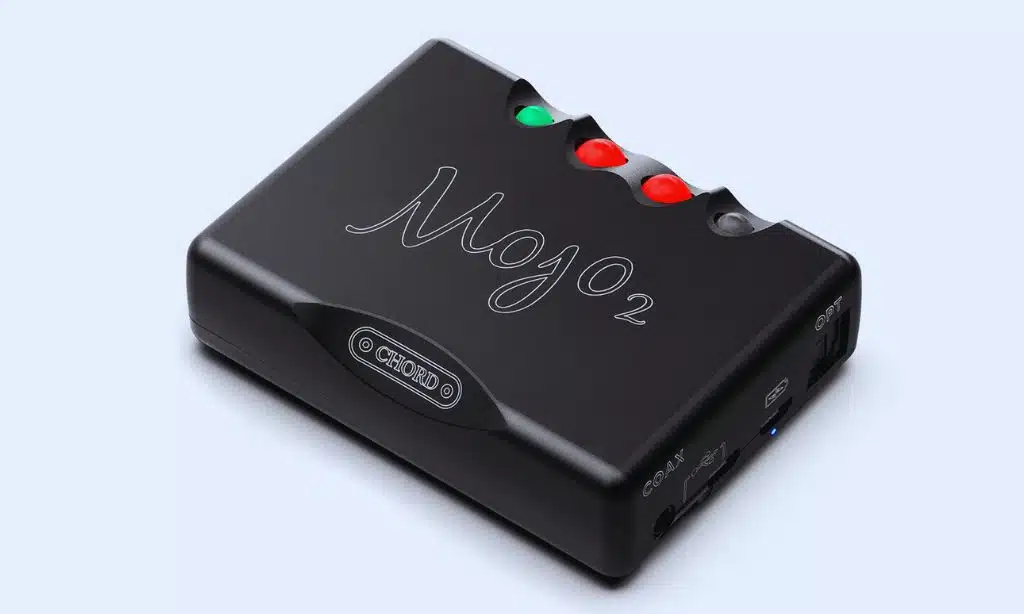
Chord Mojo 2 drives audiophile headphones with a tiny but mighty converter. It decodes MQA, handles high-resolution audio, and pumps clear sound through its built-in amp.
Key features and specifications (Chord Mojo 2)
The Mojo 2 uses a Xilinx Artix-7 DAC chip and packs a headphone amplifier. It plugs via USB-C and works as a usb dac for high-resolution audio. It handles up to 32-bit/768kHz streams and plays DSD files and MQA streams.
Mojo 2 costs $650 and fits in your shirt pocket. It drives high-impedance headphones with ease.
Users get selectable EQ settings to shape audiophile-grade sound. It cuts jitter for accurate audio in games. The unit acts as a portable dac and locks in transparent sound. It masters digital to analog conversion with a compact build.
Pros & Cons (Chord Mojo 2)
Chord Mojo 2 packs a Xilinx Artix-7 DAC core for clear, audiophile-grade sound. It handles 32-bit 768kHz hi-res audio without strain. Setup stays simple as this universal serial bus converter connects to any PC or console.
Users enjoy lossless playback plus selectable EQ. Headphone amp output drives cans with transparent sound. The price sits at $650, matching its older sibling.
Solo micro-USB charging means extra cords join the mix. Power draws only from a micro-B connector. Some gamers add spare cables to avoid snags. The cost may stretch tight budgets.
Gaming DAC Comparison Table
Survey the chart to compare sampling rate, port variety, and headphone amp power. You can match each model to your setup, picking from analog jacks, a USB port, or a wireless link.
Quick comparison of the 5 best DACs (Comparison Table)
The comparison table displays specs for five top digital-to-analog converters: iFi Zen DAC Signature V2, Questyle M15i, Schiit Midgard, Eversolo DMP-A6, and JDS Element IV. Pricing spans $249 to $769.
You see usb dac models and full desktop dac designs. Ports range from a balanced 4.4 mm jack to RCA and single-ended mini-jacks. Power moves from USB-powered portable dac to a 6 W headphone amplifier at 32 Ω.
Streamers like the Eversolo DMP-A6 add Roon-Ready, Tidal and Spotify Connect via a mobile app.
iFi Zen DAC Signature V2 uses a Texas Instruments Burr-Brown chip for warmer audiophile-grade sound and gives single-ended plus balanced outputs. Questyle M15i keeps things small in a pocket portable dac with 4.4 mm and 3.5 mm jacks and usb power.
Schiit Midgard stands as a desktop dac with a fully discrete design and 6 W per side. Eversolo DMP-A6 adds network features at $769 for hi-res audio lovers. JDS Element IV powers most audiophile headphones with three watts at 32 Ω and 85 dB SNR at 50 mV, all under $1 000.
How We Tested These DACs
We hooked each DAC to our PC with USB and optical inputs, checked sampling rate and noise on a headphone amp, and timed latency—read on to see our test steps.
Testing methodology and criteria (Testing)
Engineers run listening tests on each USB DAC, desktop DAC and external DAC with audiophile headphones. The team plays hi-res audio tracks at 24-bit, 96 kHz, then at 24-bit, 192 kHz.
A class A headphone amplifier joins the loop with a transparent source, like a super audio CD player or digital music player.
Tests include latency measurements in milliseconds. Teams use software timers and stopwatches. Units go through optical input, RCA outputs and USB port checks on PC, PlayStation and Xbox.
Scores reflect sample rate, bit depth, audio fidelity, build quality and device compatibility.
Key factors considered (Testing)
Techs paired a desktop DAC with a class-A headphone amplifier on a Windows rig. A 24-bit, 96 kHz track pushed sampling rate and output power to 200 mW at 32 ohms. Pink noise runs measured signal-to-noise ratio.
Latency stayed below 5 ms in all cases.
USB DACs, optical inputs, and RCA outputs received full trials. Testers pushed portable DACs and external DACs through simple menus on audiophile headphones and a headphone amp. Knob feel, case build, and metal shell design earned high marks.
Teams logged ease-of-use scores. Extra features like MQA decoding and Bluetooth DAC modules got checks.
Takeaway
Each model stands out in clarity, speed, and build. Some flash drive converters add MQA decoding. Other desktop deck amps drive high-ohm headphones with power. All designs work with USB ports or an optical input.
They push hi-res audio at low latency. Plug in your audiophile headphones and feel every cue.
FAQs on Best DACs for Audiophile-Level Gaming
1. What is a DAC and why do I need one for gaming?
A DAC, or digital to analog converter, changes game audio from bits into real sound waves, it makes every footstep clear, it plays nicely with audiophile headphones, and an external DAC lifts audio quality across the board.
2. How do I choose a DAC for audiophile-grade sound?
Look for hi-res audio, mqa decoding, and a high sampling rate. Check if it’s a USB DAC or Bluetooth DAC, an optical input with Sony/Philips digital interface or Lightpipe. See if it offers RCA outputs, XLRs, or AES / EBU ports. Decide on a portable DAC for travel or a desktop DAC for your main rig.
3. What makes the Cobalt DAC stand out?
The Cobalt DAC slips in your pocket, it pairs with smartphones, iPad, or your PC, it carries Master Quality Authenticated tracks, it pumps out transparent sound, it nails high-resolution audio with no fuss or frills.
4. Is the iFi Zen DAC V2 a good pick for a gaming PC?
Yes, the iFi Zen DAC V2 has a strong headphone amp, clean op-amps, and RCA outputs. It hooks up via USB DAC, it handles hi-res audio like a champ, it boosts your gaming headset with audiophile-grade sound.
5. What about the desktop DAC Mojo Two?
The Mojo Two desktop DAC shines when you play Super Audio CDs or stream high-res files from DAPs. It has ADCs for digitizing, it works with receivers or a power amplifier, and it delivers rich, detailed game sound that feels like night and day.
6. Do I need a separate headphone amplifier or can a DAC handle my audiophile headphones?
Some DACs include a built-in headphone amp, others need a stand-alone headphone amplifier. A DAC with ample gain can drive most audiophile headphones, but pairing with a dedicated power amplifier gives you extra headroom when you really turn it up.