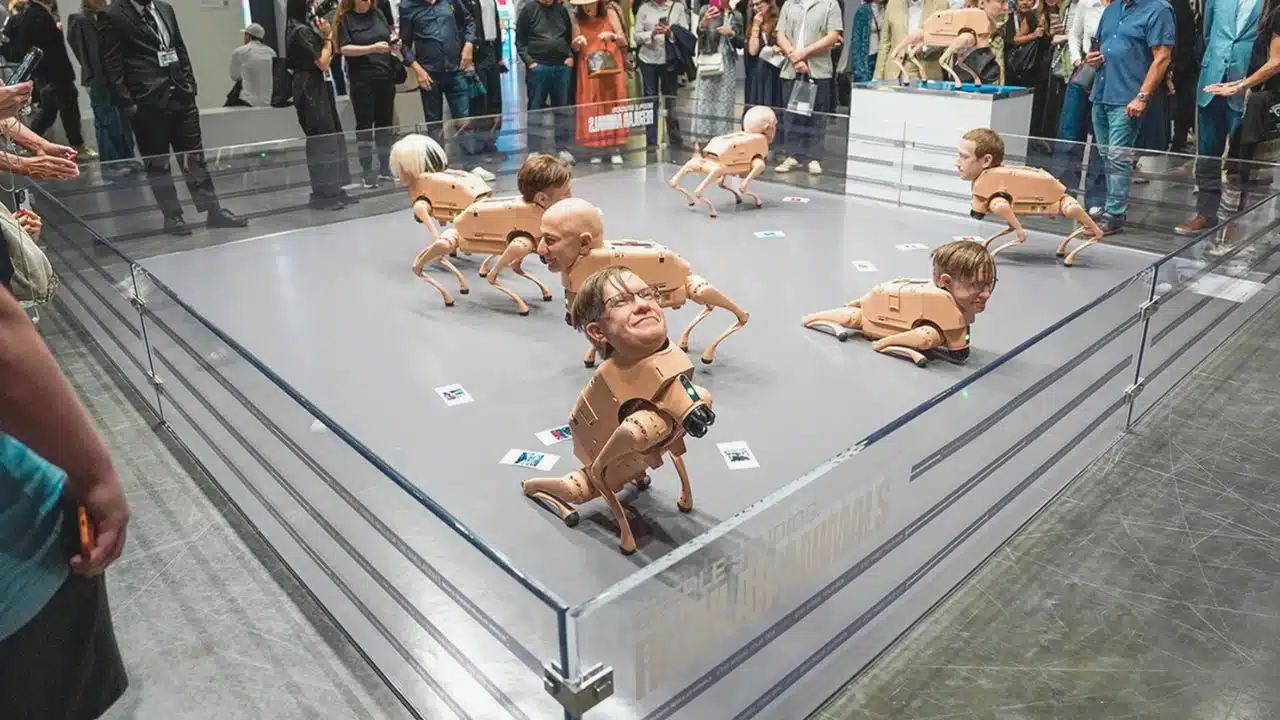
A pack of robot dogs fitted with eerily lifelike human heads of tech billionaires and art icons is drawing crowds at Art Basel Miami Beach 2025, in a new installation by digital artist Beeple titled Regular Animals. The work, presented in the fair’s new Zero10 digital art section at the Miami Beach Convention Center from 3–7 December, merges robotics, AI, NFTs and satire to question how powerful platforms shape what billions of people see online.
Robot dogs with billionaire heads
The installation features robotic quadrupeds moving inside a specially built area, each topped with a hyperreal silicone head modeled on public figures including Elon Musk, Mark Zuckerberg, Jeff Bezos, Andy Warhol, Pablo Picasso and Beeple himself (real name Mike Winkelmann). The work sits at the heart of Art Basel Miami Beach’s Zero10 digital art zone, which was launched this year to foreground AI-driven and screen-based work within the convention center. Fair organizers and commentators say the piece has quickly become one of the most talked‑about attractions of the 2025 edition, widely shared in videos across social media.
Key facts about Regular Animals
| Item | Detail |
| Artist | Mike Winkelmann (Beeple) |
| Work title | Regular Animals |
| Event | Art Basel Miami Beach 2025 |
| Venue/section | Zero10 digital art space, Miami Beach Convention Center |
| Dates on view | 3–7 December 2025 |
| Number/type of robots | A small pack of robotic dogs with human heads |
| Public figures depicted | Elon Musk, Mark Zuckerberg, Jeff Bezos, Andy Warhol, Pablo Picasso, Beeple |
Inside Beeple’s Regular Animals installation
The robots roam, twist and collide like a restless herd, while embedded cameras continuously photograph the surrounding crowd and fair environment. On a timed cycle, each machine produces a printed image from its rear, functioning as a kind of certificate of what it has just seen and processed. A QR code on these prints links buyers to NFTs that store the images on the blockchain, extending Beeple’s long‑running interest in crypto‑native art formats beyond screens into physical, kinetic sculpture.
How the robot dogs work
| Feature | Description |
| Base hardware | Four‑legged robotic platforms adapted as dogs |
| Heads | Hyperreal silicone masks of tech and art figures |
| Vision system | Onboard cameras capturing continuous photos of the surroundings |
| Output | Printed images dropped onto the floor at intervals |
| NFT link | QR codes on prints connect to blockchain‑stored artworks |
| Data lifespan | Image‑capture and blockchain uploads planned to run for about three years |
| Physical lifespan | Robots are expected to keep moving even after data capture ends |
Art journalists report that the creatures are penned but clearly visible at close range, with visitors often pressed along the edges filming and photographing their movements. Video clips shared from the fair show many attendees reacting with a mix of amusement and unease to the combination of realistic faces, mechanical gaits and the way the printed images literally drop onto the floor.
Satire of tech power and algorithmic influence
Beeple’s installation is framed as a commentary on how a handful of tech platforms, led by figures like Musk and Zuckerberg, mediate news, culture and everyday communication through opaque recommendation algorithms. The choice to place these faces on animal‑like machines that watch, process and output images in a loop is intended to make visible the invisible pipelines that decide what users see online. Designers involved in the Zero10 space say the layout deliberately keeps visitors and robots in a shared environment rather than behind traditional screens, to underline how deeply such systems are embedded in daily life.
People and platforms referenced in the work
| Figure | Role in installation | Associated platform or legacy |
| Elon Musk | Robot head on one dog | X (formerly Twitter), space and AI ventures |
| Mark Zuckerberg | Robot head on one dog | Meta’s social platforms and VR ecosystem |
| Jeff Bezos | Robot head; one edition reportedly not for sale | Amazon and space ventures |
| Andy Warhol | Art‑historical reference as robot head | Pop art and mass‑media imagery |
| Pablo Picasso | Art‑historical reference as robot head | Cubism and modern painting |
| Beeple himself | Appears as two robot heads | NFT pioneer and digital artist |
According to interviews at the fair, Beeple suggests that each robot sees and translates the world through the aesthetic lens of the person it represents, echoing how individual platforms filter reality in distinct ways. Commentators note that by turning that process into a crude, mechanical act that ends in a print falling from the back of a machine, the work literally embodies concerns that our feeds are curated streams shaped for engagement rather than understanding.
Sales, audience buzz and Beeple’s digital‑art track record
Art‑market reports from the VIP preview say each robot is priced at around 100,000 dollars, produced in editions of two plus one artist’s proof, and that all available works quickly found buyers on the opening day of the fair. The enthusiastic response strengthens the position of digital and tech‑driven work within Art Basel’s program, after several years of debate about the staying power of the NFT boom that first propelled Beeple to global fame.
Market and context snapshot
| Aspect | Detail |
| Price per robot | Around 100,000 USD |
| Edition structure | 2 editions + 1 artist’s proof per figure |
| Availability | Reported sold out by end of VIP preview day |
| Notable exception | Jeff Bezos version reported as not for sale |
| Fair section | Zero10 digital art program at Art Basel Miami Beach |
| Social‑media impact | Widely shared reels and clips from the installation |
| Beeple’s prior milestone | 69.3‑million‑dollar NFT sale at Christie’s in 2021 |
Beeple’s earlier NFT auction at Christie’s, where a single digital collage sold for about 69.3 million dollars, made him one of the highest‑priced living artists and a central figure in debates over crypto art. Analysts note that Regular Animals builds on that reputation while moving decisively into robotics and physical spectacle, aligning Beeple with a broader shift in digital art toward immersive, hardware‑based experiences in major fairs and museums.