
Are you hunting for a steady job in healthcare, but feel lost without a doctor’s degree? Many people face this snag, craving roles that help patients heal while dodging years of med school.
Imagine yourself as a hero in scrubs, fixing lives one step at a time, like a coach guiding folks back to strength.
The allied health field makes up over 60% of all healthcare workers, with jobs set to jump from 15.6 million in 2010 to 19.8 million by 2020. This post spotlights eight hot allied health careers, from speech-language pathologists to physical therapists and respiratory therapists, plus key skills like communication and tech know-how.
We’ll show you how to get started, with tips on education, certifications, and staying sharp in patient care spots like hospitals and outpatient clinics. Stick around for the scoop.
Key Takeaways
- Allied health jobs make up over 60% of healthcare workers and will grow from 15.6 million in 2010 to 19.8 million by 2020, due to aging population needs.
- Speech-language pathologists earn an average of $71,550 yearly with 21% growth from 2014 to 2024; physical therapists average $109,034 and grow 14%.
- Diagnostic medical sonographers get $97,864 on average with 15% growth; respiratory therapists earn $85,613 and grow 13%.
- Radiology technologists average $85,748 with 6% growth; occupational therapists make $105,560 and grow 11%.
- Key skills include communication, tech know-how, and problem-solving; start with degrees like associate or master’s plus certifications like RRT or OTR.
What Is Allied Health?
Allied health covers a big chunk of jobs in the healthcare industry. These roles support doctors and nurses in patient care. Think of them as the unsung heroes, like physical therapists helping folks walk again after an injury.
Allied health professionals make up over 60% of the total healthcare workforce. They work in places like hospitals, outpatient clinics, and rehabilitation facilities. Jobs include speech-language pathologists fixing communication disorders, or respiratory therapists aiding those with lung issues.
The Bureau of Labor Statistics calls healthcare the largest sector. It stays that way because of an aging population and growing healthcare needs. Picture a team where physicians lead, but allied health workers keep everything running smooth.
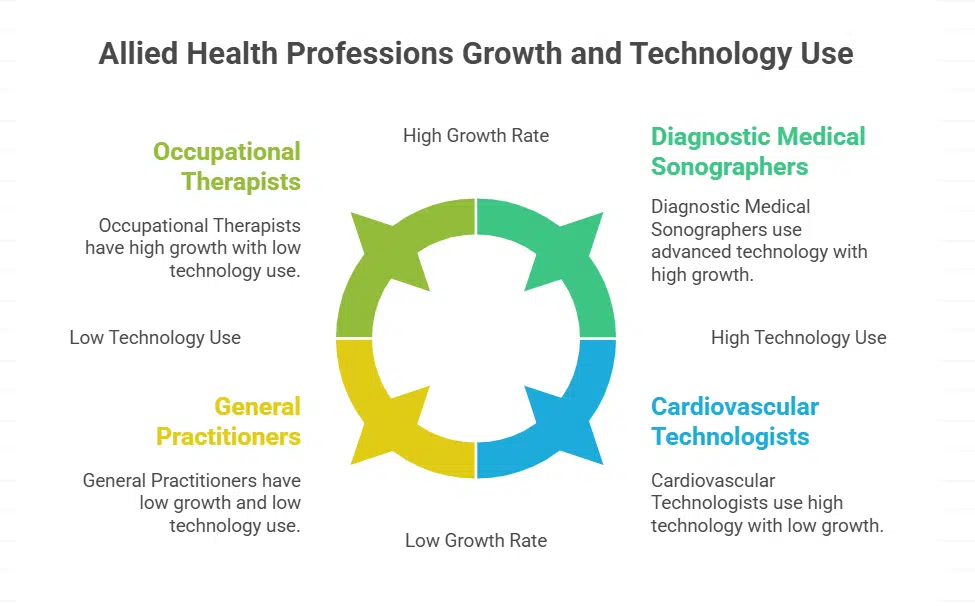
Job chances in allied health professions jump from 15.6 million in 2010 to 19.8 million by 2020. Fast-growing spots like occupational therapists and diagnostic medical sonographers see rates of 6% or more through 2033.
You find these experts using tools such as ultrasound technology for scans, or heart catheters in cardiovascular work. They team up with registered nurses and cardiologists in care facilities.
Employers seek folks skilled in medical technology advancements. It’s like being part of a puzzle that fits therapeutic services into everyday health services. Allied health careers offer solid work-life balance too, especially in aged care or with general practitioners.
Top 8 Rising Allied Health Careers
You know, with folks living longer and tech changing the game in patient care, these jobs in healthcare professions are booming like never before. Picture yourself helping someone breathe easier as a registered respiratory therapist, or guiding a kid through communication disorders—stick.
Speech-Language Pathologist
Speech-language pathologists help people fix communication disorders. They work with kids who stutter or adults after strokes. Imagine trying to chat but words get stuck, like a jammed door.
These pros swing that door open with therapy. Jobs in this field grow fast, at 21% from 2014 to 2024. That beats many other healthcare professions. You find most jobs in Texas, California, New York, Florida, and Illinois.
Pay looks good too, with an average salary of $71,550. Earnings range from $44,940 to $111,000. Top spots for high pay include Connecticut, California, Alaska, the District of Columbia, and New York.
Speech-language pathologists, or SLPs, team up in outpatient clinics and rehabilitation facilities. They use tools like ultrasounds for diagnostic imaging. Folks in speech-language pathology enjoy solid work-life balance amid the aging population’s needs.
Picture helping someone say “I love you” clearly again; that’s the heart of it in the healthcare workforce.
Physical Therapist
Physical therapists help patients regain strength and mobility after injuries or surgeries. They create custom plans to ease pain and boost function, often in outpatient clinics or rehabilitation facilities.
Picture a coach guiding you back to the field, that’s their role in the healthcare workforce. This allied health career sees a 14% growth ahead, drawing many to join the ranks of healthcare professionals.
You need a Doctor of Physical Therapy (DPT) degree plus certifications to start. Earn an average annual salary of $109,034, or $52.42 per hour, with highs up to $69 hourly. Staff jobs pay $2,096 weekly, but travel roles bump that to $2,177, offering better work-life balance for some.
These experts use tools like exercise bands and ultrasound machines, focusing on patient care amid an aging population.
Diagnostic Medical Sonographer
Diagnostic medical sonographers use ultrasound machines to create images of the body’s insides. They help doctors spot issues like tumors or baby growth in pregnancies. This job fits into allied health careers, and it grows fast with medical technology advancements.
Picture yourself as a detective, scanning for clues with sound waves instead of a magnifying glass. You work in outpatient clinics or hospitals, aiding healthcare providers in diagnostic imaging.
The field expects 15% growth, so jobs will boom. Earn an average annual salary of $97,864, with an hourly rate of $47.05 that can hit $69 at the top. Start with an associate degree, then grab certifications like R.T.(S)(ARRT), ACS, or RCS.
These pros handle patient care, explaining scans in clear terms to ease worries. Hey, if you love tech and helping folks, this role offers solid work-life balance in the healthcare industry.
Respiratory Therapist
Respiratory therapists help patients breathe easier, especially those with lung problems. They work in hospitals, outpatient clinics, and rehabilitation facilities. Picture a hero in scrubs, battling asthma or COPD with machines and care.
These pros treat people from tiny babies to the aging population. Demand grows fast in the healthcare workforce, with anticipated growth at 13 percent. That means more jobs in allied health careers.
You need an associate degree to start as a respiratory therapist. Then, get your RRT certification as a registered respiratory therapist. Salaries shine bright, folks. Average annual pay hits $85,613.
That breaks down to $41.16 per hour on average, with the highest hourly rate at $56. They use tools like ventilators for patient care in respiratory therapy. Skills in therapeutic services make a big difference.
It’s rewarding work, like giving someone a fresh breath of life.
Radiology Technologist
Radiology technologists play a key role in the allied health workforce. They use diagnostic imaging tools like X-ray machines and computed tomography scanners to help doctors spot health issues.
Imagine you’re the detective in a medical mystery, capturing clear images that guide patient care in hospitals or outpatient clinics. This job demands sharp skills in medical technology advancements.
It offers a solid work-life balance too, with chances to work in rehabilitation facilities or even as travel staff.
Jobs in this field grow at 6 percent, faster than many others in the healthcare industry. Earn an average annual salary of $85,748, or $41.22 per hour. Top earners hit $61 hourly. Staff positions pay $1,649 weekly, but travel roles jump to $2,318.
You need to finish a Radiologic Technology Program and get certifications like R.T.(R)(ARRT). Allied health professionals here support dentists, physical therapists, and cardiovascular technologists in therapeutic services.
Hey, if you love tech and helping folks with an aging population’s needs, this career fits like a glove.
Cardiovascular Technologist
Cardiovascular technologists play a key role in spotting and fixing heart and vascular issues. They help doctors diagnose problems like heart disease, which hits more folks as our population ages.
Envision yourself as the hero in the lab, using tools to check blood flow and spot blockages. Demand for these allied health professionals grows with the whole healthcare industry, thanks to rising heart troubles.
You need an associate or bachelor’s degree in cardiovascular technology or a similar field to jump in.
Certifications like Registered Cardiovascular Invasive Specialist, or RCIS, open doors to better jobs. Other specialized badges boost your skills in patient care too. These roles offer solid pay and chances to advance in spots like cardiac cath labs.
With medical technology advancements pushing the field forward, you stay busy in hospitals or outpatient clinics. Think about balancing life while aiding folks through tough times; it’s rewarding work in the healthcare workforce.
Occupational Therapist
Occupational therapists help people regain daily skills after injuries or illnesses. They work in rehabilitation facilities, guiding patients through exercises that feel like a puzzle coming together.
Imagine a kid learning to tie shoes again after a setback; that’s the magic they create. These pros focus on therapeutic services for the aging population, making life easier one step at a time.
This career sees an anticipated growth of 11 percent, with an average annual salary of $105,560. Expect an average hourly rate of $50.75, and the highest can hit $67. You need a master’s or doctoral degree plus OTR certification to join the ranks of these allied health professionals.
Many team up with physical therapists in outpatient clinics, boosting patient care through hands-on problem-solving.
Medical Transcriptionist
Medical transcriptionists turn audio recordings from doctors and other healthcare providers into clear written documents. This role fits right into allied health careers, helping with patient care in the growing healthcare industry.
Demand for these pros rises as more people need healthcare services, thanks to an aging population and medical technology advancements. You can find them in hospitals, outpatient clinics, or even working from home for better work-life balance.
You’re like a bridge, connecting spoken words to vital records that keep everything running smooth.
To jump in, grab a postsecondary certificate; it sets you up with the basics. Strong attention to detail and top-notch language skills make you shine here. Training opens doors for advancement, letting you grow in allied health professions.
Many start as medical assistants or allied health assistants and move up. Hey, if you love details and hate the chaos of an operating room, this gig feels like a cozy fit in the healthcare workforce.
Skills Needed for Success in Allied Health Careers

Picture yourself chatting with a nervous patient in an outpatient clinic, turning their fears
Communication and Interpersonal Skills
Communication and interpersonal skills form the backbone of success in allied health careers. You deal with patients every day, so clear talks build trust and teamwork. Think of it like a smooth chat with a friend; it makes everything flow better.
Certified Occupational Therapy Assistants and Physical Therapy Assistants use these skills to grasp patient needs and track progress in rehabilitation clinics. Audiologists and speech-language pathologists rely on them to teach and guide folks through communication disorders.
Medical assistants shine in outpatient clinics by chatting well with patients and healthcare teams. Emotional intelligence and empathy help allied health professionals respond to concerns with real care.
Strong skills boost patient satisfaction and lift health outcomes across the board. Picture a respiratory therapist calming a worried patient; that connection changes lives in the healthcare industry.
Technological Proficiency
Allied health professionals must master tech to handle advanced healthcare tools. Think about it, like a mechanic who fixes cars with the latest gadgets. COTAs and PTAs use technology to document patient progress and support rehabilitation in places like outpatient clinics.
Audiologists rely on hearing tech to diagnose and manage disorders in communication. Registered dietitians grab specialized software for assessing and tracking dietary needs. This skill keeps patient care top-notch in the healthcare industry.
Education in allied health careers stresses technical training and familiarity with relevant technologies, you know, to stay sharp. Continuous learning helps you adapt to medical technology advancements, especially with an aging population needing more therapeutic services.
Picture a respiratory therapist updating skills for new breathing machines. Stay on top, and success follows in these allied health professions.
Adaptability and Problem-Solving
Healthcare pros, like allied health professionals, stay sharp by adapting fast. They meet patient needs that change all the time, especially in shifting care settings. An aging population throws curveballs, and tech advances keep things fresh.
Problem-solving shines here, as they diagnose and treat issues in roles across the board. It’s key for success in allied health careers.
Occupational therapists craft custom plans, blending flexibility with smart fixes for rehab. Respiratory therapists, those registered respiratory therapists, tackle chronic lung woes with bendy methods.
Lab techs tweak skills often for spot-on tests, thanks to quick medical technology advancements. These moves help in places like rehabilitation facilities and outpatient clinics.
Obtain Relevant Education and Certification
You want to jump into allied health careers with the right prep. Education and certification open doors to roles like speech-language pathologists and physical therapists.
- Start with a master’s degree in speech pathology for speech-language pathologists (SLPs), then grab that state license to help folks with communication disorders in outpatient clinics or rehabilitation facilities.
- Go for an associate degree as a Certified Occupational Therapy Assistant (COTA), add a state license, and join occupational therapists in providing therapeutic services to improve patient care.
- Earn an associate degree for Physical Therapist Assistants (PTAs), secure a state license plus hands-on training, and support physical therapists in helping people regain movement, like after an injury, in the growing healthcare industry.
- Pursue a four-year doctorate in audiology to become an audiologist, get your state license, and tackle hearing issues amid medical technology advancements and an aging population.
- Complete a two-year program for Hearing Aid Specialists, obtain a state license with one year of supervised training, and assist in allied health professions by fitting devices that boost work-life balance for those with hearing loss.
- Aim for a master’s degree as a Physician Assistant (PA), pass the certification exam called PANCE, and work alongside health practitioners in diagnostic imaging or operating rooms as part of the allied health workforce.
- Train as a registered respiratory therapist (RRT) through relevant programs, earn certifications, and provide vital care in respiratory therapy, especially in health professional shortage areas.
- Build skills for cardiovascular technologists with specialized education, get certified, and use tools like computerized tomography to aid in heart-related patient care, keeping up with healthcare workforce demands.
Stay Updated with Industry Trends
Allied health careers change fast, like a river that never stops flowing. Keep your ear to the ground by joining groups for physical therapists or speech-language pathologists. Travel allied health jobs offer higher weekly rates than staff positions, so see yourself hitting the road for better pay.
Demand spikes in California, Texas, and Florida, where aging populations need more patient care in outpatient clinics and rehabilitation facilities. Chat with fellow allied health professionals at conferences; they share tips on medical technology advancements.
Explore online courses or newsletters about diagnostic imaging and therapeutic services. Think of a respiratory therapist friend saying, “Hey, these trends saved my day in the ICU.” Track jobs for cardiovascular technologists or occupational therapists; spots fill quick in hot states.
Significant demand exists for roles like radiology technologist in Florida’s busy hospitals. Stay sharp, and you’ll snag those high-paying travel gigs before they vanish.
Takeaways
We covered what allied health means, plus eight hot careers like speech-language pathologists and physical therapists that boost patient care in places like outpatient clinics and rehabilitation facilities.
These paths offer simple steps to start, with education and certifications that fit busy lives without much hassle. Picture the impact, jobs in this field will jump to 19.8 million by 2020, helping the aging population and fixing shortages in the healthcare workforce.
Check out the U.S. Bureau of Labor Statistics for more stats, or talk to pros in respiratory therapy for real tips. Jump in now, your skills could change lives, just like when I helped a friend pick occupational therapy and saw her thrive.
FAQs on Allied Health Jobs
1. Hey, what exactly are allied health careers, and why are they rising now?
Allied health careers, like those of physical therapists and occupational therapists, focus on patient care in places such as outpatient clinics and rehabilitation facilities; they’re booming because of an aging population and medical technology advancements that demand more therapeutic services. Think of them as the unsung heroes in the healthcare workforce, stepping up when doctors need backup, you know?
2. Can you tell me about speech pathologists in allied health?
Speech pathologists, or speech-language pathologists, help folks with communication disorders, often working in schools or clinics to make talking easier. It’s like being a coach for words, turning stumbles into smooth chats.
3. What do physical therapists do in this growing field?
Physical therapists aid people in regaining movement after injuries, using exercises in rehabilitation facilities to boost strength and mobility. They team up with patients, turning “I can’t” into “Watch me,” especially with our aging population pushing demand higher. Imagine them as body mechanics, fine-tuning the human engine for better runs.
4. Are occupational therapists part of these rising allied health professions?
Yes, occupational therapists guide individuals back to daily tasks, like dressing or working, in settings from hospitals to homes. With healthcare industry shifts, they’re key for work-life balance in patient recovery.
5. What’s the deal with cardiovascular technologists in allied health?
Cardiovascular technologists handle diagnostic imaging for heart issues, assisting in labs or operating rooms with tools that spot problems early. They’re like detectives in the heart’s mystery novel, using tech to save the day amid medical technology advancements. This role fits right into the expanding allied healthcare professions, offering steady spots in a busy field.
6. How about registered respiratory therapists; are they rising too?
Registered respiratory therapists, or RRTs, provide breathing support in hospitals, helping with lung conditions through therapeutic services. As the healthcare workforce grows, they’re vital for folks with ongoing issues, especially in outpatient clinics. It’s a hands-on gig that blends care with tech, keeping air flowing like a well-oiled fan.