It is hard to get mental health care when you feel anxious or down. More than 10,000 AI mental health applications exist, but few show proof they work. We will list seven clever bots and tools that use CBT methods, emotion logs, and conversational agents to support your emotional health.
Read on.
Key Takeaways
- Wysa acts like a 24/7 pocket therapist, uses AI, NLP, and CBT tools, and enforces strong privacy rules to help the 70% of people who get no care.
- Happify taps real-time feedback to offer mood tracking, gratitude games, and resilience challenges; users report less stress after four weeks.
- Rootd links with wearables to spot panic attacks up to 30 minutes early, guides deep breathing, and serves part of the 301 million people with anxiety disorders.
- Youper’s self-CBT app helped 4,500 people cut anxiety and depression in a study; 83% say they feel better after mood tracking and over 3 million use it.
- Woebot cut student depression in two weeks with CBT chats (78% saw less anxiety); Replika cut anxiety by 64% in four weeks and 82% find it more reachable than in-person care.
Wysa: Your AI-Powered Mental Health Companion

Wysa feels like a pocket therapist, ready to listen day or night, with an AI chatbot that speaks in plain English. The app uses natural language processing, mixing digital health with cognitive behavioral therapy (CBT) to spot tricky thoughts.
It offers 24/7 support and personalized interventions, so you can work on mood tracking, breathing drills, or thought records at your own pace. Data privacy rules guard your chats, while machine learning tweaks sessions to fit your mood.
Studies show Wysa’s AI agents reduce depressive symptoms, though peer reviewed evidence remains scant. That matters since 70% of people with mental health conditions receive no care, often blocked by cost, travel, or social stigma.
This tool breaks down walls, sending care across distances, cutting fees, and flipping the script on stigma in mental healthcare.
Happify: Science-Based Activities for Stress Management
Happify uses real-time feedback from Ecological Momentary Assessment, also called EMA. It pairs that data with Ecological Momentary Intervention, or EMI, to spot your stress spikes.
The platform runs on artificial intelligence, natural language processing, and machine learning algorithms. You can track your mood, play a gratitude game, or join a resilience challenge.
A quick quiz might pop up while you walk, or a guided meditation might arrive when you pause at the bus stop. These activities tap science-based tools from positive psychology and cognitive-behavioral therapy.
Millions of users grab science-based tasks to curb anxiety and build calm. Happify cuts out limits like geography, cost, or stigma. It works 24 hours a day, 7 days a week, on phones or tablets.
Users praise its digital therapeutics and AI-powered mental health support. A fun dialogue box might ask, “Hey, what bright spot caught your eye today?” Real folks report less stress after four weeks of logging their feelings.
Data privacy sits front and center, with clear policies and no hidden algorithmic bias.
Rootd: Panic Attack and Anxiety Relief
Rootd taps AI chatbots for instant crisis intervention. It uses real-time monitoring with wearable devices to catch panic attacks up to 30 minutes ahead. It blends cognitive behavioral therapy (CBT) tools, mood tracking, guided breathing, and digital therapeutics.
A timepiece sync notices spikes in heart rate, alerting users before fear floods in. Pre-crisis detection cuts the lag for therapy sessions, giving quick mental health support at scale.
Jen texted, “My chest feels like it’s vaulting out of my ribs,” during a mall meltdown. Rootd guided her through deep breaths and a swift CBT exercise. Relief washed over her like a warm wave after cold rain.
With 301 million people facing anxiety disorders worldwide, that kind of aid matters. The app respects data privacy and fights algorithmic bias. It uses natural language processing to chat in a warm, human tone.
Youper: AI-Driven Self-CBT for Emotional Wellness
Youper uses AI to guide users through self-CBT sessions. It relies on machine learning algorithms and natural language processing to offer personalized interventions. A study of over 4,500 participants showed moderate reductions in anxiety and depression.
More than 3 million people trust this app for mental wellness. Eighty three percent of users report better moods after mood tracking exercises. The service has powered over 10 million mental health conversations.
Top organizations like Mental Health America, NVIDIA, and Quest Diagnostics endorse Youper.
The AI software feels like a pocket therapist waiting at your beck and call. It fuses behavioral health science, cognitive behavioral therapy, and conversational AI in a neat package.
Users can pair the app with wearables for real time mood tracking. The design respects data privacy and fights algorithmic bias. Clinicians can view reports in hybrid care models or offer prescription digital therapeutics alongside the tool.
This tool drives stigma reduction and makes mental health support feel natural.
Yuna: Guided Self-Therapy for Personal Growth
Yuna guides self-therapy sessions to boost personal growth. Mood tracking and cognitive behavioral therapy mix in its design. Machine learning algorithms and natural language processing simulate a chat with a coach.
Personal plans tap triggers, past responses, and cultural background. Neural network models built with OpenAI tech power each lesson. Price tags run from twenty dollars to eighty dollars every month.
Anonymous mode protects user identity, easing stigma and worry. Secure data privacy eases privacy concerns.
Hybrid care models tie Yuna to health professionals for extra support. Scalable mental health solutions ease pressure on busy clinics. Users swipe through digital therapeutics modules like exposure therapy and mood exercises.
High distress flags trigger a live crisis link in real time. Developers monitor algorithmic bias to keep suggestions fair. Personalized interventions shape each session to user goals.
A study found seventy-one percent of users stay active after six months. Peers share wins on social media and slash stigma fast.
Replika: AI for Emotional Connection and Support
Replika taps into natural language processing (NLP) and machine learning algorithms to chat like a friend. This app offers mental health support through artificial intelligence. It does not provide cognitive behavioral therapy (CBT) or mood tracking.
It tears down barriers like geography, cost, and stigma. A trial found a 64% reduction in anxiety after four weeks. Eighty-two percent of users rated AI-powered mental health apps as more reachable than traditional visits.
Early chatbots like Eliza used fixed scripts. Replika adapts with each message, learning your style. It tweaks its tone to match yours over time. It stays online day and night, like a trusty night light.
That can matter if you face a crisis at two a.m. You type your fears. You get a calm reply. You feel heard, not judged.
Woebot: Evidence-Based Chatbot for Cognitive Behavioral Therapy
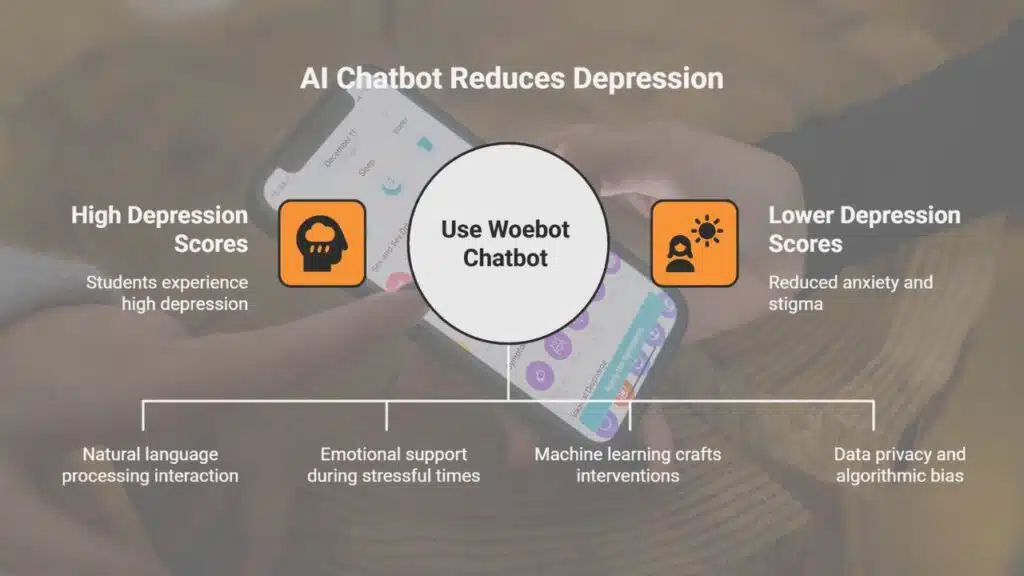
College students saw lower depression scores in two weeks with Woebot. Artificial intelligence drives natural language processing for cognitive behavioral therapy chats. 78% of users report reduced anxiety after short sessions.
The tool pairs mood tracking with emotional support whenever stress hits.
This digital treatment runs at $20 to $80 per month, which cuts typical therapy fees. Machine learning algorithms craft personalized interventions for each mood swing. Privacy stays at the top to address data privacy and algorithmic bias fears.
Many praise it as a scalable mental health solution that nudges stigma reduction.
Benefits of AI-Powered Mental Health Apps
AI apps cut costs and close gaps. They give care anytime and guard privacy.
- Lowers cost and crosses borders. People can access mental health treatment without high fees or long travel.
- Offers private chat and mood tracking. Users enjoy stigma reduction and safe, anonymous spaces.
- Delivers continuous emotional support. It helps during depressive episodes and crisis intervention.
- Lets machine learning algorithms pair with data privacy measures. Natural language processing and explainable AI guard personal details.
- Scales cognitive behavioral therapy and dialectical behavior therapy. Neural networks drive digital therapeutics for behavior therapy.
- Serves the 70 percent who get no care. Eighty-two percent find AI in healthcare more accessible than a psychiatrist or counselor.
- Keeps users on track with personalized interventions. Seventy-one percent still use these tools after six months.
- Fits hybrid care models with virtual reality therapy or wearable technology. Mental health professionals can blend digital tools with face-to-face sessions.
Challenges and Ethical Concerns in AI Therapy
Apps collect mood data, chat logs, and health history. Users share sensitive personal information, sparking privacy concerns. Some chatbots run on pattern recognition systems that work like black boxes.
They offer support, yet users cannot see the logic, which shakes trust. A few services have no clinical oversight, so they can dish out advice that misses the mark. Non-representative datasets fuel algorithmic bias.
That issue leaves certain groups with weaker guidance, and risks widening stigma. Natural language processing must spot crisis words, but some models fail to flag emergencies in time.
Design teams often chase market growth over user safety. Platforms operate with scant encryption, leaving personal notes exposed. Many digital therapeutics lack transparent code or human checks, and that gap can steer a person into harm.
AI in mental health needs both code and compassion. Regulatory bodies still scramble to update rules, and they struggle with complex GPT models. Patients need systems that explain how they work and offer human backup.
Developers should add clear pathways to real therapists, so mental health support stays both smart and safe.
The Role of AI in Expanding Accessibility to Mental Healthcare
AI in mental health care breaks down walls in small towns and big cities. Natural language processing (NLP) reads your words and tracks mood swings. It crafts personalized interventions in cognitive behavioral therapy and dialectical behavior therapy.
Neural network frameworks work quietly behind the scenes. They run on lightweight phone chips, cutting cost and travel time. This lifts barriers for 301 million people with anxiety disorders, 280 million with depression, and the 70% who get no help.
Smart digital therapeutics provide crisis intervention when emotional states spike. It blends empathetic tone with data privacy safeguards. You chat with GPTs for support and VR modules to face phobias.
Hybrid care models pair AI with human counselors in real time. This lowers stigma and offers scalable mental health solutions to millions. It shows how computing machinery and intelligence can solve mental health problems.
Engineers audit machine learning algorithms to curb algorithmic bias.
Can AI Replace Human Therapists?
Digital platforms scan mood and offer self-guided therapy exercises. Machine learning uses natural language processing to spot unhelpful thoughts. A Stanford study tracked users for four weeks and found 64% less anxiety.
Seventy-eight percent of people said they felt calmer and 65% saw lower depression scores. These digital therapeutics deliver personalized interventions with CBT and DBT tools. They support emotional health but lack real human empathy.
Clinicians often pair chatbots with talk therapy in hybrid care models. This approach boosts access while keeping human connection. Users gain stigma reduction through discreet chat features.
Privacy concerns remain around data privacy and algorithmic bias. Developers work on explainability to meet safety and ethical standards. Human therapists retain a crucial role in crisis intervention and complex cases.
Scientific Validation of AI Mental Health Tools
Studies on Woebot show real gains. Woebot cut depression symptoms in college students within two weeks. Youper tested more than 4,500 users. It showed moderate reductions in anxiety and depression.
The programs employ machine learning algorithms and NLP. They use CBT and mood tracking for personalized support. These digital therapeutics scale mental health care.
Seventy eight percent of users report lower anxiety. Sixty five percent say they cut depression scores. They rate crisis intervention features highly. Scientists run randomized controlled trials and meta analyses.
Researchers watch for data privacy and algorithmic bias. Validation remains limited but improving.
The Future of AI in Mental Health Care
Officials plan to approve AI mental health apps by 2025. They will link FDA nods, insurance plans, and global rules. Cutting edge technologies will blend digital therapeutics with live therapy to cut wait times and fight stigma.
These scalable mental health solutions will reach rural areas, easing crisis intervention with simple mood tracking.
Quantum computing and heart rate sensors will power real time predictive analytics. EEG headsets may scan brain signals to spot mental health crisis events. Emotion recognition tech will read facial cues and vocal tone, and deliver personalized interventions with CBT or DBT tips.
NLP tools will adapt chat tone to each user, boosting emotional support and precision medicine.
Takeaways
Therapy feels more reachable now. Wysa, Woebot and Youper link chatbots to cognitive behavioral therapy and mood tracking. Happify and Rootd ease stress and panic. Replika and Yuna offer AI guided talk and growth tools.
Machine learning adapts support to your needs. Data privacy and bias still need clear guard rails. More clinical trials must confirm real value. You now carry digital therapeutics in your pocket.
FAQs
1. What is cognitive behavioral therapy in these AI-powered mental health tools?
Cognitive behavioral therapy, or CBT, uses talk therapy steps to change unhelpful thoughts. The AI tool offers prompts and exercises, like a coach in your pocket. It learns from your answers with machine learning algorithms, to deliver personalized interventions at scale.
2. How do mood tracking and natural language processing help me?
Mood tracking lets you log feelings fast, even with a tap. Natural language processing then reads your words, spots stress signals, and guides you. This combo cuts through data noise and offers prompt emotional support.
3. Can I get crisis intervention from these apps?
Yes, some apps include a crisis button or direct links to hotlines. They use algorithmic bias controls to flag urgent messages fast. If a tool spots a mental health crisis, it can roll up its sleeves and connect you to human help.
4. Are my data privacy and security at risk with digital therapeutics?
Most tools follow strict data privacy rules. They use encryption, anonymize records, and limit data sharing. That said, privacy concerns still pop up. Always read the app’s policy on data use before you sign up.
5. Will AI replace human psychotherapy completely?
No, these mental health supports shine as scalable mental health solutions. They help with stigma reduction and fill gaps between sessions. Yet hybrid care models pair AI tools with real therapists, for best results.