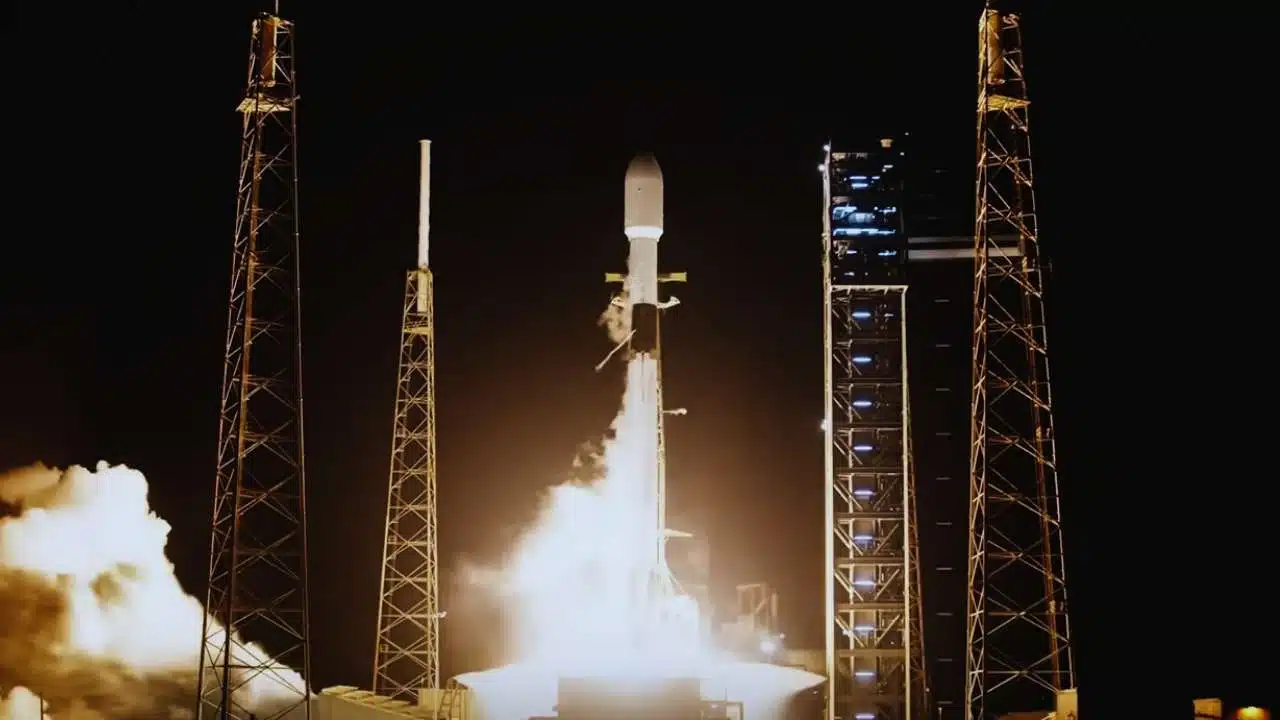
Google’s Project Suncatcher explores AI data centers in space using solar-powered satellites and laser links; SpaceX’s growing Starlink network and its 2026 orbit-lowering plan underline both the promise and the crowding that now shape LEO.
What Google Is Building Toward With AI Data Centers in Space?
Google’s space-computing push is framed as a long-range research effort, not a finished product. Under Project Suncatcher, Google researchers are testing whether future AI infrastructure could shift some of its growth off Earth by putting compute in orbit and powering it directly with sunlight.
The idea targets a real constraint: the fastest-growing AI systems increasingly depend on very large clusters of specialized chips that draw enormous amounts of electricity and require reliable cooling and network connectivity. Project Suncatcher asks a bold “what if” question: if sunlight is more continuous in certain orbits, could AI clusters run there more steadily than on the ground, with fewer energy interruptions?
Google’s published concept focuses on a modular constellation made of many smaller satellites rather than one massive “space station” data center. In the reference design Google modeled publicly, the system is a tight cluster of satellites flying close enough to behave like a single computing fabric. That closeness matters because training large AI models is not just about raw compute. It also depends on very fast communication between chips.
Google’s design work emphasizes four building blocks that must all work together for “data-center-like” performance in orbit:
- Near-continuous solar power from a sun-advantaged orbit
- High-bandwidth satellite-to-satellite links (optical/laser) so chips can share data quickly
- Radiation-aware compute that can keep working in a harsh space environment
- Thermal control capable of removing heat without standard terrestrial cooling methods
To move from theory toward evidence, Google has also described early testing steps—especially around networking and chip resilience—to show which obstacles are shrinking and which ones still look fundamental.
Key Elements In Google’s Published Reference Design
| System Element | What Google Describes Publicly | Why It Matters For AI Training |
| Orbit choice | Sun-synchronous “dawn–dusk” style LEO in concept modeling | Aims for more consistent sunlight and steadier power |
| Formation | A tightly clustered group (example: dozens to ~80+ satellites) | Helps keep communication distances short |
| Interconnect | Optical (laser) links between satellites | Needed to approximate a data center’s internal network |
| Compute | TPU-based acceleration concept | Specialized hardware is central to modern training |
| Thermal | Radiators and thermal engineering emphasis | Heat removal is a major limiter for dense compute |
| Ground link | Connectivity to Earth via ground stations | Many workloads still need ingestion and delivery on Earth |
Even in its own framing, this is not “Google is launching a space data center next year.” It is Google laying down a technical path that would allow prototypes to answer the hardest feasibility questions—starting with whether modern AI accelerators and high-speed links can reliably operate in orbit.
Where SpaceX Fits: Starlink, Launch Capacity, and Orbit Reconfiguration?
SpaceX is central to this story for practical reasons that go beyond any single partnership. It is the company that has most aggressively scaled operations in low Earth orbit, and it has the launch cadence that often defines what’s economically plausible in space.
The Confirmed Google–Starlink Connection
Google Cloud and Starlink have a confirmed commercial integration that focuses on bringing satellite connectivity closer to cloud infrastructure. In that arrangement, Starlink ground stations are positioned at or near Google data center properties so that satellite traffic can connect into cloud systems with lower latency and fewer intermediate hops.
This matters for “space compute” conversations because any orbital computing system still needs a strong path back to Earth for customer access, data delivery, and control. Whether the compute is in orbit or on the ground, networks define what services can actually be offered.
SpaceX’s 2026 Move: Lowering Thousands of Starlink Satellites
On January 1–3, 2026, SpaceX described a major operational change: it plans to move roughly 4,400 Starlink satellites from around 550 km down to about 480 km during 2026.
The reason is simple and significant collision risk and space safety. Below about 500 km, there is generally less long-lived debris density than higher LEO bands, and defunct satellites fall out of orbit faster due to atmospheric drag. Lowering altitude can also make disposal more reliable if satellites fail.
This shift is highly relevant to any proposal involving clustered satellite formations for AI. If one of the world’s largest satellite operators is redesigning orbital placement primarily around safety and congestion, it signals how quickly LEO has become crowded—and how high the bar is for adding new high-density systems.
Why Starlink Scale Changes The Space-Compute Equation?
SpaceX’s presence changes two constraints that have historically killed ambitious space infrastructure concepts:
- Launch frequency: repeated access to orbit reduces schedule risk for iterative development.
- Operational learning: at massive scale, operators learn where collision avoidance, tracking, and coordination break down—and what needs new tooling or governance.
SpaceX’s orbit-lowering plan also shows that big constellations are no longer “set and forget.” They are dynamic systems that can require reconfiguration, which affects spectrum planning, ground networks, and even customer service continuity.
Starlink Orbit Shift: Key Numbers
| Item | Earlier Typical Value | 2026 Reconfiguration Target | Operational Rationale |
| Starlink shell altitude (example) | ~550 km | ~480 km | Reduce collision risk and speed deorbiting |
| Satellites affected | — | ~4,400 | Large-scale safety-focused adjustment |
| Implementation timing | — | Through 2026 | Gradual maneuvering reduces disruption |
Why AI Data Centers in Space Are Being Discussed Now?
The timing is not random. The AI boom has pushed power demand into the center of data center planning, and the grid is becoming a limiting factor in multiple markets.
In the U.S., federal analysis has already highlighted how quickly data center electricity consumption is rising and how much more it could take in the near future. The broader global conversation mirrors that pattern: more AI use cases mean more training, more inference, and more always-on infrastructure.
This pressure creates a search for “new surfaces” where compute can grow—new energy sources, new cooling approaches, and new locations with fewer constraints than crowded urban grids.
What Makes AI Workloads So Power-Intensive?
AI infrastructure differs from earlier cloud growth in three ways:
- Density: AI chips pack enormous compute into tight racks, increasing heat and power concentration.
- Utilization patterns: training can run for long continuous periods with high sustained draw.
- Network intensity: large models require fast internal communication, which adds both power and design complexity.
When those forces collide with limited transmission capacity, long permitting timelines, and water constraints for cooling, companies look for alternatives—some practical (efficiency, new sites, demand response) and some experimental (advanced nuclear, new cooling, offshore builds, and now space-based concepts).
Earth-Based vs. Space-Based Drivers
| Pressure On Earth | Why It Matters | Space-Based Concept Response (In Theory) |
| Grid congestion and interconnection queues | Delays new capacity and raises costs | Orbit-based solar aims to bypass local grid bottlenecks |
| Water and cooling constraints | Limits siting and public acceptance | Vacuum/radiative cooling could reduce water dependence |
| Land availability and community opposition | Creates siting friction | Space avoids many land-use conflicts |
| Renewable intermittency | Requires storage and backup | Sun-synchronous orbit aims for more continuous generation |
None of this proves space compute is “better.” But it explains why it is now being treated as a serious research question rather than a pure sci-fi pitch.
The Biggest Technical and Regulatory Hurdles
Project Suncatcher-style systems face hard, testable constraints. These are the areas that will decide whether “AI data centers in space” remain a research curiosity or become a genuine infrastructure path.
1) Power Generation Is Not The Same As Power Delivery
Even if sunlight is abundant in orbit, usable power depends on the full system:
- Solar panel efficiency and degradation
- Power electronics and conversion losses
- Battery sizing for unavoidable eclipses or operational gaps
- Thermal impacts that reduce efficiency
- Attitude control and pointing needs
A space-based system must also power communication links, propulsion for station-keeping, and onboard computing overhead. The power “available” is never equal to the power “delivered to chips.”
2) Heat Must Be Managed Without Standard Cooling
On Earth, data centers rely on air handling, chilled water loops, evaporative systems, and sometimes direct-to-chip liquid cooling. In space, you cannot simply vent heat away with air. Heat must be conducted to radiators and emitted as infrared radiation.
That introduces design tradeoffs:
- Radiators add area and mass.
- Higher heat density demands more radiator surface or higher operating temperatures.
- Large radiators create drag and pointing constraints in LEO.
- Thermal swings can stress materials and electronics.
This makes thermal management one of the most important feasibility gates for space AI compute at meaningful scale.
3) Networking Must Be Both Fast And Reliable
AI training depends heavily on low-latency, high-throughput communication across many accelerators. If the network is slow or unstable, scaling stalls.
In orbit, optical links promise high bandwidth, but they add challenges:
- Precise pointing and tracking between moving platforms
- Maintaining link quality amid vibration, thermal changes, and alignment drift
- Handling line-of-sight constraints and potential obstructions
- Designing redundancy so one failed link does not isolate a compute segment
Any serious system must also include routing and congestion control that resembles terrestrial data center fabrics—while also dealing with satellite dynamics.
4) Radiation And Reliability Are Constant Threats
Space radiation can flip bits, degrade components, and shorten lifetimes. Even with shielding, chips must be designed and operated for resilience.
A space-based AI cluster would likely need:
- Strong error correction and memory protection
- Redundant compute paths
- Fault-tolerant scheduling that can isolate failing nodes
- Monitoring and recovery systems built for high latency and limited physical access
This is not an “if” problem. It is a “how well can you manage it” problem.
5) Orbital Congestion And Collision Risk Are Getting Worse
SpaceX’s decision to lower thousands of satellites in 2026 is a reminder: LEO is crowded and getting more crowded. That affects space-based compute ideas directly because they would add more objects and potentially operate in relatively popular altitude bands.
For a tight “cluster” that tries to function like a single data center, collision avoidance and safe formation management become critical. Close spacing increases the need for robust navigation, coordination, and autonomy.
NASA has also highlighted the need for better coordination tools as operations scale, including approaches where operators can share responsibility for maneuvers more efficiently. That type of coordination becomes essential if multiple mega-constellations—and future compute clusters—coexist.
Hurdles Summary Table
| Hurdle | Why It’s Hard | What Would Count As Progress |
| Power delivery | Generation, storage, conversion, and overhead all reduce usable watts | Stable multi-kW-to-MW class delivery per cluster segment |
| Thermal | Radiative cooling requires mass/area and careful design | Sustained high-load operation without throttling |
| Networking | Precision optical links plus routing at scale | Demonstrated “data-center-like” bandwidth and low latency |
| Reliability | Radiation and limited servicing | Long-duration fault-tolerant operation with low degradation |
| Congestion | More satellites increase coordination burden | Proven safe operations with transparent maneuver practices |
Timeline, What Comes Next, and Why It Matters?
The near-term story here is not “space data centers are arriving tomorrow.” It is that major players are now publishing designs, testing key components, and planning demonstrations that can validate or falsify the biggest claims.
Key Timeline For The Emerging Space-Compute Conversation
| Date / Window | Event | Why It Matters |
| May 2021 | Cloud-to-satellite integration announced (Starlink ground stations placed at/near cloud data center sites) | Shows the “satellite-to-cloud” pathway that space systems can rely on |
| Nov 2025 | Google publicly details Project Suncatcher as a scalable space AI infrastructure concept | Signals that space compute is being explored by a top-tier AI infrastructure builder |
| Late 2025 | Google publishes deeper technical system design material | Moves discussion from marketing to engineering constraints |
| Jan 2026 | SpaceX outlines plans to lower ~4,400 Starlink satellites during 2026 | Highlights that congestion and safety are now driving major constellation redesigns |
| Early 2027 (target) | Prototype/demonstration satellites planned with Planet | Creates a real-world testbed for power, compute, and networking assumptions |
What Readers Should Watch In 2026–2027?
Several developments will shape whether “AI data centers in space” remain conceptual:
- Prototype results: Does on-orbit hardware behave the way labs and models predict?
- Optical networking maturity: Can links stay stable under real orbital dynamics?
- Thermal performance under sustained load: Can compute run at high utilization without throttling?
- Policy and coordination changes: Does space traffic management evolve fast enough to support new dense systems?
What Comes Next?
AI data centers in space are best understood as a high-risk, high-reward research path responding to real terrestrial limits: electricity availability, cooling constraints, and the growing cost and complexity of scaling AI infrastructure.
Google’s Project Suncatcher puts a recognizable engineering frame around the idea—one that can be tested step by step rather than treated as fantasy. SpaceX’s actions in early 2026, especially the decision to lower thousands of Starlink satellites for safety, underline the other side of the equation: orbit is becoming a heavily managed environment where congestion risk is now shaping even the biggest operators’ strategies.
If the next wave of prototypes demonstrates stable power, reliable networking, and workable thermal design, space-based computing could move from “concept paper” to “emerging infrastructure option.” If not, the same experiments may still deliver value by improving optical links, radiation-tolerant compute practices, and space traffic coordination tools that benefit many other missions.