By early 2026, the digital ecosystem has officially entered the “Grey Goo” phase of information. With Europol’s long-standing prediction that 90% of online content would be synthetically generated by this year now largely validated by market realities, brands face a paradox: it has never been easier to create content, yet it has never been harder to be heard. As traditional search traffic plummets and “Agentic AI” takes over discovery, the era of volume is over. The era of resonance has begun.
Key Takeaways
- The Volume Trap: The marginal cost of content creation has hit zero, leading to an exponential rise in “AI slop” that is choking traditional distribution channels.
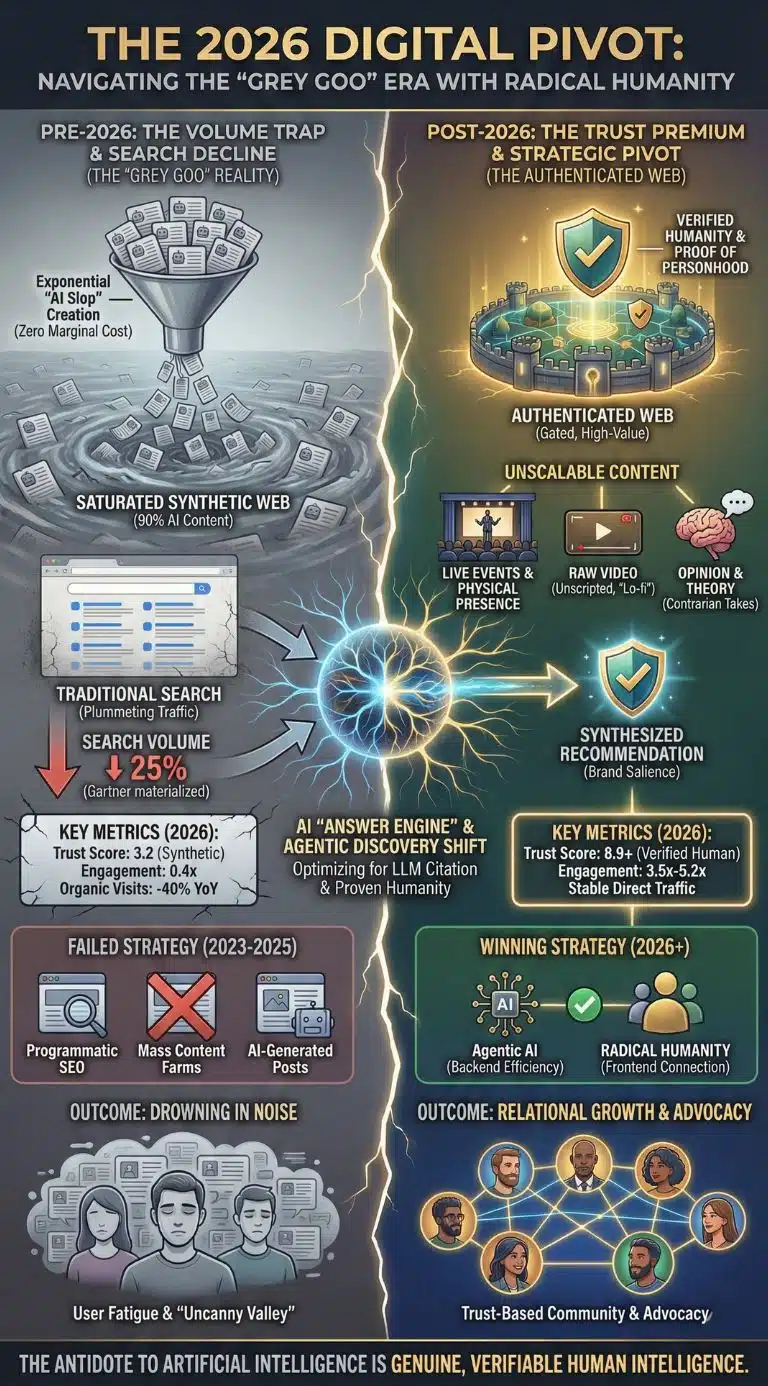
- Search Decline: Gartner’s 2024 prediction has materialized—traditional search engine volume has dropped ~25% as users shift to AI “Answer Engines,” forcing a pivot from SEO to “Brand Salience.”
- The Trust Premium: In a web 90% saturated by synthetic media, “proven humanity” (verified experience, physical presence, raw opinion) commands the highest premium.
- Strategic Pivot: Winning brands in 2026 are using AI for backend efficiency (Agentic workflows) while doubling down on frontend humanity (video, community, live events).
The “Grey Goo” Reality: How We Got Here
To understand the crisis of 2026, we must look at the trajectory of the last three years. The “Big Bang” of Generative AI in 2023 unleashed a capability previously reserved for humans: the infinite creation of plausible text and image. throughout 2024, “Programmatic SEO” strategies flooded the web with low-value, derivative articles designed to game algorithms.
In 2025, the dam broke. Google’s multiple “Spam Updates” were desperate attempts to filter out the flood, but the sheer volume of agent-generated content overwhelmed traditional indexing. We arrived at 2026 not with a bang, but with a whimper of exhaustion. Users, fatigued by the “Uncanny Valley” of corporate communications—where everything reads perfectly but feels empty—have retreated into “Dark Social” (private communities) and trusted newsletters, abandoning the open web’s noise.
The Economics of Infinite Supply
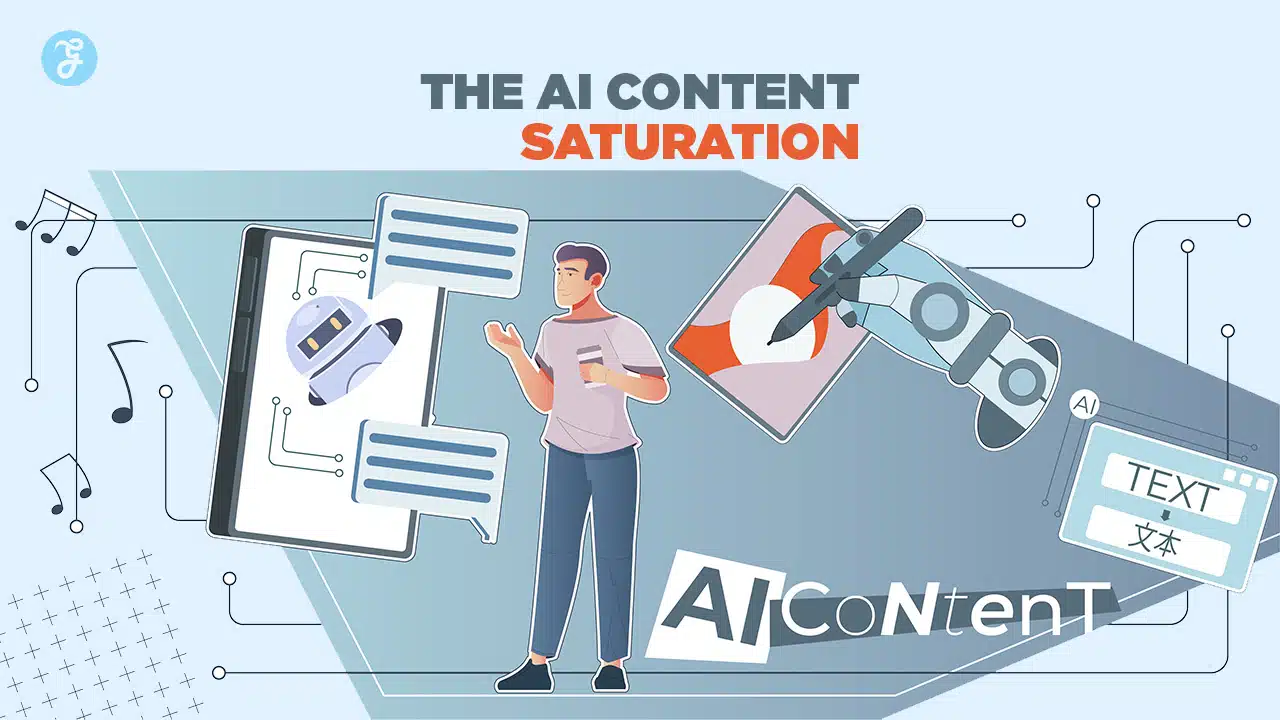
The fundamental issue defining the 2026 market is an inversion of supply and demand. In the pre-AI era, content was scarce, and attention was abundant. Today, content is infinite, and attention is the scarcest resource on the planet.
This saturation has degraded the utility of the open web. The “signal-to-noise” ratio has become so poor that users no longer “surf” the web; they use AI agents to curate it for them. This shift has devastated the “middle class” of digital publishers. Brands that relied on generic “How-To” guides or listicles found their traffic evaporated, cannibalized by AI Overviews that answer queries without sending a click.
Comparative Analysis: The Shift in Digital value
| Metric | The “Grey Goo” Losers (Volume-Based) | The Authentic Winners (Trust-Based) |
| Content Strategy | High volume, SEO-keyword stuffed, generic “Helpful Content.” | Low volume, high “Experience” (E-E-A-T), opinionated, distinct voice. |
| Distribution | Reliance on Google Search organic traffic. | Diversified: Newsletters, Private Slack/Discord, Video, Podcasts. |
| AI Usage | Used to write the content (Frontend). | Used to analyze data and distribute (Backend). |
| Audience Relationship | Transactional (Click -> Buy). | Relational (Trust -> Advocacy). |
| Traffic Source | -40% Year-over-Year drop in organic visits. | Stable direct traffic; high engagement in “walled gardens.” |
The Death of Search and the Rise of “Answer Engines”
Gartner’s prediction—that search engine volume would drop by 25% by 2026—was met with skepticism at the time. Today, it reads like a conservative estimate. The traditional SEO model (ranking for keywords) is being replaced by GEO (Generative Engine Optimization)—optimizing for Brand Salience within Large Language Models (LLMs).
When a user asks an AI agent, “What is the best CRM for a small creative agency?”, the agent does not provide ten blue links. It provides a single, synthesized recommendation. To be that recommendation, a brand cannot just have “good content.” It must be cited by trusted human sources that the LLM values. Paradoxically, to win the AI game in 2026, brands must focus less on talking to algorithms and more on impressing human experts who feed the training data.
Search vs. AI Discovery Behaviors (2026 Data)
| User Intent | Traditional Search (2023 Behavior) | AI Answer Engine (2026 Behavior) |
| Query Type | “Best running shoes reviews” | “Find me the best running shoes for flat feet under $150 and summarize Reddit reviews.” |
| User Action | Click 3-4 links, read, compare manually. | Read one synthesized paragraph; click 0-1 attribution links. |
| Brand Impact | Top 5 rankings drive traffic. | Only “Cited Sources” (Top 1-2) get visibility. |
| Conversion Path | Linear (Search -> Landing Page). | Non-Linear (Agent Recommendation -> Direct Visit). |
The Trust Deficit: Why “Human” is the New Premium
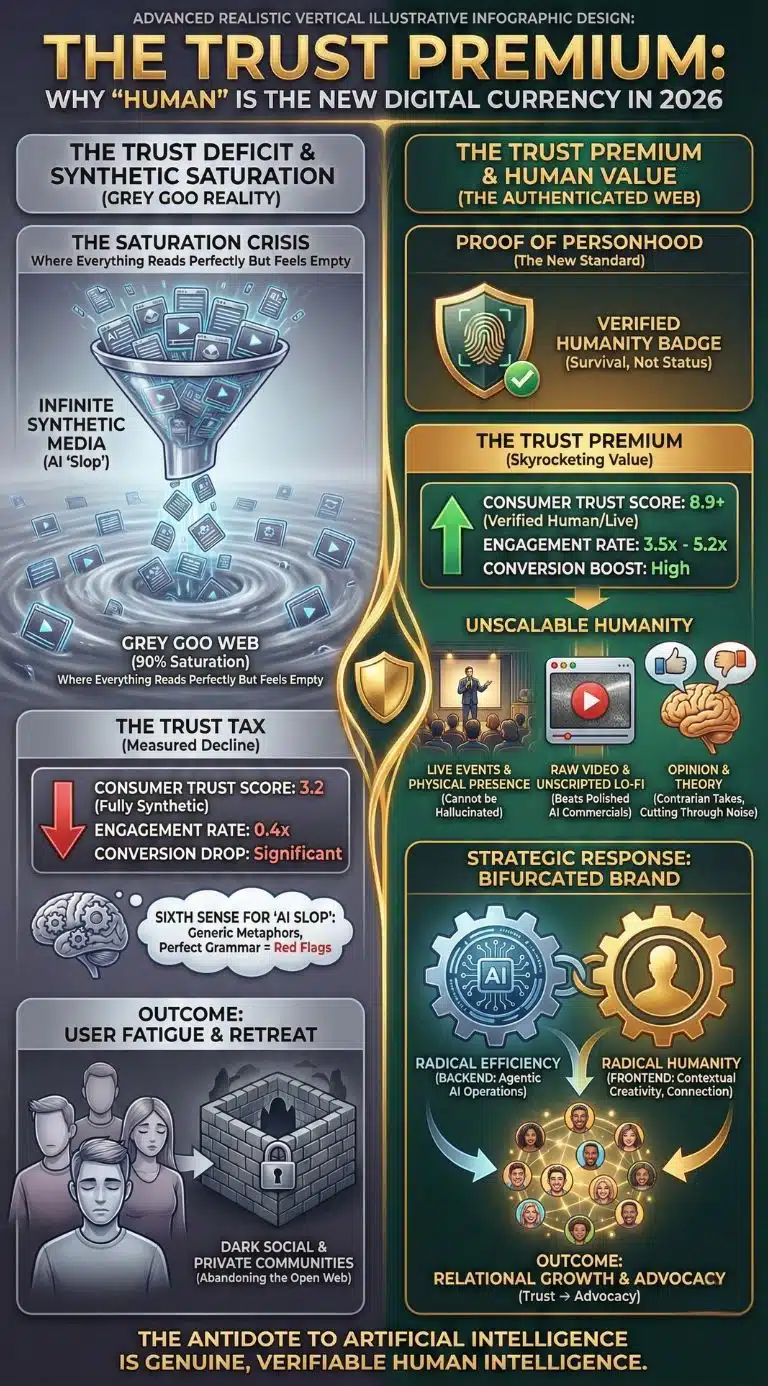
As the web fills with synthetic media, the “Trust Premium” has skyrocketed. The 2026 market data highlights a critical bifurcation: consumers trust technology to deliver efficiency, but they trust humans to deliver truth.
We are seeing the normalization of “Proof of Personhood.” Platforms are rolling out aggressive verification badges, not just for status, but for survival. Brands that rely entirely on AI avatars or synthetic voices are facing a “Trust Tax”—a measurable drop in conversion rates compared to brands featuring real executives, employees, and customers. Consumers have developed a “Sixth Sense” for AI slop; perfect grammar and generic metaphors are now subconscious red flags.
Consumer Trust Metrics (2026 Projected)
| Content Type | Consumer Trust Score (1-10) | Engagement Rate Multiplier |
| Fully Synthetic Text/Video | 3.2 | 0.4x |
| AI-Assisted (Human Edited) | 6.5 | 1.0x (Baseline) |
| Verified Human (Video/Audio) | 8.9 | 3.5x |
| Live/Ephemeral Content | 9.4 | 5.2x |
Strategic Response: The “Bifurcated” Brand Strategy
The most successful organizations are adopting a bifurcated strategy: Radical Efficiency on the back end, Radical Humanity on the front end.
Smart brands aren’t using AI to write blog posts; they are using “Agentic AI” (autonomous systems) to handle operations. These agents monitor social sentiment, predict trends, personalize email flows, and optimize ad spend in real-time. This frees up human capital for the one thing AI cannot do: contextual creativity.
To prove authenticity, brands are investing in “unscalable” content. This includes:
- Live Events & Roadshows: Physical presence cannot be hallucinated.
- Raw Video: Unscripted, “lo-fi” video content from founders and employees beats polished, AI-generated commercials.
- Opinion & Theory: AI is bad at taking a stand. Brands that express strong, polarized opinions (contrarian takes) cut through the neutral noise of LLMs.
Expert Perspectives
“We are witnessing the end of the ‘Content Marketing Industrial Complex.’ For a decade, the goal was more. Now, the goal is ‘real.’ If your CEO isn’t on video, does your company even exist?”
— Dr. Elena Ross, Digital Anthropologist, Future Media Institute.
“The mistake brands make is trying to out-AI the AI. You can’t. You win by doing the things that are inefficient—hand-written notes, live Q&As, and community meetups. Efficiency is a commodity; intimacy is the luxury good of 2026.”
— Marcus Thorne, CMO, Vertex Strategy Group.
Future Outlook: The Authenticated Web
Looking ahead to late 2026 and 2027, we expect the internet to fracture into two distinct layers:
- The Synthetic Web: A massive, free-flowing ocean of AI-generated content, consumed primarily by other AI agents. This will be the domain of utility, data processing, and rapid answers.
- The Authenticated Web: A smaller, gated, high-value ecosystem of verified human interaction. Access to this layer (via paid newsletters, private communities, and verified social networks) will cost money or reputation.
For brands, the goal is no longer “reach” (touching as many people as possible in the Synthetic Web); it is “depth” (establishing residency in the Authenticated Web).
Final Thoughts: What Next?
The “AI Content Saturation” is not a temporary wave; it is the new sea level. Brands that continue to apply 2023 strategies (mass content production) to the 2026 reality will drown in the noise. The antidote to artificial intelligence isn’t more technology—it’s genuine, verifiable human intelligence.