
You want your writing to stand out, but that nagging worry is always there: will Google spot if you used a little AI help? Maybe your teacher or boss has asked for work in your own words, and you are terrified of an accidental flag. With so many blogs and school papers using smart tools now, lots of people are asking the exact same thing: AI Content Detectors: Can Google Actually Tell? One big fact is this: “AI Content Detectors” have become popular tools for checking who wrote what. Many sites say they can sniff out computer-made text just by looking at how sentences flow and which words get used most.
If you’re unsure about content detection or want better tips for safe posting online, I’ve got you covered. We will look at how these detectors really work, if Google actually uses them, and the specific tricks that make some tools smarter than others. Wondering if robots can really fool Google? Let’s walk through it.
What Are AI Content Detectors?
AI content detectors spot patterns in digital text, kind of like how a keen teacher recognizes copied homework. These tools act as watchdogs. They sniff out anything that hints the words were spun up by machines instead of people.
Definition and Purpose
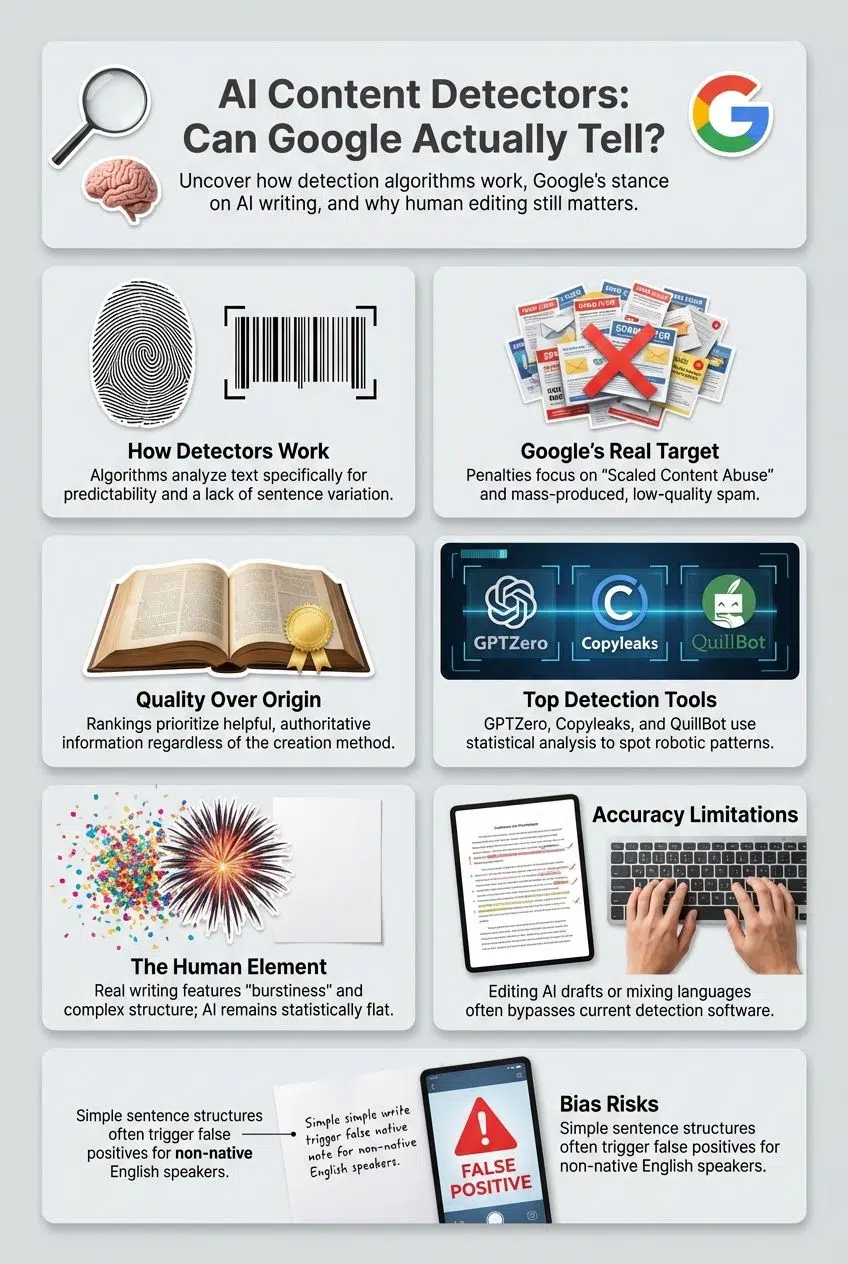
Content detection tools find out if a person or a machine wrote something. These digital helpers use smart programs to spot clues hidden in the words and phrases. If a text seems too tidy, repeats patterns, or copies common AI styles, these tools might flag it as AI-generated content.
Teachers use them for homework checks; website owners use them to avoid spam detection by search engines like Google. They help keep writing honest and fair online. Detection algorithms look for signs of artificial intelligence in articles, blog posts, and essays.
Machines can write stories now, but with the right analysis, we can spot their fingerprints.
Popular AI Detection Tools
First, you learned what AI detectors are and why people use them. Next up, meet some big players in AI content detection.
- GPTZero: It spots patterns common in machine learning-generated texts. Teachers use it worldwide to check if students wrote their essays or if artificial intelligence lent a hand.
- Copyleaks AI Detector: It works fast and scans for both regular plagiarism and AI-generated content. It claims over 99 percent accuracy, with updates as new models appear.
- QuillBot AI Detector: It checks if the text might come from an artificial intelligence model. Many writers trust it to double-check work before publishing online.
- Zero GPT: It supports checking large files and many languages. Its detection rate sits close to 98 percent on tested samples, making it popular for business and classroom use.
- Grammarly’s AI Detector: It helps spot sentences that may sound too much like a robot wrote them. It integrates directly into the popular Grammarly tool, giving instant feedback right in your browser.
How Do AI Content Detectors Work?
AI content detectors scan your text for patterns and writing styles. They spot clues that signal if a machine, and not a person, wrote the words.
AI Logic and Algorithms
AI detection tools use smart patterns to spot text created by machines. Algorithms break down each sentence, looking for clues like repeated phrases, odd wording, or too-perfect grammar.
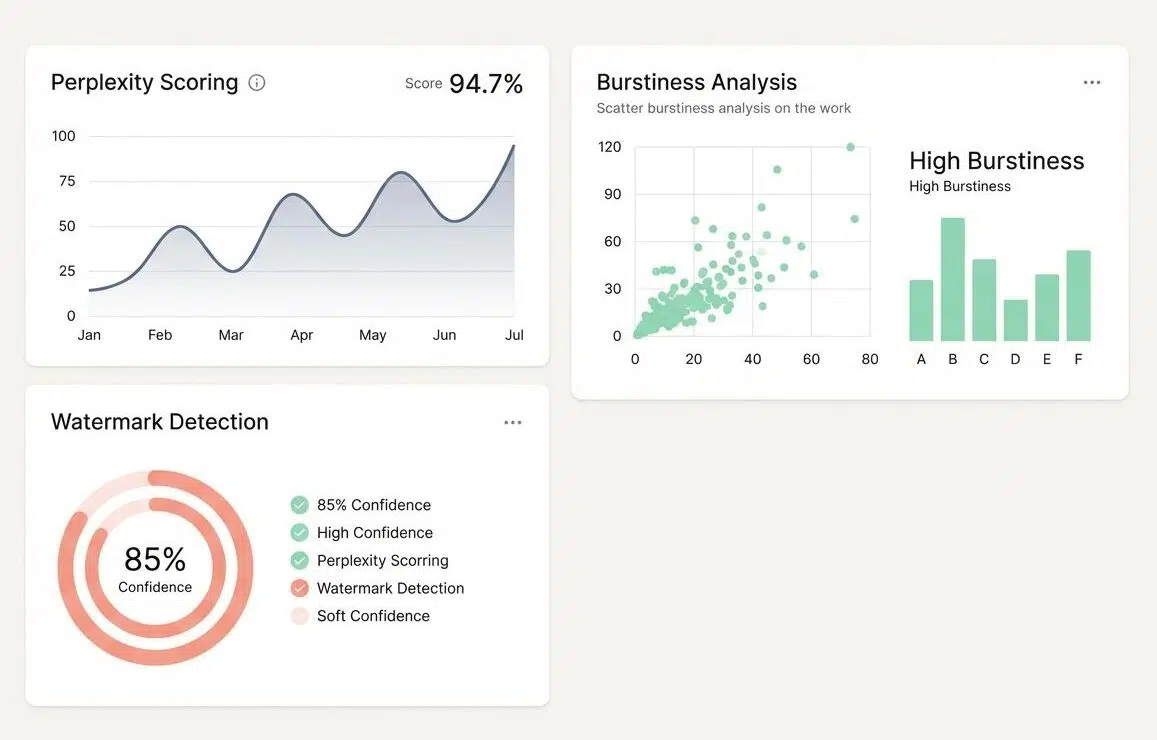
Most tools rely on two specific measurements: perplexity and burstiness. Perplexity measures how “surprised” the AI is by your word choice. If the AI can predict every next word easily, the perplexity is low, which suggests a machine wrote it.
Burstiness looks at sentence variation. Humans write with “bursts” of creativity, mixing short, snappy sentences with longer, complex ones. AI models tend to be monotonous. If your writing has low burstiness, it looks robotic to the detector. Google’s algorithms scan online content using these ideas, but keep their exact methods secret.
Patterns and statistics help flag AI-generated content before it climbs search rankings or triggers content penalties.
Key Features of Detection Tools
AI Logic and Algorithms give these tools their power, but the details matter. Every detection tool looks for different clues to spot AI-generated content.
| Feature | Why It Matters |
|---|---|
| Perplexity Scoring | Measures how predictable your words are. Low scores often mean AI. |
| Burstiness Analysis | Checks for sentence variety. Monotonous rhythm is a red flag. |
| Watermark Detection | Scans for hidden codes that some AI models embed in their text. |
- Most tools scan text for patterns that match known AI models, such as GPT-4 or ChatGPT.
- Some detection systems measure sentence length and word choice, looking for odd repetition or overly smooth flow.
- Many rely on natural language processing to evaluate how much the text sounds like a machine instead of a person.
- Detection tools can check if facts seem made up or if there’s lots of fluff with little real meaning.
- Popular models use statistical analysis to spot sudden shifts in writing style within the same piece.
- Several platforms compare suspicious text with huge online databases to flag copied or spun content, helping with plagiarism checks.
- Tools like GPTZero and Copyleaks offer scores that show the chance a passage came from artificial intelligence.
- Detection software sometimes scans metadata or timestamps to see if large blocks of text appeared all at once—a common AI sign.
- Some systems break down sentences into small bits, checking each section against lists of trigger words often used in generated copy.
- Many tools highlight text sections they find risky so users can focus on editing where it counts most.
Can Google Detect AI-Generated Content?
Google uses clever computer programs to spot text made by machines. If you’re curious about how sharp those tools really are, the truth may still surprise you.

Google’s Approach to AI Detection
Google uses complex algorithms for content analysis. Its detection tools hunt for signs of artificial intelligence language models, like repeating phrases or unnatural word choices.
Here is the critical update you need to know. In the March 2024 Google’s Core Update, it explicitly targeted “Scaled Content Abuse.” This means they are not just looking for AI content; they are hunting for low-value content generated at a mass scale to manipulate rankings.
The search engine applies quality assessment and spam detection to weed out this low-value material. Machine learning helps Google spot patterns in online text that often point to AI involvement.
Accuracy is not perfect, but team members tweak the systems day by day. Google does not focus on punishing all AI generation; instead, they target harmful or misleading material using digital detection tools.
If you mix human writing with machine-made sentences, it gets tricky for any algorithm to tell which is which, especially after edits or rewrites change the original style. Now comes a look at what holds back these smart detectors from being right every single time.
Limitations of Google’s Algorithms
Google uses smart algorithms to spot AI-generated content. Still, these tools face big hurdles. The algorithms can miss tricky patterns in writing that mix human and machine text. They may flag honest work or let some fake posts slip by with no problem at all.
Sometimes, Google’s detection methods struggle when people edit AI-generated texts or write in different languages. Many writers change the wording just enough to fool the system, making true content analysis tough for even powerful detection tools. No magic button catches every case of spam or low-quality content yet.
Challenges in AI Content Detection
Detecting who wrote what can get pretty tricky, like spotting a chameleon in a garden. Sometimes, even experts scratch their heads at the results. It makes you wonder who’s fooling whom!
Mixed Human and AI Content
Writers often use both their own words and AI-generated text in one article. This mix can fool detection tools, since it blends natural human style with machine-made patterns. Some content analysis algorithms search for sudden shifts in tone or strange word choices, but skilled editors can smooth out these signs without much effort.
Today’s detectors may trip up if a short AI passage sits beside longer sections written by people. Google’s quality assessment tools look at patterns, sentence structure, and unusual repetition to spot mixed sources of online content. Still, no detection algorithm gets it right every time.
People might tweak an AI model’s first draft just enough to confuse even top-end digital detection tools like GPTZero or Copyleaks AI Detector. Multilingual pages make things even trickier; words change meaning between languages, so spotting mixed authorship becomes harder for any machine learning system trying to protect search engine optimization standards.
Edited AI-Generated Texts
Changing AI-generated content can easily trick most detection tools. Small edits, like swapping words or shuffling sentences, may hide computer patterns that detectors search for during content analysis.
Some writers use grammar-checkers or paraphrasing software to edit text from AI models, making the final version look more natural and harder for algorithms to flag as machine-made.
Detection accuracy drops fast after editing. Even Google’s advanced algorithms face trouble with well-edited texts mixed with human writing styles. This creates problems for content quality checks and makes spam detection far tougher than before. Tools often miss these subtle tweaks, meaning penalties might not always apply to edited AI content in online searches.
Multilingual Detection Issues
AI content detectors often trip up on text in different languages. Many tools do well with English but miss key patterns or grammar when they face French, Spanish, Chinese, or Hindi.
This is a major blind spot. A 2023 study from Stanford University found that detectors flagged over 60% of TOEFL essays written by non-native English speakers as AI-generated. This false positive rate shows a massive bias against simple, standard sentence structures often used by language learners.
Some detection algorithms fail to spot AI-generated content if it mixes several languages or uses slang and idioms that only native speakers know. Online content flows across borders faster than ever before, so this is a big deal. Writing may look natural in one language but seem odd after translation; machines struggle here too.
Multilingual gaps make accuracy drop for detection tools as they scan more global texts. Next up are the leading AI Content Detection Tools that try to tackle these bumps along the road.
Leading AI Content Detection Tools
Many tools out there can spot if the content is made by AI or not. Some use smart tech to pick up clues even the sharpest eyes might miss.
GPTZero
GPTZero scans text fast and sorts it as human-written or AI-generated. Edward Tian, a student from Princeton, created GPTZero in 2023. Teachers use this tool to spot homework written by chatbots like ChatGPT.
It checks sentence patterns, word choices, and writing style using machine learning and natural language processing. GPTZero works on school essays, news articles, blogs, and even job applications. One of its standout features is the “Deep Analysis” mode, which breaks down exactly which sentences triggered the alarm.
It flags content that matches known AI patterns, but does not always get it right. Short texts can trick the system into false positives or negatives. Its quick results help with academic integrity and spam detection, but sometimes leave users guessing about accuracy. Continue reading for details about Copyleaks AI Detector next.
Copyleaks AI Detector
Switching gears from GPTZero, Copyleaks AI Detector steps into the scene with a sharp eye for content analysis. This tool checks if the text comes from artificial intelligence or a human.
It uses machine learning and natural language processing to spot patterns in writing styles, sentence structure, and word choices. Some schools use Copyleaks to fight off academic cheating by flagging essays created by AI models like ChatGPT. It is widely used because it integrates directly with learning platforms like Canvas and Blackboard.
The platform scans over 100 languages, so it does not stick to just English. Educators and businesses often pick Copyleaks because its detection tools help with quality assessment and spam detection, too. Results come fast, sometimes within seconds, which suits those on tight deadlines or fighting content penalties before they hit publish.
QuillBot AI Detector
QuillBot AI Detector checks if a piece of text comes from an AI. It works by using special algorithms and content analysis, spotting patterns often found in AI-generated writing. Users paste their text into the tool, and it shows a score for how likely the content is machine-made.
The tool helps teachers, editors, or anyone worried about fake or spammy writing spot suspicious text fast. It supports English language detection and updates its system to keep up with new AI models like ChatGPT and GPT-4. Many trust QuillBot’s accuracy for academic integrity and content authenticity checks.
Zero GPT
Moving from QuillBot AI Detector, Zero GPT enters the scene as another popular tool for content analysis. People use it to spot text created by artificial intelligence. It checks patterns in writing, looking for clues that point to machine generation.
Zero GPT claims high accuracy rates; some reports say it can detect over 98 percent of AI-generated content. Teachers and business owners often pick this detection tool for quick results. The platform works with several languages, not just English, which helps with global content quality testing and spam detection. As a bonus, anyone can access its core features without paying or making an account.
Grammarly AI Detector
Grammarly AI Detector checks text for signs of AI-generated content. Its tool scans writing, searching for patterns and language styles that often come from machines. It compares human-written and machine-written sentences using detection algorithms.
Grammarly’s system can flag awkward phrases or repeated structures that computers might use without understanding context. Writers enjoy the instant feedback on their text quality, but even top detection tools like this face challenges with mixed human-AI writing or well-edited drafts.
Many users notice its clean interface and easy steps in content analysis. Results help spot possible issues before posting work online or sharing it for school, work, or fun projects. Next up is how these detectors help keep academic honesty strong and protect ideas from being copied by bots.
Benefits of AI Content Detectors
AI content detectors help keep facts straight and protect writers’ work from sneaky copycats. They also boost trust, making sure what you read is the real deal, not smoke and mirrors.
Academic Integrity
Schools need fair grades and honest work. AI content detectors help spot essays written by machine learning tools. Google’s detection algorithms look for patterns in text that may not match human style, keeping things clear for everyone.
Teachers use these digital detection tools to stop cheating and protect intellectual property rights, just like a referee calls out fouls on the field. Good content analysis supports search engine optimization and keeps academic spaces safe from spam detection issues.
Every student gets credit for their effort, not just clever tricks or copied answers from online content generators.
Intellectual Property Protection
Writers and creators want to keep their ideas safe. AI content detectors help spot copied or reused text. These detection tools use algorithms to scan for matches across online content.
For example, schools and businesses can check if a report, essay, or article comes from an AI model like ChatGPT. Strong intellectual property protection means fewer cases of stolen work ending up on search engine results. Companies rely on machine learning for faster content analysis and spam detection, too.
This helps protect creative effort while keeping quality high. Up next, let’s look at how these tools guarantee that content is real and trustworthy through authenticity checks.
Content Authenticity Assurance
Moving from protecting intellectual property, content authenticity plays a big role in digital spaces today. People want to know that the articles they read come from real human thought and not just machine output.
Google uses many content analysis tools that check text for AI-generated patterns, odd language structures, or repeated phrases. These detection algorithms flag suspicious content so readers can spot if something feels off.
Content authenticity also helps with search engine optimization and spam detection. Sites filled with genuine writing often rank higher and face fewer penalties from Google’s systems. Academic groups use accuracy checks to keep work honest and original.
Schools even rely on detection tools like GPTZero or Copyleaks to see whether papers use too much artificial intelligence help. Whether you run a blog or manage an online store, showing that your material is authentic builds trust fast, like telling visitors “Yes, this was written by real people,” without saying a word!
The Limitations of Current AI Detectors
AI detectors get tripped up by errors, gray areas, and tricky writing styles. Stick around to see just how wild things can get.
Accuracy Concerns
Accuracy often slips through the cracks in content analysis. Tools like GPTZero or Grammarly can flag regular writing as AI-generated, even if a person wrote it. False positives happen more than people realize, with studies showing detection tools can wrongly label up to 15 percent of human-written text.
Sometimes, these algorithms miss the mark by not catching clever tweaks. A quick rewrite or simple edit fools many detectors easily. Content quality drops when creators try to “game” detection tools instead of focusing on what readers want. Multilingual content adds another layer; machines struggle even harder there.
Ethical Implications
AI content detection tools can sometimes make mistakes, flagging honest writers as cheaters. This can lead to unfair penalties for students or creators who did nothing wrong. People worry about privacy too, since these detection tools often scan and store lots of personal text without clear permission.
Teachers and companies may lean heavily on algorithms, trusting them more than human judgment. Machine learning can show bias against certain writing styles or those whose first language is not English.
These systems use patterns that do not always match real life, so they might label original work as AI-generated content just because it looks unusual. Ethical questions arise every time someone risks a penalty based only on what an algorithm claims to see in the words they write.
Wrapping Up
Google uses smart algorithms and machine learning for content analysis. These tools search for patterns that may signal AI-generated content or spam detection issues. Sometimes, they catch odd phrases or unnatural structure, which can point to text made by an AI model.
Detection tools like GPTZero and Copyleaks scan digital text quickly, but their accuracy is not perfect. Mixing human edits with machine-made sentences can confuse even the best detection algorithms. Online content keeps shifting, so every tool must work hard just to keep up with new tricks in quality assessment and search engine optimization.