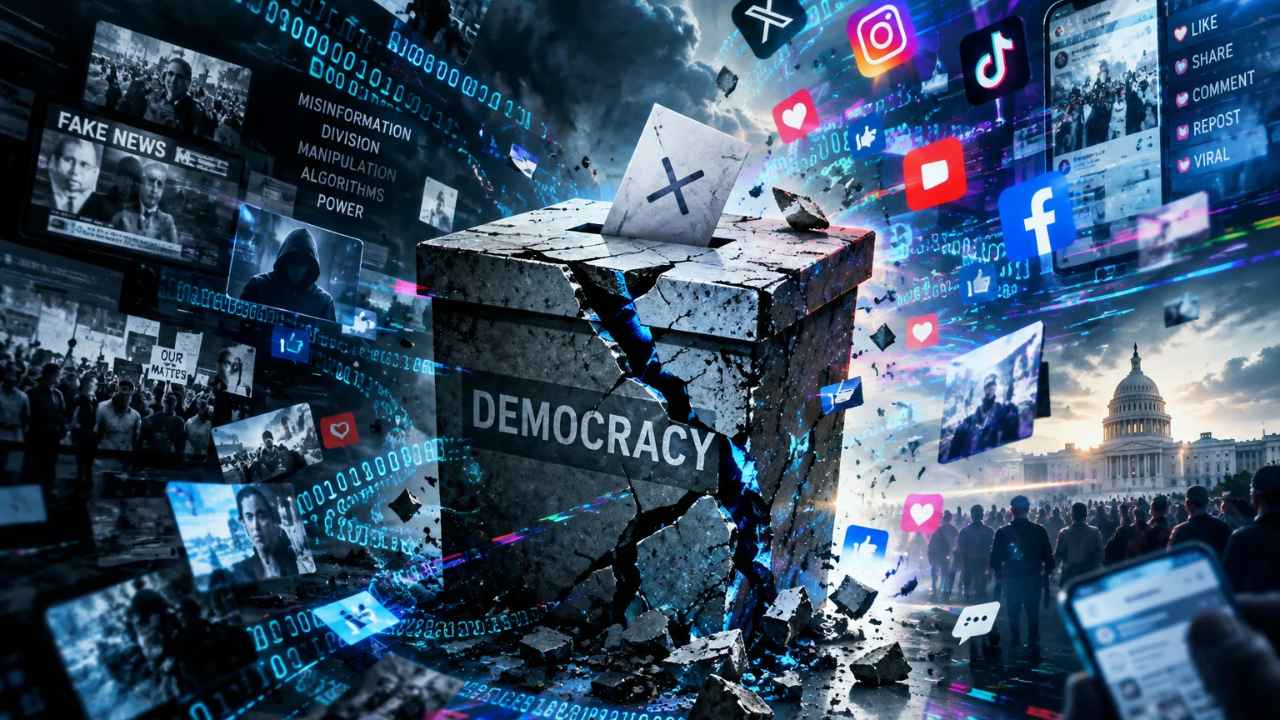
Democracy is in crisis. Not long ago, that line belonged to the political fringe. Today judges, scholars and policymakers across the spectrum say it with a straight face. But most of them misread where the danger comes from.
The problem is not that technology turned against us. It is that the state’s power to watch its citizens has grown far faster than the laws meant to restrain it. The courts are improvising. The legislators are behind. And the civic checks that once kept power honest have quietly stopped working.
I am not against surveillance. Used under clear, proportionate and reviewable authority, it has a real place in a free society. But that condition has to be a hard limit built into how these tools are designed and used, not a phrase dusted off afterward to justify whatever already exists.
A Crisis of Leadership Not of Machines
When Pew Research Center surveyed experts on the state of democracy, one of them summed it up in a single line: democracy faces “a crisis in global leadership.” I think that diagnosis is exactly right. Technology did not create this mess on its own. It poured fuel on a governance failure that was already underway.
The Kofi Annan Foundation has made a similar point, noting that new technologies and social media are profoundly changing democracies all over the world. What hasn’t changed fast enough is the leadership and the law. The everyday rules around privacy and consent have shifted beneath our feet while our institutions stood still.
What makes this moment different from earlier periods of strain is scale. Governments and corporations now hold more personal data than at any point in human history, and it moves across borders with almost no friction. The systems that collect it are invisible to the people being watched. Voter rolls, identity databases, and the detailed behavioral profiles used by political campaigns and police departments alike—all of it sits on legal foundations poured before automated tracking existed. Our privacy law was written for a world that no longer exists, and every year the distance between that law and reality grows.
I am wary of anyone who predicts democracy will collapse by some specific year. The evidence for decline is uneven, and doom-mongering helps no one. But some of the evidence is not in doubt. Public trust in Congress has dropped. Trust in banks has fallen even more sharply. Analysts working with Freedom House data see political manipulation and public apathy wearing down democratic norms around the world. And the collision between expanding surveillance and constitutional rights is not a prediction. It is already written into statutes, court records and agency practice.
Surveillance You Will Never See
Here is what unsettles me most. In modern democracies, surveillance rarely breaks the law. It runs through it.
Judges sign warrants under seal. Compliance officers at phone companies quietly carry out the orders. Gag orders keep the target in the dark. Everything is lawful, and everything is invisible. Civil liberties groups like the ACLU have shown how deeply these practices are now woven into federal, state and local agencies. The proceedings are closed. There is no one on the other side to object. Surveillance powers can expand for years before lawmakers or the public grasp how far they reach.
Think about what this does to a basic right. When police search your home, someone knocks on your door with a warrant you can read. You can call a lawyer. You can challenge how the search is carried out. A digital search skips every one of those steps. The court order goes straight to your service provider, and a gag order keeps you outside the process entirely. If you never learn a search happened, you can never object to it. The adversarial process at the heart of the Fourth Amendment has nothing left to work with.
Worse, the government increasingly doesn’t need to collect the data itself. Why build expensive surveillance systems when you can simply buy the information, or request it, from data brokers, platforms and telecom companies that already hold it? Access comes through administrative subpoenas, commercial purchases or voluntary data-sharing deals. Analysts at TRT World’s research center have flagged this as a critical pressure point: agencies can now tap private data pools on a scale no public surveillance budget of the past could ever have funded. Public policing and private profit now draw from the same well.
Ordinary citizens have no realistic way to keep up. Few people can predict how data from license plate readers, cell-tower tracking and purchased commercial datasets will be combined and searched months later. Public assumptions trail far behind what the state can actually do, and that gap lets surveillance keep growing with almost no political cost.
Legal Pieces by Piece Are Dangerous as a Whole
Modern surveillance is not one program resting on one law. It is a stack of separate tools, agency databases and legal authorities running at the same time. Together they produce an investigative power that no single act of Congress ever approved.
License plate readers show how this works. One camera catching one car tells you almost nothing. Connect thousands of them across a region and keep the records for months, and you can map where a person sleeps, where they worship, which doctor they see and who they visit on weekends. Even civil liberties advocates admit these cameras can be valuable investigative tools. That is precisely the trap.
Each piece, on its own, can be perfectly legal, and that is why the whole structure survives. Courts review these tools one at a time, often using precedents from a different technological age, and tend to find each one constitutional. The full surveillance ecosystem almost never lands on a judge’s desk. Nobody in the judiciary is asked to weigh its combined reach, so the bigger picture stays out of frame.
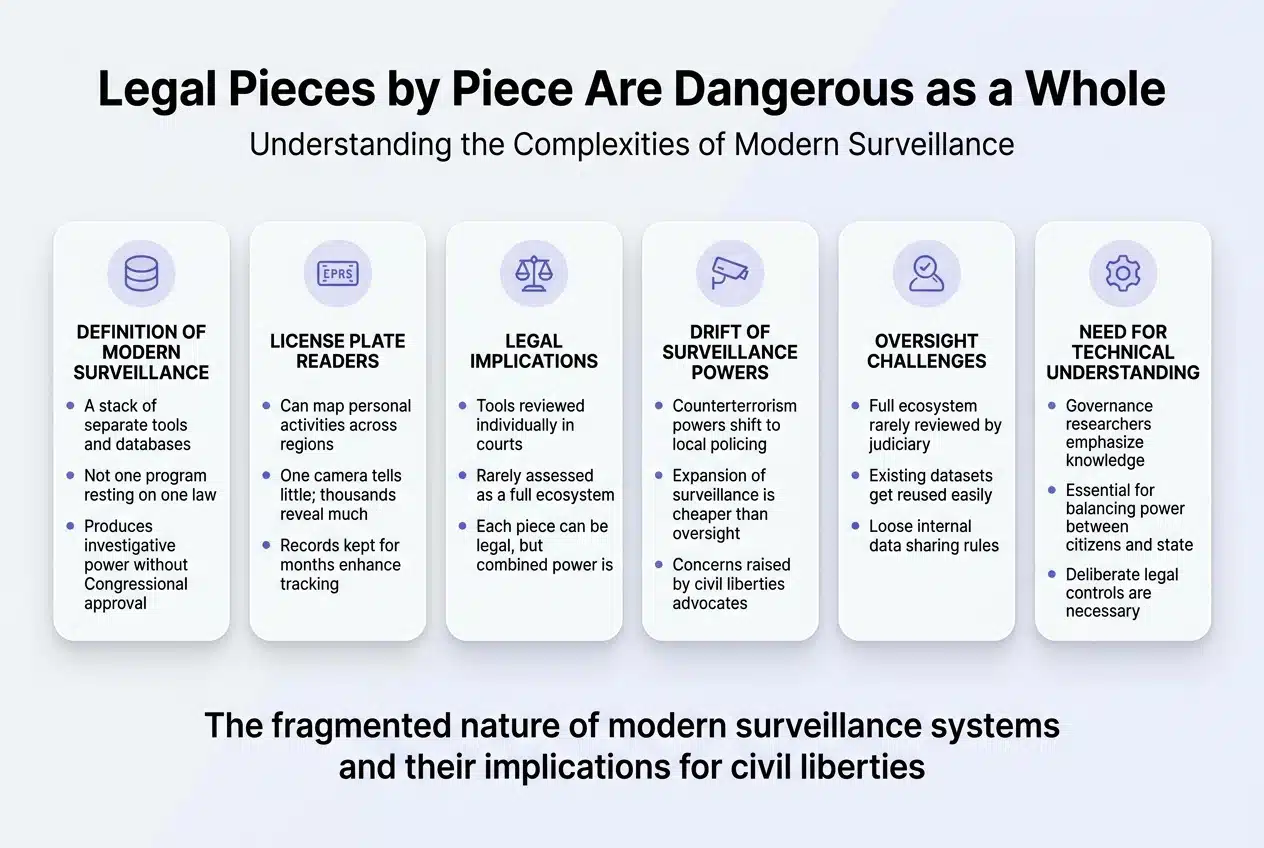
And once a large dataset exists, it gets reused. Powers originally granted for counterterrorism or serious felonies drift into routine local policing, a pattern civil liberties advocates have warned about for years. Searching a database that already exists costs almost nothing, and loose rules on internal data sharing make it easier still. Expansion is cheap. Oversight is expensive. It isn’t hard to guess which one wins.
Governance researchers have warned that public managers, politicians and citizens all need real technical understanding if we want the benefits of surveillance without fundamentally changing the balance of power between citizens and the state. Left without deliberate legal controls, pooled data tends to concentrate power in the executive branch and wear down the very oversight meant to check it.
Laws Are Built for Paper
Our constitutional protections were designed around a physical world: papers, houses, and fixed borders. Those same principles now have to govern cloud servers spread across continents, constant location feeds and algorithms that never sleep. Scholarship from Stanford Law School describes the result as a national stalemate that more than a decade of debate since 2013 has failed to break. Courts and regulators keep responding one case at a time. A doctrine that fits modern surveillance still does not exist.
The clearest failure is the third-party doctrine, the idea that you give up constitutional privacy the moment you share information with someone else. That rule was born in the era of landlines and paper bank deposit slips, and it made a certain kind of sense then. It makes almost none now. Third parties sit in the middle of nearly everything we do. They store our GPS trails, our browsing histories, even our biometric data. Stretching a rule built for occasional transactions over continuous, automated tracking produces results that are arbitrary at best and openly contradictory at worst.
Nowhere is that clearer than in cases involving location history. Federal and state courts are sharply divided over whether police need a warrant to collect months of historical cell-site records or automated tracking logs. Some courts treat long-term digital aggregation as fundamentally different from a single record and demand a warrant. Others stick to a narrow reading of older precedents and allow collection without one. What hangs on that question is enormous: whether the state can build a complete map of your private life without ever showing probable cause.
Nobody is Watching the Watchers
Policy research keeps arriving at the same uncomfortable conclusion. Public agencies can now do far more than the institutions overseeing them understand. Technical capability has raced ahead. Institutional design and administrative controls, especially around procurement, have not.
Much of this expansion doesn’t arrive through dramatic decisions. It arrives through shopping. An agency upgrades its data analytics or adopts a new platform for sharing information between departments, all in the name of better public services. Its surveillance power grows right alongside, often without anyone examining it. Governance scholars warn that weak internal controls let these projects tilt the balance of power between citizens and the state. No single choice looks dangerous. Dozens of small purchases, each harmless on paper, add up to something nobody voted for.
Part of the problem is plain expertise. Judging the civil liberties impact of automated data ingestion, machine-learning queries and linked databases, it takes specialized knowledge that many city managers and legislators simply don’t have. When policymakers don’t understand how their own systems connect, review comes late. Usually it arrives only after a leak or a lawsuit drags the issue into public view.
The damage goes beyond privacy violations. Fair administration depends on clear standards, accountable decisions and predictable behavior. All three erode once officials have open-ended, unlogged access to commercial and municipal databases. Without tamper-proof audit trails, independent oversight bodies and transparent access rules, technical capability keeps quietly replacing the democratic process.
Two Continents, Two Answers, Neither Finished
Europe and America are tackling this problem in very different ways. On November 12, 2025, the European Commission adopted the European Democracy Shield as part of its wider Democracy Package. It pulls election security, foreign disinformation and civil-society resilience under a single EU-wide framework, building on commitments in Ursula von der Leyen’s political guidelines. The aim is common standards across all member states, set from the top.
On paper, it is impressive. In practice, it is untested. Strong political backing is not the same as results. The Shield depends on 27 member states actually complying, on sustained funding and on enforcement mechanisms that have never been tried. It treats digital threats as systemic weaknesses in governance that need unified, proactive regulation rather than one-off responses. That is the right instinct. Whether it works is still an open question.
The United States has nothing comparable, and its system looks fragmented because it is. No single federal body oversees how state surveillance powers interact with digital privacy. Instead there is a patchwork of narrow federal privacy laws, state consumer protection statutes and scattered court rulings that rarely add up to a clear standard. Decentralization does have one real advantage. Individual states can experiment quickly, and several have moved faster than Congress ever could. But there is still no coherent national framework for governing surveillance as a whole, and divided government keeps blocking one.
Can Citizens Fill the Gap?
Some scholars have stopped waiting for legislatures to catch up. They point instead to citizen assemblies, randomly selected panels of ordinary people who study an issue in depth and make recommendations. These bodies could take on technology policy exactly where elected officials have stalled.
Analysts at the Lowy Institute describe a new global wave of deliberative democracy, powered in part by digital platforms. Online tools make it easier than ever to run public consultations, petitions and participatory budgets. That is genuinely encouraging.
But there is a catch. Political scientists Michael Alvarez and Thad Hall warn that a lack of trust in digital systems can undermine the legitimacy of direct democratic practices and drive down public confidence. If people suspect that a public comment portal or an online petition is being monitored or mined, they will pull back, no matter how secure the code actually is. Perception does the real work here. Open deliberation and hidden monitoring are uneasy neighbors, and wider access to a system people distrust can speed up the decline in confidence rather than reverse it.
Yes, the Security Matters the Most
I take the security argument seriously, and so should anyone who wants to be heard on this issue. Organized crime groups, hostile intelligence services and terrorist networks use encrypted messaging, move money across borders and operate in loose, decentralized cells. Agencies that cannot investigate them effectively will be outmatched. Proportionate, legally authorized intelligence work is a legitimate part of keeping people safe. Bulk collection that no one can review is something else entirely.
So the real debate is narrower than it sounds. The question isn’t whether police and intelligence agencies should have modern tools. It’s whether anyone has the legal authority, the technical expertise and the transparency to stop those tools from creeping beyond their purpose. Right now, the honest answer is no.
The cracks appear when separate tools are combined. A single license plate reader may be useful, but that judgment tells us nothing about the far larger power created when dozens of datasets are joined together. No law currently forces anyone to examine that combined capability. Until one does, proportionality remains a nice idea rather than a working rule.
Final Thoughts: What Reform Has to Look Like
The fixes are not mysterious. Courts should be required to review the combined power of surveillance systems, not just individual tools. Sealed warrant hearings need an independent advocate arguing the other side, so the citizen’s interest is represented even when the citizen doesn’t know the hearing exists. Agencies should publish regular, standardized audits of how much data they collect and how often they search it. None of this would strip security services of what they genuinely need. It would simply rebuild oversight for tools that have outgrown the laws written for them.
Europe’s Democracy Shield points in one direction. Citizen assemblies and other deliberative experiments point in another. Neither is a complete answer, but both rest on the same principle: people deserve to understand how decisions about their data are made. “Trust us, oversight happens somewhere” is not good enough, and it never was.
What’s missing isn’t ideas. Every reform listed above has been proposed, debated and recommended many times over. What’s missing is the political will to turn recommendations into law. Today’s surveillance machinery runs on automated, networked systems built to stay hidden. Whether our democratic institutions can drag that machinery back into public view will decide how much legitimacy they have left.