
Building software for broad audiences forces startups to compete against entrenched tech giants with massive capital budgets. Exploring targeted saas ideas for niche communities allows founders to solve acute, highly specialized workflow problems, achieve strong pricing power, and build defensible businesses with low customer churn.
| Niche Community Idea | Target Audience | Primary Problem Solved | Recommended Pricing Model |
| 1. Independent Pharmacy Compliance Hub | Local pharmacy owners & staff | Tracking state-level drug distribution rules | Monthly tiered subscription |
| 2. Owner-Operator Fleet & Logistics Tool | Independent long-haul truckers | Managing fuel surcharges, IFTA taxes, & loads | Per-vehicle monthly fee |
| 3. Veterinary Diagnostic Case Exchange | Specialized animal surgeons | Peer-reviewing complex radiographic scans | Monthly membership + pay-per-case |
| 4. Fractional Executive Client Hub | Fractional CFOs, CMOs, & CTOs | Client benchmarking & retainer milestone management | Per-client seats / Monthly SaaS |
| 5. Urban Farming Asset Leasing Exchange | Vertical farmers & urban growers | Sharing high-cost hydroponic & lighting gear | Transaction fee + platform subscription |
| 6. CPA Continuing Education & Audit Tracker | Sole practitioner accountants | Tracking CPE credits & client audit trails | Flat annual subscription |
| 7. BioTech Investor Due Diligence Network | Angel investors & micro-VCs | Standardizing clinical trial deal evaluation | Premium user tier / Seat license |
| 8. Voiceover Artist Booking & Audio Vault | Commercial & audiobook voice actors | Managing audio rights, auditions, & payouts | Monthly user tier + storage add-ons |
| 9. Offshore Technician Certification Log | Maritime & wind turbine engineers | Tracking safety credentials & shift rosters | Enterprise seat license |
| 10. Adjunct Lecturer Curriculum Exchange | Higher-education adjunct professors | Monetizing & sharing peer-reviewed syllabi | Marketplace commission + subscription |
10 Actionable SaaS Ideas for Niche Communities
1. Compliance and Regulatory Tracker for Independent Pharmacists
Independent pharmacies face a complex maze of state and federal regulatory updates regarding controlled substances and insurance reimbursements. A dedicated micro-SaaS platform that aggregates regional compliance changes, provides automated checklist workflows, and tracks license renewals protects pharmacy owners from costly audit fines.
2. Logistics and Tax Compliance Hub for Owner-Operator Truckers
Independent truck drivers often struggle with managing International Fuel Tax Agreement (IFTA) filings, load profit margins, and maintenance logs while on the road. A mobile-first software tool designed specifically for single-truck operators simplifies expense tracking and calculates real-time cost-per-mile profitability without requiring enterprise fleet management bloat.
3. Peer-to-Peer Diagnostic Network for Veterinary Specialists
General practice veterinarians frequently run into rare medical cases that require input from certified board specialists. A specialized HIPAA-adjacent software network allows veterinarians to upload anonymized imaging scans, share diagnostic notes, and receive rapid peer reviews from global specialists for a fee.
4. Client Engagement and Benchmark Dashboard for Fractional Executives
The rise of fractional leadership (fractional CFOs, CMOs, and CTOs) has created a need for tools designed for multi-tenant advisory work. A dedicated workspace tailored for fractional professionals helps track client retainers, visualize strategic milestones, and benchmark performance across portfolio companies in a single dashboard.
Urban and indoor vertical farming operations require expensive specialized equipment like automated dosing systems and spectrum lighting. A hyper-local SaaS platform enabling regional urban growers to rent out idle equipment, share processing facilities, and coordinate bulk supply orders lowers capital expenditure barriers for small growers.
6. Continuing Education and Audit Ledger for Independent CPAs
Solo accounting practitioners must maintain strict Continuing Professional Education (CPE) requirements across multiple state boards while managing client audit trails. A niche SaaS compliance ledger tracks educational credits automatically, alerts accountants to upcoming board deadlines, and secures client document verification chains.
7. Deal Flow and Clinical Due Diligence Network for BioTech Investors
BioTech angel investors often lack the deep scientific expertise required to evaluate complex pre-clinical data. A secure software network connecting non-technical investors with verified medical researchers allows micro-VCs to order standardized peer reviews of clinical trial data before committing capital.
8. Audition Vault and Rights Management Tool for Voiceover Artists
Voice actors navigate unique workflow hurdles, including managing unmastered audition files, securing usage rights for commercial spots, and tracking voice-over royalties. A dedicated SaaS suite gives voice actors custom portfolio landing pages, watermarked audio file delivery, and automated licensing contracts.
9. Safety Certification and Shift Manager for Offshore Technicians
Offshore oil, maritime, and wind turbine technicians operate under strict international safety certifications that expire at varying intervals. A mobile compliance SaaS for offshore crew managers tracks individual sea-time hours, monitors mandatory safety certifications, and automates shift handoffs across remote vessel operations.
10. Curriculum and Rubric Exchange for Higher-Ed Adjunct Professors
Higher-education adjunct instructors frequently teach across multiple universities and spend unpaid hours drafting original lesson plans. A dedicated platform allowing adjuncts to license peer-reviewed syllabi, grading rubrics, and lecture slides directly to one another creates a new income stream for educators while saving prep time.
Evaluating the Commercial Viability of Niche Community SaaS
Before committing engineering resources to a niche software idea, validate its commercial potential using a three-part framework:
-
Urgency of the Pain Point: Ensure the software solves a financial, legal, or regulatory problem rather than a minor inconvenience. Niche users pay premium rates when software prevents regulatory fines or directly increases revenue.
-
Community Density: Assess whether your target audience congregates in identifiable channels like specialized trade associations, dedicated online forums, or industry conferences. High community density lowers customer acquisition costs (CAC).
-
Willingness to Pay: Confirm that the target niche possesses dedicated budget for software solutions. B2B professionals and licensed practitioners represent stronger targets than consumer hobby groups.
The Hidden Risks of Building for Micro-Niches
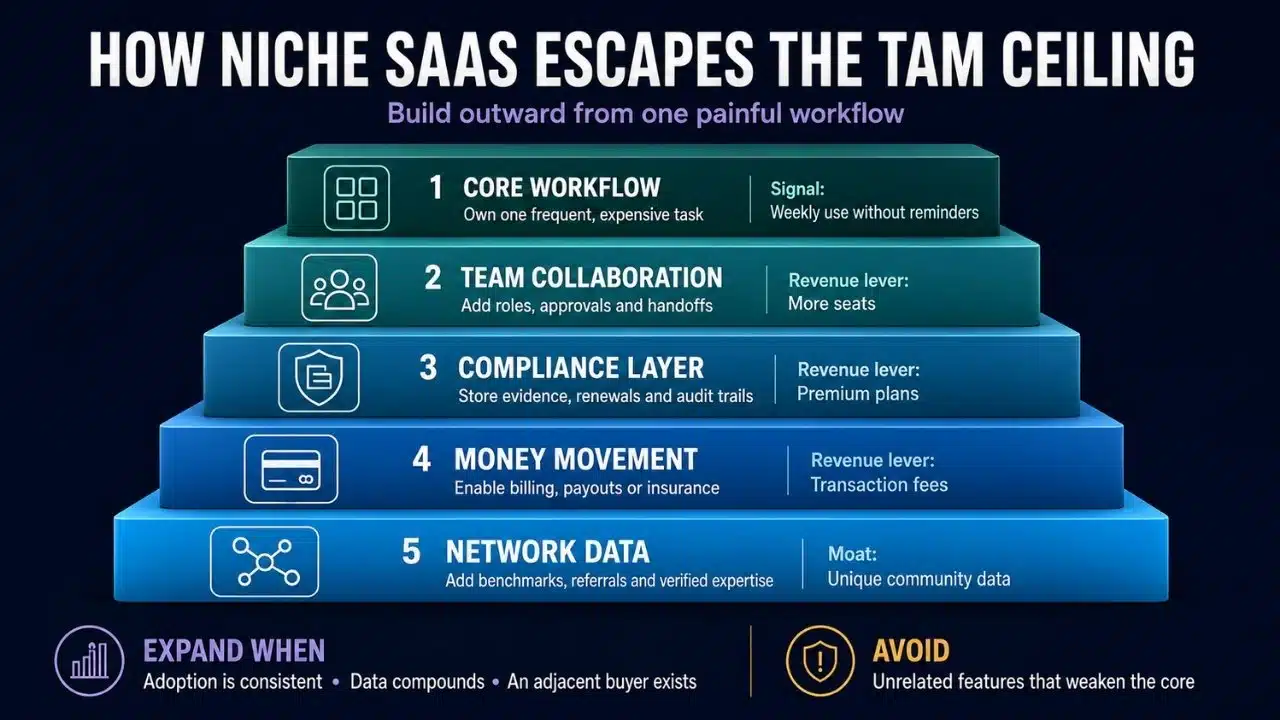
The most uncomfortable truth when evaluating software ideas for smaller markets is that total addressable market (TAM) caps arrive much faster than expected. Founders who build for hyper-specific audiences often achieve rapid initial traction, securing their first 50 customers through direct community outreach. However, once that immediate circle is saturated, growth can hit a wall if the market lacks expansion potential or adjacent verticals.
Looking ahead, as generative AI tools lower the barrier to software creation, vertical SaaS markets will become increasingly crowded with single-feature micro-tools. Long-term defensibility will not rely on software code alone, but on deep community trust, workflow integration, and proprietary data loops. Winning in niche markets requires becoming an active insider who understands the hidden operational nuances of the industry better than any outside software developer ever could.
Frequently Asked Questions (FAQs) About SaaS Ideas for Niche Communities
What makes a niche community a good candidate for a SaaS product?
A strong niche community has clear regulatory or operational pain points, high industry concentration, and a willingness to pay for specialized software that saves time or prevents legal non-compliance.
How do you validate a micro-SaaS idea in a specialized industry?
Validate the idea by interviewing key professionals in the space, pre-selling lifetime or annual memberships, and building a simple prototype to confirm users will pay for a solution before writing full code.
Can a niche SaaS business achieve venture-scale growth?
While some vertical SaaS platforms expand into billion-dollar markets by adding financial services and payments, many niche SaaS companies function best as highly profitable bootstrapped or micro-pe businesses.
How do you keep customer acquisition costs (CAC) low in niche markets?
Keep CAC low by leveraging word-of-mouth referral programs, speaking at specialized trade conferences, and partnering directly with industry trade associations or online community hubs.
What is the biggest risk of targeting a hyper-specific SaaS niche?
The primary risk is market saturation due to a small Total Addressable Market (TAM). If the niche is too narrow and lacks expansion opportunities into adjacent workflows, overall revenue growth will quickly plateau.