A creator in 2026 runs a business with a link in bio, three social platforms, an email tool, a course host, a community, a scheduling app, and a payment processor. That’s eight subscriptions before the content even exists. I’ve sat with enough creators on a Thursday night, pasting subscriber lists from one tab into another, to know the eight-subscription life isn’t a lifestyle choice. It’s a slow leak of hours, and the leak is the part nobody budgets for.
The creator economy grew from about $205 billion in 2024 and is projected to pass $1.35 trillion by 2033, per Forbes’ April 2026 analysis. Most of that money is being made by people drowning in their own tool stack, which is a sentence that should not be true and keeps being true anyway. The ones who are winning aren’t adding more apps. They’re consolidating onto unified tools, and the data says the switch is worth real money. This article walks through why the consolidation started, what unified actually buys you, and the math that decides whether the switch makes sense for your stack.
Eight subscriptions before the content exists
I’ve spent enough evenings with creators pasting subscriber lists between apps to know the feeling of the pile, one app for every job, none of them talking to each other. The newsletter lives in one place, the course in another, the community in a third, and the analytics in a fourth. Every month there’s a new subscription, a new login, a new export.
The numbers explain why this pattern spread. Over 207 million people identify as content creators worldwide, according to SNS Insider’s 2025-2026 data, and more than 2 million operate at a full-time expert level. Almost half of them, 48 percent per Circle’s 2026 survey, work completely solo. A solo creator has no ops person to glue tools together. The glue is their own evenings.
The cost isn’t just money. Every integration that doesn’t exist is manual work. Every manual step is a place where a launch slips, a subscriber misses an email, or a payment falls through a crack. Chaos isn’t a personality trait of creative work. It’s a tax on fragmented infrastructure.
The bill arrives when the stakes do
The chaos got expensive because the stakes did. The creator economy stopped being a hobby market, and the tooling expectations scaled with it. Forbes puts the global creator economy at $205 billion in 2024 with a 23.3 percent compound annual growth rate, heading toward $1.35 trillion by 2033. AMT’s July 2026 analysis estimates 2025 settled near $250 billion and forecasts past $1 trillion by the early 2030s. This is now a serious industry with serious infrastructure demands.
Three trends made the fragmented stack untenable in 2026, and they arrived at the same time. Income structure changed first: 68.8 percent of creators now rely on brand deals as their primary income source, while only 7.3 percent depend mainly on ad revenue, per SNS Insider. Brand deals mean invoices, contracts, deliverables, and follow-ups, all of which live in different tools. AI adoption piled on next, with over 90 percent of creators in the US and UK using generative AI tools for content production, per ShortsIntel. That’s another layer of tools on an already tall stack. Then came community expectations, the shift that probably mattered most: 56 percent of creators launched their community in the last two years, per Circle, and a community isn’t a content file. It’s a living operation with members, payments, and support.
Each of those trends is individually manageable. Together, they turned the eight-app stack into a full-time job that isn’t content creation.
Creators moved before the platforms did
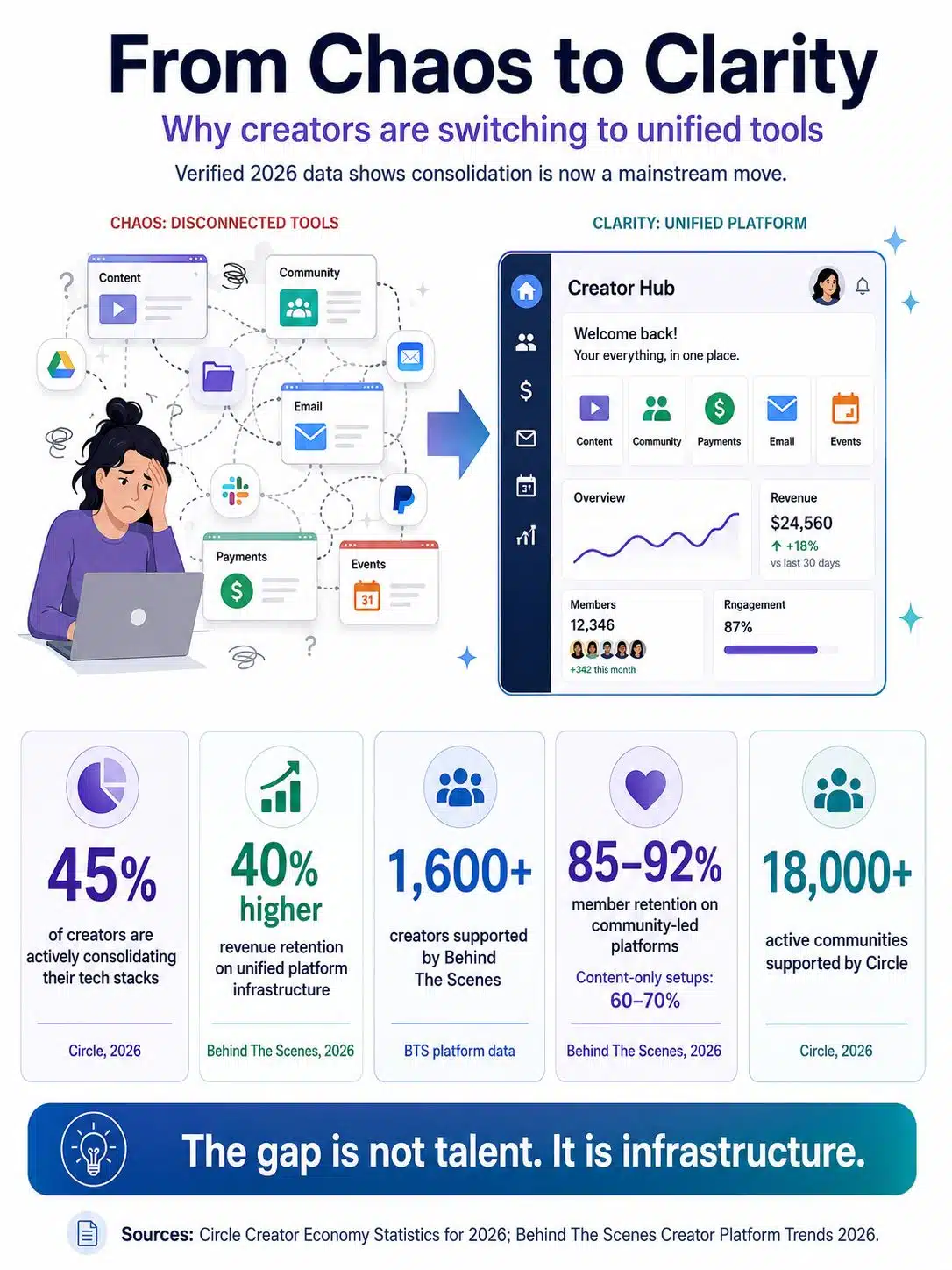
The interesting part is that creators figured this out before the platforms did. Circle’s 2026 survey found 45 percent of creators are actively consolidating their tech stacks. That’s not a niche behavior anymore. It’s the mainstream move.
And the data says the move pays, though I’d be lying if I said the switch is painless. BehindTheScenes, which works with over 1,600 creators, reports that creators on unified platform infrastructure see 40 percent higher revenue retention compared to those using fragmented tool stacks. Their conclusion is blunt: the earnings gap isn’t about talent. It’s about infrastructure.
The pattern shows up in community economics too. BehindTheScenes measured community-led platforms retaining 85 to 92 percent of members, versus 60 to 70 percent for content-only setups. When everything lives in one place, members stay, renewals stay, and revenue compounds. Circle now supports over 18,000 active communities, and the growth is concentrated exactly where the consolidation is happening.
What unified tools actually mean
Unified tools don’t mean one mega-app that does everything badly. It means one place where the business operations actually connect: membership, content, events, payments, and workflows in a single system. Circle’s research describes exactly this as the winning setup for 2026 creators.
The all-in-one platforms have converged on this idea from different directions. Stan Store is the monetization-first version, built into the link in bio, with unlimited products and subscribers, zero transaction fees, and plans from $29 to $99 a month. Kajabi is the funnel-first version, with websites, courses, email, and memberships from $89 to $499 a month. Podia sits between them with a course, email, and community bundle around $39 to $89 a month.
The creation side of the stack is consolidating the same way, and this is where the real chaos lives. A creator making one video post typically juggles a video editor, an AI image tool, a voice generator, and a design app. That’s four subscriptions to produce one asset. ImagineLab, the AI creative studio at imaginelab.art, is one attempt at fixing exactly this, positioning itself as an AI Creative Operating System that folds video, image, infographic, and voice generation into a single workspace backed by a unified API. It’s not the only one, and not every claim on a landing page survives contact with real work, but the direction it points is where the market is going.
| Fragmented creation stack | Monthly cost | Unified alternative | Monthly cost |
| AI video tool | $20-30 | ImagineLab studio | One subscription |
| AI image generator | $10-20 | Included | – |
| Voice/audio generator | $20-30 | Included | – |
| Infographic/design app | $15-25 | Included | – |
| Total | $65-105 | Total | One platform |
The structure mirrors the selling side: one connected system instead of four disconnected jobs. It’s the same logic applied to making content instead of selling it. ImagineLab launches to the public on August 14, 2026, which makes it a good moment to watch how the creation stack consolidates in practice.
What a studio like this actually does for a working creator is worth being precise about, because the category is full of marketing. In ImagineLab’s case, the promise is that you log in once, pick the asset type, and the AI handles the generation, collapsing four separate workflows into one. The unified API behind it, served from api.imaginelab.art, is the part I find more interesting than the flashy demos, because an API is what turns a tool into infrastructure. The demos will improve; the API is the durable bet.
The payoff is practical rather than dramatic. You stop exporting a design from one app and re-uploading it into another, because every asset stays in the same workspace. The money math is hard to argue with: the fragmented creation stack runs $65 to $105 a month, and a unified studio replaces it with one subscription. And because video, image, infographic, and voice come from the same system, the brand looks the same across formats without anyone policing it. The quiet win, the one most solo creators underrate, is that there’s a single interface to learn instead of four.
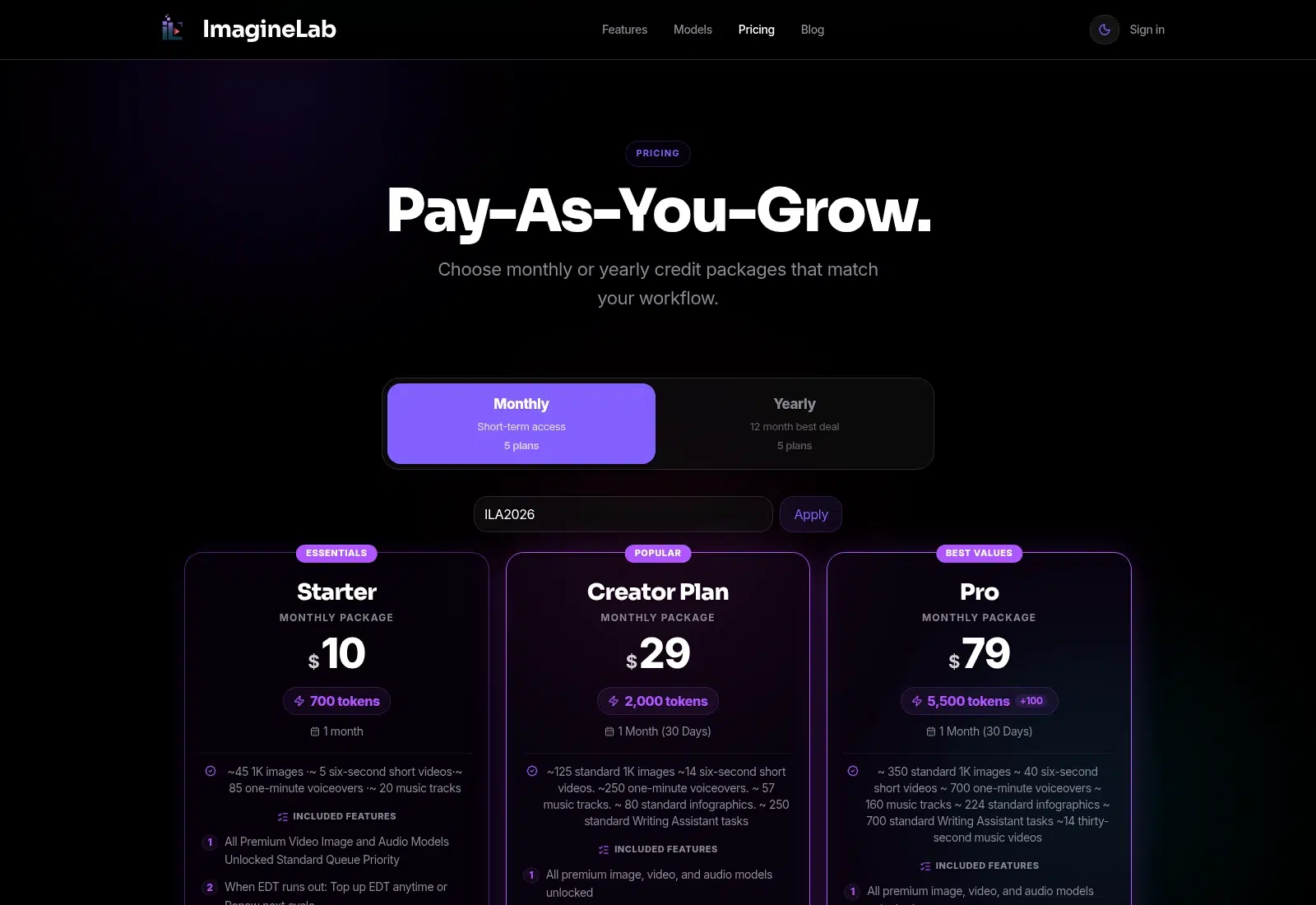
ImagineLab’s pricing page is where the consolidation promise becomes concrete: one subscription, multiple creative formats, no per-tool stacking. Full-screen capture: imaginelab.art/pricing, August 2026.

Notion is the workspace half of the unification story: pages, databases, docs, and tasks in one canvas. Full-screen capture: notion.so, August 2026.
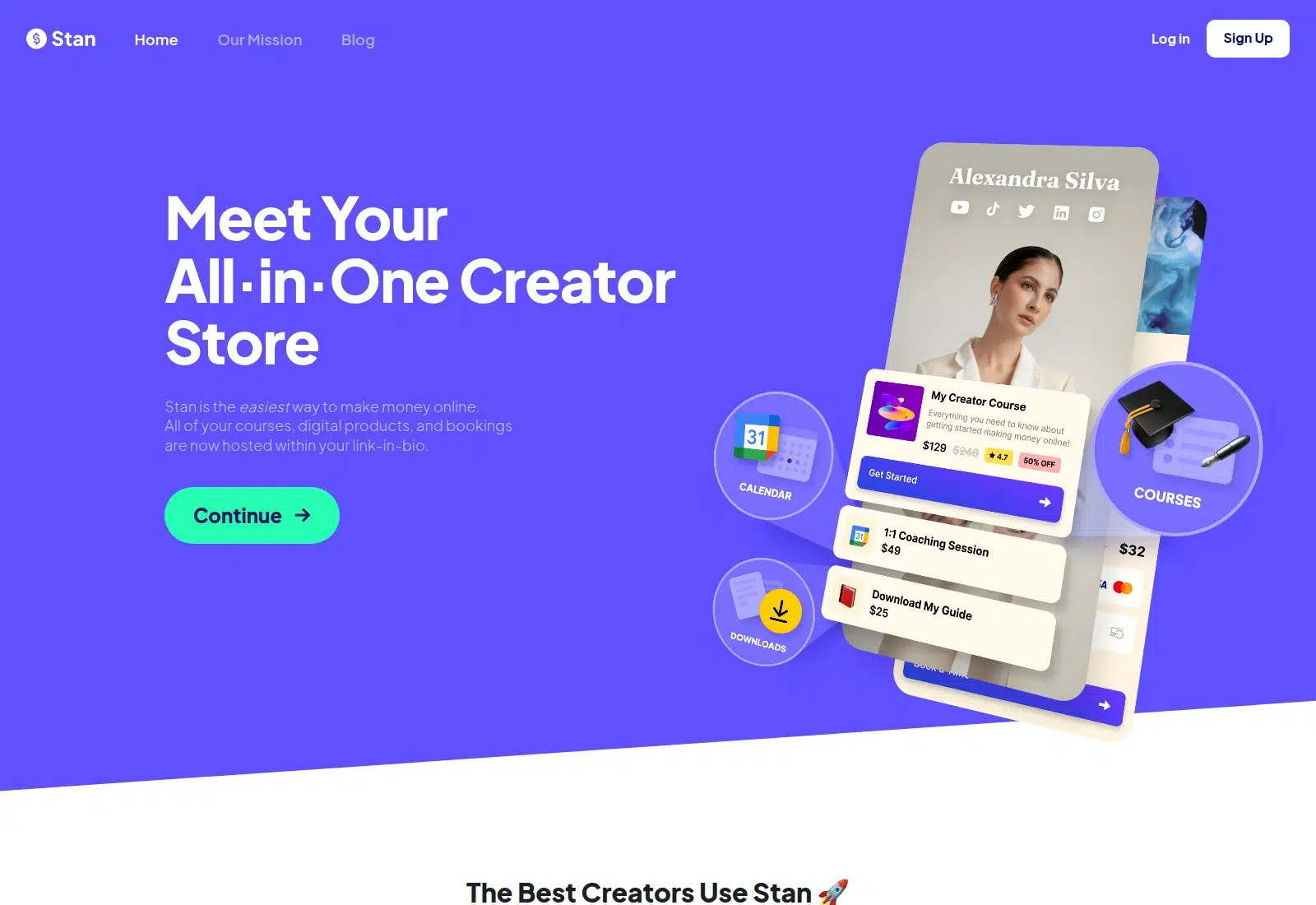
Stan Store’s homepage leads with the promise that made it the default for link-in-bio selling: one storefront, every offer, no transaction fees. Full-screen capture: stan.store, August 2026.
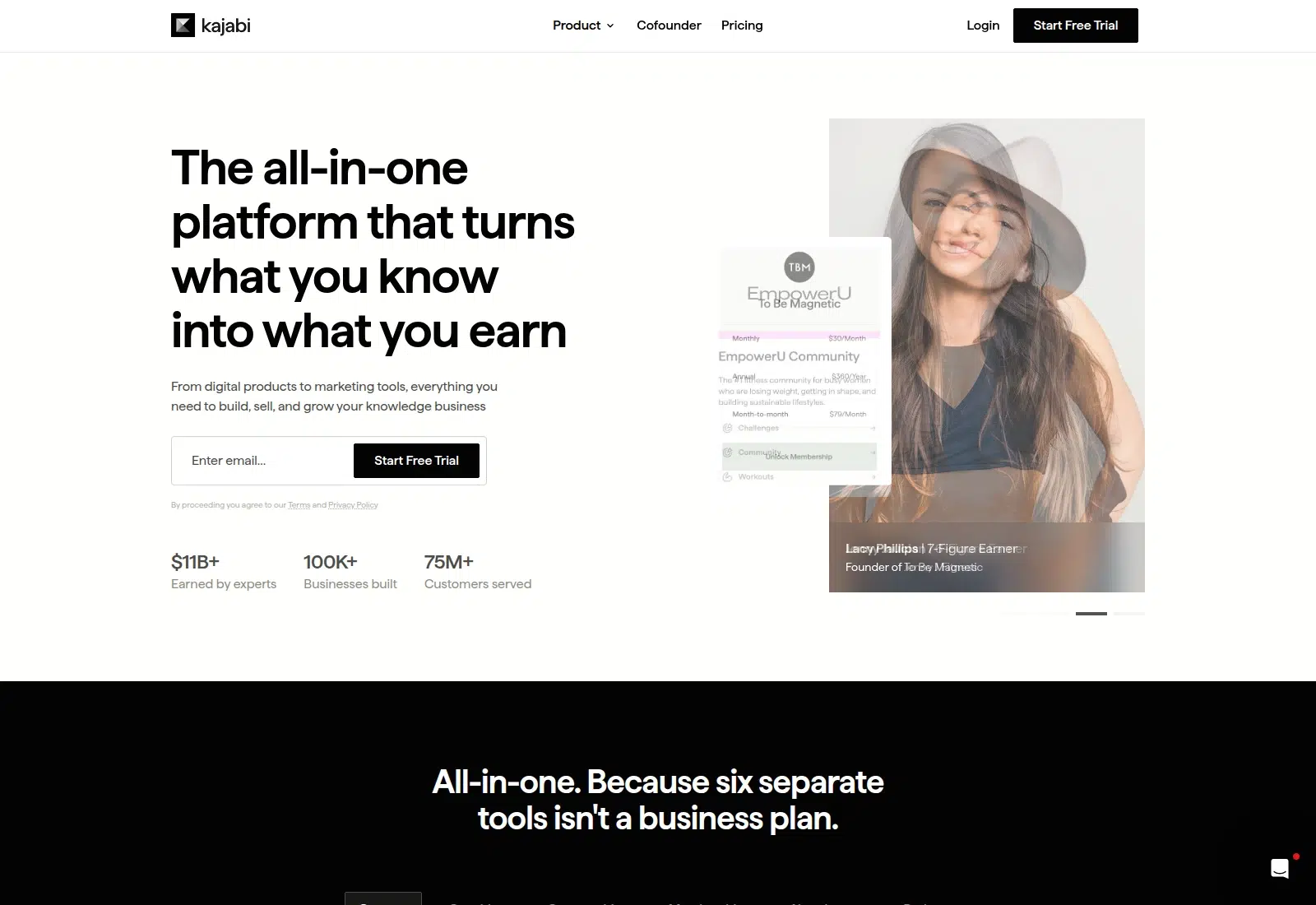
Kajabi’s homepage sells the full stack: websites, courses, email, and funnels under one roof. Full-screen capture: kajabi.com, August 2026.
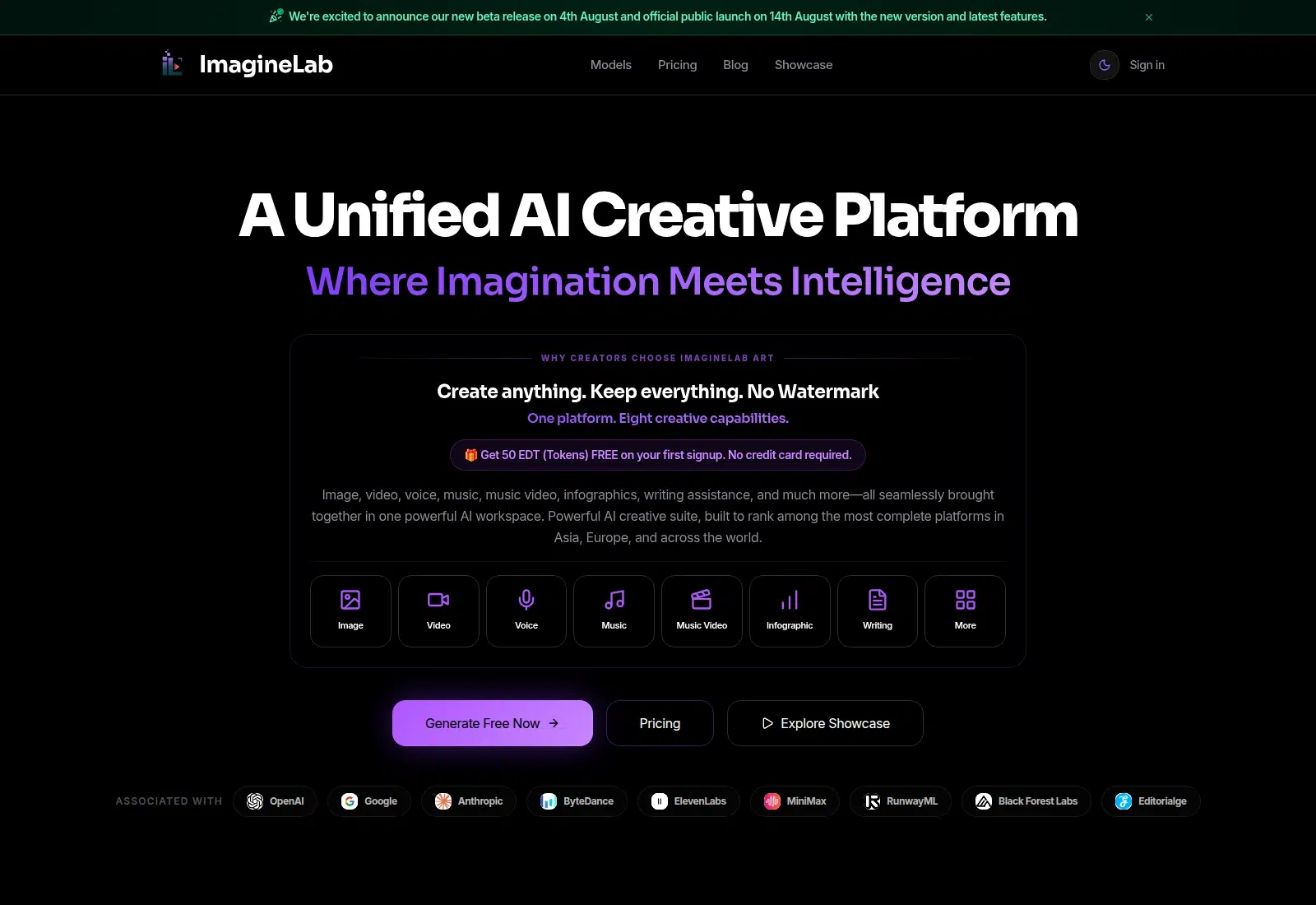
ImagineLab takes the same consolidation promise to the creation side: video, image, infographic, and voice generation under one AI-powered studio. Full-screen capture: imaginelab.art, August 2026.
The point isn’t which platform wins, and I’ve been wrong before about who’d come out on top. What matters is what they all promise: fewer logins, connected data, and a customer who stays inside one ecosystem from first click to renewal. That’s the clarity creators are switching for.
The spreadsheet test
The decision usually comes down to a spreadsheet, so here’s the one I run with creators who ask whether consolidation is worth it.
| Fragmented stack | Monthly cost | Unified alternative | Monthly cost |
| Link in bio | $5 | Stan Store or similar | $29-99 |
| Email tool | $15 | Included | – |
| Course host | $29 | Included | – |
| Community | $25 | Included | – |
| Payment processing | 3-5% fees | 0% (Stan) | – |
| Scheduling | $12 | Included or dropped | – |
| Total | ~$86 + fees | Total | ~$29-99 |
The monthly numbers are close to a wash at the low end. The real difference is the 40 percent revenue retention gap and the hours saved. One creator with $2,000 in monthly revenue keeps an extra $800 a year from retention alone, before counting the time no longer spent copying subscriber lists between tools.
The checklist that never makes the chart
Based on BehindTheScenes’ work with 1,600 plus creators, the practical rule is to evaluate platforms on whether they consolidate at least four of your current tools. Anything less and you’re adding a subscription, not removing chaos.
Four things matter more than the feature list, though they rarely appear on a comparison chart. Migration decides everything, can you move your existing subscribers, products, and content without a data-loss horror story? The email system runs a close second, because if it’s weak you’re back to two tools on day one. Transaction fees change the math faster than any plan difference, a platform that takes a cut of every sale gets expensive quickly. And support matters more than it should, because solo creators don’t have an IT department, so response time is infrastructure.
I’d also check the exit door. A platform that makes it hard to leave is a platform you’ll eventually resent. Export your data on day one, and keep a copy every quarter.
The compounding year
The consolidation trend has room to run because the underlying economics favor it. US full-time creator jobs grew from about 200,000 in 2020 to 1.5 million, per BehindTheScenes’ analysis, and the top 10 percent of creators average $48,500 a month. Businesses at that scale don’t run on duct tape.
The platforms that win the next phase will be the ones that fold AI into the unified stack rather than bolting it on. Over 90 percent of creators already use AI tools, per ShortsIntel, and the ones who consolidate first get to plug AI into a single connected system instead of eleven disconnected ones. That’s why studios like ImagineLab matter: the creator who consolidates now gets one AI-powered pipeline for making and selling, not separate AI subscriptions for every job. The creator who switches from chaos to clarity this year is also the creator whose AI setup works next year.
Frequently asked questions about unified creator tools
1. Is the creator economy big enough to matter in 2026?
Yes. Forbes values it at $205 billion in 2024 with a 23.3 percent CAGR, projected past $1.35 trillion by 2033. This is a large, fast-growing industry.
2. How many creators are consolidating their tools?
45 percent are actively consolidating, per Circle’s 2026 survey, and the share is growing.
3. How much can a unified platform improve retention?
BehindTheScenes reports 40 percent higher revenue retention for creators on unified infrastructure versus fragmented stacks.
4. Which is better, Stan Store or Kajabi?
It depends on your model. Stan is monetization-first and cheaper, $29 to $99 a month with zero transaction fees. Kajabi is funnel-first, $89 to $499 a month, with heavier website and funnel tools.
5. Do I need to consolidate everything at once?
No. Start with the four tools that take the most manual work, and evaluate replacements on whether they consolidate at least four of your current tools.