Thinking about a master’s degree in 2026 often feels like a high-stakes gamble. You are likely wondering if the late nights and tuition bills will actually result in a better job or a bigger paycheck. With grad school costs continuing to climb, it is clear that not every degree offers the same return on investment.
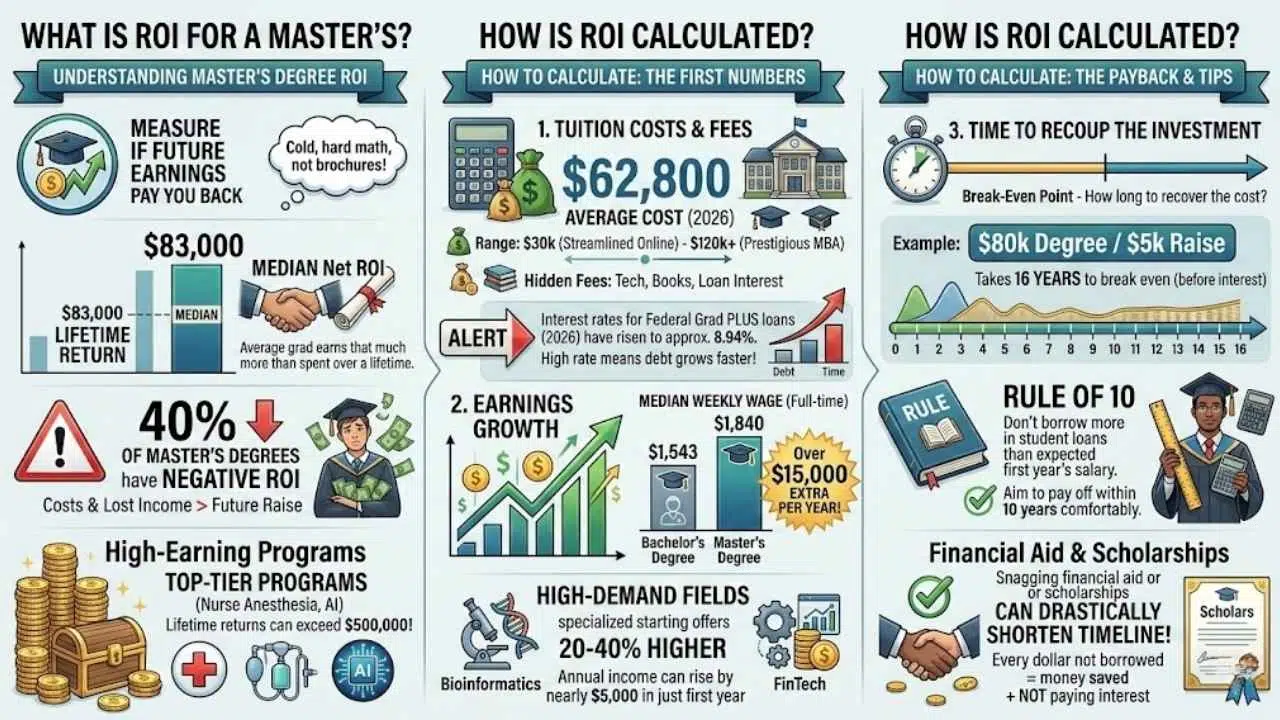
Here is a number that might surprise you: on average, workers with ROI of a master’s degree earn about $1,840 per week, compared to $1,543 for those with just a bachelor’s. That is a significant bump, but it does not tell the whole story.
The numbers have been carefully analyzed to help determine whether this path is the right choice. A clear breakdown of the real costs, the hidden financial traps, and the specific degrees that truly deliver value will provide the full picture.
What Is ROI for a Master’s Degree?
ROI, or return on investment, is simply a way to measure if the money and time you put into a degree will pay you back in future earnings. It helps you look past the fancy brochures to see the cold, hard math.
In the world of higher education, the median net ROI for a master’s degree sits at approximately $83,000. This means that over a lifetime, the average graduate earns that much more than they spent on the degree, after accounting for all costs.
However, that average hides a massive range of outcomes. For instance, dat a from the Foundation for Research on Equal Opportunity (FREOPP) reveals a startling fact: about 40 percent of master’s degrees actually have a negative ROI. This happens when the cost of the program, combined with the income you lose while studying, outweighs any future salary increase.
On the flip side, the right program can be a goldmine. Graduates from top-tier nurse anesthesia or artificial intelligence programs often see lifetime returns exceeding $500,000. Your goal is to be in that high-earning group, not the 40 percent who lose money.
How is ROI Calculated for a Master’s Degree?
Think of ROI as your personal financial scoreboard. To calculate it accurately, you need to look at three specific numbers: what you pay upfront, how much more you earn later, and how long it takes to break even.
Tuition costs and fees
The “sticker price” of a master’s degree can be shocking. In 2026, the average cost for a master’s degree in the U.S. hovers around $62,800, but the range is enormous. You might find a streamlined online program for $30,000 or a prestigious MBA that sets you back over $120,000.
Smart students look beyond just tuition. You must also factor in hidden fees like technology charges, books, and the interest on your loans. Speaking of loans, this is a critical detail for 2026:
“Interest rates for Federal Grad PLUS loans have risen to approximately 8.94%. This high rate means your debt grows much faster than it did a decade ago, making your initial borrowing amount even more important to control.”
High fees often force students to rely on financial aid. While the median net ROI is $83,000, keep in mind that expensive private loans can eat into that profit quickly. Always weigh the total cost of borrowing against your expected first-year salary.
Earnings growth after graduation
The main reason to go back to school is the paycheck boost. According to the Bureau of Labor Statistics (BLS), full-time workers with a master’s degree earn a median weekly wage of $1,840, while those with a bachelor’s earn $1,543. That difference adds up to over $15,000 extra per year.
In high-demand fields, the jump is even sharper. A specialized master’s in fields like Bioinformatics or Financial Technology (FinTech) can lead to starting offers that are 20–40% higher than standard entry-level roles. Top performers in these sectors often see their annual income rise by nearly $5,000 in just their first year of employment.
Time to recoup the investment
This is the “break-even” point. If you spend $80,000 on a degree but only get a $5,000 raise, it will take you 16 years just to pay back the principal—and that is without counting interest.
Most experts recommend following the “Rule of 10.” This guideline suggests that you should not borrow more in student loans than you expect to earn in your first year after graduation. If you can stick to this rule, you can typically pay off your debt within ten years while still living comfortably.
Snagging financial aid or scholarships can drastically shorten this timeline. Every dollar you do not borrow is a dollar you do not have to pay interest on later.
Key Factors That Influence ROI in 2026
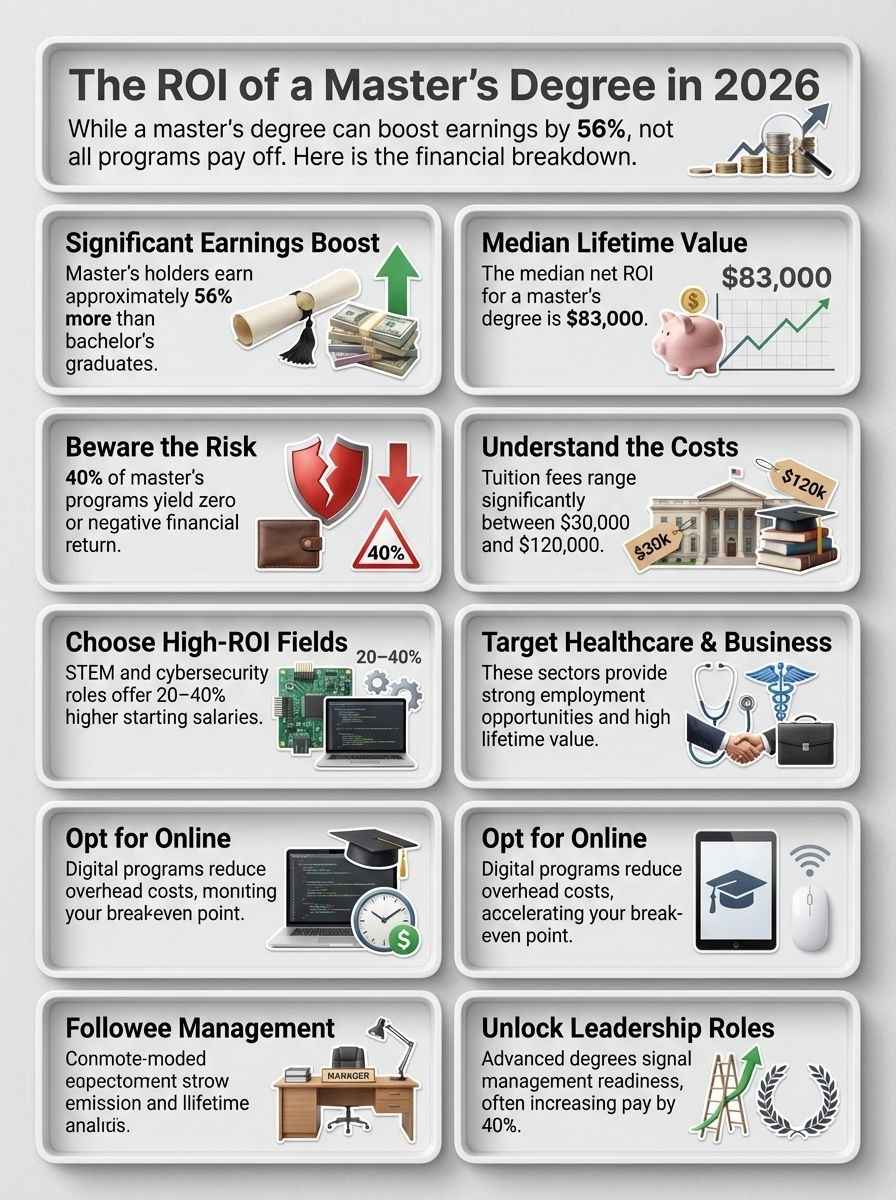
Your degree’s value depends heavily on three main levers. Pulling the right ones can mean the difference between retiring early and paying off debt forever.
Field of study and industry demand
Your major is the single biggest predictor of financial success. STEM degrees continue to dominate the ROI charts. For example, a master’s in Computer Science or Engineering offers high financial returns because industries are desperate for these skills.
Here is how different fields stack up in the current market:
| Field of Study | Typical ROI Trend | Why It Pays Off |
|---|---|---|
| Computer Science / AI | High (often $500k+) | Massive demand for machine learning expertise. |
| Nursing (CRNA/NP) | High (often $500k+) | Critical shortage of advanced healthcare providers. |
| Arts & Humanities | Low to Negative | Salary bumps rarely cover the high cost of tuition. |
| MBA (Top 50 Schools) | High | Access to elite networks and high-paying consulting roles. |
Jobs in tech, data analysis, and advanced healthcare remain hot tickets for career advancement. Graduates holding these degrees often earn nearly $5,000 more in their first year than those without them. Conversely, about 40 percent of programs—mostly in low-demand fields—provide no net financial gain at all.
Program format: Online vs On-campus
The format you choose changes the math completely. Online programs have become a cheat code for high ROI because they often cost a fraction of the price. A perfect example is Georgia Tech’s OMSCS, a fully online master’s in computer science that costs less than $7,000 total. Compare that to a $60,000 on-campus version, and the value is undeniable.
Online options allow you to keep working full-time, meaning you do not lose two years of salary (the “opportunity cost”) while you study. This preserves your income advantage and keeps your debt low.
On-campus study still has perks, like face-to-face networking and access to physical labs. If you are pivoting to a completely new career where you need intense mentorship, the extra cost might be worth it. But for many busy workers, online degree programs offer the same labor market value with far less financial risk.
Geographic location and job market trends
Where you live determines what your degree is worth. A master’s in Public Policy might be incredibly valuable in Washington, D.C., but less so in a small rural town. Similarly, tech degrees pay the highest dividends in hubs like Seattle, Austin, or San Francisco.
You should also check the Cost of Living (COL) in your target city. Earning $100,000 in New York City feels very different than earning $100,000 in Cleveland. Tools like NerdWallet’s Cost of Living Calculator can help you see how far your new salary will actually go.
The labor market shifts quickly. Demand for healthcare and management professionals continues to climb in many states as of 2026. Choosing a school near these industry clusters can boost your job prospects significantly.
Benefits of Earning a Master’s Degree
Beyond the raw numbers, a master’s degree can unlock intangible benefits. It can give you a sense of authority, expand your professional circle, and qualify you for roles that are simply off-limits to bachelor’s degree holders.
Increased earning potential
We know that graduates with a higher education degree generally enjoy bigger paychecks. The data shows a clear weekly earnings gap: $1,840 for master’s holders versus $1,543 for bachelor’s holders.
In some niche fields, this gap widens into a canyon. Top-tier cybersecurity grads often see starting salaries 20 to 40 percent higher than their peers. The median net return on investment of $83,000 is just the middle ground; the top 10 percent of earners often see their lifetime wealth increase by millions.
Employers view your degree as a signal. It tells them you have specialized knowledge and the grit to complete a rigorous program. This signal is often what justifies that higher starting offer.
Improved job security
A master’s degree acts like a shield during tough economic times. During downturns, workers with advanced degrees are statistically less likely to be laid off. In fact, the unemployment rate for master’s degree holders is typically very low, often hovering around 2.0%.
Companies invest more in highly skilled employees and are reluctant to let them go. A person holding a graduate degree in a core function like Supply Chain Management or Healthcare Administration becomes essential to the business.
Statistics back this up consistently. Those who have completed higher education earn more and stay employed longer. This stability is a key part of the “return” in ROI.
Access to leadership positions
Many senior roles have a “glass ceiling” that you cannot break through without a master’s degree. Big companies and healthcare systems often require an MBA or MHA for director-level positions. They look for candidates who have proven they can think strategically.
Graduates with these advanced degrees earn about 56% more than their peers over the course of a career, largely because they can ascend the corporate ladder faster. Many top-tier programs include specific training in negotiation and team management, skills that are critical for leadership positions.
If you want to move from doing the work to managing the team, this degree is often the fastest key to that door.
Opportunities for career change
Switching fields feels risky, but a master’s degree can be your safety net. Many graduates use their education investment to pivot entirely, leaving stagnant industries behind for booming ones like Green Energy or Data Science.
In 2026, many programs are designed specifically for “career switchers” and do not require a background in the field. These “bridge programs” allow you to move from a liberal arts background into a technical role.
Labor market data supports this move. High-value programs in STEM or business offer students the chance to double their earnings after graduation. A well-chosen degree acts as a bridge, carrying you from a job you tolerate to a career you love.
Challenges to Consider
It is not all good news. The path to a master’s degree has potholes that can wreck your finances if you are not careful. You need to go in with your eyes open.
High upfront costs
Paying for graduate programs requires a serious strategy. Tuition and fees can easily top $60,000, and unlike undergraduate loans, Grad PLUS loans have higher interest rates (currently around 8.94%) and origination fees.
You also face the “opportunity cost”—the money you do not earn while you are in school. If you quit a $50,000 job to study for two years, your degree actually costs you the tuition plus $100,000 in lost wages.
However, there is a workaround. Many companies offer tuition reimbursement benefits. The IRS allows employers to give you up to $5,250 per year tax-free for education. If your employer offers this, you are leaving free money on the table by not using it.
Potential student loan debt
Student loan debt is the anchor that drags down your ROI. Many students finish school with a shiny new diploma and a $80,000 debt balance. Since 40 percent of master’s programs have no net financial value, many graduates find themselves struggling to make payments.
This risk is why the “Rule of 10” is so important. If you expect to earn $70,000, do not borrow more than $70,000. For lower-paying fields like social work or education, you must prioritize programs that offer assistantships or stipends that cover your tuition.
Careful review of tuition costs against potential median earnings helps keep student debt manageable. Financial aid or scholarships can lower your educational investment, so treat the scholarship search like a part-time job.
Variability in ROI across programs
The gap between the best and worst degrees is massive. While the median net return sits at $83,000, a Master of Fine Arts (MFA) might leave you $40,000 in the hole, while a Master of Science in Nursing (MSN) could net you over $500,000.
You simply cannot rely on general averages. You must investigate the specific outcomes for your program. Ask the admissions office for their “First Destination Report,” which shows exactly where their graduates work and how much they earn.
Choosing wisely opens doors to higher earnings; picking poorly is an expensive mistake. Your field of study and the program’s reputation are the two factors that will decide your fate.
Top Master’s Degrees with High ROI in 2026
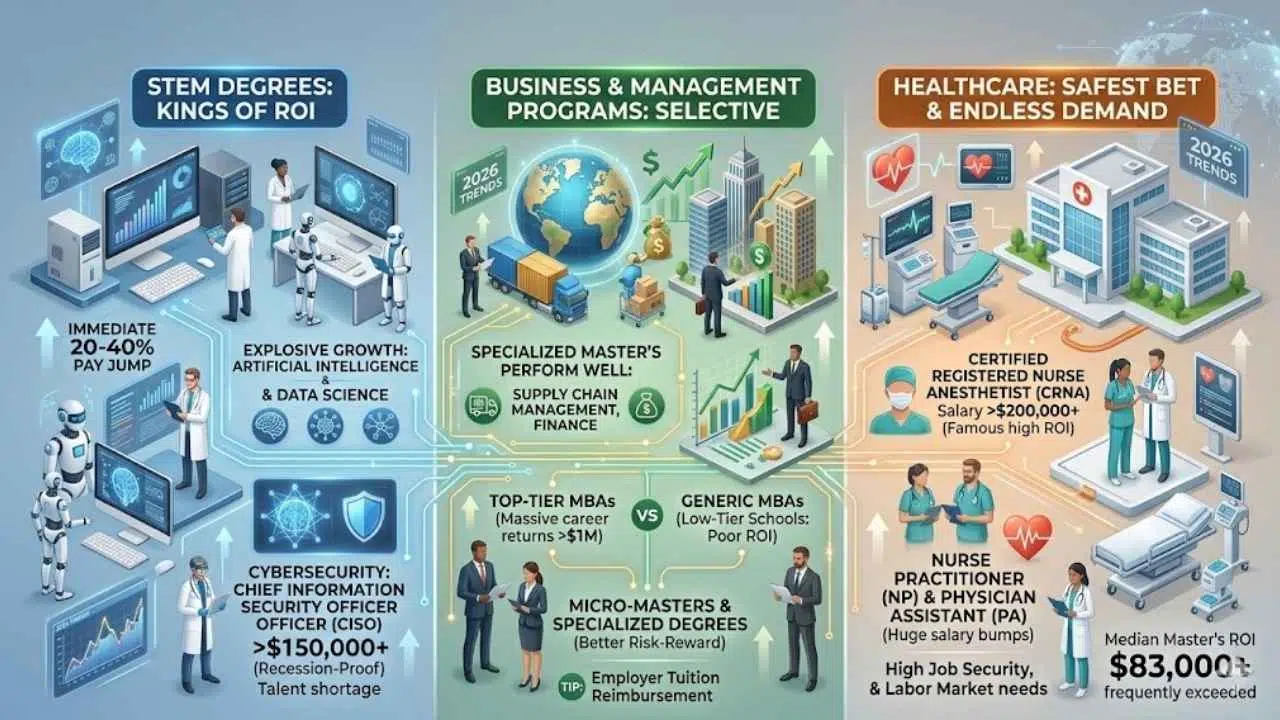
If you want to maximize your odds of a great return, these are the fields where the math works in your favor. These degrees consistently turn tuition dollars into higher paychecks.
STEM (Science, Technology, Engineering, and Mathematics) degrees
STEM degrees remain the kings of ROI in 2026. Graduates with a master’s in these fields often see pay jumps of 20 to 40 percent immediately. Specifically, degrees in Artificial Intelligence and Data Science are seeing explosive growth as companies race to adopt new tech.
Cybersecurity is another standout. With cyber threats growing, a Chief Information Security Officer (CISO) often needs a master’s degree and can command a salary well over $150,000. These jobs are recession-proof and exist in every major city.
Many STEM master’s degrees hit far above the net ROI yardstick of $83,000. Labor market trends push these numbers higher because the talent shortage is real. For anyone aiming for stable income advantage, this path stands tall among graduate degree programs.
Business and management programs
Business programs are a mixed bag, so you have to be selective. A generic MBA from a low-tier school often has a poor ROI. However, specialized master’s degrees in Supply Chain Management or Finance are performing exceptionally well.
Top-tier MBA graduates still see massive returns, often breaking into the million-dollar mark over a career. But for most people, the “micro-masters” or specialized business degrees offer a better risk-to-reward ratio.
Financial aid plays a critical role here. Reducing upfront tuition boosts long-term returns. If you can get your employer to pay for your MBA using that $5,250 annual IRS benefit, your ROI skyrockets.
Healthcare is arguably the safest bet for a master’s degree. The demand for providers is endless. A Certified Registered Nurse Anesthetist (CRNA) degree is famous for its high ROI, with median salaries often exceeding $200,000.
Graduates with credentials like Nurse Practitioner (NP) or Physician Assistant (PA) also see huge salary bumps compared to their bachelor’s-level peers. The median ROI of a master’s sits at $83,000, but these medical specialties frequently blow past that mark.
The labor market keeps craving skilled professionals for hospitals and clinics. With the right field, earning potential rises while job security strengthens—a perfect mix for 2026.
Is a Master’s Degree Worth It in 2026?
A master’s degree can still be a powerful career accelerator in 2026, but it is no longer a guaranteed golden ticket. Graduates generally earn a weekly premium of about $300 over bachelor’s holders, which adds up to significant wealth over time.
However, the data is clear: the field matters more than the degree itself. Programs in STEM, healthcare, and specialized business tracks offer huge returns, while others may leave you with debt you cannot pay. The median return on investment sits around $83,000, but you want to be an outlier on the high side.
Location and format are your secret weapons. Choosing a high-quality online program like Georgia Tech’s or leveraging employer tuition reimbursement can drastically lower your costs. Upfront costs feel steep, but smart planning can stretch your long-term gains.
Master’s study gives clear income advantages if you choose a degree that the labor market actually needs. Do the math, check the starting salaries, and make your move with confidence.
Final Thoughts
We have covered how a master’s degree can lead to better pay, more job options, and faster career growth. The return on investment depends entirely on your strategy: the field you choose, the cost of the program, and how you fund it.
If you keep tuition low by finding an employer to sponsor you or choosing an affordable online option, the payoff comes much quicker. Some degrees will boost your income right away, while others might become a financial burden.
For those hungry for facts before making this big leap, resources like the BLS website or college salary reports can shed light on current trends. Taking smart steps now could turn today’s grind into tomorrow’s paycheck boost, so why not stack the odds in your favor?