
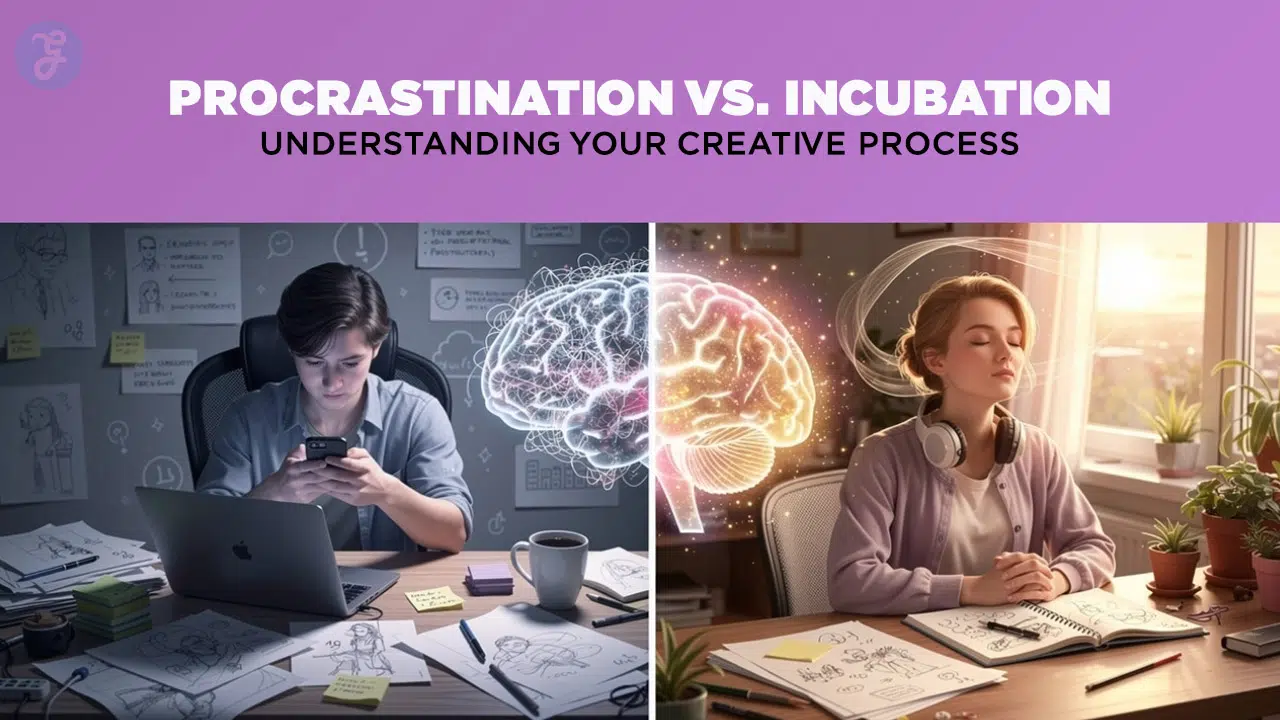
You sit down to get your work done, but your mind wanders. Your phone buzzes, or suddenly you want a snack. You tell yourself you’re just giving your brain a break, but the task sits there, waiting. Many people struggle with knowing if they are truly stuck in procrastination or letting their ideas grow quietly through incubation.
Here’s an interesting fact: Procrastination pops up before the hard work starts and often feels stressful, while incubation comes after action and can feel inspiring. Explore the difference between putting things off and helping new ideas bloom. Understanding the subtle battle of Procrastination Vs Incubation is the secret to mastering your creative workflow. Keep reading to see which one will boost your creativity next time you hit a wall.
What is Procrastination?
Procrastination sneaks in when you keep putting off a task, even though you know it needs to get done. Sometimes, your best ideas hide away while you scroll or clean, just waiting for their turn.
Definition and Common Traits
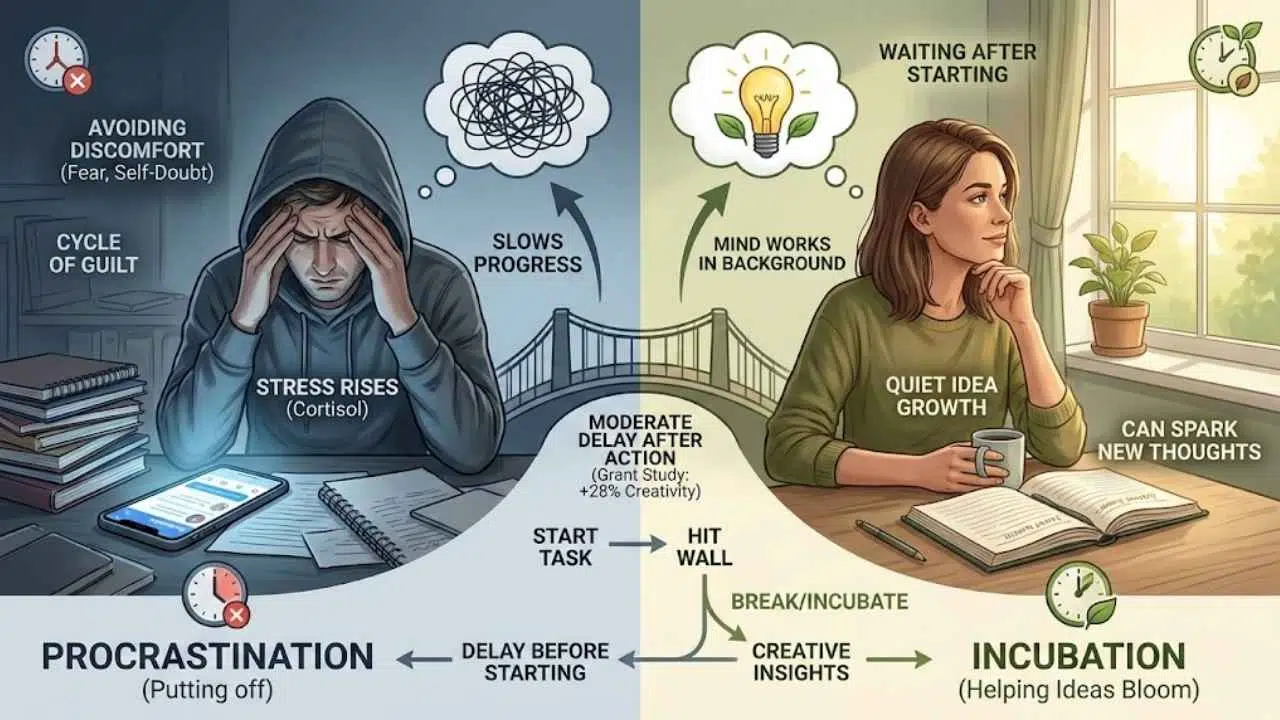
People often choose to put off difficult work. This is called procrastination, and it shows up as avoiding a task or delaying it on purpose, even though you know you may hurt your progress.
Research from experts like Dr. Tim Pychyl at Carleton University shows that this isn’t a time management issue. It is an emotional regulation issue. You aren’t avoiding the work; you are avoiding the bad feelings the work gives you, like fear or self-doubt.
True procrastination means the person knows the delay will bring problems but still does it anyway. This leads to a cycle of guilt that actually makes it harder to start later.
On the other hand, some creative minds use waiting after hard work to let ideas grow. This pattern links to incubation in creativity. People sit with their ideas in this stage without force or pressure; the mind works quietly in the background while they do something else.
The process of procrastinating can sometimes spark new thoughts if someone feels inspired and motivated deep down inside them. Both habits shape how people manage time and move through mental blocks that slow idea generation and flow state.
How Procrastination Impacts Creativity
Procrastination slows progress and can block new ideas from surfacing. Many creative tasks stall at the starting line because of fear, self-doubt, or confusion. Instead of moving forward, workers may avoid risk and cling to comfort zones.
Stress rises as deadlines approach, making it harder to think clearly or spark inspiration. When your brain is flooded with cortisol from stress, it shuts down the playful, associative thinking needed for innovation.
However, recent data suggests a nuance. A study by Adam Grant, a professor at the Wharton School, found that “moderate procrastination” can actually boost creativity by 28%. The key is that the work must be started first.
If you delay before you even know the problem, that is just stalling. But if you start, hit a wall, and then delay, your brain continues to process the problem. Procrastination often brings frustration instead of joy in the creative process.
Confidence takes a hit when someone delays work on purpose yet knows they should act. Tasks pile up while uncertainty clouds decision-making and problem-solving skills suffer too.
Creative blocks turn into bigger obstacles without action and reflection. While some knowledge absorption happens during delay periods, actual growth needs more than just avoidance. It thrives when paired with intent and practice within the creative process itself.
What is Incubation?
Incubation is like putting your ideas on the back burner, letting them simmer for a while. Sometimes, your best thoughts show up when you stop forcing answers and let your mind wander.
Definition and Purpose in the Creative Process
Taking a break to let your mind wander is not always wasted time. After you work hard on a task, your brain still keeps going in the background, even if you do not notice it.
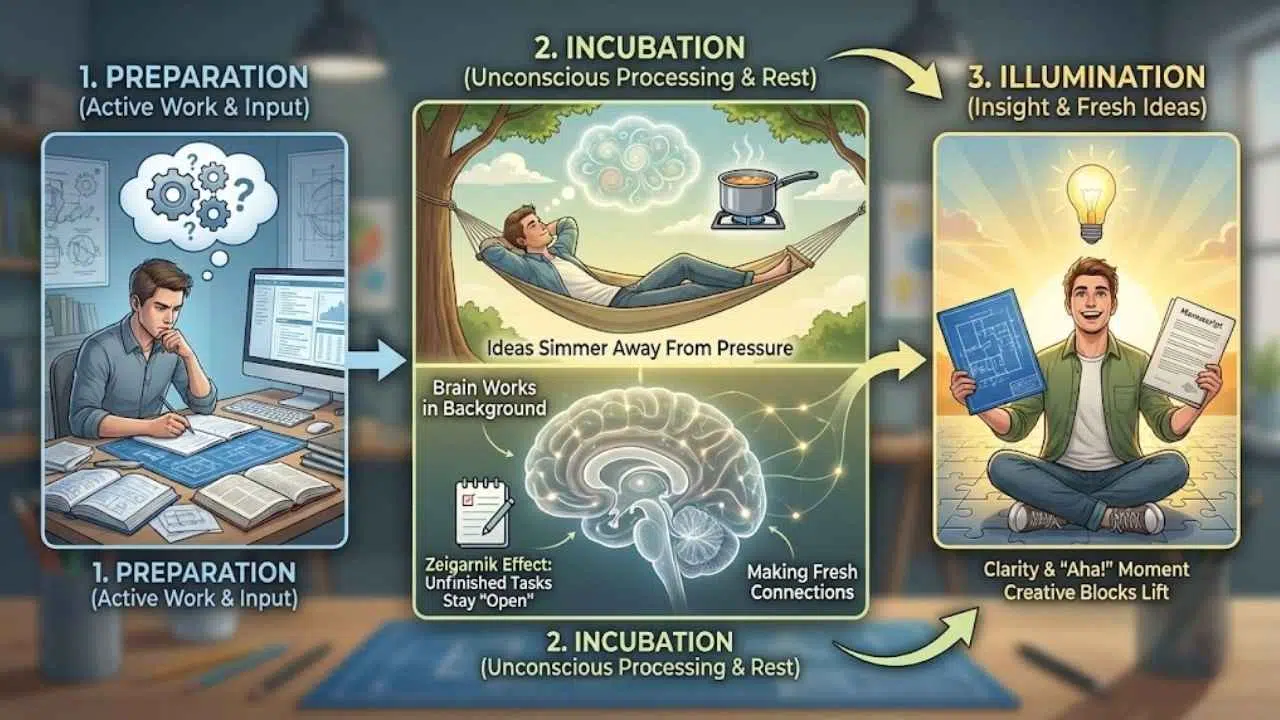
This step is called incubation and plays a big part in creativity. It was first defined by social psychologist Graham Wallas in 1926 as one of the four essential stages of creativity: Preparation, Incubation, Illumination, and Verification.
Writers often need this downtime for story seeds to grow into strong ideas with real potential. Without the “Preparation” phase of hard work, incubation is just daydreaming.
Many great thinkers use incubation to solve tricky problems or gain inspiration for new projects. During this period, thoughts simmer and come together without pressure or fear slowing things down.
That quiet pause helps foster innovative ideas and allows knowledge absorption at its finest. Creativity grows best while the mind chews on pieces of information away from frustration or creative blocks, making space for clarity and fresh insight later on.
The Role of Unconscious Thought in Incubation
Unconscious thought works behind the scenes during incubation. Ideas sit quietly, waiting for your focus to shift away, often after some hard work. Creative processes kick in while you do other things like showering or walking the dog.
This phenomenon is often linked to the “Zeigarnik Effect,” named after psychologist Bluma Zeigarnik. Her research found that people remember unfinished tasks better than completed ones. Your brain keeps the “tab open” in the background, scanning for solutions while you do the dishes.
Your brain keeps working on problems under the surface, looking for fresh connections and patterns without stress or pressure. Research shows that all creativity needs this kind of mental break to grow new ideas.
Writers call it letting a story seed sprout in its own time. Incubation lets your mind rest so thoughts can connect on their own, far from fear and self-doubt common in procrastination.
Unlike getting stuck due to avoidance, creative blocks lift as fresh inspiration bubbles up while you wait productively. This silent reflection boosts motivation and makes room for knowledge absorption that fuels problem-solving and decision-making down the road.
Key Differences Between Procrastination and Incubation
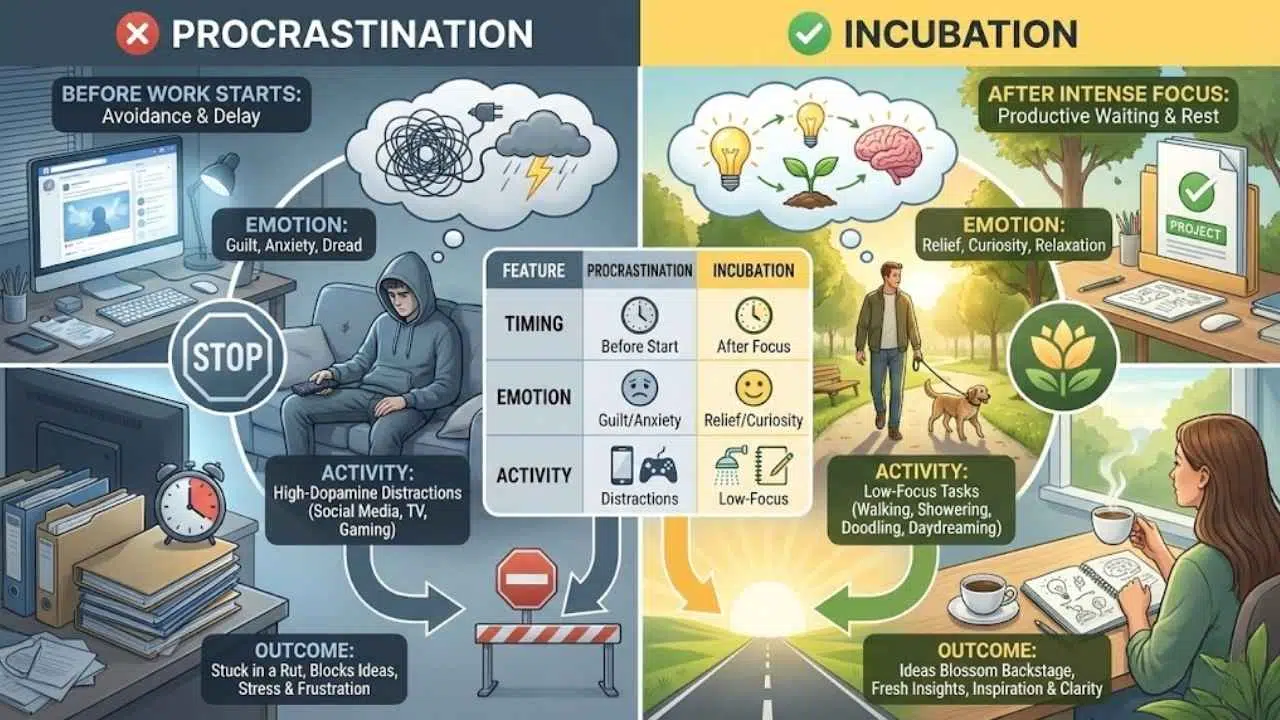
One keeps you stuck in a rut, while the other lets your thoughts blossom backstage. It’s like confusing a traffic jam for a rest stop. Both are pauses, but only one gets you ready to roll again.
Procrastination as Avoidance vs. Incubation as Productive Waiting
Procrastination slams the brakes on creativity. People dodge tasks, let fear or self-doubt creep in, and often feel stuck or overwhelmed. This kind of delay happens before real work starts.
Serious procrastination involves choosing to avoid important jobs even when you know it causes stress and leads to missed deadlines. It is an active refusal to engage with the problem.
Incubation takes a different route; it’s like letting your mind wander after hard thinking. Ideas bloom quietly in the background as you do something else, like walking your dog or sipping coffee.
Writers use incubation to nurture story seeds into full creative blooms. Productive waiting allows fresh ideas and solutions to bubble up from deep thinking without forced effort. Sometimes inspiration strikes during these breaks!
Creativity thrives here because the pause feels exciting and wholesome, not heavy with guilt or worry. To make this clear, look at the comparison below:
| Feature | Procrastination | Incubation |
|---|---|---|
| Timing | Happens before you start the work. | Happens after a period of intense focus. |
| Emotion | Guilt, anxiety, and dread. | Relief, curiosity, and relaxation. |
| Activity | High-dopamine distractions (social media, TV). | Low-focus tasks (walking, showering, doodling). |
Emotional States: Frustration vs. Inspiration
Stuck in procrastination, many feel self-doubt and fear. Frustration grows as tasks keep piling up, fueling stress instead of creativity. People avoid risks and worry about failing or not meeting expectations.
This emotional state drags motivation down and blocks new ideas from forming. You feel drained before you have even begun.
Incubation lights a spark inside the creative process. After hard work, inspiration often visits quietly. Thoughts connect in unexpected ways while you rest or do something else; writers watch story seeds grow during this time.
Excitement fills the mind as ideas develop without force. Unlike frustration, this phase feels wholesome and nurturing, opening doors for clarity and focus to blossom naturally.
The Benefits of Incubation in Creativity
Sometimes, waiting gives your mind the space to spark new ideas. Fresh thoughts often arrive when you least expect them, like a sudden lightbulb turning on in a dark room.
Fostering Innovative Ideas
Incubation acts like rich soil for new ideas. After a burst of hard work, the mind keeps turning over problems on its own. Creative people, like writers and artists, often describe this time as nurturing or even exciting.
Researchers have found that taking intentional breaks gives your brain space to connect random thoughts in surprising ways. A 2012 study published in Psychological Science found that engaging in an undemanding task during a break led to a significant improvement in creative problem-solving compared to no break or a demanding break.
Instead of rushing results, trust that giving ideas room to breathe helps them grow stronger roots. Great inventions rarely pop up out of nowhere; they come after quiet moments where the subconscious solves puzzles behind the curtain.
Even science backs this up: all creativity needs some amount of incubation time before ideas bloom fully into stories, paintings, or solutions nobody saw coming.
Allowing Subconscious Problem-Solving
Ideas often stew beneath the surface after some hard work. Famous inventors like Nikola Tesla and writers such as Maya Angelou have shared stories of breakthroughs that bubbled up while walking, showering, or even napping.
The famous crime writer Agatha Christie is a perfect example. She once said, “The best time for planning a book is while you’re doing the dishes.” The rote physical task kept her body busy while her mind solved murder mysteries.
Creative blocks sometimes break apart quietly in the background, away from conscious effort. The mind sorts facts and connects patterns during this downtime.
Subconscious problem-solving arrives while you wash dishes or stroll outside; it does not knock on your door with a big announcement. Studies show all creativity needs time to ripen below awareness before new solutions pop up.
This silent inner work often leads to flashes of inspiration at odd moments, giving your tasks fresh energy without extra stress or self-doubt crowding in.
Enhancing Clarity and Focus
Incubation gives your brain a quiet space to process tough problems. After hard work, you step away from the task, and your mind keeps working in the background. Creative people like writers see this as a key part of their creative process. “Your unconscious mind can process vast amounts of data that your conscious mind struggles with. Stepping away lets the heavy lifter take over.”
Letting story ideas rest allows small details to come together naturally. Taking a break is not wasted time. During incubation, new insights can appear without warning, making tasks seem clearer than before.
Some studies and experts say all creativity needs this pause for clarity and focus to bloom. You feel more inspired instead of anxious or doubtful, which helps you find solutions with less effort and stress.
The Risks of Procrastination in Creativity
Putting things off can sap your drive and make ideas stall out in your mind. Too much delay chips away at your spark, leaving projects gathering dust instead of taking flight.
Stalling Progress and Increasing Stress
Procrastination stalls progress, leaving tasks half-done or not started at all. Deadlines get closer, your ideas stall out, and pressure builds like a kettle about to whistle.
Feelings of self-doubt creep in while motivation drops; it can feel like standing in quicksand rather than running on a track. Research shows that true procrastination is a voluntary delay people know will hurt their outcomes, yet they still do it.
Many creators become frozen by fear of failure or confusion about the next step. Instead of inspiration bubbling up during incubation, stress grows stronger with every minute lost to avoidance.
Frustration takes over as you watch time slip away without making any real headway on your creative process or problem-solving goals. This creates “decision fatigue,” where the mere act of deciding to start becomes exhausting.
Undermining Confidence and Motivation
Self-doubt grows with every task delay. The longer someone puts off a creative job, the more fear and confusion creep in. Research shows that true procrastination requires a voluntary delay, even if it harms progress.
This kind of waiting chips away at motivation like water dripping on stone. Motivation starts strong but weakens as unfinished work piles up.
Creative blocks feel bigger, sometimes making people think they have lost their spark or talent for good. Stalling also leads to stress and worry about missed deadlines or wasted opportunities, which only feeds the cycle of avoidance and frustration in the creative process.
How to Distinguish Between Procrastination and Incubation

Sometimes, your mind is just stretching its legs, taking a stroll through ideas. Other times, it’s hiding under the covers, dodging the task at hand.
Recognizing Emotional Cues
Feelings can reveal if you are procrastinating or letting your ideas grow. Frustration, fear, and self-doubt often tag along with procrastination. You might feel stuck or worry about failing a task.
This emotional fog signals avoidance, not progress. If you find yourself checking your email for the tenth time in an hour, that is anxiety, not incubation.
In contrast, inspiration and excitement bloom during incubation. There is a sense of trust that new ideas will arrive in their own time. Creative blocks start to fade as your brain connects new pieces quietly in the background.
If you sense motivation bubbling up or notice sudden clarity after a break, you may be experiencing healthy incubation instead of delay driven by stress or confusion.
Evaluating Progress and Intent
Track progress by checking what you have done since starting your creative task. If work is piling up and stress levels are rising, it may be procrastination at play.
Notice if self-doubt, confusion, or avoidance creeps in while thinking about the next step. That’s often a red flag for task avoidance instead of letting ideas grow naturally.
On the flip side, incubation feels productive even during downtime. You might jot down a fresh idea after an intentional break or notice how solutions pop into your head without force.
This phase follows effort; it gives your brain space for knowledge absorption and deeper reflection. Ask yourself if you’re stuck out of fear or waiting to see an idea bloom with new inspiration. The answer often reveals your true intent and helps manage time better in any creative process.
Strategies to Transition from Procrastination to Incubation
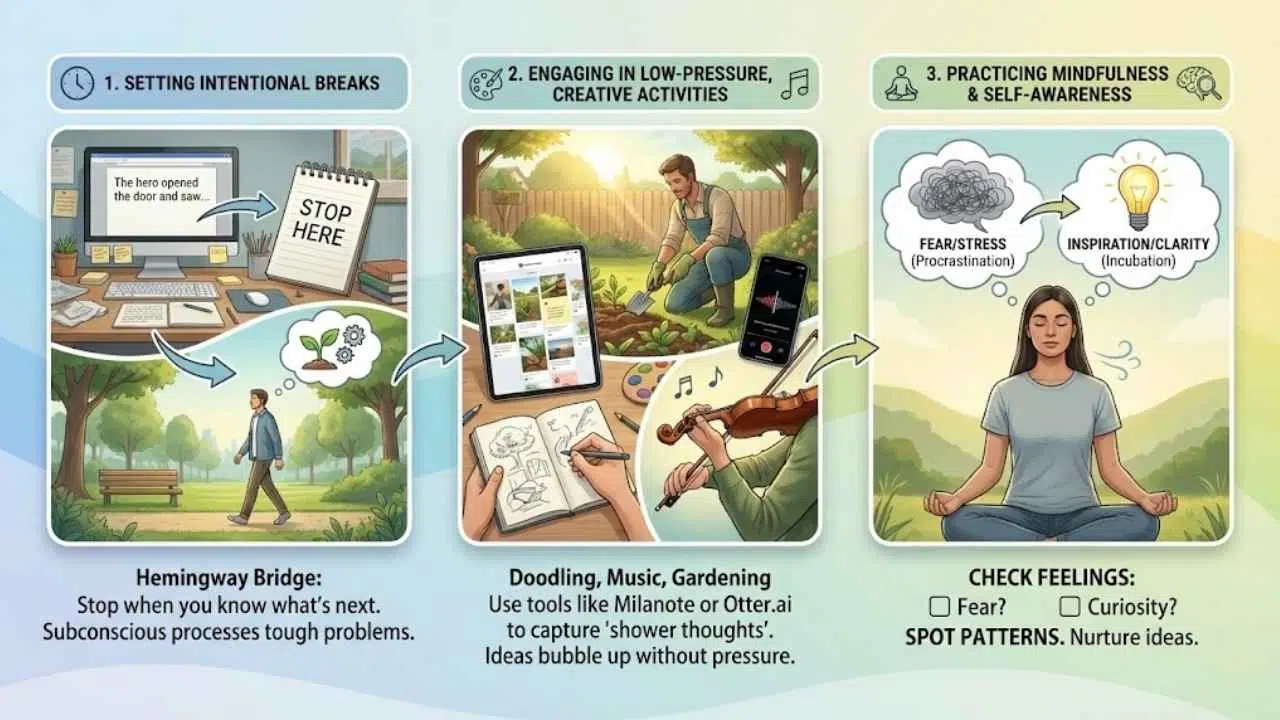
Sometimes the best ideas spark when you pause with purpose, not just out of habit. Curious about switching gears from stalling to creating? Keep reading for simple methods that make space for inspiration.
Setting Intentional Breaks
Short breaks can turn a creative block into a spark of inspiration. Setting aside time for intentional rest helps your subconscious chew on tough problems, letting “story seeds” grow and surprise you later.
Writers and artists often find their best ideas bloom after they step away from the desk, even if only for a few minutes or an hour. A popular method for this is the “Hemingway Bridge,” named after the author Ernest Hemingway.
He would stop writing for the day only when he knew exactly what was going to happen next. By leaving a sentence unfinished, he gave his brain a specific hook to incubate on overnight, making it easy to start again the next morning.
Creative professionals like J.K. Rowling and Steve Jobs have talked about stepping back to let new thoughts take shape. These pauses feel different from procrastination because incubation is exciting, almost wholesome. It is a safe space where frustration gives way to clarity.
Planned breaks allow knowledge absorption, reflection, and idea generation without guilt or self-doubt lurking around every corner. Even five or ten minutes can help you shift from stress toward motivation and focus.
Consider it productive waiting rather than avoidance; the goal is progress without pressure.
Engaging in Low-Pressure, Creative Activities
Painting, doodling, gardening, or playing music allow your mind to wander. Albert Einstein often played the violin during his breaks to help him think through complex physics problems.
Such low-pressure creativity lets ideas bubble up without pressure or fear. Incubation thrives in these moments, helping you tap into inspiration and problem-solving skills.
For modern creatives, digital tools can help capture these moments. Apps like Milanote allow you to create visual boards for your ideas to sit and simmer. Voice note tools like Otter.ai or Cleft let you speak your “shower thoughts” instantly so you don’t lose them.
Rather than forcing results, these playful acts help creative blocks fade. Research shows that moderate procrastination mixed with enjoyable activities can foster innovation when motivation is strong.
Letting yourself explore freely invites new connections and clarity for your next big idea or writing project.
Practicing Mindfulness and Self-Awareness
Pausing to check your feelings can help spot the shift from task avoidance to productive waiting. Self-awareness shines a light on patterns, like feeling stuck in fear or confusion during procrastination.
Mindfulness can steer you through creative blocks, letting inspiration bubble up instead of getting lost in stress or self-doubt. Creative minds use simple breathing exercises, short walks, or a few quiet moments to listen to their thoughts.
Experts say that all creativity needs time for ideas to grow; mindfulness helps nurture those ideas. Even famous creators use these tools. Writers often step away to let story seeds develop into something rich and full of potential.
If you feel energy drop and motivation fade, it might signal procrastination creeping in rather than incubation at work. Mindful reflection helps break the cycle by spotting these cues early and making better choices with your time and focus.
With just ten minutes each day spent checking in with yourself, clarity grows and tasks become bite-sized steps rather than mountains blocking your path forward.
Final Thoughts
Procrastination and incubation may look similar, but they shape your creative process in very different ways. Now you know that putting off work can fuel anxiety, while allowing ideas to grow brings clarity and fresh inspiration.
Simple habits like mindful breaks or playful tasks help shift from being stuck to making progress with ease. These small changes take little effort but bring big rewards for creativity, motivation, and problem-solving skills.
Take a moment to reflect on the last project where stepping away opened your mind; sometimes self-kindness is the best spark for ideas. Give yourself room to pause without guilt and watch how new solutions bubble up when you least expect it!