Have you ever clicked a link and waited so long for the page to load that you just gave up? It happens to all of us. Slow websites drive visitors away, hurt your search rankings, and cut down your sales Site owners everywhere are asking if speed is still the top priority in 2026. The answer is a bit more complex than a simple yes or no. But the stakes are high.
One fact stands out clearly. A single second delay in page load time can drop conversions by seven percent. That is money lost and users gone. I am going to show you what really matters for site speed now. We will look at how Core Web Vitals set new rules and smart ways you can keep your website fast.
Stay with us. Your site’s future might depend on it!
What Are Core Web Vitals?
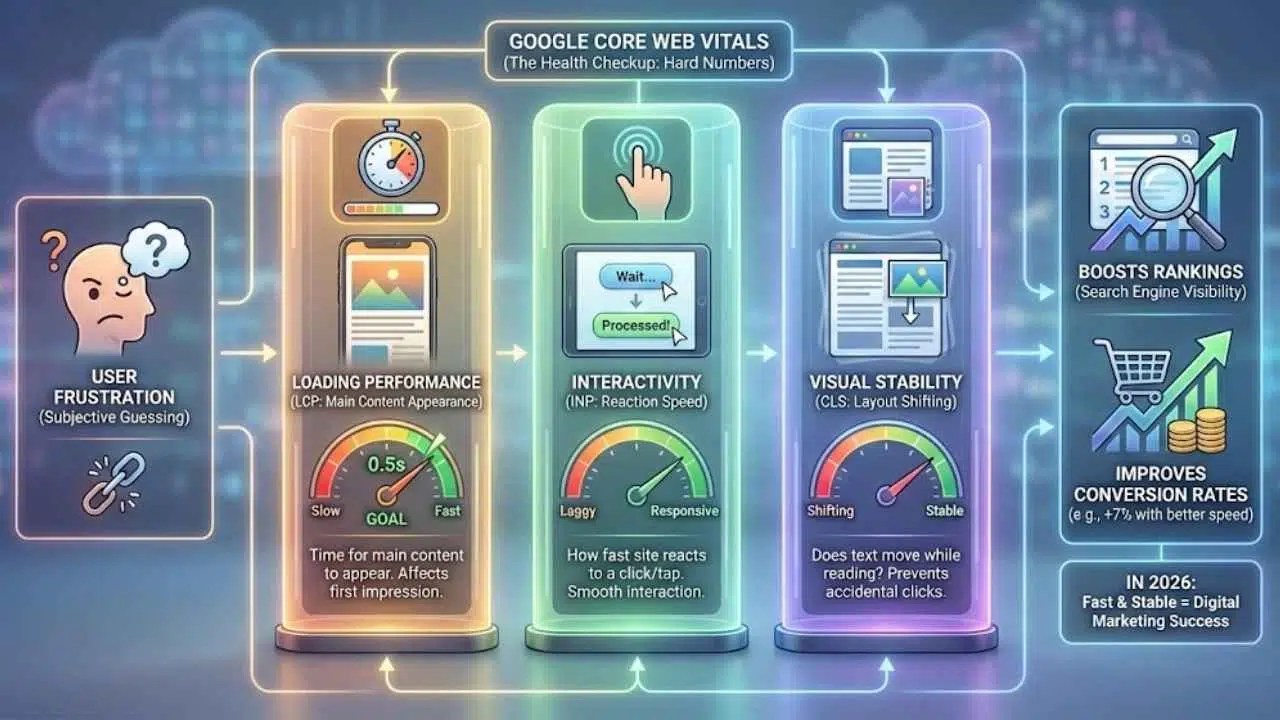
Core Web Vitals are three key website metrics that Google uses to check site performance and user experience. Think of them as a health checkup for your website. They measure how fast it loads, how quickly it reacts to clicks, and how stable the layout is while you browse.
Google introduced these metrics to quantify something that used to be subjective: user frustration. Instead of just guessing if a site feels slow, we now have hard numbers to track.
Having a fast website helps keep users happy. It also boosts rankings on search engines like Google and improves conversion rates. Even in 2026, speed matters. A one-second delay in page load time could cut conversions by up to 7 percent.
Google’s Core Web Vitals measure real user interactions with your website. Good scores mean pages load quickly. They respond smoothly when tapped or clicked. They do not jump around as content appears.
These specific metrics give you a clear roadmap for improvement:
- Loading Performance: How long does it take for the main content to appear?
- Interactivity: How fast does the site react when you press a button?
- Visual Stability: Does the text move while you are trying to read it?
Fast loading times and stable layouts play a big role in digital marketing success today. Hitting a 0.5 second LCP for mobile sites keeps you ahead of the pack as web standards keep changing each year.
Understanding the Three Core Web Vitals
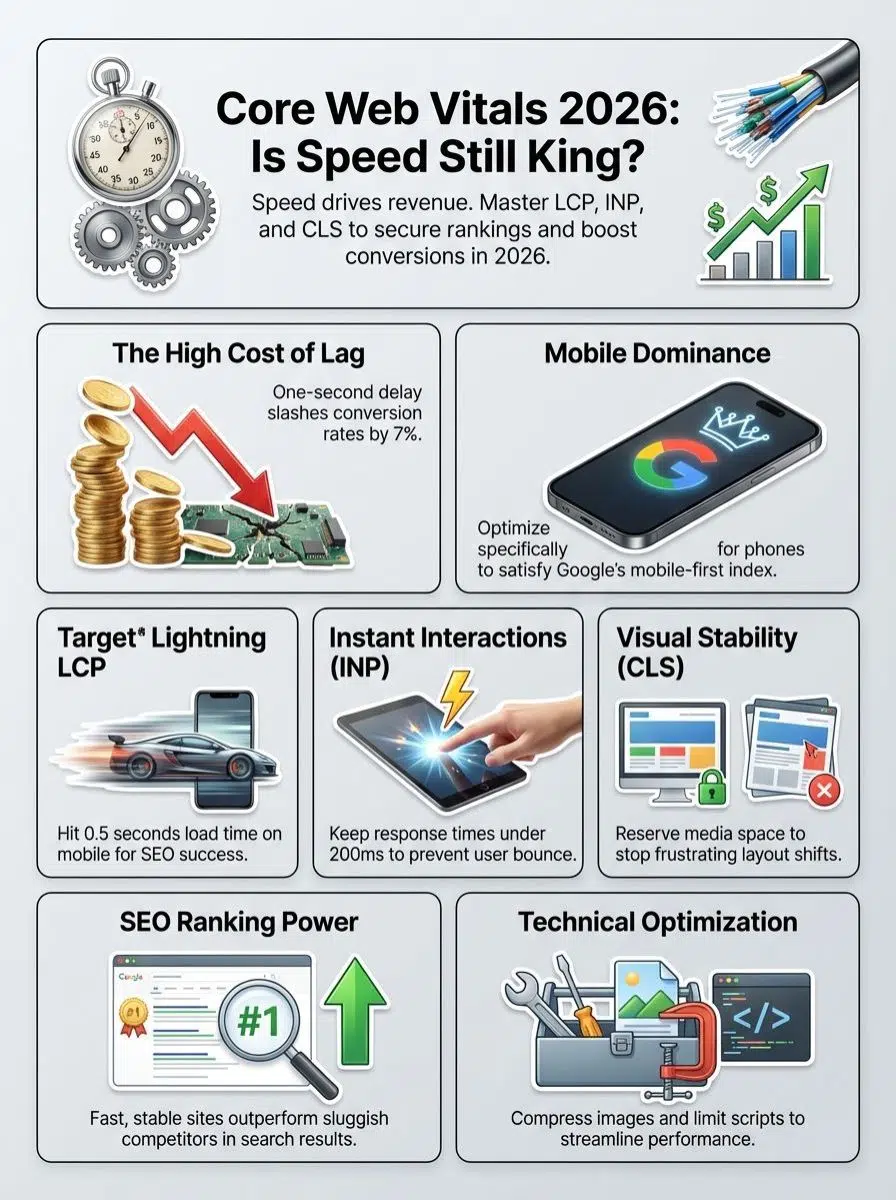
These three metrics shape how fast, smooth, and stable a website feels to people. Get curious. Each one plays its own key part in web performance today.
To help you see the difference, here is a quick breakdown of the benchmarks you should aim for in the US market:
| Metric | What It Measures | The “Good” Score | The “Poor” Score |
|---|---|---|---|
| LCP | Loading Speed | 2.5 seconds or less | More than 4.0 seconds |
| INP | Responsiveness | 200 milliseconds or less | More than 500 milliseconds |
| CLS | Visual Stability | 0.1 or less | More than 0.25 |
Largest Contentful Paint (LCP)
Largest Contentful Paint, or LCP, shows how fast the main content on a web page loads. This is usually the main hero image or the headline text. In 2026, Google expects mobile sites to hit a lightning-fast 0.5 seconds for LCP if they want top rankings.
That is quick. Blink and you might miss it! If your site drags its feet, people bounce away like kids leaving broccoli at dinner. One extra second of load time could drop conversions by 7%.
Fast Page Load Time means happier visitors and higher conversion rates. To achieve this, many developers now use Content Delivery Networks (CDNs) like Cloudflare or Fastly. These tools store copies of your site in different locations across the US, so a user in New York downloads data from a New York server, not one in California.
Sites with slow LCP scores struggle in SEO Optimization today just as much as five years ago. Web Performance depends on good hosting quality plus smart Website Optimization tricks. You should look into next-gen image formats like AVIF, which are much smaller than older JPEGs but look just as good.
Poor mobile speed still hurts rankings most. Users expect quick access whether they shop, search facts, or browse memes late at night. Strong Site Performance in LCP keeps digital doors open and cash registers ringing louder in this race for attention online.
Interaction to Next Paint (INP)
Interaction to Next Paint, or INP, tracks how fast your site reacts after a click or tap. This metric officially replaced First Input Delay (FID) back in 2024 because it is a more accurate measure of responsiveness. Users expect pages to respond almost right away.
Slow reaction times create frustration and can send people leaving for good. Imagine clicking “Add to Cart” and nothing happens for two seconds. You would probably click it again or just leave. That is a poor INP score in action.
Google made INP part of its Core Web Vitals because users want quick results. A delay in responsiveness can mean trouble for both rankings and conversion rates. Even one extra second waiting on a button press might lose you 7% of conversions.
In 2026, improving user experience by boosting response speed is still key for SEO optimization and happier visitors. The most common culprit here is heavy JavaScript execution. When the browser is busy running complex code, it cannot listen to your mouse click.
Prioritizing swift interactions helps keep your website ahead in digital marketing and web performance metrics alike.
Cumulative Layout Shift (CLS)
Cumulative Layout Shift, or CLS, measures how much your web page jumps around as it loads. You might tap the wrong button if things move while you scroll or read. A shifting layout can frustrate users and hurt site performance.
Google tracks this as a Core Web Vitals metric. They focus on real user experience since its introduction. The most common cause of this is images or ads loading without defined dimensions. The browser does not know how much space to save, so it pushes text down once the image appears.
Too much shifting drops rankings and lowers conversion rates. Even small layout jumps can push users to leave fast. This costs you business goals. Sites in 2026 need stable layouts for better SEO optimization and higher conversions.
Aim for smooth movement by reserving space for images, ads, and fonts right from the start. Nothing should surprise visitors after the page begins loading.
Why Core Web Vitals Still Matter in 2026
Core Web Vitals still matter in 2026 because search engines and people both love sites that feel quick, smooth, and easy. Curious about why? Keep reading!
“We found that a 0.1 second improvement in mobile site speed increased conversion rates by 8.4% for retail sites.” – Deloitte Digital Study
Impact on SEO Rankings
Fast page load time keeps sites high in the rankings. Google’s sophisticated Core Web Vitals metrics keep a close eye on how users experience your website, especially as of 2026.
If visitors wait too long or face jumpy layouts, your site drops behind faster competitors. A one-second delay in loading can slash conversion rates by up to 7 percent. This makes each second count for SEO optimization and business growth.
Sites with good hosting quality and strong security get extra points from search engines. Mobile speed now plays an even bigger role. Slow pages give a direct advantage to fast websites targeting mobile users.
Meeting that key target can make all the difference. Hitting a 0.5 second Largest Contentful Paint (LCP) for mobile can determine if you stay visible or slip into digital obscurity.
Influence on User Experience
Page load time can make or break your site. In 2026, every second matters. A one-second delay in loading cuts conversions by as much as 7%. People leave slow sites quickly. This means fewer sales and lower rankings.
Hosting quality plays a big part too. Weak servers hold back good content. You might write the best articles in the world, but if your host takes three seconds to start sending data, you have already lost the reader.
Web performance impacts more than speed alone now. Largest Contentful Paint (LCP) needs to hit 0.5 seconds on mobile for sites to compete for top spots. Smooth interactions also matter. People expect responsive layouts without weird jumps or glitches.
Google’s Core Web Vitals track all this closely. They use real user data to measure how seamless and enjoyable the experience feels from start to finish across devices.
Is Speed Still King in 2026?
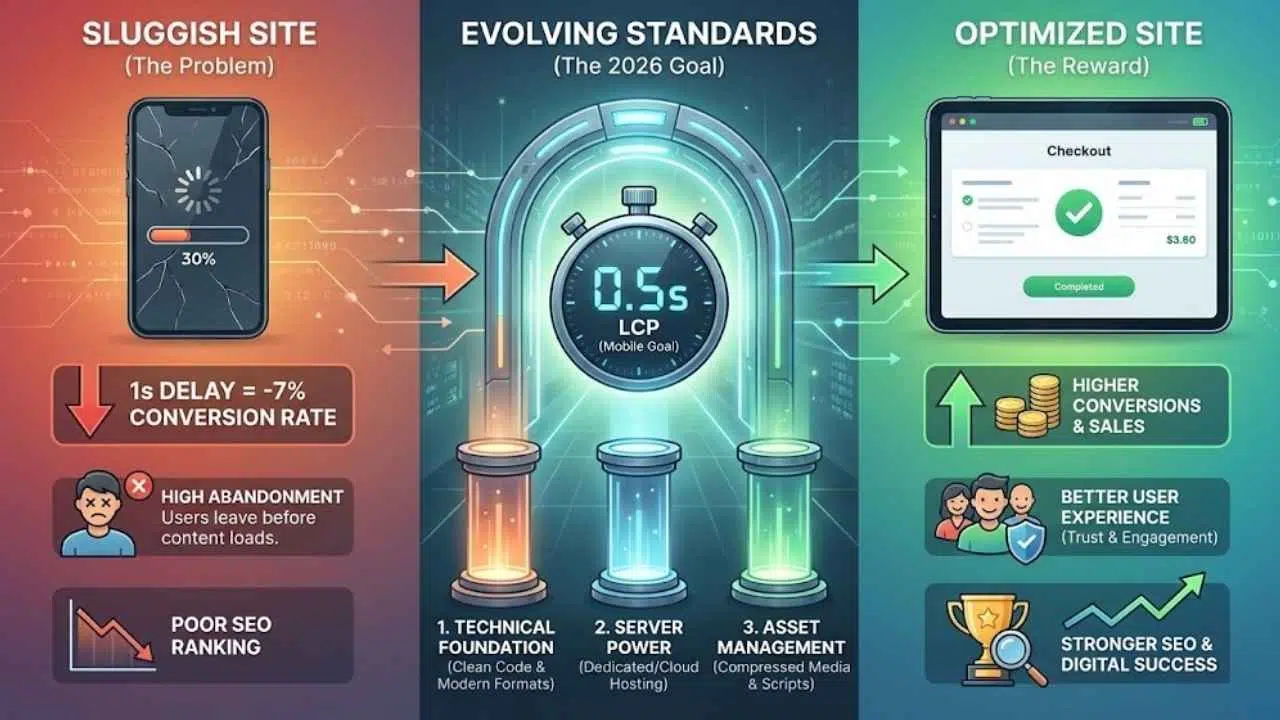
Speed still calls the shots in 2026, but you might be surprised how much more there is to this story. Keep reading for the inside scoop.
The Role of Website Speed in Performance
Fast website speed acts like a green light for your visitors. Pages need to load in less than 0.5 seconds for mobile, or people may leave before seeing what you offer. Google uses site performance as a ranking factor. Sluggish sites drop in SEO rankings faster than kids lose socks in the laundry.
A one-second delay cuts conversion rates by up to 7 percent. That lost second can cost sales and sabotage business goals. Quick pages also improve user experience, especially on phones where slow loading really frustrates users.
Hosting quality plays a part too. Strong security and fast servers keep both Google and visitors happy in 2026. Fast-loading sites win more clicks, higher SEO scores, and better results across all digital marketing channels.
Evolving Standards for “Fast Enough”
In 2026, “fast enough” keeps getting faster. Google expects sites to hit a 0.5-second Largest Contentful Paint for mobile page speed if they want to stay ahead in SEO rankings and web performance metrics.
One extra second of delay can drop conversion rates by about 7 percent. This adds up quickly if your site handles lots of users or sales. To meet these new standards, you need to focus on three pillars:
- Technical Foundation: Using clean code and modern formats.
- Server Power: Moving away from shared hosting to dedicated or cloud solutions.
- Asset Management: strict control over third-party scripts and plugins.
Sites that focus on fast loading times, high responsiveness, and smooth layouts have the best chance at strong rankings and higher conversions. With user experience now measured more deeply than ever before, laggy sites get left in the dust while snappy ones win clicks.
Slow is out. Quick is king for hosting quality and digital marketing success as new standards push everyone to race against the clock.
Common Issues Affecting Core Web Vitals
Even the slickest sites stumble with hidden speed bumps that can frustrate users. Keep reading to spot what slows you down.
Slow Loading Times
Slow loading times can test anyone’s patience. In 2026, even a one-second delay in page load time can cut conversion rates by 7 percent. That lag means fewer sales, lost email sign-ups, and users clicking away faster than you can blink.
Mobile speed matters more than ever for SEO rankings and user experience. Google watches how fast your site loads on phones. It rewards sites that hit or beat the 0.5 second Largest Contentful Paint (LCP) mark.
The biggest issue here is often oversized media files. Many site owners upload raw photos directly from a camera or stock site. These files can be 5MB or larger, choking mobile data connections. Tools like TinyPNG or Squoosh are essential for reducing file size without losing quality before you upload.
Hosting quality plays a big role too. Slow servers often leave visitors waiting with spinning wheels or blank screens instead of real content. Fast loading keeps people engaged and lifts both web performance metrics and conversion rates across digital marketing campaigns.
Poor Responsiveness
Tapping a button and waiting feels like watching paint dry. People expect a site to react right away, not after a long second or two. In fact, Google considers anything slower than 200 milliseconds for clicks as poor performance in 2026.
A slow response can cause users to leave. This hurts your rankings and conversion rates. Even one extra second of delay may slash conversions by up to 7 percent.
Mobile devices highlight this even more since most users browse on their phones now. Pages that lag or freeze drive visitors away fast, especially if another competing site reacts instantly. Often, this is caused by bloated JavaScript bundles. If your site is trying to track analytics, load a chat bot, and run ads all at once, the browser main thread gets clogged.
Quick responses boost user experience and keep people coming back. Both are big wins for any digital marketing plan focused on SEO optimization and better business results.
Unstable Layouts
Unstable layouts make pages jump around while loading. This leaves users feeling frustrated and lost. Google measures this with Cumulative Layout Shift, or CLS. Every unexpected move impacts user experience and SEO rankings in 2026.
For example, a button might shift just as you try to tap it on your phone. Suddenly, you click the wrong thing instead. Even small layout shifts can hurt conversion rates by making shoppers feel unsure about what will happen next.
Sites that ignore layout stability lose ground fast against smoother competitors. Fast loading times and strong hosting quality reduce these issues by keeping images, ads, and fonts from shifting out of place.
In 2026, stable layouts play a big part in web performance metrics. A smooth site looks professional. It keeps visitors happy. It boosts business goals like higher conversion rates and better digital marketing results.
Strategies for Optimizing Core Web Vitals in 2026
Tweaking your site for better web performance can boost engagement and rankings. Smart fixes today mean visitors stick around tomorrow. Plain and simple.
Accelerating LCP
Fast page load time wins in 2026. Aim for a Largest Contentful Paint, or LCP, under 0.5 seconds on mobile devices to stay ahead of rivals and please Google’s updated SEO metrics.
Slow loading risks losing visitors and can cut conversion rates by up to 7 percent with just a one-second delay. Here are the most effective ways to speed things up:
- Use Native Lazy Loading: Add the
loading="lazy"attribute to images below the fold so they only load when needed. - Implement Caching: Use plugins like WP Rocket or server-side caching to serve static versions of your pages.
- Upgrade Hosting: Move to a performance-focused host like Kinsta or WP Engine that uses server-level optimization.
Smaller image files help speed things along. Compress images before upload, use next-gen formats like WebP, and only show what users see first above the fold. Strong website hosting still makes a difference in site performance too. Poor servers drag down your web performance metrics no matter how sleek your design looks.
Focus on fast server response times, smart caching, and limiting third-party scripts that bog down the page speed score for better ranking factors and user experience.
Enhancing INP
Improving Interaction to Next Paint, or INP, boosts site performance and user experience. Users notice slow responses right away. Bad responsiveness can make people leave fast, especially if the site lags on mobile devices.
Sites in 2026 face tougher competition, so low INP scores can hurt SEO rankings and conversion rates. For example, a one-second delay in page load time drops conversions by about 7 percent.
Websites need to focus on smooth clicks and quick taps across every device. Compress scripts and cut extra code, so browsers work less. You should specifically audit your third-party tracking tags. Using a Tag Manager to control when these scripts fire can free up the browser’s main thread significantly.
Aim for noticeable speed improvements on buttons, forms, or menu actions. These are where users get frustrated the most if things freeze up even for half a second. Good hosting quality also helps keep site interactions snappy without sudden hiccups that could chase visitors away.
Reducing CLS
Cumulative Layout Shift, or CLS, means your site moves around as it loads. This can annoy visitors and make them click the wrong thing. Sites with too much movement lose trust fast.
In 2026, smooth layouts help keep scores high for SEO optimization and boost conversions. You can fix this with a few CSS tricks:
- Set Aspect Ratios: Always include
widthandheightattributes on your image and video tags. - Reserve Ad Space: Hard-code the size of your ad slots so content does not jump when the banner loads.
- Font Loading: Use
font-display: swapin your CSS so text appears instantly, even if your custom font takes a moment to download.
Use fixed sizes for images, videos, and ads to stop shifting. Web Performance Metrics in Google’s Core Web Vitals now watch these layout jumps closely on both desktop and mobile. Make sure fonts load quickly from local storage or reliable CDNs.
High Hosting Quality keeps things steady by loading content faster so nothing pops around after the page looks done. Stable layouts lead to happier users, longer visits, better conversion rates, and improved rankings. No magic tricks needed.
Core Web Vitals Beyond SEO
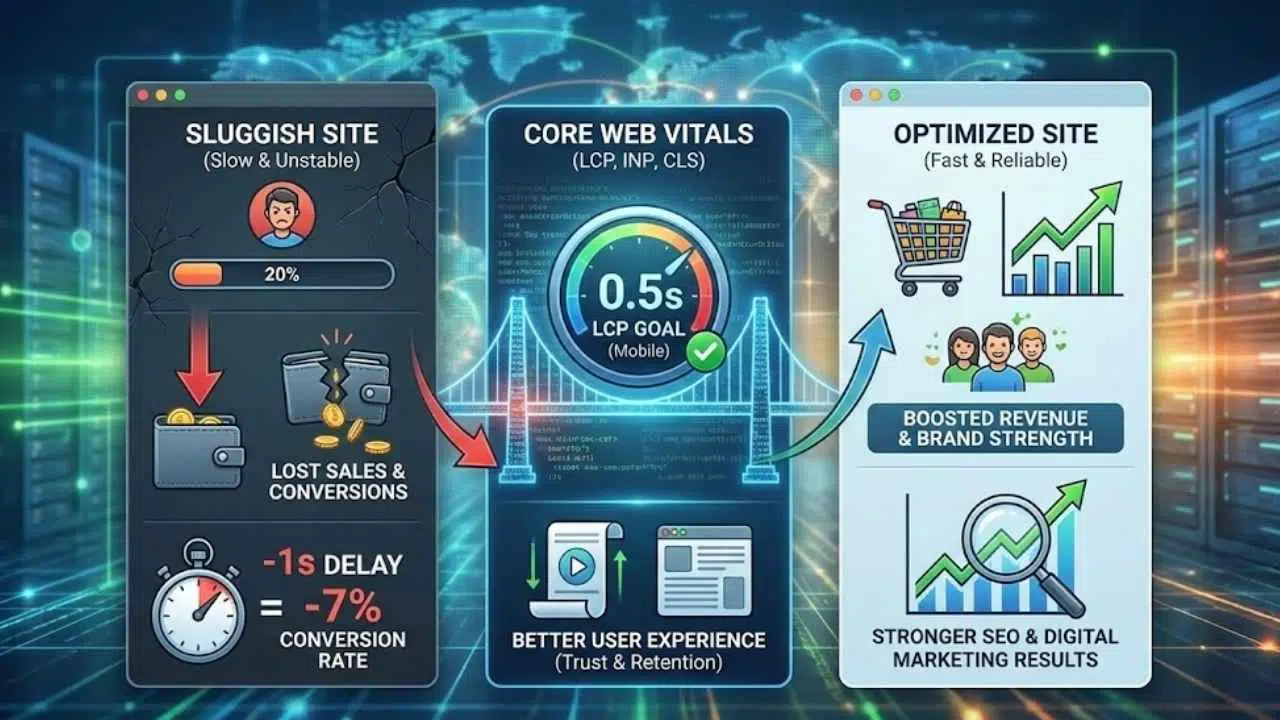
Good Core Web Vitals can lift your sales and help people finish what they start on your site. Better pages also make folks stick around longer, which keeps your brand strong in a crowded market.
Impact on Conversions and Business Goals
Sluggish site speed makes wallets snap shut. A single second delay in page load time slashes conversion rates by up to 7%. That means lost sales, missed sign-ups, and frustrated shoppers who bounce away before buying.
In 2026, Core Web Vitals like Largest Contentful Paint or LCP matter deeply for business outcomes. Hit the gold standard of a 0.5-second LCP on mobile if you want to edge out your rivals.
Google’s sharper focus on real user experience hits the bottom line directly. Poor mobile performance drags down both rankings and revenue while fast sites win trust and boost digital marketing results.
Even small tweaks in responsiveness or layout stability nudge people closer to that final click or purchase, supporting stronger SEO metrics and better conversion rates every day.
Final Thoughts
Speed remains a big deal in 2026, but smooth user experience and strong site stability are just as vital. Quick page load times, responsive clicks, and layouts that don’t jump around keep visitors happy. This boosts conversions.
Easy wins like faster hosting or smaller images can go a long way. Paying attention to these practical tips makes your website stronger on search engines. It also helps you stand out from the crowd.
For those ready to learn more, Google’s own guides make solid next steps. Staying fast online isn’t just technical. It shows respect for every visitor who might turn into your next customer. So invest in it today and see results tomorrow!